

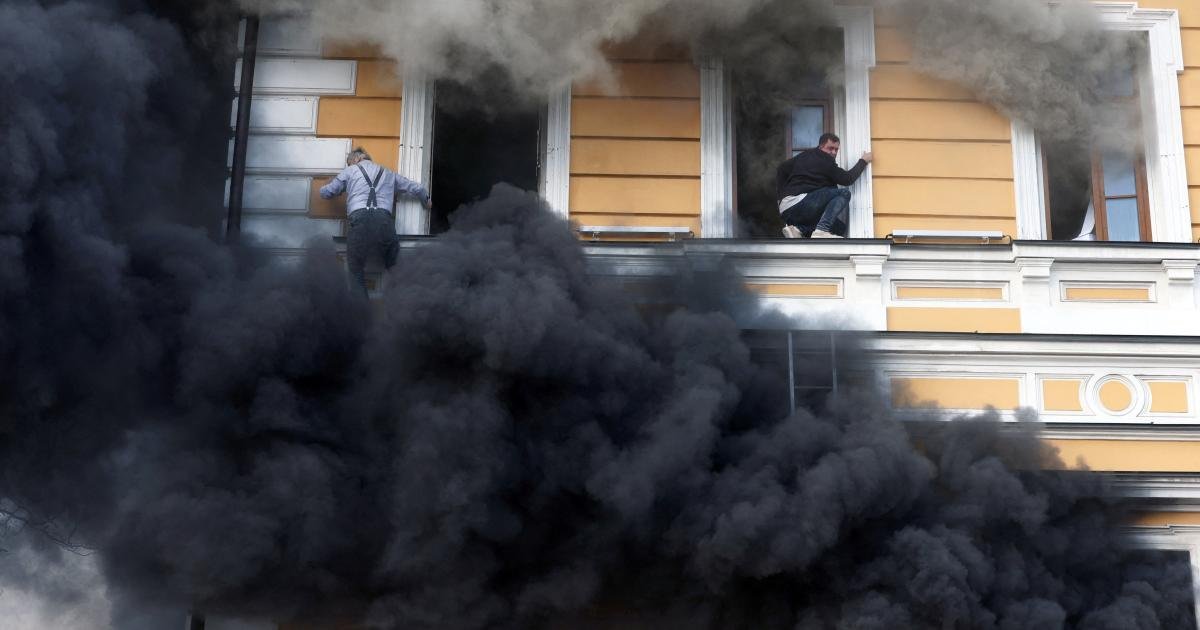
Since the beginning of July, Russian drones and missiles have been terrorizing Kyiv with exceptional intensity. Air raid sirens blare day and night, warning residents of oncoming fire and sending people running underground. Many of the drones have been shot down, but not all, and the ballistic missiles have largely gotten through, destroying buildings and killing civilians; so far, roughly 100 have died. The bombardments have become so intense that, in recent weeks, Ukrainians have been posting a grim joke on Instagram and TikTok: “Thank God I live in Kyiv, so I do not have to plan for the future.”
Kyiv has now endured almost five years of war, so its residents are used to hardship. But this kind of pessimism is new. For the first half of 2026, observers were celebrating what looked like a turning point in the conflict. After a year of grinding Russian progress, Ukraine learned how to better conduct precise middle- and long-range strikes, allowing it to hit Russian targets far behind the frontlines. As a result, Moscow’s progress came to a halt. The country, which was already losing too many troops, began incurring casualties that seemed unsustainable. Many analysts began to speculate that the Kremlin might soon have no choice but to settle.
But Ukraine’s new capabilities could not deliver victory. And this summer, Russia sharply increased its use of ballistic missiles and deployed fast, long-range, jet-powered drones at newfound scale. It also widened its set of targets. Before, the Russian military concentrated almost all its firepower on cities and towns near the frontlines, particularly in Ukraine’s eastern Donbas region. But now it has started mass bombing cities in the interior—particularly Kyiv. It is even reaching places along Ukraine’s western border.
Together, these changes are indicative of Russia’s new theory of victory. Moscow no longer hopes to win by merely capturing cities, or even by degrading Ukraine’s energy infrastructure. Instead, it wants to disrupt Ukraine’s whole economy and break the population’s morale by terrorizing urban centers. It aims to make city life so intolerable that residents and businesses flee, and it wants to sever the logistical connections between metropolitan areas. Moscow calculates that this will make Ukrainians increasingly angry at their own government for failing to protect them, weakening the country’s long-admired cohesion and internal resolve.
There is no guarantee that this plan will succeed. Ukraine is large, decentralized, and considerably more capable and resilient than even many of its supporters think. But the country’s economy is in dire straits, and its government is facing budget shortfalls that it needs outside help to fill. Moscow is betting that such help won’t soon arrive. Instead, it thinks that the price Washington and Europe are willing to pay to support Kyiv is limited, whereas the price Russia is prepared to pay to conquer Ukraine is not. Russia’s principal target, then, is not Ukraine’s territory or infrastructure. It is the will of the Ukrainian people and of their partners.
HOLDING ON FOR DEAR LIFE
No one in Ukraine has ever been safe from the consequences of Russia’s invasion. People from every city and region have fought and died to protect their state. Stores everywhere suffer from shortages, and the economy has contracted. Still, the invasion has not affected the whole country equally. People living near the frontlines have faced constant bombardments and the imminent threat of occupation, whereas those in the rear can, at times, tune out the conflict.
That is changing now that Russia is targeting places far from the battlefield. In Kyiv, for example, residents used to face a few drone and missile barrages a week—disruptive, but not enough to stop city residents from going about their lives. Now Russia is continuously sending projectiles toward the capital, day and night. On August 27, Kyiv registered a record 13 air raid alerts in a single day. On the night of September 8, a single alert stretched for ten hours, from 7:39 PM until 5:40 AM. Two weeks later, nothing had changed: Kyiv had 11 alerts on September 23 and a nine-hour alert the next morning. A month ago, those of us living in the city would go to sleep expecting a large overnight attack but knowing that it would probably be followed by a normal workday. Today we live with constant sirens and chaos.
So far, Kyiv has borne the brunt of Moscow’s increased bombings. But Russia’s attacks are beginning to hit other relatively protected cities, as well. On the night of July 30, Russia fired more than 20 cruise missiles at Lviv, a city just 45 miles from the Polish border, killing a 35-year-old police officer and injuring 38 people. In mid-September, drones reached the western Ukrainian city of Lutsk, setting a passenger railway carriage on fire. Russia has attacked Ivano-Frankivsk, Ternopil, and Stryi—all cities in Ukraine’s interior. And across the country, Moscow’s forces are destroying warehouses, pharmaceutical distribution centers, and data centers that provide Internet capability. One day, they might take out the facilities that keep Ukraine’s sewage systems running.
The terror from the air has exhausted Ukraine’s society. People are working miracles to keep the economy functioning as they adapt to ever harsher conditions, and they have rightfully earned admiration from across the world. But it is important to understand that Ukrainians are steadfast because they know that capitulating would make life even worse—as Russia’s conduct in the occupied territories attests. Even so, they may not be able to hold out forever. There are no signs, for now, that the country is at its breaking point. But no one can say where that point lies.
A FRIEND IN NEED
To avoid collapse, Ukraine’s government must take several concrete measures immediately. First, its parliament needs to expeditiously pass the legislation required to unlock funds that others have pledged to Kyiv. These laws usually mean higher domestic tariffs and taxes. Ukraine’s lenders, for example, are demanding that it eliminate the tax advantage enjoyed by low-value imports from foreign online marketplaces by applying a value-added tax to parcels, primarily from China, worth less than 150 euros (or roughly $170). Such measures are tough to impose on a population that is rapidly becoming poorer under the pressure of war. They are therefore unpopular with the public, so lawmakers frequently delay them. But the situation is simply too perilous to entertain any more pauses.
The government must also improve public procurement, particularly in the security and defense sector. The problems facing this system, such as prepaid contracts that go undelivered for months, are not systemic, but Ukraine cannot afford any errors. The country must therefore eliminate schemes, such as a kickback scheme at the state nuclear operator exposed in November 2025, that are unrelated to defense spending but capable of triggering major corruption scandals. The country’s National Anticorruption Bureau and Specialized Anticorruption Prosecutor’s Office have made great progress at eliminating graft in recent years, pursuing cases that show officials and the public that no one in Ukraine is immune from anticorruption prosecution. But the government can take further steps to curtail graft.
Still, there is only so much Ukraine can do by itself to shore up its position. No matter how many reforms Kyiv makes, the sad reality is that it does not have enough money to fund itself. The government has estimated that as of September 2026, it will require $52 billion in external financing in 2027 to meet its needs, only $20 billion of which is currently guaranteed.
Traditionally, the United States and Europe have helped Kyiv meet its budgetary needs with grants and loans. But Washington has made it clear that it will no longer provide Kyiv with financial support. The European Union has budgeted roughly $100 billion in assistance for 2026 and 2027, but it is reluctant to earmark more, given that its countries are confronting financial and political pressures. The most obvious solution would be for the EU to provide Ukraine with Russia’s frozen assets, which amount to $300 billion. The bloc’s members generally support giving this money to Kyiv. But most of it is locked in Euroclear, a Belgian securities depository, and Brussels fears that handing over the assets will result in court cases that eventually force it to pay Moscow back. The European Central Bank and Brussels also fear that confiscating Russia’s reserves would damage the euro’s standing and Belgium’s reputation as a financial safe haven. And Washington, for its part, wants the assets to remain frozen so it can use them as leverage with Moscow. But if EU states are unable to meet Ukraine’s financial needs themselves, they will need to ignore U.S. concerns and allay Belgium’s by jointly underwriting the latter’s legal exposure. Even if they decide they can pay more themselves, the choice between taking money from their own pockets or Russia’s should be obvious.
The terror from the air has exhausted Ukraine’s society.
The EU should also overcome its taboo on financing the pay of Ukrainian service members. Although European funds let Kyiv buy all kinds of weapons, the continent has long considered it unacceptable to cover personnel costs. This rule makes no sense from Europe’s perspective: there is no moral distinction between paying for ammunition and paying the people firing it. But it does mean something to Kyiv. Paying Ukrainian soldiers is the government’s most essential and expensive task. (This year, the country is on pace to spend $35 billion on military personnel.) As a result, it is a source of enormous stress for Ukrainian officials and eats up a large share of Ukraine’s tax revenue. If at least some of the cost of paying soldiers were underwritten by external sources, Kyiv would feel more certain about the state of its military budget and thus be willing to channel resources into shoring up its overall economy.
Europe, of course, should also do more to help Ukraine produce weapons. But this aid should be better calibrated. Right now, for example, most of the discussion of supplying Kyiv with arms focuses on providing more missile and drone interceptors. Yet although supplying air defenses is essential, protecting Ukraine’s skies cannot be the only strategy, because of simple arithmetic. The United States’ stockpile of Patriot interceptors is running low, and the country produces, at most, 840 per year, which it must distribute between itself and all its partners. Russia, by contrast, produces more than 1,200 new ballistic and quasi-ballistic missiles per year, which it then supplements with missiles from North Korea.
Eventually, Ukrainians will likely invent air defenses that can be made more quickly and cheaply than those currently in existence—much as they have created cutting-edge attack drones. But until then, Kyiv needs to get ahead of Moscow and stop its ability to wreak aerial havoc. That means striking Russian production facilities, launch systems, and logistics. Western capitals, in turn, could quickly provide Kyiv with more long-range weapons and lift all political and technical restrictions on how they can be used. Such limits do not amount to prudence. They allow Moscow to use Russia’s interior as a sanctuary and reinforce Russian President Vladimir Putin’s belief that he can continue the war without facing additional consequences.
MUTUAL AID
Many Western officials understand very well what Ukraine needs and what they should do. But almost five years into the war, they have started to grumble about the need to keep supporting Kyiv. Some leaders, including U.S. President Donald Trump, even oppose increasing pressure on Putin and hope to sweet talk him into making a deal.
But the reality is that diplomacy will not be able to stop the conflict. Even if Kyiv agreed to cede the Donbas territory it still holds, as Russia has demanded, the Kremlin would remain unsatisfied. For years, Putin has been ideologically committed to subjugating all of Ukraine, attacking and reattacking the country in order to control all of it. Now he has effectively locked himself into a state of permanent warfare. The president has reworked Russia’s economy and political system around the conflict, channeling investment into weapons factories and making loud proponents of the war central figures in the country’s government. As a result, ending it would pose greater risk to his regime than continuing and expanding the fighting.
Some Western leaders seem tempted to cut Kyiv off, anyway, believing it to be of little importance to their governments. But such thinking is backward: helping Ukraine to definitively end the war is very much in NATO’s self-interest. Consider, first, the relative economic costs. A recent Norwegian study by the Oslo-based consultancy Corisk and the Norwegian Institute of International Affairs found that a Russian victory would cost Europe roughly $1.3 to 1.8 trillion over four years. The cost of adequately supporting Ukraine over the same four years, by contrast, is roughly $570 to 910 billion.
Ukrainians expect evidence that the path toward EU membership is irreversible.
Russia might also strike NATO territory, including before the current war ends. Putin’s ambitions, after all, go beyond just this one neighbor. For 20 years, Russian propaganda has portrayed Washington and all of Europe as the country’s enemies. The draft treaties he presented to the United States in December 2021, as American officials tried to avert war, demanded that NATO roll back its presence to the alliance’s 1997 borders. And Putin is now engaging in all kinds of provocations against NATO states, including by floating drones over the alliance’s territory. As a result, many senior Western officials are finally warning that a Russian attack on the EU is entirely plausible. Although Russia may not wait until it has achieved its aims in Ukraine to start such an operation, if it does, the resulting conflict would prove particularly devastating. Ukraine’s army is currently the only real counterweight to Russian military power on the continent, and it would then be turned against Europe itself.
Offering help to Ukraine now, by contrast, would help NATO absorb much of the knowledge that has made Kyiv’s forces so effective. Ukrainian defense firms have made major innovations that they are already sharing with their partners and that they could transfer more of. But Ukrainian companies suffer from a shortage of capital and a lack of secure locations where they can expand production. (Only about 30 percent of the production capacity of Ukrainian defense companies, for example, is currently funded.) Europe should thus launch more joint ventures with Ukrainian manufacturers on EU territory, sign additional long-term procurement contracts with Ukrainian manufacturers that can attract private capital, and give Ukrainian companies full access to European defense financing programs such as the EU’s Security Action for Europe initiative. This will both help Kyiv build more weapons and place Ukraine’s extraordinary military engineers inside European factories, giving NATO armies expertise on how to defeat their biggest adversary at a fraction of the amount that they spend currently on weapons. It would thus allow Europe to lift its defense industry to a whole new level.
The Trump administration has made it clear that it will not directly invest any more in Ukraine’s military base. But Kyiv is already using its knowledge to help improve the U.S. armed forces, including by giving the country advice on drone warfare as it fights against Iran. Multiple top American officials, including Dan Caine, the chairman of the Joint Chiefs of Staff, have declared that Washington has much to learn from Ukraine. It is thus high time for the administration and for Congress to encourage private U.S. investment in Ukraine’s defense sector.
The best way to better integrate Ukraine’s defense innovations into Western militaries would, of course, be to admit Kyiv into Western institutions. When it comes to NATO, such an outcome is unlikely to take place in the near future, given U.S. and German objections. The European Union, by contrast, still says Ukraine will join its ranks—but it has been vague about when or by what process. The body must start providing more clarity on both fronts. Ukrainians do not expect to enter the European Union tomorrow. But they do expect regular evidence that the path toward full membership is steady and irreversible. The country’s people sustain themselves with the hope that they are suffering for the quiet and dignified life already enjoyed by citizens elsewhere in Europe, and a clear path toward joining the EU will strengthen their will.
STAYING POWER
For years, Western leaders have failed to understand Moscow’s thinking. Now, as NATO officials work through how to support Kyiv for the next six months, Putin has made it clear that he is reorganizing his state for a prolonged confrontation. He intends to break Ukrainian morale by breaking the country’s economy and external support for it. He is meddling in European politics to turn it away from Ukraine. If the United States and Europe want Russia’s president to lose, they must build the will to outlast him.
Ukrainians remain committed to fighting on. Despite a bleak situation, the country has what it takes to survive the winter. But there will be no cease-fire in the spring. It is thus time for Europe and the United States to make sure that Ukrainians have what they need not only to survive but also to return fire. They need to act in concert with Ukraine to prove that Russia’s theory of victory will not be effective—and to turn Kyiv into a city where people can again plan for the future.
Loading…
