

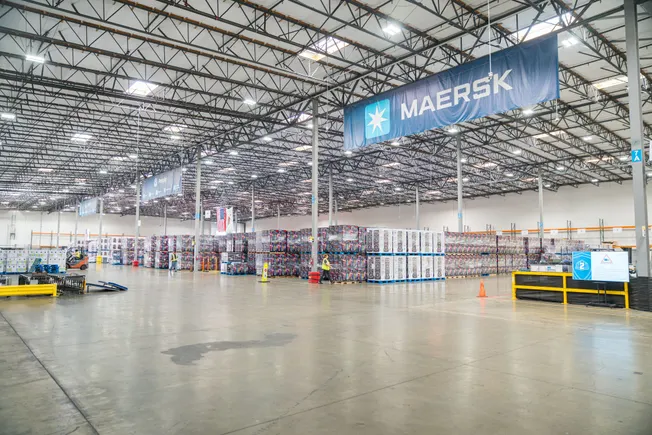
Say the name “Maersk” and ocean carrier comes to mind. But the logistics giant has been working to change that perception, Maersk President of North America Ditlev Blicher told Supply Chain Dive in an interview.
“When I look at our setup here, we’re now a material player in the domestic space in North America, actually across supply chains,” Blicher said.
Maersk’s journey to become more than an ocean carrier can be traced back to 2021 when it aimed to move its network away from port-side flow logistics into omnichannel fulfillment and e-commerce, CEO Vincent Clerc said at the time. It did so through its 2020 acquisition of Performance Team.
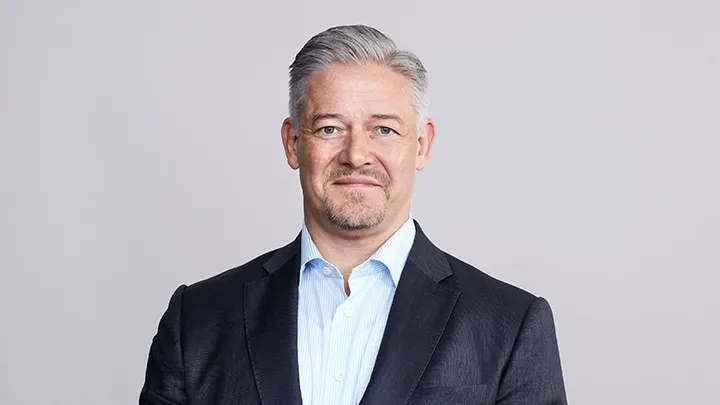
Maersk President of North America Ditlev Blicher.
At that time, Performance Team operated 24 warehousing sites of about 800,000 square meters, which were expected to double Maersk’s warehousing and distribution footprint.
A glimpse into some of Maersk’s North America land logistics:
Maersk Ground Freight
- Approximately 470 trucks owned or leased
- 4,000+ trailer assets owned
- Agency network of approximately 140 locations
- 58 stations across the U.S.
- 7 linehaul hubs
Maersk E-commerce
- About 5 million home deliveries per year
- Home delivery items consist of big and bulky items like sofas and refrigerators
- Integrates with several of its logistics services, such as Maersk Contract Logistics and Maersk Air Freight
Together, these land services from Maersk help the company gain visibility and control over its operations, while expanding service offerings for shippers.
Maersk isn’t necessarily trying to be a one-stop shop, but it wants to have several capabilities to offer shippers within its supply chain, Blicher said. The company’s intent is to remove waste and create a better quality product for shippers, which means removing unnecessary disruptions during transloads, unreliable networks, and duplicated infrastructure and systems.
Fixing the transload problem at hubs
One major problem that nobody had resolved, per Blicher, is what Maersk calls the transload problem
“Every time you had to shift a container from one vessel to another in a hub, it would take at best a week,” he said.
Maersk has invested more than $3 billion in fixing the problem by digitizing its hubs and significantly expanding the operational capability. The changes have made room for Maersk to transition its East-West trades from a string principle into a hub and spoke principle.
The hub and spoke model can be seen in the Gemini Cooperation, the ocean alliance between Maersk and Hapag-Lloyd. The two carriers have two or three vessel calls each at the origin and destination; this means more reliability for shippers in the event of a disruption at one of the ports.
In contrast, the string principle is how ocean markets have operated with vessels going from port to port all the way through, Blicher said.
“[I[f you are port number three out of a string of 22, you know that if something happens there, you have a choice,” Blicher said. “If there’s a delay, either you have a domino effect all the way through or you say I’m going to have to catch up, so I’m going to omit the next port.”
Since the shift to the model in May of last year, “we have for the most part been at around 90% or above reliability,” Blicher said. Maersk has also cut transload times in half, per Blicher.
Advancing efforts for an efficient fulfillment offering
The company’s omnichannel fulfillment capabilities, which Blicher describes as a core strength, include integrating inventory and services for wholesale, retail and e-commerce within the same pool. Blicher describes it as a core strength of Maersk. Since wholesalers may need palletized warehouse operations, while e-commerce brands require an individual approach to sorting inventory, Maersk can offer a more simplified solution and remove multiple systems through one integrated omnichannel model.
Maersk added many of these capabilites when it acquired Performance Team. It then acquired a logistics player in Asia, LF Logistics, in 2022, further advancing its expertise in omnichannel fulfilment to position it well within the global e-commerce market, Blicher said in a 2022 press release.
In 2024, Maersk opened a fulfillment center to service Levi Strauss & Co.’s wholesale, retail and e-commerce channels. The Groveport, Ohio facility was meant to improve the company’s on-time performance, reduce container handling time and enhance speed and efficiency.
In July, Maersk announced plans for a new fulfillment hub in Hopedale, Massachusetts, which would expand its logistics footprint and support a major e-commerce customer, but the company did not disclose the customer’s name.
“We’re in a great space right now. We’re nowhere near done, but we’re a scalable player in the market, and it’s resonating really, really great with the fantastic clients that we have in North America,” Blicher said.
Editor’s note: This story was first published in our Logistics Weekly newsletter. Sign up here.
