

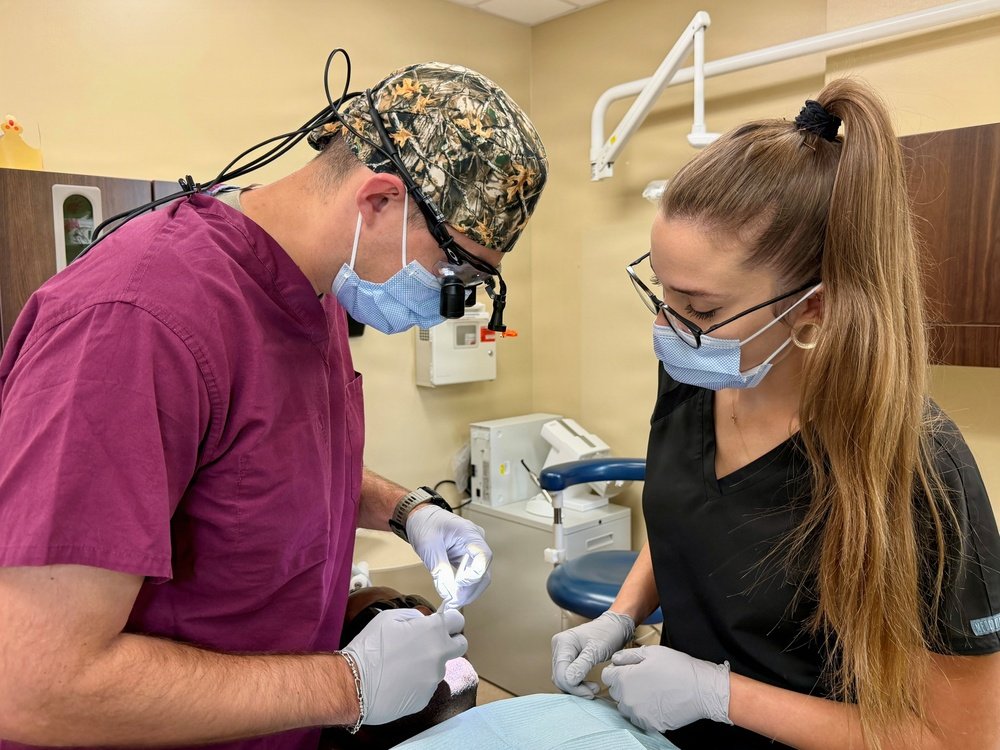
The Soldier’s face and eyes were swelling, and she did not know why.
Manes, a dental assistant, began checking the patient’s blood pressure and asking questions. She then alerted Capt. Wesley Hargett, the general dentist scheduled to perform the exam.
Within minutes, the routine appointment became an emergency response.
The Sept. 22 incident brought together Manes’ vigilance, Hargett’s clinical training and a team prepared to act when a patient needed care beyond a dental exam. No dental treatment had begun when the symptoms were recognized, according to Capt. Adam Fraeyman, the clinic’s officer in charge.
Hargett examined the patient and asked about her medical history, possible exposures and whether she was having difficulty breathing or swallowing. When she reported that her throat felt as though it was beginning to close, he recognized the signs of anaphylaxis.
He directed Manes to stay with the patient and continue monitoring her blood pressure while he retrieved epinephrine from the clinic’s emergency cart.
Dental assistant Cassidy Johnson alerted the front desk and Fraeyman. Medical support assistant Anna Tester called 911.
Hargett returned, explained what was happening and administered epinephrine. Manes stayed beside the patient, helping monitor her condition and offering reassurance.
Even as the team moved quickly, Hargett worked to keep the patient comfortable. Manes recalled that he spoke calmly and made the patient smile as he explained why she needed the medication.
“The team moved quickly while maintaining a calm demeanor,” Manes said. “I couldn’t be prouder of how Shira Dental came together for our patient.”
Hargett said the Soldier reported feeling better and that the swelling around her eyes visibly decreased. He said that the military police and emergency medical services arrived in less than five minutes. He briefed the emergency responders on her symptoms, blood pressure readings and the medication administered before EMS transported her to the Bayne-Jones Army Community Hospital emergency department.
For Manes, who joined the clinic in November 2025, nearly a decade of dental assisting experience helped her recognize a change that needed attention.
Her previous work included assisting with lengthy procedures involving patients under intravenous sedation. Those experiences taught her to watch closely for changes in breathing, skin color, blood pressure and other indicators while anticipating what the patient and dentist might need.
“I consider assistants and doctors to be patient advocates, always making their health the number one priority,” she said.
Hargett, a San Antonio native who has served at Fort Polk for a little more than two years, said his preparation began at the University of Texas Health Science Center at San Antonio School of Dentistry. He continued that training during a one-year advanced education in general dentistry residency at Fort Campbell, Kentucky.
Emergency care instruction, Advanced Cardiac Life Support training and military medical training further strengthened his ability to respond under pressure.
The response demonstrated how maintaining clinical skills supports medical readiness beyond routine dental procedures. Hargett’s emergency training and Manes’ experience monitoring patients helped them recognize a developing emergency, provide immediate care and coordinate the Soldier’s transfer to the hospital.
Hargett emphasized that preparation mattered most when paired with trust in the people working beside him.
“It was 100% a team effort with not one person doing more than the other,” he said. “I trust my team completely and this allows me to confidently give someone a task and I know it will be completed flawlessly.”
Fraeyman said clinic providers and staff train for medical emergencies and know the location of the emergency response kit. Pharmacy checks its supplies monthly.
Lt. Col. Kaisha Calvin, acting deputy commander for dental services, learned about the incident when Fraeyman called to update her. She highlighted Manes’ recognition of the swelling and the team’s calm, coordinated response.
“I am proud of this team every day, but this makes me even more so,” Calvin said. “Their ability to communicate clearly and work seamlessly together was outstanding.”
Hargett contacted the Soldier the next day to check on her recovery. She told him she was doing much better, and the team later welcomed her back to complete her dental exam.
Manes remembered seeing her again in better condition, with a smile on her face.
“When an unexpected medical concern arises, I want our patients to know that their safety and well-being are our absolute top priorities,” Hargett said.
