

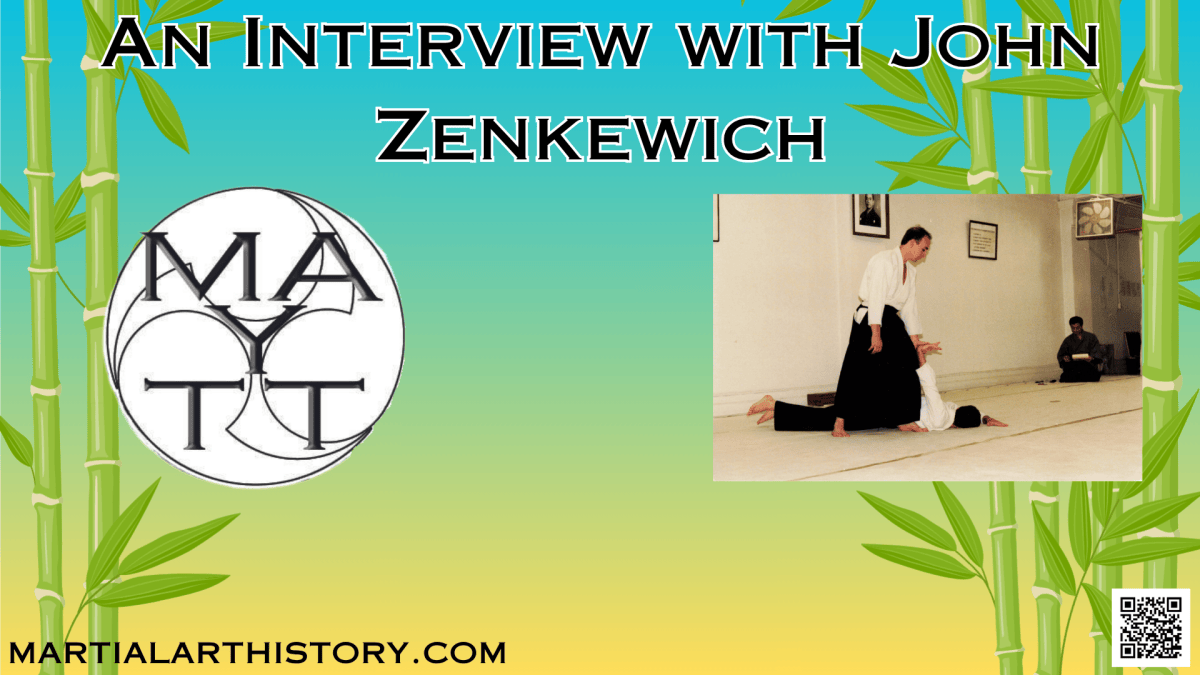
John Zenkewich was given a choice: train at the Aikikai in New York City to learn technique or train at the Ki Society to know how aikido is supposed to feel. After calling the dojo, Shizuo Imaizumi answered the phone, leading Zenkewich to become a lifelong student of Imaizumi. Joining in 1978, he witnessed the evolution of his teacher from the strict Ki-Aikido curriculum to freer and more inclusive of his Shin-Budo Kai curriculum. Today, Zenkewich took the time to discuss his observations on Imaizumi’s teaching approach, his connection to the political sphere of aikido, and his ultimate legacy in the art.
MAYTT: Why do you think Imaizumi did not fully grow into being an organizational leader?
JZ: Well, that’s a big question about organizations. I don’t think he ever developed a big personal organization, and part of the reason Shin-Budo Kai didn’t become a large organization is because he wasn’t a promoter. He wasn’t out there trying to promote himself. He just wasn’t a big self-promoter. In New York City, there were other people doing a lot of promotion for their schools, whether it was aikido or other arts. He wasn’t like that at all.
And I can only assume that was just part of his personality. He wasn’t someone saying, “I’m the greatest, I’m this, I’m that.” That kind of approach does attract students, but because of that, I also don’t think he attracted many people who were promoters themselves. So even his students weren’t really pushing to build big organizations either. A lot of his students, I think because he was who he was – so skilled and so solid – they were just happy to study under him. For a long time. Almost indefinitely. He was the sensei. Which is interesting, because nowadays everything is about titles – Shihan this, Shihan that. For us, he was just Sensei. He was Sensei Imaizumi. And to me, he always will be. Even if you call him a master or whatever, he was just “Sensei.”
So, he had that kind of humble presence. And I think that’s part of why the organization never became very large. He probably wasn’t really interested in building it in that way. That may also be why he eventually handed things over to Kashiwaya for the national structure. And then, ultimately, he split from Tohei as well, for whatever the internal politics were at the time.
What’s interesting is that Koretoshi Maruyama came over; he and Imaizumi were supposedly very close friends back in Japan. So, when Maruyama came to the dojo and did a seminar, it was a big deal. A lot of people also left Tohei’s organization around that time, so you can see that pattern. But I think the main point is this: it wasn’t that something was missing in him organizationally. It was more that his personality wasn’t oriented toward promotion or building a large structure. He was fine with people doing what they wanted. There was a guy, Martin Lewis, who even started a dojo in Westchester for a while. So it wasn’t that he discouraged people, it’s just that he didn’t attract a crowd of people who were trying to build big organizations in the first place. And I don’t know if that matches what you’ve heard elsewhere, but that’s how I’ve always seen it.
MAYTT: Thank you. In 1988, Imaizumi established Shin-Budo Kai. Did you notice any change in the way Imaizumi operated or taught compared to his time in Ki Society?
JZ: He did not want to recreate the Ki Society. So, his organization, I think, was based on people being free to do what they wanted to do – not having the whole tentacles of an organization reaching into every individual dojo. He still basically taught the same way. But his curriculum expanded tremendously, especially with the additional jo work and bokken work, and even Yagyu-style influences being brought in. So, the curriculum itself grew a lot.
When I saw him again after the 1990s – and I wasn’t there consistently anymore because I had a family and different responsibilities, so I would come in and out – what I saw of him as a person and as a teacher was almost the same. That’s why I always say he was very consistent. I wouldn’t say things changed all that much, except that the curriculum was larger and you simply had to learn more. But he was still very open, letting people do what they wanted to do. So, in that sense, I don’t think he changed all that much.
I was around when Shin-Budo Kai was first starting, which was really interesting. We had a dojo on Fifth Avenue, and after he left, that closed and we moved to 14th Street. We started things up there, and then when he came back, we had some meetings. At one point, I was helping out and tried to make a mock-up of a certificate. Not really knowing Japanese, I took the “shin” from one of Don Draeger’s books and used it for Shin-Budo Kai. I put it in, and he looked at me and said, “That’s the wrong ‘shin.’” And I said, “What do you mean?” He said, “No, that shin means ‘new.’ My shin means ‘true.’ So that’s wrong.” And I said, “Okay…” I didn’t even know there were two different kanji for shin, one meaning “new” and one meaning “true.” So that was a good lesson. It was actually a fun time. We were just starting things up, talking, working things out. Donna was very involved, Warren as well. And it was interesting to see that side of him; he explained the difference between “new” and “true,” and that really reflected his personality. He wasn’t trying to create something “new,” he was trying to express something “true.”
By that time, he had basically retired when he went back to Japan. So, when he came back, it felt like it was our club or our dojo, and he was coming in to teach for us. There was a kind of separation there, and that probably had something to do with his respect for Tohei and the whole split and all of that. But honestly, I don’t really know.
MAYTT: With the expansion of the Imaizumi’s curriculum, how did the long-term students react or cope with the literal mountain of material?
JZ: I think most people found it interesting. And, you know, trying to learn it and all that, because for the core people – Donna, Warren, people from New Jersey – they were still around. I think everybody liked it. It was a bit overwhelming, sure, but they loved Sensei, and they were following Sensei, so it was fine. It was different, and you were learning more things. In some ways, it even felt like a kind of badge of honor that you were learning all this extra material. Of course, I’m sure some people would have preferred it if things had stayed simpler. And then you get that natural transition – people leave for different reasons, and that might have been part of it. But I think, for most of the people there, they were Sensei’s students. They liked him, they trusted him, and they followed him. So, it wasn’t really a big issue. It was just like you said, more challenging.
MAYTT: In returning to New York, why do you think Imaizumi ultimately came out of his first retirement?
JZ: He still had ties in New York City. And when he went back to Japan, he was involved in his family business – the family business, the horses and all of that. I’m sure there were things tied to that. We did get some letters from him, and he seemed to enjoy being back in that world. But I have a feeling that once New York gets into your system, that’s it.
As an aside, I lived in Westchester. In that area, Scarsdale especially, there were a lot of Japanese businesspeople who ended up living there when they were working in the city. It was convenient, you could take the train in and out. My daughter’s pediatrician actually had so many Japanese patients that she learned how to speak Japanese, just to be able to take care of the women and their families. And after a few years in the United States, especially in New York, a lot of those women would be crying about having to go back to Japan. They didn’t want to leave, but they had to, they were following their husbands and the business situation. So, I think that was probably part of it too – being in New York like that. I think part of it was that he retired, that was the end of his time with the Ki Society, and then he was a free man again. And I think that was primarily what it was.
MAYTT: How would you describe Imaizumi as a person off the mat?
JZ: From my perspective, I think he was a quiet person, more, I don’t know if “shy” is the right word, but quiet in that way. I did have a personal relationship with him, but we weren’t buddies. We didn’t go out drinking or anything like that. It wasn’t that kind of relationship. From what I saw, he wasn’t like some of the “Sensei party” types you see. He was quieter, more withdrawn. The person who really knew him best is Donna. She was like his uchi deshi, his caretaker in a way, and she really took very good care of him. She had a very close personal relationship with him and with Atsuko, so whatever she would say about him in that sense would carry the most weight.

He would come to dojo parties and things like that, and he was there socially, but at least with me, he was always Sensei. There was always a bit of separation. He wasn’t a “buddy” kind of guy. We could talk, of course, but it was really more of a teacher–student relationship, at least from my side. So, I can’t really give you much beyond that. But he was a very warm person. He and Atsuko took an interest in the students and in people in general. Still, there was that boundary, though maybe that was also us, and how we understood how to relate to that kind of cultural role. He was Sensei. Because back then, in the 1970s and 1980s, being a Sensei was a big deal. Not like today; now everybody is a Sensei. But back then, it carried a very different weight.
MAYTT: What do you think makes Imaizumi unique within the larger aikido world?
JZ: Well, obviously this is history. He was an instructor, but also a student from that one generation of people who were actually touched by O-Sensei, Morihei Ueshiba. He saw him when he was young. Well, Sensei Imaizumi was young, not O-Sensei, but he was there, and he absorbed a lot of that experience, and he grew from it. And I think that connects to a lot of the controversy in aikido today, because there’s this ongoing question about MMA, cross-training, and all of that. But if you remember, the original students of O-Sensei already had other experiences. They didn’t just come in and learn how to do the “unbendable arm.” They already understood what I call the “crush, kill, and destroy” side of things – they had some sense of that already. And then they were drawn into aikido for whatever reason.
If you look at the stories of people like Rinjiro Shirata Sensei, being able to pin a sumo wrestler, and even Gozo Shioda, what they got from their time in the dojo is a completely different vision and experience than what my generation received. I’m lucky, and you are too, because there’s still a chance for us to be thrown by somebody who was thrown by O-Sensei. But in a few years, that’s going to be gone with the generational shift.
So, I think he made a choice early on, being connected with Tohei when he was younger, and then when the split came, deciding to stay with Tohei. Whatever that whole situation was about, I don’t really know why he chose Tohei. I have my own ideas, but he never told me, so I can’t really speak about it. But that puts him in a very specific lineage of experience, and there are very few people like him who had what he had. We were very lucky to have that time with him.
And one of the interesting things is this: if you look at Shirata Sensei, and then the offshoot through John Stevens and Classical Aikido, you can actually see the progression of aikido techniques over time, how things shifted from harder expressions to softer ones to ki-oriented work, and so on. Imaizumi understood all of that. I told you before, when he said, “go ahead, try to hit me,” and the next thing I know I’m on the floor, he had already hit me in the ribs and everything else. He knew that material. But he chose not to make that the center of the Aikido he was teaching. That’s why I think he made that distinction between self-defense and aikido. In aikido, there were rules. I remember doing certain things and he would say, “No, no, no. we’re not doing karate. Don’t do that with your partner.” Just those small, subtle corrections. So, he had a very clear vision of what aikido was supposed to be, and I think it came directly from his experience in aikido in the 1960s, when O-Sensei was still alive, and then trying to carry that forward and bridge it.
And I think some of the other guys may have talked to you about this idea of “what is it,” right? What Imaizumi was teaching in genkido, Ki Society, or Ki Development, the aiki was in there. But you had to learn how to recognize it. You had to “steal” it, in the old sense – you don’t just get it handed to you, you have to grow it. That’s why New York was such a unique environment. You had some of the greatest Tai Chi masters, kung fu people, all of that. And people would go study those arts and then come back thinking, “Wait… we’re already doing that with Imaizumi.” He wasn’t labeling it the way people do now: fascia, structure, kua, all of that. Those terms weren’t being used. But when you grabbed him, you could feel it. You could feel the change in his arm, his body. He was doing all of that internal work, you just weren’t told about it. Now everything is explained with different terminology, but then it was experiential. If you grabbed him and were allowed to really hold him, you could feel it. Sometimes it felt like he melted in your hand. One of my friends, Matt, said when he grabbed him it felt like an electric wire or like a steel bar.
And Imaizumi had this metaphor: you start training as a piece of iron. As you train, you slowly become like steel, and eventually like a fluid, almost like water or air. That was the progression. He didn’t talk about it much, but every so often it would come up. So there was a lot that he knew, but he wasn’t a talker. He didn’t explain it verbally. You had to feel it. If you were willing to experiment, you could pick it up.
And I think he was part of a generation we don’t really have anymore – people who carried that kind of transmission. You see it in different lines: Koretoshi Maruyama with his group, Seishiro Endo Sensei with his. You can see the evolution. And if you trace it back, you can still see the connection to what Tohei was teaching. In New York, before the split, you walked into the Aikikai and there was Tohei’s picture. The old material – the “unbendable arm” and the “unraisable body” – was part of the vocabulary. Then later it was dismissed as “not aikido,” and things shifted. With Imaizumi, you still had that foundation. And then when Shin-Budo Kai developed and the curriculum expanded, you suddenly had all this additional material layered on top. And then it became your responsibility as a student to figure out how to integrate it. So, I think, as a teacher, he gave his students a lot of responsibility for their own development. He didn’t spoon-feed anything. And in that sense, it was actually a very good thing.
MAYTT: It is amazing to see how similar Imaizumi was to his peers but then also different from them. Final question: what do you think Imaizumi’s legacy is to either his students or to the larger aikido world?
JZ: What I would hope is that the seeds he planted in us will get transmitted and not forgotten.
Where I live, there’s a kind of senior aikido group, we call it “Senior Citizen Aikido.” It’s mostly people sixty years old and up, so primarily it’s that older Ki Development type of work. There are a few younger guys, but not many. And because of the age, there’s not a lot of throwing – people can’t really take that anymore – so we focus more on techniques like kote gaeshi, sankyo, nikyo, ikkyo, and things like that.

When I came down here, the person who started the group was a student of, I think, Dan Frank from the Maryland Ki Society. So, when I met him, it was really funny because he forgot to ask me if I had any experience. He tried to show me the unbendable arm, and I just did it back to him, and then I did something else, and he looked at me and said, “Oh, you have some experience!” And I said, “Yeah.” And he goes, “Why didn’t you tell me?” I said, “Because you didn’t give me a chance to tell you.” So, we started talking, and it came out that he knew Dan Frank, and I said, “Oh, I know those lines,” and for him it was kind of cool because I knew his teachers. Now we train together, and I’ll say things I learned from Imaizumi Sensei, and he’ll look at me and say, “I’ve never heard that before.” And to me, it feels like the most basic stuff. So, it’s interesting – like, wait a second, how is this not known?
In a way, it feels like the circle has come back around. I started with Imaizumi Sensei, then for a period I moved away and got involved in Aikikai, and now I’m back in a Ki Society-type environment again, but I’m teaching what I learned from Imaizumi Sensei. That’s my base. Other people influenced me too, but that’s the foundation.
So, in a way, it’s just about planting seeds. Hopefully the people involved will keep it going. Warren and whoever his students are, where he is now, hopefully someone will continue it. The guys in Durango and New Mexico, maybe even Texas – at least some of them will keep passing it on. Because the reality is, Sensei didn’t build a large, strong organization. So, there’s always that concern that things could disappear. There isn’t a lot of written material either. There is that Shin-Budo Kai book and some newsletters, but he wasn’t a writer. He wasn’t a YouTube guy, none of that. What’s interesting is you can still find the old video he made before he retired – the one with all the techniques. That’s him. Even in his seventies, he was still doing everything like that. Some people used to say he was almost like a machine – boom, boom, boom. So hopefully that will always be there in some form. But there isn’t really a written legacy. It’s going to come through people like Warren and Donna, and the people who were actually there. What you’re doing too is important, because it helps preserve that history. It is a bit of a shame that the organization never really became strong in that way. But I think his real legacy is in the people, and in what gets passed on through them.
I’ve also trained with other groups; Aikido Schools of Ueshiba has their New Year training, and there’s a dojo near me now. One of my students goes to a United States Aikido Federation dojo as well. And it’s interesting, because I’ll talk about things there that they don’t really talk about in those places. So hopefully there’s some cross-pollination. But in the end, it’s really just about seeds. And hopefully those seeds keep growing, and something continues to bloom from them.
MAYTT: Would you like to add anything before we finish?
JZ: I would like people to know that Imaizumi Sensei was a wonderful person; very open, and always wanting his students to grow and develop on their own. He never acted like he was better than anybody else just because he was the Sensei.
Like I said, I would come in and out over the years and do different things, so I’d visit the dojo from time to time. I remember once I came back and we were talking, and I said, “Oh, you know, I went to this Zen monastery for aikido, da-da-da,” and we were discussing it. And he just said, “Oh yeah, I did that too when I was young,” that kind of thing. He was always like that, very open. At least for me, he was always very open and very freeing. Even when I kind of veered off and out of the official organization, he was still very welcoming when I came back. I remember hearing him say, and I’ve heard this kind of attitude from him before, that if you’re my student, you’re my student. And if you go somewhere else, that’s where you were meant to go. And if you were really meant to be my student, you’ll come back. So, he was very open in that way – very philosophical, very much his own personal approach to things.
I think I was very fortunate to have experienced training with him and learning from him. And the foundation I got from him allowed me to go into any other organization and fit right in. I never felt like I was missing anything. In fact, I think we really got a great foundation without even realizing it at the time.
Most of us didn’t know how lucky we were to be his students in the 1970s, 1980s, and 1990s, and even now, the people who are still connected. We were very, very fortunate that he was there and that he chose to come back from Japan and continue what he was doing. So that’s really all I can say. He was a great guy; Imaizumi Sensei was a great guy.
MAYTT: Thank you for this great conversation about Imaizumi’s impact!
JZ: It was nice talking about it again!
Learn more about Shizuo Imaizumi, John Zenkewich, and more in Aikido’s Hidden Gem!

