

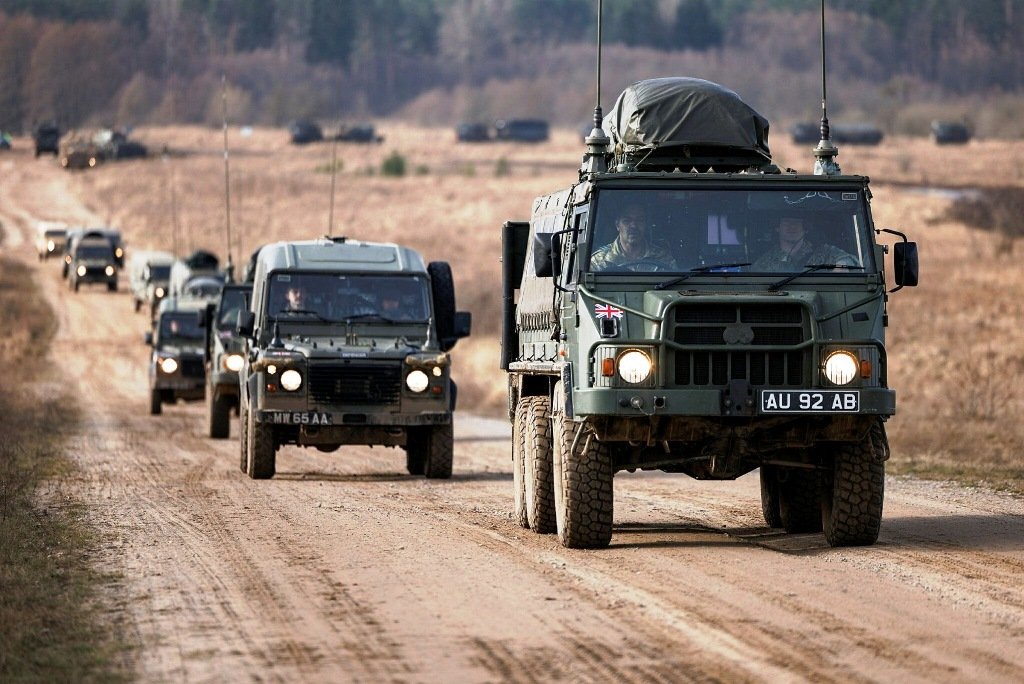
One of the most talked about pending UK MoD procurements in recent months has been that of the Light Mobility Vehicle (LMV). LMV is the long overdue replacement project for the UK’s Land Rover and Pinzgauer light vehicle fleets
The venerable Land Rover accounts for almost 90% of the vehicles to be replaced, the Land Rover model in question being the Defender eXtra Duty (XD) High Specification (HS). The XD/HS first entered service with the UK MoD in 1997, and to the UK MoD is known as Truck Utility Light (TUL) High Specification (HS) and Truck Utility Medium (TUM) High Specification (HS), or Wolf. The XD/ HS battlefield ambulance variant is known as Pulse, and while comparable in automotive terms to the XD/HS TUL/TUM Wolf, Pulse was in fact procured following dedicated trials and under a separate contract.
Including 879 Pulse, around 8,700 Defender XD were delivered to the MoD. The original stated out-of-service date (OSD) for this fleet was 2011, but this was quickly revised to 2014. And then in 2003 the Operational Utility Vehicle System (OUVS) appeared. OUVS was intended to replace, among other things, remaining older Land Rover models, Defender XD/HS, Pinzgauer, and the loathsome RB-44 fleets but was ultimately cancelled in 2010 after procuring nothing… Between 2010 and the General Support Utility Platform (GSUP) which was outlined during 2022, the OUVS-following Multi Role Vehicle – Protected (MRV-P) would spend another decade procuring… nothing!
The older Land Rover models and the RB-44 would be cast and some small interim light vehicle buys including white fleet were made, but the Defender XD fleet would soldier on during this time. The approximate 1600 TUL XD/HS bought would also be cast as they simply became too small for evolving roles, and between 2010-2013 just under 7,000 XD/HS TUM would go through the Project Remus 1 life-extending upgrade.
However, by the beginning of the current decade stories of maintainability and supportability issues with the Defender XD/HS fleet were rife. However, in civvy street maintaining a Land Rover Defender of comparable age to the XD/HS fleet has never been a problem, and as while this may sound counterintuitive, it is currently probably easier to maintain an aged Defender than it is a new Defender under warranty… However, the MoD has never proven to be particularly good at accessing the extensive network that supports these older Land Rover vehicles… And realistically, even if they could viably access what is essentially a network of small businesses that support the many Land Rover ‘enthusiasts’ out there, should the MoD even think about keeping the XD/HS fleet running Trigger’s Broom-style just because they can?

No, is in all honesty the right answer to that question. It is one thing to run even a small fleet of vehicles that by age alone are maintenance intense, but to try and maintain the availability of a fleet of thousands is entirely another. Inarguably, by the time the current LMV project reaches fruition, the time will definitely be right for the Defender XD/HS to retire gracefully, with even the youngest examples approaching 30 years of age. Although it must be said, once retired many examples will almost certainly have a decade or three of life left to look forward to in the hands of another grateful user, even if that user turns out to be a military one in some dark corner of Africa…
Based on maintaining a capability alone, there is a definite need for the LMV project to succeed where its predecessors have failed. Not only are the current assets aged, but there are simply not enough of them, this latter point highlighted by the recent buys of around 800 light utility vehicles under Projects Niala and Zeus. It must be made crystal clear here that these projects are in no way connected to LMV, although let’s be honest, any lessons learned will hopefully be shared with the LMV team…
Industry is quietly confident that the LMV project will result in some form of a procurement decision, although it has to be said a fair percentage do have doubts that actual procurement will end up being anywhere near ‘as advertised.’
The LMV project itself can be traced back into 2022s GSUP, although there were the almost inevitable requirements shift, timeline extensions and name changes before in May of this year LMVs (as part of the Land Mobility Programme (LMP)) Request for Information (RfI) was released. That RfI was followed by the August-issued Procurement Specific Questionnaire (PSQ), responses to which had to be submitted by 1st September.

Before looking at LMV’s actual requirements, we should take a very quick look at the other remaining light vehicle that LMV will replace, the Austrian Steyr-Daimler-Puch (SDP) Pinzgauer. As previously outlined, Pinzgauers make up only 12% of the current fleet, but there are 31 Pinzgauer variants on the books, compared to 67 Defender XD/HS variants in the other 88% of the current fleet. So quite a specialist and varied fleet then.
The first Pinzgauers entered UK service in 1995, with batch deliveries that included numerous 6×6 configurations running until around 2007-2008. The current OSD for the Pinzgauer is officially also 2030, although the support contract for these apparently has an option to run until 2031… The majority of the current Pinzgauer fleet is newer than the Defender XD/HS, and while the specialist nature of many of the platforms would suggest lower usage rates, the fleet is reportedly more difficult for the MoD to support than the Defender XD/HS fleet, albeit for similar reasons. In 2000 and as part of the break-up of SDP all Pinzgauer production shifted to the UK, and by Automotive Technik Limited (ATL). In 2005 ATL was acquired by the then Stewart & Stevenson, the FMTV-producing vehicle division of which was acquired in 2006 by Armor Holdings. BAE Systems then acquired Armor Holdings in 2007, and along with it the IP to the Pinzgauer. Having little-to-no use for such a niche product, BAE Systems shunted the Pinzgauer to South Africa and had effectively ended it by 2009, claiming no viable customer interest in further developments of the design.
Returning to LMV, the proposed contract which includes a substantial through-life support element is valued at up to £ 2 billion and runs for an initial nine years, with options stretching to 20 years. Based on experiences with previous fleets, this too will likely be stretched. The LMV requirement is currently understood to call for in excess of 9,500 vehicles if all options are exercised, with the initial tranche thought to be around 3,170, the bulk of these (around 60%) the basic General Purpose Variant (GPV). The MoD has stated that it desires LMV to comprise of a family of vehicles delivered on a Commercial Off-The-Shelf (COTS) Common Base Platform (CBP), configured into nine variants for which it issued Cardinal Points Specification (CPS) to guide prospective bidders. The nine variants are:
- General Purpose Variant (GPV)
The LMV base variant; a general-purpose platform for movement of up to 4 persons and up to 1 tonne of additional cargo with CIS integration appropriate to fielded requirements
- Battlefield Ambulance (BFA)
A Medical Evacuation platform able to sustain medical treatment of the most serious casualties in transit on and off-road
- Command & Control Vehicle (C2V)
A mobile C2 node with enhanced CIS communications infrastructure delivering a suitable platform environment in which operational planning can be conducted
- Tactical Mobility Vehicle (TMV)
Reduced profile LMV to enhance tactical mobility and survivability; weapon at readiness to enable survival in the defensive fire zone in the event of tactical surprise
A logistic platform for distribution of cargo loads of at least 2 tonnes based upon the LMV CBP to leverage cross-defence line of development efficiency and reduce deployment footprint
- Troop Carrying Vehicle (TCV)
A mobility support platform for bulk personnel transit intended to serve in special conditions like Air Landing Operations where lack of personnel lift has historically imposed logistic drag
- Equipment Support Vehicle (ESV)
A recovery platform, a platform for carriage of equipment support Specialist Tools and Equipment and a platform transporting first-line spares
- Mission Systems Vehicle (MSV)
This is not a distinct platform design but rather represents a set of role-specific configurations derived from one of the core variants and modified by other delivery programmes to generate additional mission effects or capabilities
- Enhanced Protection Vehicle (EPV)
Provides tactical protected mobility for strategic security tasks, with a separate engine compartment but common combined occupant area. Has a top cover sentry hatch to maximise situational awareness and enable operation of service personnel personal weapons
Many will no doubt have opinions on the issued LMV requirement, but the fact remains what is issued is issued, end of… Until the MoD changes things that is… And there will be further changes.

Many components of LMV’s requirement have become ‘hot topics’ of discussion, with a key one of those being the right- or left-hand drive question? The MoD has not yet formally stated any preference regarding this, and realistically one has to hope that if either were to be a mandatory requirement, this would have been stated by now. Any right-hand drive mandate, or even weighted preference, would certainly impact some potential contenders more than others…
But…, is right-hand drive (left-side driving) really essential? First off let’s just mention the fact that anyone from anywhere in Europe, with the exception of the Channel Islands, Cyprus, Malta and Ireland is entirely right-side driving (left-hand drive), can just bring a vehicle into the UK and off the bat be considered competent to drive on their ‘wrong side’ of the road. The same works in reverse of course. Now take a global overview. Only 30% of all nations are left-side driving, which is around 35% of population based on some higher-population countries. Are we, the UK, planning to invade or even likely to deploy to in numbers the likes of left-side driving Australia, India, Indonesia or even South Africa? Probably not. Arguably, and based on all recent deployments, UK forces are far more likely to find themselves deployed to one of the 70% of nations that are right-side driving…
And to aid in any left or right decision-making process then throw into the mix that the MoD has just bought a decent-sized batch of left-hand drive Chevrolet Silverado LD under Project Zeus, and that somewhere between 30-40% of the current wheeled vehicle fleet is left-hand drive. And let’s not forget that between 1,000-2,000 (nobody seems to know exactly how many…) of the original Defender XD/HS buy were left-hand drive, with these making up an estimated 20% of the remaining fleet…
Specific debate-generating requirements aside, and as a ‘helicopter’ opinion of the wider LMV requirements, it is clear that variants such as the baseline GPV can easily be met by an inexpensive albeit well-spec’d commercial pick-up truck painted green. And while this would clearly fall within the UK MoD’s desired Cat B licence requirement (3,500 kg MAM/GVW), it is as clear that a fair percentage of the other more complex variants (BFA an example) would not, would some industry sources suggesting that around 40 to 50% of the LMV fleet as currently spec’d will ultimately need to exceed 3,500 kg GVW. And a potential stumbling block for the LMV’s CBP requirement is that a lot of 3,500 kg MAM/GVW commercial pick-up trucks simply cannot by design be stretched to the dimensions and weights needed for those heavier variants without a re-design… This and other factors have clearly seen the interpretation of a Common Base Platform vary somewhat from PSQ response to PSQ response…
The MoD has not provided a list of respondents to the PSQ, and probably will not, but what is known is that the PSQ included pass/fail elements, with failure resulting in immediate disqualification. On September 30th the MoD advised the seven it had selected to progress beyond PSQ, inviting them to participate in the next phase of the programme, trials. By late-October those seven will be expected to deliver one each off GPV, TMV and BFA variants for trials. That selection is a clever move by the MoD and is pretty much an all-encompassing line-up that runs from the most basic variant (the GPV) through to probably the two most complex, the WMIK-like TMV and the BFA. This selection for trials could further reduce numbers as not all those invited are likely to be capable of supplying of three fully compliant variants.
Following trials, a further down-selection to around three bidders is expected for the Invitation To Tender (ITT) stage, the ITT anticipated to be released just before Christmas. The LMV contract award is currently projected for May 2027, although most in industry believe this will see some slippage.
At the recent DVD show held at Millbrook in the UK it became known that there had been 14 respondents to LMV’s PSQ, with ten of those identifying themselves at the show. Of those ten, six are included in the MoD’s down-select along with a name not even mentioned at the show… The seven selected to progress by the MoD following PSQ submission are:
And a quick look at those who may or may not have failed to progress beyond PSQ…
Photos courtesy Crown Copyright and S. Connors
