

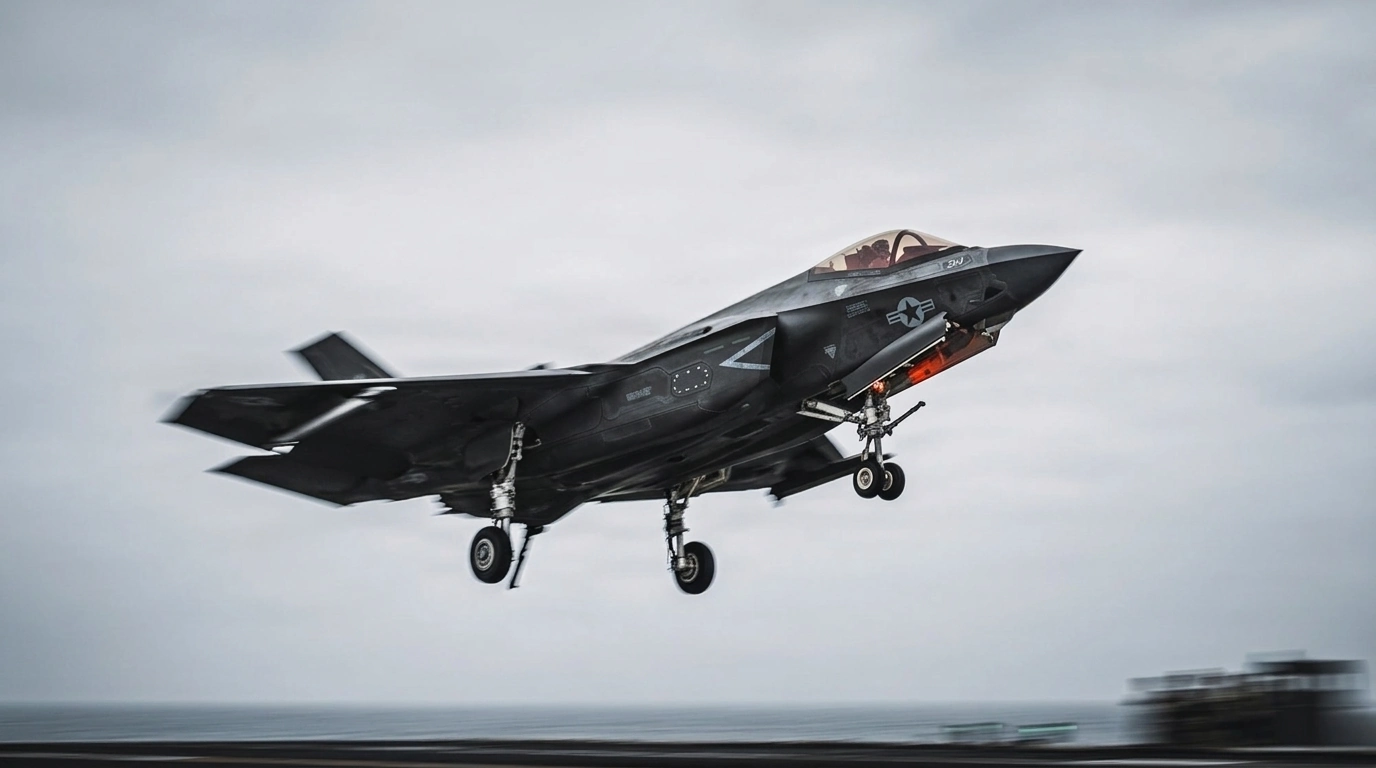
Landing a fighter on an aircraft carrier is one of the hardest jobs in military aviation.
Now add stealth.
The F-35C Lightning II was built to handle both. Its larger wings, reinforced landing gear, folding wingtips, and strengthened airframe were designed around catapult launches and arrested landings. Underneath that carrier-specific structure sits the same basic fifth-generation idea that defines the F-35 family: stay difficult to detect, collect information from multiple sensors, and give the pilot a clearer picture of the fight.
That combination is what makes the F-35C Lightning II so interesting.
The F-35A can use normal runways. The F-35B can operate with short takeoffs and vertical landings. The F-35C Lightning II has a different job. It has to launch from a carrier deck, recover on a moving ship, and still carry enough fuel and weapons to remain useful after leaving the ship.
The numbers show how much the design had to change. The F-35C Lightning II has a larger wing than the F-35A, a strengthened landing gear system, and a carrier arresting hook. Its wings also fold so the aircraft takes up less space when parked on the flight deck.
But the real advantage goes beyond the airframe.
The F-35C Lightning II combines the AN/APG-81 AESA radar, Distributed Aperture System, electronic warfare sensors, electro-optical systems, and sensor fusion into one cockpit picture. That gives the pilot more than a stealthy aircraft. It gives the carrier air wing a forward sensor that can find, track, and share information about threats.
And the F-35C Lightning II is now being pushed toward longer-range maritime strike missions, including testing tied to the Long Range Anti-Ship Missile, or LRASM.
So why is this carrier fighter so powerful?
Because the F-35C Lightning II wasn’t simply modified to survive carrier operations.
It was built around them.
What Is the F-35C Lightning II?
The F-35C Lightning II exists because a carrier fighter faces problems that a land-based fighter doesn’t.
A runway can be kilometers long and mostly fixed. A carrier deck is short, moving, and surrounded by water. The aircraft has to launch at high speed from a catapult, then return with enough control at low speed to catch an arresting wire.
That changes the aircraft.
The F-35C Lightning II was developed as the carrier variant of the F-35 family for the U.S. Navy and Marine Corps. Its job is not simply to carry the F-35’s stealth features onto a ship. Its airframe had to be reshaped around carrier operations while keeping the sensors and low-observable design that define the Lightning II.
The clearest difference is the wing.
The F-35C Lightning II has a much larger wing than the F-35A, with folding outer sections for storage aboard a carrier. The larger surface gives the aircraft more lift at low speeds, which helps during carrier approaches. The structure is also reinforced to handle the repeated loads of catapult launches and arrested recoveries.
Then there is the landing gear.
The F-35C Lightning II uses stronger landing gear than the land-based F-35A because a carrier landing is not a normal touchdown. The aircraft essentially meets the deck with enough force to engage the arresting system and stop within a very short distance.
That sounds brutal because it is.
But the F-35C still has the core features that make the F-35 family different. Its pilot gets information from radar, electronic warfare sensors, infrared systems and other onboard sensors through a fused tactical picture.
This is why calling the F-35C Lightning II simply a “naval F-35” misses the engineering story.
It is a stealth fighter redesigned around one of aviation’s most demanding jobs: operating from a carrier deck without giving up the information advantage of a fifth-generation aircraft.
And that compromise is exactly what makes the F-35C so distinctive.
F-35C Lightning II Specifications and Design
The F-35C Lightning II looks familiar beside the F-35A, but its numbers reveal how much the Navy changed the aircraft for carrier duty.
| Specification | F-35C Lightning II |
| Crew | 1 |
| Engine | 1 × Pratt & Whitney F135 |
| Maximum speed | Mach 1.6 |
| Maximum g-load | 7.5g |
| Internal fuel | About 20,000 lb |
| Takeoff | Carrier catapult or conventional |
| Landing | Arrested carrier landing |
| Primary role | Carrier-based multirole fighter |
| Radar | AN/APG-81 AESA |
The most important number isn’t its Mach 1.6 top speed.
The F-35C Lightning II was never designed to win by being the fastest fighter in the sky. Its design puts much more emphasis on stealth, sensors, fuel capacity, and carrier handling.
The larger wing is a major clue. Compared with the F-35A, the F-35C has more wing area and folding outer sections. That gives it better lift during slow carrier approaches while allowing the aircraft to fit into the tight parking spaces aboard a carrier.

The F-35C Lightning II also carries roughly 20,000 pounds of internal fuel, giving it more fuel capacity than the F-35A. That matters because carrier aircraft often need to spend significant time away from the ship before returning to the deck.
Then comes the structure.
The landing gear and airframe were strengthened for carrier operations, while an arresting hook sits between the engine exhausts. The aircraft also has a larger wing fold system that adds weight and mechanical complexity.
Those changes come with a cost.
The F-35C Lightning II is heavier and less agile in some respects than the land-based F-35A. Its maximum load factor is 7.5g, compared with 9g for the F-35A.
That’s not a design failure.
It’s the price of making a stealth fighter strong enough to be thrown off a carrier and then slammed back onto one.
Why Does the F-35C Have Such Large Wings?
The F-35C Lightning II’s large wings solve a very specific problem: getting a heavy stealth fighter onto a short carrier deck at low speed.
That sounds simple until you think about the final seconds of a carrier landing. The pilot has to keep the aircraft slow enough to approach the deck safely, but fast enough to maintain lift and control. There is very little room for error.
More wing area helps.
The F-35C Lightning II has the largest wing of the three F-35 variants. Its outer wing sections fold upward when the aircraft is parked, reducing the space it occupies on the carrier deck. When extended in flight, that larger surface produces more lift and gives the aircraft better low-speed handling than a smaller wing would provide.
The folding mechanism isn’t just a visual feature.
A carrier flight deck is crowded with aircraft, fuel equipment, weapons crews and moving machinery. Every meter of parking space matters. Folding the outer wing sections allows the Navy to fit more aircraft into the available deck and hangar space.
The wing also supports the F-35C’s greater internal fuel load.

The aircraft carries roughly 20,000 pounds of internal fuel, more than the F-35A. That helps offset the demands of carrier operations, where the fighter may need to launch, fly a mission, hold for recovery, and still return with enough fuel to land safely.
But the larger wing creates a trade-off.
More structure means more weight. More weight means the aircraft needs more lift and thrust to achieve the same performance. The F-35C therefore gives up some of the F-35A’s maximum maneuver load, with a 7.5g limit compared with 9g for the F-35A.
That’s a good example of why carrier aircraft can’t be judged by one specification.
If you only compare maximum g-load, the F-35A looks better. Put both aircraft on a carrier deck, and the question changes completely.
The F-35C’s large wing isn’t there to make the aircraft look impressive.
It’s there because the last few seconds before touchdown are unforgiving.
How Powerful Are the F-35C’s Sensors and Weapons?
The F-35C’s real advantage starts before a weapon is launched. Its sensors are designed to give the pilot a clearer picture of the fight while the aircraft remains difficult to detect.
The AN/APG-81 AESA radar sits at the center of that system. But treating the radar as the aircraft’s main sensor would miss the point. The F-35C also uses the Distributed Aperture System, electro-optical sensors, and electronic warfare equipment to collect information from different parts of the battlespace.
The aircraft then combines that information through sensor fusion.
That’s where the F-35C Lightning II becomes more interesting than a conventional fighter with a powerful radar.
A pilot doesn’t have to build the entire picture from separate displays. The aircraft processes data from its sensors and presents a more unified view through the cockpit and helmet-mounted display. In a complicated air environment, saving even a few seconds of interpretation can matter.
Stealth adds another layer.

The F-35C Lightning II carries weapons internally when maintaining a low radar signature matters most. That keeps the aircraft’s external shape cleaner than a fighter carrying a large missile load under its wings.
But the F-35C Lightning II isn’t limited to internal weapons.
Its external stations can carry additional weapons when the mission doesn’t require the lowest possible radar signature. That’s a useful distinction because stealth is a tool, not a permanent rule. There are missions where carrying more weapons matters more than minimizing every radar reflection.
The weapons mix is also expanding.
In 2026, Lockheed Martin completed the first phase of flight-science testing for integrating the Long Range Anti-Ship Missile, or LRASM, with the F-35C Lightning II. The work began in 2024 and is aimed at giving the carrier fighter a longer-range maritime strike option.
That could matter in a serious naval fight.
A carrier fighter that can quietly approach a contested area, collect targeting data, and help support long-range anti-ship weapons gives the carrier air wing another way to threaten ships without relying only on traditional strike aircraft.
The F-35C’s strength, then, isn’t one spectacular weapon.
It’s the combination of stealth, sensing, information sharing, and the ability to carry the right weapon for the mission.
How Does the F-35C Work With a Carrier Air Wing?
The F-35C Lightning II becomes far more useful when it works as part of a carrier air wing rather than as a lone fighter.
A modern carrier doesn’t send one aircraft to do everything. Different jets bring different strengths, and the F-35C Lightning II fits into that mix as a stealthy sensor and strike platform.
Take Carrier Air Wing 5 aboard USS George Washington. Its aircraft include F-35Cs, F/A-18E/F Super Hornets, EA-18G Growlers, E-2D Hawkeyes and helicopters. Each fills a different gap. The F-35C isn’t replacing all of them. It adds another layer to the force.
The E-2D Hawkeye can provide long-range airborne surveillance and command support. The EA-18G Growler specializes in electronic attack. Super Hornets provide a large share of the carrier’s fighter and strike capacity.

The F-35C Lightning II brings something different.
Its stealth and onboard sensors allow it to operate closer to heavily defended areas while collecting information that can be shared with other aircraft and ships. The aircraft can detect a threat, build a track, and pass useful information across the force instead of keeping that data inside its own cockpit.
That changes the way a carrier air wing can operate.
Imagine the F-35C Lightning II finding a threat while another aircraft remains better positioned to engage it. The F-35C doesn’t necessarily need to carry the weapon or even remain over the target. Its information can help another platform make the engagement.
That’s why I wouldn’t judge the F-35C by its own weapons load alone.
Its value is partly measured by what it enables other aircraft to do.
This becomes even more relevant as the Navy works toward longer-range weapons such as LRASM. The F-35C can provide the sensing and targeting side while other platforms contribute weapons, electronic attack, or additional surveillance.
The carrier air wing becomes a network of different tools.
And the F-35C Lightning II is one of the most sophisticated sensors inside that network.
What Missions Can the F-35C Lightning II Perform From an Aircraft Carrier?
The F-35C Lightning II is built to do much more than defend the carrier itself.
Its real value comes from how it can move between sensing, air combat, strike, and support missions during the same deployment. That flexibility matters because a carrier air wing can’t assume every mission will involve the same threat.
For air defense, the F-35C Lightning II can use its radar and passive sensors to detect and track aircraft while keeping its own signature low. Its sensor fusion can also help the pilot understand where threats are without relying entirely on active radar emissions.
But the aircraft’s role gets more interesting when it moves closer to contested areas.

The F-35C Lightning II can support suppression of enemy air defenses, gather intelligence, identify threats, and help build a targeting picture for other aircraft and ships. Its low-observable design gives it an advantage when operating where older aircraft may face greater detection risk.
It can also conduct strike missions.
Internal weapons carriage lets the F-35C Lightning II maintain a lower observable profile while carrying a limited internal load. When stealth becomes less important, external stations can increase its weapons capacity.
Maritime strike is becoming another important part of the story.
The Navy and industry are working toward integrating LRASM, a long-range anti-ship missile designed to give U.S. forces another option against surface ships.
Lockheed Martin completed the first phase of F-35C LRASM flight-science testing in 2026, moving the program closer to a broader weapons integration effort.
The F-35C’s operational value has also moved beyond testing.
Marine F-35Cs have operated with Navy carrier air wings, including deployments associated with Operation Epic Fury in 2026. That matters because carrier aviation is where the aircraft’s design has to prove itself under real operating conditions, not just in a test range.
Still, the F-35C Lightning II isn’t meant to replace every aircraft on the deck.
The Super Hornet carries a larger conventional weapons load. The Growler specializes in electronic attack. The Hawkeye provides airborne early warning.
The F-35C Lightning II fills a different gap.
It can move forward, sense what is there, share what it finds, and use its own weapons when needed.
That’s a powerful role for one aircraft.
