

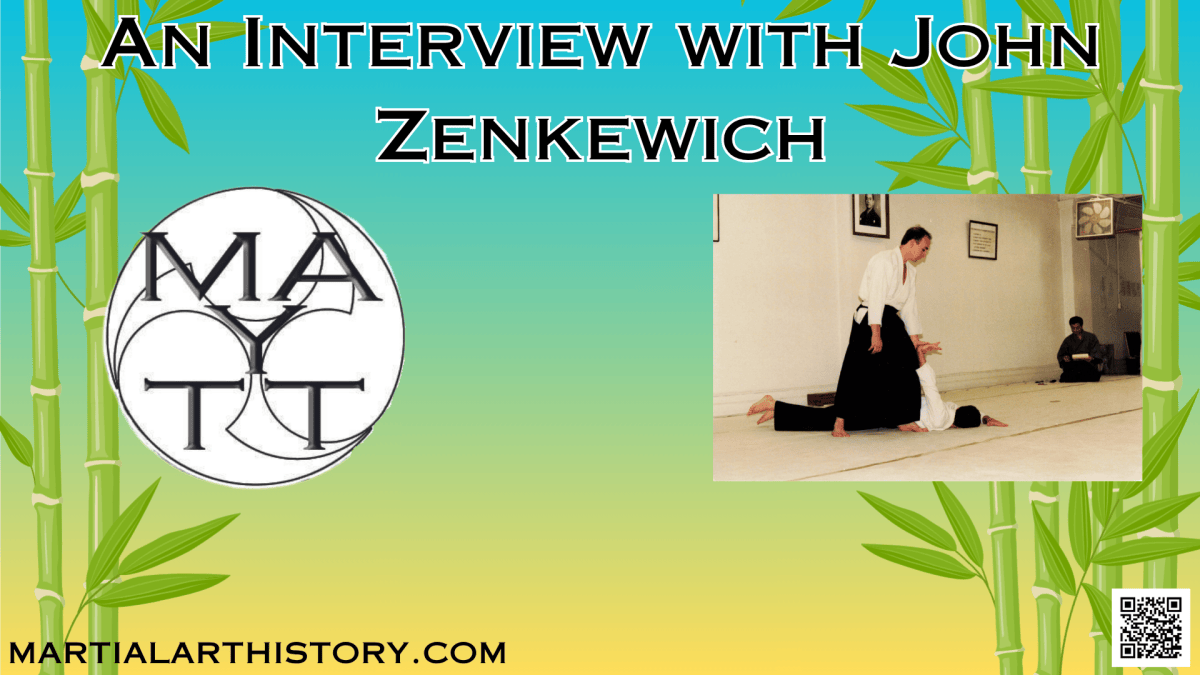
John Zenkewich was given a choice: train at the Aikikai in New York City to learn technique or train at the Ki Society to know how aikido is supposed to feel. After calling the dojo, Shizuo Imaizumi answered the phone, leading Zenkewich to become a lifelong student of Imaizumi. Joining in 1978, he witnessed the evolution of his teacher from the strict Ki-Aikido curriculum to freer and more inclusive of his Shin-Budo Kai curriculum. Today, Zenkewich took the time to discuss his observations on Imaizumi’s teaching approach, his connection to the political sphere of aikido, and his ultimate legacy in the art. Images provided by John Zenkewich.
Martial Arts of Yesterday, Today, and Tomorrow: Welcome Zenkewich Sensei! Thank you for joining us to talk about Imaizumi!
John Zenkewich: Thank you for having me.
MAYTT: What were the sequence of events that led you to train under Shizuo Imaizumi?
JZ: Well, I was always interested in aikido. In college, I had done Taekwondo, and before that I was into Olympic weightlifting, so I was always strong enough to take on really big guys. But I always wondered what would happen if I met somebody stronger – someone as strong as me, pound for pound, but much bigger. So, I heard about aikido from my cousin, who had seen Koichi Tohei, I think, when he was in the service, and I was always interested in the philosophy of aikido. I wanted to try it out. But in New York, we had the two main schools – Shizuo Imaizumi Sensei and Yoshimitsu Yamada Sensei with the Aikikai – and I didn’t really know which one I wanted to do, because I had read a lot of Tohei’s stuff and all that.
Then one night, I was working at a counter, and a girl came up wearing an aikido t-shirt. So, I said, “Wow, you do aikido and all that?” She said, “No, no, I don’t do it—my brother does. And my brother is a really big shot in aikido.” I said, “Oh,” and told her I was wondering where I should study. She said, “Well, my brother says if you want to learn technique, you should definitely go see Yamada Sensei. But if you want to see how it’s really supposed to feel, then you should go see Imaizumi Sensei.” So, I figured, why would I want to just learn the technique and then go someplace else to see what it would really be like? I ended up calling the dojo, and Imaizumi Sensei actually answered the phone. This was 1978. I went down, watched the class, liked it, and the rest is history.
MAYTT: It sounds like it was almost fate.
JZ: Yeah, because up until then, I had never met anybody that actually did aikido. I didn’t live in the city; I lived outside the city in Westchester. Are you familiar with New York?
MAYTT: Yes. Westchester is north of the city. How far is it from New York City?
JZ: The borders meet. It’s right above New York City, so I lived about a half-hour car drive away. Half hour to forty minutes, depending on traffic, you know how that works.
MAYTT: When you started training, did Imaizumi teach all the classes or were some of his early students teaching alongside him?
JZ: No, he taught every class. Most of the time when he was there, he always taught all the classes. When I started, Donna was there. I don’t know if you ever spoke to Donna Carlson or Warren Wynshaw. Donna was the main person, and have you ever had a chance to talk to Donna?
MAYTT: I did have a chance to talk to her a few years ago.
JZ: She knows Sensei the best, which I’m sure you’ve got from everybody else.
When I started, the three main people were Donna, Warren Wynshaw, and Frank Wolkenberg. They were the three most senior students, with Donna being the most senior. They were there, but Sensei taught every class, which was great. It was great. How long have you been doing aikido?
MAYTT: About twenty-four years.
JZ: Well, one of the biggest questions you always get from people is, “How do you learn how to breakfall?” The way I learned was… I got thrown by Imaizumi Sensei once, and I did a breakfall. I didn’t get hurt or anything – I was a twenty-something-year-old kid – so I could take it. After that, he could throw me anytime he wanted, and I’d just go. But if you asked me how to teach a breakfall, I had no clue. People would say, “How do you do a breakfall?” and I’d say, “I don’t know. He just threw me and I survived, that’s all.” And it was great. I never got hurt or anything like that, so that’s how I learned. That’s one of my big memories from him.
The other thing that really stuck with me, and I’m sure you know this question too, is: does aikido work in a real fight? I was a twenty-something-year-old guy, and my best friend at the dojo, John – we started together, tested for shodan together – we used to play around and attack each other really hard, much harder than in a normal class. One day, Imaizumi Sensei walked over and said, “Come here. Attack me.” So, I attacked him. He hit me in the ribs, did something else, and in the blink of an eye, I was on the floor looking up. He looked down at me and said, “See? I know this stuff too,” and just walked away. And that was that. He was really an amazing guy. I was lucky; I started with him in 1978, when he was young and in his prime. Even into the 1980s, he was still really good, but back then, he was something else.
Another thing I’d like people to understand, maybe nobody mentioned this, is that he had Secret Service Treasury agents as students, and he did seminars for them. Before that, he ran a self-defense seminar, and he made a very clear distinction between self-defense and practicing aikido. In a real self-defense situation, you’re not limited by the “rules” of aikido, even though you’re using aikido principles. He wasn’t teaching aikido to make you a super fighter; you were learning skills and techniques that, if you understood them, could absolutely be used to defend yourself. What I started to realize was this: when I began training, it was under the Ki Society. So, if we were doing something like katatori ikkyo – someone grabs your collar, your hand comes out – there was never any atemi. But after that experience where he dropped me, I realized that even within those basic Ki Society techniques, you were creating openings for atemi if you wanted it. It was all there. It could have been a strike to the face – we just didn’t hit each other in the face. I really liked that, and I started to see it more and more.
Another thing: when we first started with Imaizumi Sensei, he didn’t talk much in class at all. Maybe it was his teaching style, maybe it was the language barrier, but he didn’t explain much during practice. Later on, though, he started giving lectures outside of class. I remember one he did on ki at an Astrological Society. We were always invited, but most of the regular students didn’t go – we figured, we see him every night at the dojo, why go? But I went. And there, he explained things he never explained in class. That balance – minimal talking in practice, deeper explanation in lectures – was perfect. It really helped me understand what Aikido was, what ki development meant, and how everything fit together. Because back then, in the 1970s, it was still pretty close to the split, and there was always that separation between the Ki Society people and the Aikikai people.
MAYTT: You bring up ki. How did Imaizumi explain the concept of ki?
JZ: Ki was life energy. He would put up the calligraphy and show how the elements of ki were air, steam, rice, water; all the things you need for life. He always talked about it that way. Then, when it came to practice, ki was something you could extend, using your mind, your energy, your force, your power going in a certain direction, especially if somebody was holding you or resisting. But at the Astrological Society, he explained it a little differently. There, ki was the life energy that we all have, and aikido was about becoming one with the energy of the universe. You know, he presented it in that whole way.
MAYTT: How did Imaizumi bridge those philosophical and theoretical concepts of ki with aikido, from your perspective?
JZ: I think we learned that aikido is blending your personal ki with the ki of the universe, joining with the energy, or even the intention, of your opponent or your partner. A lot of the techniques came out of that idea. If somebody’s holding you and their strength is going in a certain direction, you don’t oppose it, you blend with it, you move with it.
Back then, he was teaching the basic Ki Society program, so we had separate ki classes and aikido classes. The ki class was the first hour, focusing on movement exercises, centering, and all the basic ki tests. Then in the aikido class, we’d do a little of that, but really it was about applying what you learned in the ki class. The beauty of that was how it brought people along. A friend of mine, he was older than me, started in the ki classes because he was actually afraid of aikido. He had done karate and all that, but he didn’t want to be thrown. So, in the ki classes, he learned how to move, other basic things like rolling back and forth, getting up, handling someone pushing on you, all those tests. That gave him the confidence to eventually try the beginner aikido class. At the time, classes were split, beginners were below third kyu, and then advanced was third kyu and above, so there was a nice progression. It was a great way to bring people in. You’d get women, or people who weren’t especially athletic, coming in because they were interested in the philosophy and the idea of ki. They’d start with the ki development classes, and that became a bridge. If they stuck around, they’d see the aikido. Or guys like me, doing both, would say, “Come on, you can try this. You can do it, just give it a shot.” And then they’d step in. It was a really good way to ease people into it, especially those who were afraid of being thrown, rolling on the floor, all that. You know how it is with aikido demonstrations; the big falls make people think they won’t be able to handle it.
In the aikido classes, you practiced the ki principles, but like I said, he didn’t explain ki all that much. What he would do is show you. If we were working on something like ryotetori nikyo, he’d come over, grab you, and just relax completely, and stop you dead. You couldn’t move. Then he’d guide you – relax your arm, settle your weight – and suddenly he could move right in, do a tenkan, and apply the technique. So, it was more of a feeling than a lecture. And, you know, as a college kid, an American, you want things explained. That’s why going to that outside lecture at the Astrological Society was so important for me. There, he talked about things he never explained in class. We were doing the same exercises, but now he explained the principles – relax completely, keep your weight underside, things like that. There was even a bit of Asian philosophy mixed in. It was just a different audience. At the Astrological Society, he explained things. In the aikido class, you learned hands-on; you just did it, over and over, learning how to relax. Typical class stuff.
MAYTT: Sounds like Imaizumi was very hands-on. Would that be how you would describe the training you experienced under him?
JZ: It was definitely experiential, very hands-on. You did the technique; you did the work.
In the basic class, back when it was still Ki Society before Shin-Budo Kai came in, you’d start by coming in and reading a verse from the Ki Sayings. Then you’d warm up, do the exercises, and after that he would demonstrate a technique. From there, you had to do it. You were always switching partners; none of this working with the same person the whole class. You’d rotate, work with different people, and just keep going. He would usually show four, five, maybe six techniques at most. He’d write them on the chalkboard so you could see them, especially since sometimes the words weren’t always clear, and then you’d go out and practice. At the end of class, you’d go through each technique again individually, and then finally you had to do them all, one after the other. That was pretty much how the classes went.
But it was always hands-on, constant switching, working with different people, so you got a lot of experience dealing with all kinds of partners.
MAYTT: How did you see Imaizumi change and evolve while you were training consistently with him?
JZ: He was a very disciplined person. And when he taught for the Ki Society, he was the Ki Society; he simply did what their program was. He did bring in other elements for a short time, a bit of philosophy and even some Zen meditation, but that didn’t last long. After that, it was just the ki work. That was his way. His techniques were really ingrained in him. His physical movement didn’t really change. He was consistent the whole way through. He could demonstrate the same thing the same way, amazingly, every time. It wasn’t like he started out strong or weak and then developed into something different – he was just very steady. So, between 1978 and 1986 or 1987, when Shin-Budo Kai started, things were very consistent. Classes were pretty much structured the same way. You’d do different material, but you were always working with different partners. There was a lot of rotation.
At that time, they also had summer classes, like a kind of summer school or summer camp. During those first eight years, Tohei came and visited the dojo and did a seminar. Koretoshi Maruyama also came to New York and did a seminar. We did everything: bokken, jo, the whole curriculum. And he was always studying as well – the bokken and jo material you later saw more developed in Shin-Budo Kai. He was always reading, always learning, always adding little details here and there, but he kept the main program intact. He was very loyal and disciplined about keeping things the way they were meant to be. So, I never felt that his physical technique really changed over that ten-year period. The only thing that changed was me; because as I got better, he could throw me harder, and I could take more. That was just my development. He was always very protective of students. Nobody should get hurt. Very rarely did anybody get seriously hurt; sometimes knee issues and things like that, but not really from accidents, just the physical nature of training. Even up until just before covid, I was still training with him right up until then, he was still consistent. Very strong, still capable, still doing everything.

And I think the best way to put it is this: he was looking for you, the student, to discover things for yourself. He didn’t explain a lot verbally. He would do the technique on you and throw you so you could feel it. But he didn’t impose it with words like “you should do this” or “you should do that.” Even when we were preparing for tests, and you probably saw the lists of techniques, there were always slight variations in how he would show things. So, you’d ask, “Sensei, if we’re doing katatetori kokyu nage or shiho nage, I can do it this way or that way…” and he would just say, “Yes.” So, you’d try to figure it out, and eventually I asked him directly, “Okay, I can do it this way or that way, so which way do you prefer?” And then he would say, “Oh, I prefer…” and he would show a very definite version. But if you asked in general, “Can I do it this way or that way?” the answer was always yes. So, I learned to ask before tests, “Which do you prefer?” and then I would just follow that.
In that way, I found him a very freeing instructor. We could explore, and because of that, even in the 1970s and 1980s, and afterward, I was able to train with other instructors and never feel like I was being disloyal. There was no issue with that, and I never hid the fact that I was seeing other teachers.
Back then, in the 1970s, you had people like Terry Dobson around, so I got to see him. Mitsugi Saotome would come to Bond Street Dojo. I saw Kisshomaru Ueshiba at a seminar. Morihiro Saito did a seminar in New Jersey. I even went to a seminar with Seiseki Abe, the calligrapher who taught O-Sensei. At that Saito seminar – I had specifically attended to see Saito – he asked me who I trained under. I told him Imaizumi Sensei and he immediately called me into the office and said, “Oh yes, he’s a nice boy.” I started laughing, because of course Imaizumi wasn’t a “boy” at that point, but Saito knew him from earlier, when he was younger. So, to him, he was still “a nice boy.” As a result of that connection, and a few other things that came up, I actually got a lot of personal attention at that seminar – attention I’m sure I never would have received otherwise. So, that was really a good experience. And I never felt that because I was Imaizumi Sensei’s student I couldn’t see anyone else. The only clear instruction he ever gave me in that regard was when I started teaching myself. He said that if I had my own students and brought them for testing, they had to look like his students. So, there was a standard.
But beyond that, he was very open and allowed me to have a broad experience. And all of those teachers respected him, so everything worked well together. In the beginning, there was a bit of tension in New York between Aikikai and Ki Society circles, but among the senior teachers, it was never really an issue. So, to come back to the main point: I can’t say his technique really changed. Even at the end of his teaching, he was still consistent, still strong, still able to do everything. And I had fun with him. Now I’m in my sixties and he was in his seventies and eighties, and we could still play with each other on the mat.
MAYTT: It is amazing how you had that almost one-on-one experience with Saito! Earlier you mentioned Tohei and Koretoshi Maruyama coming by New York for seminars. What was communication like within the Eastern States Ki Society? How often did the entire federation come together?
JZ: Alright, for a while there was the Eastern States Ki Society, and then the broader United States organization. In the beginning, Imaizumi was the head of the whole thing. He would travel and visit other dojos. My friend John – I used to call him the “ambassador of aikido” – he would travel wherever Sensei went. He had friends in every dojo around the country. There was a real network, a lot of connection that way. You had people from Maryland and the eastern states, Virginia – George Simcox and Dan Frank – those were some of the main teachers. Terry Pierce in New Jersey as well. They would all come up to see him, and he would do seminars for them. So, there was a strong level of interaction. But eventually, for whatever reason – and I’m not even sure Imaizumi Sensei really enjoyed being the head of an organization – he kind of stepped back. And that’s when Koichi Kashiwaya took over. There was even a bit of a joke about it, because Kashiwaya was younger and better suited in some ways to run an organization. But before that shift, Imaizumi was definitely the man.
Around that same general period, when Tohei came to New York in the early 1980s, because of his age, we were told it might be his last trip to the United States. So, people came from all over. Ultimately, it wasn’t his last trip, I was corrected later when I mentioned that, but at the time, that’s what we were told. Traditionally, when Japanese teachers reached a certain age, they didn’t travel as much anymore, so there was that sense of occasion. Tohei was there, and it was a great experience.
At one point, I actually got to be Tohei’s uke for a technique. That was really something. And this connects to why I originally got involved in aikido. In Kisshomaru Ueshiba’s book on aikido, Tohei wrote the foreword, or part of it, and he described attacking O-Sensei, saying he couldn’t stop him because he couldn’t feel where he was being touched. I don’t know if you remember that passage, but it always stayed with me. Tohei had come from a judo background, so I always wondered what that meant: how someone could move you without you feeling the contact point. So here I was, maybe third kyu at the time, a skinny kid, and I got called up by Tohei. During the ki tests, I would often get paired with much bigger partners, and Tohei would come over and show me how to sit, how to stand, how to align so this big guy couldn’t move me. And it looked like this skinny kid was stopping a much larger person – it was a lot of fun.
But when Tohei called me up to demonstrate, we were doing ryotetori. I had both hands on his arm. He stepped around me, and suddenly I could feel my back going back, my hands lifting, and I’m thinking, “Why the hell am I moving?” There was no obvious pull, nothing I could detect, but I was being thrown. And in that moment I thought, “That’s it! That’s exactly what he wrote in the book.” That was a really powerful experience for me.
There were people coming from all over for those seminars, and fortunately some of those old videos are starting to surface online now – Terry’s old footage and others. It’s good to see that material again. There was also a newsletter for a while, The Higashi. I think I posted a couple of those on the Shin-Budo Kai page. Maybe two issues. I was even thinking of doing something like that again, just for the sake of it – maybe one every quarter – because that kind of material shouldn’t get lost.
But overall, Imaizumi Sensei wasn’t really an “organizational” man. So, he never tried to build a big structure or expand things in that way. That just wasn’t really his interest.
MAYTT: Speaking of communication, how often did Imaizumi discuss his Ki Society peers, like Fumio Toyoda in Chicago and Shuji Maruyama in Philadelphia?
JZ: By the time I started, I was younger, pretty much focused on New York. We knew about them. His personal interactions – I don’t know much about them. Donna would probably know the best. Maybe Warren, but Donna, definitely. When I was involved, I don’t remember. By 1978 or the 1980s, was Toyoda still alive? I don’t remember.
MAYTT: He passed in 2001.
JZ: I thought it was earlier. I knew of those people, but I never had any interaction with them.
Part two coming soon!
Learn more about Shizuo Imaizumi, John Zenkewich, and more in Aikido’s Hidden Gem!

