

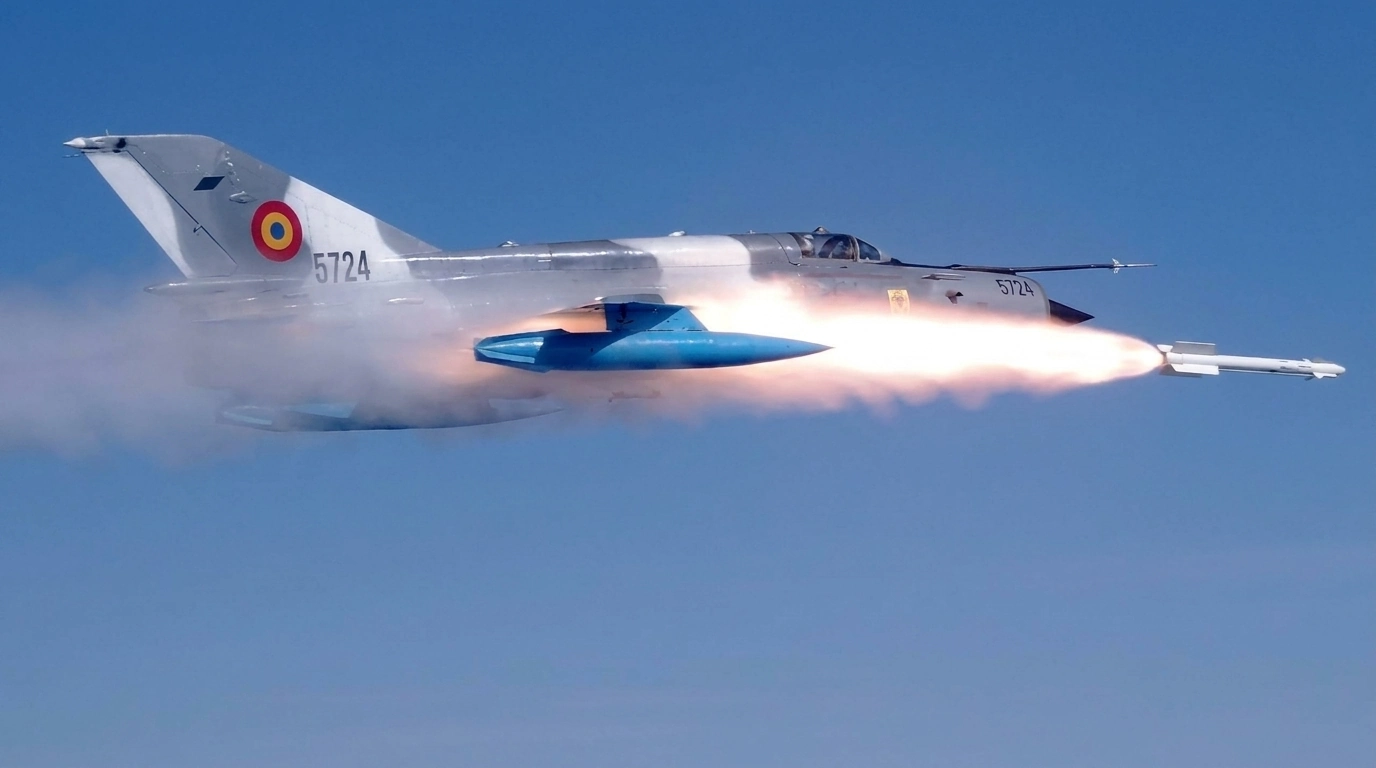
A missile designed in the Soviet era still shapes how pilots fight at close range today.
That sounds strange until you look at what the R-73 missile actually changed. When it entered Soviet service in 1984, the R-73, known to NATO as the AA-11 Archer, gave fighter pilots something older short-range missiles struggled to provide: the ability to attack an enemy well outside the aircraft’s nose.
That changes the fight.
A pilot no longer had to point the entire aircraft at an opponent before launching. With a helmet-mounted sight, the pilot could look toward the target, cue the missile, and let its seeker take over. The missile’s high maneuverability then gave it a much wider shot window than earlier weapons such as the R-60.
The textbook description is simple: the R-73 is a Soviet infrared-guided dogfight missile.
That’s true, but it misses the interesting part.
The R-73 helped push close-range air combat toward high off-boresight weapons, where the pilot’s ability to see and cue a target became almost as important as the aircraft’s nose position. That idea did not disappear with the Soviet Union. It helped shape the path toward weapons such as the AIM-9X and IRIS-T.
And the old missile keeps turning up in unexpected places.
R-73 missiles remain associated with MiG-29 and Su-27 family fighters, while modified examples have even been adapted for ground-based air defense in Ukraine. A weapon designed for a Soviet fighter pilot can now find a second life from the ground.
So the real question isn’t whether the original R-73 is still the best short-range missile available.
It isn’t.
The better question is why a 1980s weapon still matters four decades later. The answer starts with one feature that changed the geometry of the dogfight: off-boresight targeting.
What Is the R-73 Missile?
The R-73 missile was built to fix a simple problem: Soviet fighters needed a better weapon once a fight got close.
Its predecessor, the R-60, was small and highly maneuverable, but its seeker and engagement limits left room for a better short-range weapon. The Soviet Union turned to Vympel, which developed the R-73 as a new infrared-guided air-to-air missile for close combat.
It entered service in 1984.
That date matters. The R-73 appeared when fighter combat was moving toward a much more demanding question: how quickly could a pilot turn a fleeting visual contact into a missile shot?

The answer was no longer just better aircraft maneuvering.
The R-73 was built around a wide seeker field of view and extreme maneuverability. That allowed it to engage targets away from the fighter’s centerline. When paired with the pilot’s helmet-mounted sight, the system became far more useful than the missile’s size suggested.
NATO gave it the name AA-11 Archer, a label that became widely known after the missile entered Western intelligence assessments during the late Cold War.
The R-73 was also closely tied to fighters such as the MiG-29 and Su-27. Those aircraft were designed with close-range combat in mind, and the missile fit that role almost perfectly. A pilot flying a MiG-29 did not need to win a long turning fight before getting a useful shot. If the opponent appeared far enough to the side, the pilot could cue the missile toward him.
That distinction is easy to miss.
The R-73 wasn’t simply a faster replacement for the R-60. It was part of a different way of thinking about the dogfight. The missile and the pilot’s sighting system had to work together.
And that’s where the R-73 missile became genuinely interesting.
Its infrared seeker searched for the heat produced by an aircraft, while the missile’s control system gave it the agility needed to chase a target immediately after launch. The weapon was therefore designed around the first few seconds of an engagement, when a fighter might have only a brief chance to fire.
The exact performance figures vary between R-73 versions and launch conditions, so quoting one range number as if it applies to every missile is a common mistake. The original R-73 and later improved derivatives should not be treated as identical weapons.
What stayed consistent was the basic idea: get the missile looking at the target before the aircraft has to point directly at it.
That idea would prove much harder to counter than the missile’s Soviet-era origins might suggest.
Why Was the R-73 So Revolutionary in Dogfights?
The biggest R-73 missile advantage was not its maximum speed. It was the extra few seconds it could give a pilot in a close fight.
Before high off-boresight weapons became common, getting a short-range missile onto a target usually meant pointing the fighter toward that target. That sounds obvious until two aircraft are turning hard in opposite directions. A pilot might have a clear visual contact but still lack the nose position needed for a launch.
The R-73 attacked that problem from another direction.
Its seeker could be pointed away from the missile’s centerline, while its high-agility control system gave it the ability to turn sharply after launch. Add a helmet-mounted sight, and the pilot’s head became part of the targeting process.
That changed the geometry of a dogfight.

Imagine two fighters crossing at close range. One pilot sees the opponent slide across the canopy but cannot immediately point the aircraft at him. With an older missile, that moment might be useless. With an R-73 and compatible helmet-mounted cueing system, the same visual contact could become a firing opportunity.
That is the part of the R-73 story that gets lost when people reduce it to a specification sheet.
The missile also exposed a weakness in the old way of comparing air-to-air weapons. Maximum range matters, but range is not everything in a knife-fight. A missile that can be launched from a difficult angle can be more useful than one with a longer advertised range that requires a better aircraft position.
The West took the threat seriously.
The R-73’s appearance in Soviet service helped drive renewed attention to high off-boresight combat and helmet-mounted sights in the United States and Europe.
The AIM-9X, ASRAAM, and IRIS-T belong to a later generation, but they reflect the same basic combat logic: see the target, cue the seeker, and attack before the aircraft is perfectly aligned.
The common mistake is to say the R-73 single-handedly transformed air combat.
It didn’t.
Training, radar, aircraft maneuverability, pilot skill, and situational awareness still decide whether a missile gets a useful shot. A high off-boresight missile cannot rescue a pilot who never sees the threat.
But once both pilots can see each other, those extra degrees of seeker freedom become brutally relevant.
That is why the R-73 still deserves attention. It helped turn the dogfight from a contest of nose position into a contest of who could build a missile shot first.
R-73 Missile Specifications and Variants
The R-73 missile looks compact, but its design packs a lot of control into a relatively short weapon. The original missile is about 2.9 meters long, roughly 170 mm in diameter, and weighs around 105 kg, depending on the source and variant.
Those figures tell only part of the story.
| Specification | R-73 |
| Type | Short-range air-to-air missile |
| Origin | Soviet Union |
| NATO designation | AA-11 Archer |
| Guidance | Infrared homing |
| Length | About 2.9 m |
| Diameter | About 170 mm |
| Launch weight | About 105 kg |
| Speed | Around Mach 2.5 |
| Warhead | About 7 to 8 kg |
| Service entry | 1984 |
The numbers can shift between references, especially for range and later versions. That’s because the R-73 is not one frozen missile design. It became a family of weapons.
The R-73E, for example, was developed as an export version. It became widely associated with foreign operators using Soviet and Russian-designed fighters. The missile therefore spread far beyond the Soviet air force and remained relevant as those aircraft continued serving decades later.
Then came improved versions.
The later R-74 family, along with the Russian RVV-MD, pushed the original concept further with improved seekers, better resistance to countermeasures, and other changes intended to keep the weapon useful against modern targets.

This distinction matters when reading claims about R-73 performance online.
A published range figure for one version should not automatically be attached to every R-73-derived missile. Launch altitude, target aspect, speed, seeker performance, and missile configuration can all change the practical engagement envelope.
The same goes for the often-repeated claim that the missile can simply hit anything the pilot looks at.
It can’t.
The helmet sight gives the pilot a way to cue the seeker, but the seeker still has to detect and track a suitable infrared target. Flares and other countermeasures remain part of the fight.
What makes the family interesting is that the basic design philosophy survived those changes.
The original R-73 established the combination of infrared guidance, high maneuverability, and off-boresight targeting. Later missiles refined it rather than throwing the concept away.
That’s a strong sign that the Soviet designers got the central idea right.
Which Aircraft Can Carry the R-73?
The R-73 missile became far more significant because it was tied to some of the Soviet Union’s most important fighter designs.
The MiG-29 is probably the aircraft most closely linked with the missile’s reputation. The fighter was built for close air combat, and the R-73 gave its pilot a weapon that could exploit the aircraft’s ability to maneuver and fight at short range.
The Su-27 family followed a similar path. Su-27 variants, including the Su-30, Su-33, and Su-35, have been associated with the R-73 and later members of its missile family.
The combination made sense. These aircraft could generate the speed and maneuvering needed to reach a close engagement, while the missile provided a wide launch opportunity once the opponent appeared within visual range.

The relationship also extended to other Soviet and Russian aircraft.
The MiG-31 could carry short-range missiles for self-defense alongside its longer-range weapons. The Su-34 has also been integrated with the R-73 family, giving the strike fighter a close-range option when operating in a threat environment. Even newer Russian aircraft have retained compatibility with short-range infrared missiles derived from the same basic design approach.
That’s the important part: the R-73 was never tied to one fighter.
Its use across several aircraft families helped extend its service life. An air force didn’t necessarily need to redesign its entire fleet around the missile. Existing Soviet-style weapon systems could continue using it as aircraft were upgraded or transferred between operators.
Foreign use made the story even longer.
Countries that acquired MiG-29s and Su-27-family aircraft also gained access to compatible short-range missiles. India is one prominent example, with R-73s integrated into Soviet-origin fighter fleets. Other operators have used the weapon or its derivatives as part of their own air-combat inventories.
There is a practical lesson here.

A missile’s lifespan isn’t determined only by when engineers designed it. It also depends on how many aircraft can carry it, how much stock remains, and whether newer versions can fit existing launch systems.
That helps explain why the R-73 has lasted so long.
The missile was designed for a specific Soviet-era dogfight, but its compatibility with a large family of aircraft gave it something many older weapons never had: a long runway for continued use.
How the R-73 Is Still Used Today
The R-73 missile has survived for one simple reason: old does not mean useless.
Russia and other operators still field aircraft that can employ the R-73 family, while newer versions continue the same short-range missile concept. But the most interesting modern story is not in the air.
It’s on the ground.
The war in Ukraine has shown how military forces can squeeze new value from weapons designed for a completely different job. Ukrainian forces have adapted R-73 missiles for surface-to-air use, turning an air-to-air weapon into part of a ground-based air-defense system.
That sounds like a desperate improvisation. In practice, the idea has a clear logic.
An R-73 already has an infrared seeker, a warhead, a propulsion system, and a highly agile control system. If engineers can provide a suitable launcher and a way to acquire the target, much of the expensive missile already exists.
One Ukrainian example is the Gravehawk, a ground-based air-defense system reported to use R-73-family missiles. Other Ukrainian adaptations have also paired the missile with modified Soviet-era air-defense equipment.
The reason this matters goes beyond Ukraine.
It shows why inventories can be more valuable than their original design brief suggests. A short-range air-to-air missile sitting in storage may have limited value if its carrier aircraft are unavailable. Put that same missile on a ground launcher, and its role changes.
Not ideal. But useful.
There are limits, of course. An R-73 was designed to be launched from an aircraft moving at high speed and altitude. A ground launcher cannot reproduce those launch conditions. That affects the missile’s engagement envelope and makes a surface-to-air adaptation a different weapon system in practical terms.

The infrared seeker also creates constraints. Unlike a radar-guided surface-to-air missile, it depends on the target producing a usable infrared signature and on the seeker getting a workable track.
Still, the adaptation makes a larger point about the missile’s design.
The R-73 was built around a compact, agile infrared weapon that could react quickly to a target. Those qualities remain useful even when the aircraft is removed from the equation.
Four decades after entering Soviet service, the missile is therefore doing something its original designers may not have expected: serving as a reminder that a good weapon concept can outlive the platform it was designed for.
Why the R-73 Missile Still Matters in Modern Air Combat
The R-73 missile still matters because modern short-range combat adopted many of the ideas it helped prove.
That does not mean a 1980s R-73 is equal to every modern infrared missile. It isn’t. Modern seekers, processors, countermeasure resistance, and helmet-mounted cueing systems have moved far beyond the original equipment.
The important part is the design logic.
A pilot does not want to spend several seconds maneuvering an aircraft just to put its nose on an opponent. In a close fight, those seconds can disappear quickly. The R-73 attacked that problem by separating the direction of the aircraft from the direction of the missile.
High off-boresight targeting became the key.
The pilot could look toward an opponent and cue the weapon toward that line of sight. The missile then used its own seeker and control system to turn toward the target. That basic relationship between pilot, helmet sight, seeker, and missile is now a familiar feature of modern close-range air combat.
The AIM-9X is a good example of how far the concept has gone. It combines a modern imaging infrared seeker with high off-boresight capability and helmet-mounted cueing. Germany’s IRIS-T follows the same broad idea, with an imaging infrared seeker and extreme maneuverability designed for short-range engagements.
The R-73 didn’t invent every part of this system. That’s too neat a claim.
What it did was bring several pieces together in a weapon that entered operational service during the 1980s. Western air forces could see the problem it created even if their later solutions used different technology.
There is another reason the missile remains relevant: countermeasures changed the fight, but they didn’t make the concept disappear.
Flares can complicate an infrared missile engagement. Modern seekers are therefore designed to distinguish aircraft signatures from decoys more effectively. That is one reason later R-73 derivatives matter more than the original missile when discussing current Russian capabilities.
And yet the old R-73 remains useful as a reference point.
If you want to understand why today’s short-range missiles can attack targets far outside a fighter’s nose, start with the Soviet missile that helped make that kind of shot practical.
The R-73’s real legacy isn’t that it remains unbeatable.
It’s that modern air combat still plays by rules it helped write.
