

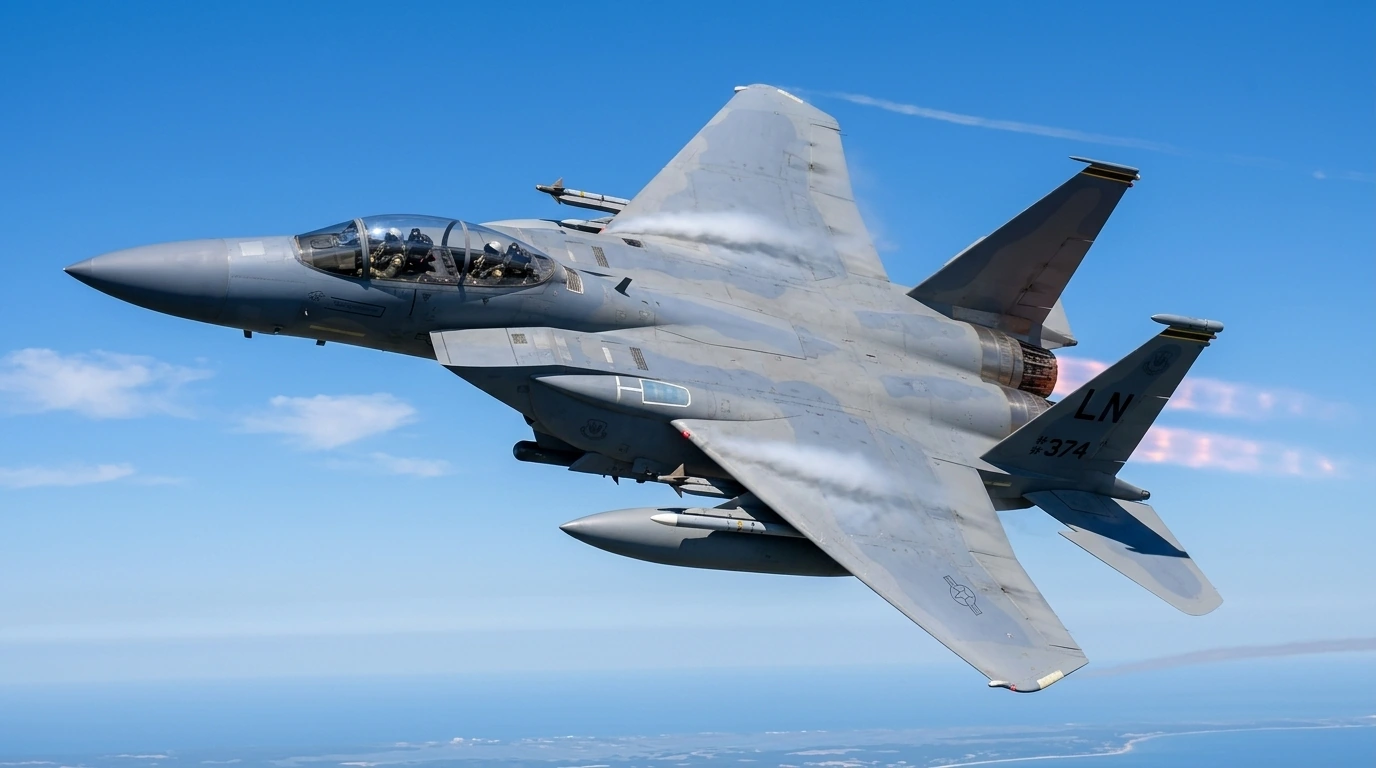
Two seats usually mean one thing in a fighter: training.
The F-15D Eagle breaks that assumption.
Built alongside the single-seat F-15C, the F-15D Eagle kept the core design that made the Eagle a dedicated air-superiority fighter. It had the same basic twin-engine layout, large wing and high-performance airframe, but added a second cockpit for another crew member.
That second seat wasn’t just for teaching new pilots.
The F-15D Eagle could still carry the Eagle’s air-to-air weapons and operate with the same basic combat systems. The U.S. Air Force introduced the F-15C and F-15D in 1979, and both received improvements that included more internal fuel and a higher maximum takeoff weight of 68,000 pounds.
So why build a two-seat version of an air-superiority fighter?
The answer goes beyond training. The extra cockpit gave the F-15D useful flexibility for instructor duties, operational missions, testing and research, while the aircraft retained the performance that defined the Eagle.
That’s what makes the F-15D Eagle interesting.
It wasn’t a trainer that borrowed the name of a fighter. It was a fighter designed with room for two.
What Is the F-15D Eagle?
The F-15D Eagle is best understood as a two-seat version of the F-15 air-superiority fighter, not as a trainer built from scratch.
That distinction matters.
The F-15C and F-15D Eagle entered service in 1979 as the next major production versions of the Eagle. The F-15D added a second cockpit, but it kept the basic fighter layout, including twin engines, the large wing and the systems needed for air-to-air combat. The U.S. Air Force lists both variants with a maximum takeoff weight of 68,000 pounds and Pratt & Whitney F100 engines.
The second seat was mainly there for training. New Eagle pilots could learn the aircraft with an instructor sitting behind them, rather than trying to master a complex fighter alone.
But calling the F-15D Eagle a trainer and stopping there misses the point.
The aircraft retained the basic performance and combat architecture of the single-seat Eagle. Depending on its configuration and operator, an F-15D could carry air-to-air weapons such as the AIM-7 Sparrow, AIM-9 Sidewinder, and later AIM-120 AMRAAM, along with the internal M61A1 20 mm cannon.
There is also a useful distinction between the F-15D Eagle and the F-15E Strike Eagle. Both have two seats, but they were designed for different jobs. The F-15E was developed as a dual-role fighter for air-to-air and air-to-ground missions, while the F-15D remained tied closely to the air-superiority Eagle family.
That makes the F-15D Eagle unusual.
The second cockpit changed how the aircraft could be used, but it didn’t erase what the aircraft was built to do.
It was still an Eagle first. The trainer role was an added advantage, not the whole identity.
F-15D Eagle Specifications and Design
The F-15D Eagle kept most of the Eagle’s performance despite adding a second cockpit. That is what makes its design interesting.
| Specification | F-15D Eagle |
| Crew | 2 |
| Length | 63.8 ft |
| Wingspan | 42.8 ft |
| Height | 18.5 ft |
| Max takeoff weight | 68,000 lb |
| Engines | 2 × Pratt & Whitney F100 |
| Maximum speed | About Mach 2.5 |
| Service ceiling | 65,000 ft |
| Cannon | M61A1 20 mm |
| Primary role | Air superiority and training |
The extra cockpit added weight, but the F-15D Eagle still used the same basic twin-engine airframe and the F100 engine family. The Air Force lists 23,450 pounds of thrust per engine for the C/D models and a maximum takeoff weight of 68,000 pounds.
The aircraft could also carry the Eagle’s air-to-air weapons. Depending on configuration and period, that included AIM-9 Sidewinders, AIM-7 Sparrows and AIM-120 AMRAAMs, plus the internal M61A1 cannon with 940 rounds.
One figure needs context: Mach 2.5 is a maximum-speed figure, not a normal combat cruising speed. Pilots rarely operate at that limit because fuel use, drag and mission needs matter more than simply reaching the top number.
The same goes for the 65,000-foot ceiling. It shows the aircraft’s performance envelope, not where every mission was flown.

What matters is how little the second cockpit changed the basic Eagle formula. The F-15D Eagle remained a large, powerful fighter with high thrust, low wing loading and the systems needed for air combat.
That’s why calling it a “trainer” based only on its second seat is misleading.
The numbers tell a better story: two crew members, but still a full-sized air-superiority Eagle.
Why Did the F-15D Eagle Need Two Seats?
The second cockpit made the F-15D Eagle much easier to train on without turning it into a lesser fighter.
The F-15 is a complex aircraft to learn. A pilot has to manage flight controls, radar information, weapons, communications and tactical decisions at the same time. Putting an instructor behind the pilot gives the training mission a second set of eyes without requiring a separate aircraft type.
That was the basic logic behind the F-15D Eagle.
The rear cockpit allowed instructors to observe training flights directly and intervene when needed. A new pilot could learn the Eagle’s systems while flying the actual aircraft, rather than trying to transfer skills from a simpler trainer.
And there was another benefit.
The second seat could support more than basic pilot instruction. It gave the aircraft room for an instructor, test personnel or another crew member during certain missions. NASA later used F-15D Eagle aircraft as research support and chase aircraft, where the rear cockpit could be occupied by someone focused on cameras and flight-test data rather than flying the aircraft.

The obvious question is whether the extra cockpit hurt performance.
A little extra weight is unavoidable. But the F-15D Eagle retained the same broad airframe and twin-engine layout as the F-15C. The difference was small enough that the aircraft remained a serious air-combat platform.
That’s the clever part.
The Air Force didn’t need to create a completely separate trainer with different handling characteristics. It could put an instructor inside an aircraft that behaved like the fighter pilots would eventually fly operationally.
For me, that’s the best reason to avoid calling the F-15D Eagle merely a trainer.
The second seat was a training tool. The aircraft underneath it was still an Eagle.
And when a fighter can teach pilots, support testing and still retain its air-combat architecture, the word “trainer” starts to feel far too narrow.
Could the F-15D Eagle Still Fight Like an F-15C?
Yes. The F-15D Eagle was still a combat-capable Eagle.
The second cockpit did not remove the systems that made the F-15C an air-superiority fighter. The F-15D retained the Eagle’s twin F100 engines, large wing and air-combat systems, while its weapons fit could include the AIM-7 Sparrow, AIM-9 Sidewinder and AIM-120 AMRAAM, along with the M61A1 20 mm cannon.
There is a catch, though.
Not every F-15D Eagle had exactly the same equipment. Aircraft differed by operator, production batch and later upgrade package. So saying every F-15D carried every weapon or radar version would be wrong.
The important point is the underlying design.
The F-15D Eagle could still generate the speed, climb performance and maneuverability expected from an Eagle. Its second cockpit added weight, but it didn’t fundamentally change the aircraft’s role.
One of the best examples came from Israel.

In 1983, an Israeli F-15D Eagle collided with an A-4 Skyhawk during a training exercise. The Eagle lost most of its right wing, yet the pilot managed to recover the aircraft and land it safely. The aircraft was later repaired and returned to service.
That’s an extreme case, not proof that every F-15D Eagle could shrug off major damage. But it does show something useful about the Eagle’s design and structural margin.
The F-15D Eagle was never intended to be a stripped-down training jet.
It could train pilots because it was a fighter first.
And that distinction matters when comparing it with purpose-built trainers. An instructor sitting behind a student doesn’t change the aircraft’s basic purpose. The same radar, engines and weapons architecture could still support operational missions when the aircraft was configured for them.
So the F-15D Eagle’s second seat was really an advantage.
It gave the Air Force a way to train crews inside a genuine air-superiority aircraft without creating a separate platform that handled differently. That made the F-15D Eagle far more useful than the word “trainer” suggests.
How Was the F-15D Eagle Used Beyond Pilot Training?
The F-15D Eagle’s second cockpit gave the aircraft a useful role beyond teaching new pilots.
That extra seat could carry an instructor, test crew member or mission specialist while the aircraft still retained the performance of an Eagle. This made the two-seat design useful when someone needed to watch, record or manage part of a flight without taking control away from the pilot.
NASA provides one of the clearest examples.
At Armstrong Flight Research Center, NASA has used F-15D Eagle aircraft as support and chase aircraft for flight-test programs. The rear-seat crew member can operate cameras and other equipment while the pilot concentrates on flying and maintaining position around the test aircraft. NASA also uses the F-15D for pilot proficiency work.
That’s a very different job from teaching a new Eagle pilot.
The aircraft has also found specialized uses with foreign operators. Israel operated F-15D Eagles, while Saudi Arabia also received two-seat F-15 variants. Japan’s F-15DJ is another interesting case. It is a Japanese-built two-seat derivative of the F-15 rather than simply an American F-15D transferred overseas.
The common thread is flexibility.

A second cockpit gives another person access to the aircraft’s sensors, communications or mission equipment while the front-seat pilot handles flight. For research work, that can be extremely useful. A camera operator doesn’t need to divide attention between filming and flying.
And that’s where the F-15D Eagle’s design makes more sense.
The aircraft wasn’t valuable because it had two seats. It was valuable because those two seats sat inside a high-performance Eagle.
For a test program, chase mission or advanced training flight, the Air Force could put another person in the aircraft without giving up the speed, altitude and handling that made the F-15 Eagle useful in the first place.
The rear cockpit wasn’t a compromise.
It was extra capacity.
Why Is the F-15D Eagle Disappearing From U.S. Service?
The F-15D Eagle is disappearing from U.S. service for a simple reason: age.
The aircraft was built around a design that dates back to the 1970s. Even with upgrades, many F-15C/D airframes have accumulated decades of flight hours. The Department of Defense has described parts of the fleet as having reached or exceeded their useful service lives, making them increasingly expensive to maintain in combat-ready condition.
That does not mean the Eagle suddenly became ineffective.
The F-15C/D remained a capable air-superiority platform, but newer fighters offered better technology and more room for future upgrades. The Air Force therefore chose to replace the legacy fleet rather than keep extending its service life indefinitely.
The replacement is the F-15EX Eagle II.

The F-15EX keeps the basic Eagle philosophy but adds modern avionics, electronic warfare systems, flight controls and a much larger weapons capacity. The Air Force describes it as a modernized derivative designed to recapitalize the F-15C/D fleet.
Kadena Air Base provides a clear example of the transition.
The U.S. Air Force is replacing its aging F-15C/D fleet there with F-15EX aircraft. In September 2026, the first F-15EX assigned to Kadena had already departed Boeing for further preparation, with permanent arrivals scheduled from fiscal year 2027.
The interesting part is that the F-15D’s basic concept has not disappeared.
The F-15EX is also a two-seat aircraft. The second cockpit remains useful for training, mission management and future operational roles.
What changed was the technology around it.
The original F-15D Eagle proved that a two-seat Eagle could be much more than a trainer. The F-15EX shows that the same idea still has value decades later, even as the original F-15D fleet reaches the end of its U.S. service life.
What Radar and Weapons Did the F-15D Eagle Use?
The F-15D Eagle’s combat value came from the systems it shared with the single-seat Eagle.
Its radar, weapons and fire-control architecture allowed the aircraft to perform air-to-air missions when properly configured. The exact equipment varied across production batches, operators and later upgrades, so there was never one universal F-15D configuration.
Early Eagles used the AN/APG-63 radar, which gave the pilot the ability to detect and track airborne targets beyond visual range. Later upgrades introduced improved versions of the radar and associated avionics, extending the useful life of many F-15C/D aircraft.
The weapon selection also reflected the F-15’s original air-superiority mission.
The Eagle could employ the AIM-7 Sparrow and AIM-9 Sidewinder, while later configurations added the AIM-120 AMRAAM. The aircraft also carried an internal M61A1 20 mm cannon, giving it an option for close-range engagements.
That combination mattered because the F-15D Eagle was not dependent on its second crew member to become useful.

The front-seat pilot could fly and fight the aircraft while the rear-seat pilot or instructor provided another set of eyes and hands. Depending on the mission, the second crew member could assist with navigation, communications, training or other cockpit tasks.
The F-15D Eagle also retained the Eagle’s large weapons capacity. External stations allowed the aircraft to carry air-to-air missiles and external fuel tanks, although the actual load depended on the mission and configuration.
There is an important distinction here.
The F-15D Eagle was not designed around the same air-to-ground mission as the F-15E Strike Eagle. The Strike Eagle introduced a dedicated dual-role concept, combining air-to-air capability with deep air-to-ground operations.
The F-15D followed a different path.
It kept the original Eagle’s air-superiority DNA while adding another cockpit.
That is why its legacy is more interesting than the label “trainer” suggests. The second seat changed how the aircraft could be used, but it never erased what the F-15D Eagle was built to do.
