

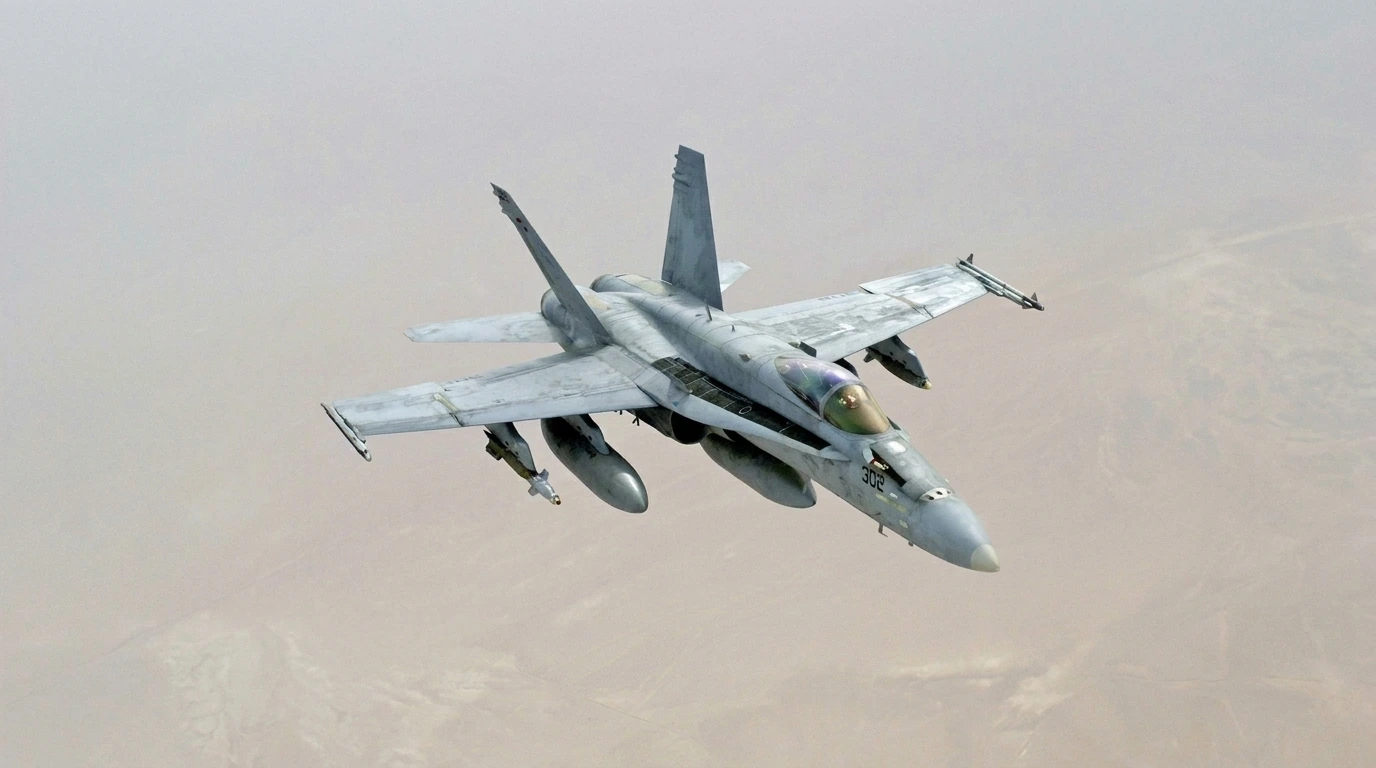
The F/A-18 Hornet should have been yesterday’s fighter by now.
Its first flight came in 1978. The U.S. Navy began receiving production Hornets in 1983. By fighter standards, that makes the original F/A-18 a very old machine.
Yet the Hornet refuses to disappear.
That tells you something.
The usual answer is that the F/A-18 Hornet was simply a great aircraft. True, but incomplete. Plenty of good fighters have had short careers. The Hornet lasted because its designers made a series of choices that still make sense decades later.
It was built to fight and attack from an aircraft carrier. It could switch between air-to-air and air-to-ground work without needing a different aircraft for each job. Its twin-engine layout gave it a useful safety margin over the sea, while its fly-by-wire controls helped make a relatively compact jet highly agile.
Then came something just as important: room to grow.
The original F/A-18A and two-seat B models were followed by the improved C and D variants. Avionics changed. Weapons changed. Mission systems changed. The basic airframe stayed useful long after the technology inside it had moved on.
Combat gave the design a harder test. During Operation Desert Storm in 1991, Hornet crews showed exactly why the multirole concept mattered. On one mission, a pair of F/A-18s attacked Iraqi ground targets and then engaged Iraqi MiG-21s. They did not need to abandon the strike mission because an enemy fighter appeared.
That kind of flexibility is the real Hornet story.
And there is a catch. The original F/A-18 is not a peer to a modern F-35 in stealth or sensor capability. The U.S. Navy retired its legacy Hornets in 2023, while the Marine Corps has been moving toward replacing its F/A-18C/D fleet.
So why talk about the F/A-18 Hornet today?
Because its long career shows something that specifications alone miss. A fighter does not need to be the newest aircraft in the hangar to remain useful. It needs a design that gives operators enough room to adapt.
The Hornet had that room.
How the F/A-18 Hornet Was Designed for Multirole Combat
The Hornet’s greatest strength was decided before it ever carried a weapon. The Navy wanted one aircraft that could handle both fighter and attack work from a carrier deck.
That sounds ordinary now.
It wasn’t in the late 1970s.
The F/A-18 grew out of the Northrop YF-17, a land-based fighter design that had lost the U.S. Air Force’s Lightweight Fighter competition to the YF-16. The Navy saw something useful in the YF-17, though. With major changes for carrier use, it could become the backbone of a new naval fighter and attack force.

McDonnell Douglas took the lead on the carrier version, working with Northrop. The result was not simply a YF-17 with stronger landing gear. The aircraft needed a structure tough enough for catapult launches and arrested landings, along with folding outer wings and other changes for life aboard a carrier.
That carrier requirement shaped the Hornet more than its sleek profile suggests.
A fighter operating from land can return to a long runway when things go wrong. A carrier pilot gets a much smaller moving target. The Hornet therefore had to be strong, predictable, and manageable at low speed. Its twin General Electric F404 engines also gave it a useful level of redundancy over open water.
But the smartest choice was the mission design.
The aircraft could carry air-to-air missiles for fighter work, then carry bombs and other stores for strike missions. The same basic jet could protect a carrier, attack ground targets, escort other aircraft, and perform reconnaissance-related missions with the right equipment.
That flexibility mattered because carrier space is brutally limited. Every aircraft takes up room, maintenance time, fuel, weapons, and people. A jet that can perform several jobs earns its place on the deck far more easily than a machine built around one narrow mission.
The name itself tells the story: F/A-18. Fighter and attack.
I think that’s where the Hornet’s reputation is often misunderstood. Its designers were not chasing the fastest possible naval fighter. They were building a useful aircraft that could do more than one job without becoming bad at all of them.
That trade worked.
The first production F/A-18A arrived in 1983, and the Navy and Marine Corps soon had a fighter that could replace several older aircraft roles. The Hornet would later prove that the most valuable feature of a combat aircraft isn’t always speed or size.
Sometimes it’s simply being useful when the plan changes.
What Made the F/A-18 Hornet So Capable?
The F/A-18 Hornet was never the fastest fighter in the room. Its advantage came from how well its parts worked together.
Start with the engines. The original Hornet used two General Electric F404 turbofans, each producing roughly 16,000 pounds of thrust with afterburner. That gave the aircraft enough power to reach about Mach 1.7 while carrying the equipment needed for carrier operations.

But raw thrust wasn’t the clever part.
The Hornet’s flight controls were. Its fly-by-wire system replaced much of the direct mechanical connection between pilot and control surfaces with electronic commands. That let engineers build an aircraft that could be highly maneuverable without making it unpleasant to control.
The result was a jet that could turn hard, handle high angles of attack, and still give the pilot predictable control.
That mattered in air combat, but it mattered around the carrier too.
A Hornet also had to survive the less glamorous parts of military aviation. Its landing gear, arresting hook, structure, and systems had to tolerate repeated carrier launches and arrested recoveries. A fighter that looks impressive in a clean-air demonstration is useless if its maintenance burden keeps it parked.
The Hornet’s size helped here. It was compact enough for carrier operations, yet had seven external weapon stations on the original A model and a built-in M61A1 20mm cannon. Its stores could include AIM-7 Sparrow and AIM-9 Sidewinder missiles, along with bombs and air-to-ground weapons.
| Feature | F/A-18A/C Hornet |
| Engines | 2 × General Electric F404 |
| Maximum speed | About Mach 1.7 |
| Cannon | M61A1 20mm |
| Crew | 1 in A/C, 2 in B/D |
| Primary roles | Air-to-air and air-to-ground |
| Carrier capable | Yes |
One common mistake is judging the Hornet by speed alone. That misses the job it was designed to perform.
A Mach 2 fighter can be impressive on paper. But if it cannot carry a useful strike load, operate safely from a carrier, or switch missions when the situation changes, that speed has limited value.
The Hornet made a different trade.
It accepted less top-end speed in exchange for agility, weapons flexibility, carrier suitability, and a design that could be upgraded. That’s why the aircraft remained useful even as radar, missiles, and combat tactics changed around it.

And there’s another detail worth remembering: the Hornet was designed with twin engines from the start. Over a carrier, that isn’t just a performance choice. Losing one engine does not automatically mean losing the aircraft.
Not glamorous. Very practical.
That practical streak runs through the entire design, and it helps explain why the F/A-18 Hornet became such a long-lived fighter.
How the F/A-18 Hornet Proved Itself in Combat
The Hornet earned its reputation in combat by doing something surprisingly hard: staying useful when the mission suddenly changed.
Operation Desert Storm in 1991 provides the clearest example. The F/A-18 was already a proven fleet aircraft, but the Gulf War put its fighter and attack roles under intense pressure.
On January 17, 1991, two Navy F/A-18s from USS Saratoga launched for a strike mission against Iraqi targets. Their job was to attack ground positions, not hunt enemy fighters.
Then Iraqi MiGs appeared.
The Hornet crews did not have to wait for another aircraft to deal with the threat. They engaged the Iraqi fighters and shot down two MiG-21s before continuing with the strike mission.
That episode became one of the Hornet’s defining combat stories because it demonstrated the logic behind the aircraft’s name. It wasn’t a fighter that could carry bombs as a side job. It was designed from the start to switch between air combat and attack work.
And Desert Storm wasn’t the end of the test.

Hornets went on to fly combat missions over Bosnia and Kosovo during the 1990s. They later operated over Afghanistan and Iraq, where the demands were often different from the high-intensity air war against Iraq in 1991.
That difference matters.
In the Gulf War, the threat included Iraqi fighters, surface-to-air missiles, and heavily defended targets. In later operations, strike aircraft often spent more time supporting ground forces and hitting targets in a very different threat environment.
The Hornet’s usefulness came from being able to handle both.
Its combat record also exposed a common misconception about multirole fighters. Being multirole doesn’t mean every version performs every mission equally well. A loaded Hornet carrying strike weapons behaves differently from a lightly loaded aircraft configured for air combat.
The advantage is flexibility, not magic.
I like the Desert Storm example because it cuts through years of marketing language. You can argue about which fighter has the better radar or missile load, but a real mission leaves less room for theory.
The Hornet was sent to attack ground targets.
Enemy fighters showed up.
It adapted.
That ability became one of the aircraft’s most valuable traits, especially for naval aviation, where the same carrier air wing has to cover a wide range of missions with a finite number of aircraft.
The Hornet didn’t need to be the best fighter at everything. It needed to be good enough at several critical jobs, and reliable enough to keep doing them.
Combat showed that the formula worked.
Why Did the F/A-18 Hornet Become So Long-Lived?
Combat proved the Hornet could fight. Maintenance and upgrades explain why it could keep fighting.
That’s the part of the story that gets less attention.
A fighter can have excellent performance and still become a headache after twenty years. New radar technology arrives. Weapons change. Computers become outdated. Parts get harder to find. Airframes accumulate fatigue.
The F/A-18 avoided some of that trap because its basic design left room for change.
The C and D models were already a major step beyond the original A and B aircraft. Improved avionics, radar, electronic warfare equipment, and weapons gave the later Hornets capabilities that the first production aircraft simply didn’t have.

The upgrades kept coming.
This matters because military aircraft don’t age like cars. You can’t simply replace the whole thing every time a new sensor becomes available. A fighter fleet represents years of training, spare parts, maintenance equipment, shipboard procedures, and pilot experience.
Keeping the airframe while changing the systems can make economic and operational sense.
The Hornet also benefited from being relatively compact and mechanically familiar to its operators. Carrier crews knew how to maintain it. Pilots knew its handling. Weapons crews knew how to load it. Entire support systems had been built around the aircraft.
That creates momentum.
A newer fighter might be better in almost every technical category, but replacing an established fleet involves much more than buying new jets. Training pipelines, simulators, hangar equipment, spare parts, tactics, and carrier integration all have to change.
The Hornet’s long service therefore wasn’t simply a vote for an old airframe.
It was partly a vote for everything built around that airframe.
There’s a useful lesson here. People often ask why the F/A-18 Hornet wasn’t retired as soon as the F-35 appeared. The answer is that aircraft fleets don’t switch overnight. The F-35 brings major advantages, especially in stealth and sensor fusion, but getting a new aircraft into squadrons takes years.
And the Hornet could keep flying during that transition.
Its twin-engine layout, carrier-hardened structure, multirole capability, and upgrade path bought operators time. Not unlimited time, but enough to make the transition manageable.
The downside eventually became unavoidable. Metal fatigue doesn’t care how good an aircraft’s software is.
By the 2020s, some legacy Hornets had spent decades landing on carriers and operating in harsh conditions. At that point, maintaining the oldest airframes became a different problem from upgrading their avionics.
The design had aged well.
The metal still aged.
That’s why the Hornet’s longevity is best understood as a combination of smart design, continuous upgrades, established logistics, and sheer operational usefulness. It wasn’t immortal. It was adaptable enough to make retirement difficult to justify for a very long time.
F/A-18 Hornet vs. Super Hornet: What Changed?
Calling the Super Hornet an upgraded F/A-18 Hornet misses the biggest part of the story.
The F/A-18E/F Super Hornet is a much larger redesign built around the same basic idea: a carrier-based aircraft that can handle both fighter and strike missions.
Read also: F-18 Hornet vs Super Hornet: What’s the Difference?
The difference becomes obvious when you look at the size of the two aircraft. The Super Hornet has about 25 percent more wing area and roughly 50 percent more internal fuel than the legacy Hornet. It also uses two General Electric F414 engines instead of the F404s found on the original aircraft.
That extra size bought something the Navy badly needed: more range and payload.
| Feature | F/A-18 Hornet | F/A-18E/F Super Hornet |
| Main variants | A/B/C/D | E/F |
| Engines | 2 × F404 | 2 × F414 |
| Crew | 1 or 2 | 1 or 2 |
| Airframe size | Smaller | About 25% larger wing area |
| Internal fuel | Lower | About 50% greater |
| Carrier role | Legacy carrier fighter/attack | Modern carrier multirole fighter |
| AESA radar | Not originally fitted | Available on later versions |
| Status in U.S. Navy | Retired | Still in service |
The Super Hornet also brought a reduced radar signature compared with the legacy design, along with newer avionics and room for further upgrades. Later aircraft received systems such as the AN/APG-79 active electronically scanned array radar.
But here’s the interesting part.
The Navy didn’t throw away the Hornet’s basic operating philosophy. The Super Hornet still had to fit carrier decks, launch from catapults, recover with an arresting hook, carry a wide range of weapons, and perform both air-to-air and strike missions.
So the Hornet’s influence is easier to see as a design family than as one unchanged aircraft.
Think of it this way: the original F/A-18 proved that a compact carrier multirole fighter could work. The Super Hornet took that concept and gave it a bigger airframe, more fuel, more payload, and far more room for modern systems.
That distinction also clears up another common mistake in online discussions. When someone says, “The F/A-18 is still one of the Navy’s main fighters,” they may actually be talking about the Super Hornet.
They’re related.
They’re not the same jet.
And the distinction matters because the legacy F/A-18C/D is now nearing the end of its U.S. military career, while the F/A-18E/F continues to serve aboard American aircraft carriers.
The name survived because the concept worked.
The airframe had to change because the threat did.
Where Does the F/A-18 Hornet Still Serve Today?
Here’s the part that needs a clean distinction: the F/A-18 Hornet still flies, but the U.S. Navy no longer operates the original C/D fleet.
The Navy retired its last legacy F/A-18C and D Hornets in 2023. That ended the aircraft’s long run as a Navy carrier fighter. The Super Hornet, the much larger F/A-18E/F, remains a different story.
The U.S. Marine Corps has kept the older Hornet alive longer.
Marine F/A-18C and D aircraft have continued serving as the Corps transitions toward the F-35B and F-35C. That transition takes time because the Hornet is tied to real squadrons, pilots, maintainers, weapons crews, and deployment plans.

The Marine Corps has planned to finish retiring its legacy Hornet fleet around FY2030.
That date matters because it changes how we should talk about the aircraft. Calling the F/A-18 Hornet a current U.S. Navy frontline fighter is wrong. Calling it irrelevant is also wrong.
The aircraft still has an operational footprint.
Outside the United States, the story is broader. Canada, Australia, Finland, Spain, Kuwait, Switzerland, and Malaysia have all operated Hornet variants, although their fleets are at very different points in their service lives. Some have retired their aircraft, while others have used upgrades or replacement programs to extend or end their Hornet careers.
Australia is a useful example of the transition problem. The Royal Australian Air Force operated the F/A-18A/B for decades before replacing the type with the F-35A. Canada, meanwhile, has continued operating its CF-18 fleet while working toward a longer-term replacement.
So the Hornet’s present-day relevance isn’t about one giant fleet still dominating the skies.
It’s about the aircraft’s unusually long tail.
A fighter introduced in the 1980s is still part of military aviation discussions because operators squeezed decades of value from the design. Some airframes have reached ages that would have seemed extraordinary when the Hornet first entered service.
And that’s where the “old fighter” argument falls apart.
Age matters. Airframe fatigue matters even more. But an aircraft can remain useful when its mission systems, weapons, support network, and operators keep pace.
The original Hornet is now approaching the end of that road in U.S. service.
Its influence isn’t.
The smarter question isn’t whether the F/A-18 Hornet can beat a fifth-generation fighter today. It’s why a 1970s design remained useful long enough to overlap with one.
