

Introduction
When the U.S. Army transitioned to Brigade Combat Team modularity during the Global War on Terror, it divested more than Cold War lineages and nostalgic memories. It reorganized previously echeloned capabilities designed to fight for information, disrupt enemy systems, and enable higher tactical headquarters to maneuver with confidence across operational depth. In the decades that followed, technological advances in battlefield transparency, precision fires at range, and unmanned systems have outpaced the evolution of force design and operational capabilities. The result is a widening gap in the landpower institution’s ability to empower combined-arms and joint-force success amid the volatility of a rapidly changing strategic environment.
The purpose of this article is to drive the dialogue and further develop how leaders think, fight, and organize for all arms maneuver against rapidly modernizing adversaries. Maneuver is not dead. The need for Armor and armored formations is not dead. When our Nation commits to the concerted execution of violence to take phase lines away from the enemy and hold them, mobile protected firepower is the required capability. Combined arms maneuver must evolve to be executed across all domains, and armor must evolve to be more deployable, more capable, and more connected to conduct armored strike as part of the joint force’s all-domain envelopment.
Armored Strike Brigade Concept
Today’s battlefields are defined by ubiquitous sensing, long‑range fires, and fortified defenses in ways that can inflict heavy attrition on tactical formations. Across Eastern Europe, the Middle East, and East Asia, adversary advances with unmanned systems, electronic warfare, and stand-off fires have increasingly collapsed the distinction between reconnaissance and strike. In this environment, success does not belong to the force that merely mass effects, but to the formation that best applies nuanced systems thinking and employs human-machine teaming to integrate data-informed targeting, artificial intelligence-driven decision-making, and all-domain attack at speed. To meet this challenge, the Army requires a purpose‑built formation for a new era of warfare: the Armored Strike Brigade.
A Revolutionary Formation
The Armored Strike Brigade (ASB) concept is not a circuitous return to the Armored Cavalry Regiment of the past, nor a rebranded Armored Brigade Combat Team with drone augmentation. It is a revolutionary, UAS‑centered, high-tempo, combined‑arms formation that is optimized to fight through adversary recon‑strike networks, enable division and corps maneuver, and provide credible strategic deterrence through maximum joint force readiness. By design, concept and function, it employs AI-driven mission command and robotic enhancement to integrate armored mobility, unmanned systems, long‑range fires, bridging capacity, mobile protection, and cross‑domain effects designed to enable echeloned commander decision-making in persistent multi-forms of contact and prevail in large-scale combat. In this era of competition, we must never allow adversaries to believe they can deny our ability to maneuver and seize terrain.
The ASB is a revolutionary, UAS‑centered, high-tempo, combined‑arms formation that is optimized to fight.
The Armored Strike Brigade provides flexible response options through multidomain capability in support of joint operational approaches. When directed, the Joint Force generates military options which may require the execution of joint forcible entry to achieve national strategic objectives. The joint force commander synchronizes operational preparation of the environment and establishes the battlefield framework as part of the conditions setting. Special operations, airborne, and infantry-centric organizations may serve as the rapidly-deployable and flexibly responsive options for our land force but provide capabilities that are generally limited in their scope and duration of mission.
Providing Optionality for the Joint Force
The Joint Force Commander establishes the minimum forces and conditions required for employment of forces, whether a surgical raid by special operations forces, a vertical envelopment by air drop or long-range air assault by a Mobile Brigade Combat Team, the contemporary operating environment is contested across domains and no one service nor capability achieves all objectives. By definition the raid does not seize and hold terrain—it is decisive and temporary. An MBCT or SBCT similarly provide ground force combat power that can move rapidly and decisively to seize key terrain or destroy enemy forces, but then often require follow on force and capability to ensure operational endurance and continued success.
Dependent upon the permissiveness of the environment, Stryker Brigade Combat Teams (SBCT) and other lighter forces can also conduct rapid movement and deliver decisive capability but lack the protection and firepower to hold ground—especially in a contested air environment. Joint force and Army commanders consequently need a force that is deployable, survivable, and lethal enough to create conditions for success.
In an operating environment where creating convergence is pulsed and temporary, the Armored Strike Brigade concept provides an increasingly required capability that can move rapidly, provide protected firepower, and move the forward line of troops through a unique combination of all domain fires and maneuver. To preserve the decisiveness of MBCT and SBCT employment, the ASB is optimized to serve as the leading element of an army division or corps that is mobile, lethal, and survivable enough to connect the ground line of communication to the decisive employment of lighter forces while ensuring that enemy terrain is seized and held under advantageous terms.
Recon Strike Warfare
Modern warfare is increasingly characterized by arrayed fires that are reducing the potential maneuver to achieve decisive outcomes. As revealed in U.S. Army combat training center rotations, unit warfighter programs, and higher echelon experimentation, persistent surveillance from unmanned aerial systems, commercial sensors, and space‑based platforms compresses time and space, rendering concealment temporary and concentration hazardous. In this environment, traditional reconnaissance and security methods—focused on stealth, indirect fires, and episodic reporting—are insufficient. Reconnaissance must lead with robotic engagement and aggressively employ mobile, protected firepower to continuously synchronize a storm of drone, indirect, and aerial fires to rapidly penetrate and exploit fleeting opportunities. Critically, recon-strike formations must include organic capacity to execute seamless gap-crossing to maintain tempo.
The Armored Strike Brigade is organized to conduct continuous counter reconnaissance with the ability to strike and break through enemy forces and defenses rapidly when able.
The Armored Strike Brigade is organized around this reality and the requirement to conduct continuous counter reconnaissance, synchronized and cuing reconnaissance, with the ability to strike and break through enemy forces and defenses rapidly when able. Rather than treating drones as auxiliary enablers, the brigade centers unmanned and robotic systems as its primary means of making initial contact to see and shape the battlefield. Tactical and operational‑level UAS provide invasive coverage across depth, employing AI-driven planning and execution to provide real‑time targeting data to brigade, division, and joint fires networks. Armed UAS and organic rocket fires collapse the sensor‑to‑shooter timeline, allowing reconnaissance elements to accurately synthesize converging data feeds that impose immediate costs on exposed enemy nodes, linkages and systems while informing decisive maneuver for follow-on forces.
A Force Tailored for the Transparent Battlefield
This recon‑strike integration is essential not only for offense, but for survival across fires-saturated battlefields that increasingly threaten to become impassable no-man’s lands where human maneuver is prohibitively expensive and credible deception is difficult to achieve. By employing algorithmically-informed systems thinking to detect enemy sensors, electronic emitters, and strike forces early enough to proactively shape conditions, the ASB employs human-machine integration at depth to disrupt adversary targeting cycles and neutralizes enemy reconnaissance before they can achieve effects. In doing so, its mechanized scouts orchestrate a phalanx of joint fires to enable higher echelon freedom of action while fighting under mobile, organic air defense shield to avoid debilitating attrition.
Optimizing for Future Combat
Our most recent Army doctrine orients the Army corps as the senior tactical formation designed to defeat the enemy through sustained combat operations, employ joint capabilities, and maneuver divisions. The corps orchestrates operations across the operational framework and is the best positioned and resourced element to achieve convergence by integrating capabilities from multiple domains against multiple decisive points. As the corps’ primary maneuver force, the Army division conducts deep, close, and rear operations, masses effects at decisive points, and maneuvers brigades. All of the Army’s Armored Brigade Combat Teams are currently uniformly manned, trained, and equipped to enable divisions to, as required by Army doctrine, “seize and retain key terrain, exert constant pressure, and break the enemy’s will to fight.”
An All-Domain Capable Force
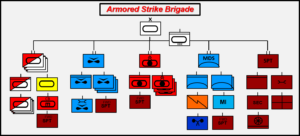
Observations from warfighter exercises and unit experimentation demonstrates that corps and division commanders often use task organization changes to build a reconnaissance and security force, with associated fires and intelligence collection support, to lead operational maneuver. The Armored Strike Brigade is the answer to the capability that is routinely built and fought in exercises, but never trained in real person or time. The ASB operates within current armored and mechanized divisions. It provides an agile, rapidly deployable force that makes contact and drives all-domain maneuver.
The UAS squadron anchors the Armored Strike Brigade and delivers precision strikes across the enemy’s networked systems. It sets conditions for combined-arms maneuver. A synchronized swarm of unmanned fixed-wing and unmanned rotary‑wing assets conduct armed reconnaissance, deep attack, and pervasive surveillance as attacking armored teams direct rocket and joint fires against vulnerable targets. Unmanned systems enable vertical maneuver and multi-axis reconnaissance across complex terrain. They accelerate AI-driven sensor-shooter cycles among forward scouts, drone operators, fires batteries, and joint platforms. This faster reconnaissance tempo maximizes effects against critical nodes in the adversary’s command-and-control system.
Reimagined Squadrons
Redesigned armored cavalry squadrons provide the maneuver capability for enabling and exploiting UAS recon-strike. ASBs are optimized for dispersed operations with critical gap-crossing capabilities under a mobile headquarters featuring next-generation mission command technologies. Each squadron integrates robotic scouts, mechanized scouts, mounted mortars, bridging engineers, and supporting heavy armor to conduct hunter‑killer reconnaissance with aligned UAS and rocket elements across extended frontage and depth. These squadrons operate independently to enable continuous degradation of enemy networks.
These reimagined squadrons do not replicate conventional cavalry. They enable transformation by integrating AI-informed targeting, autonomous fighting vehicles, and next-generation air defenses. The squadrons command and control key protection, communications, and sustainment assets that enable commanders to maneuver networks and layered defenses. They also decentralize commodities within a meshed, connected combined-arms organization that disrupts enemy intelligence collection and target acquisition.
These reimagined squadrons do not replicate conventional cavalry. They enable transformation by integrating AI-informed targeting, autonomous fighting vehicles, and next-generation air defenses.
Building on recent advances, the ASB’s attack capabilities at echelon to enable faster, more synchronized all-domain integration. Armored scouts follow a robotic advance guard, supported by tactical UAS teams, FSOs, and JTACs. The brigade controls long-endurance aerial platforms that provide extended loiter and deep sensing for division and corps objectives. Networked surveillance systems feed AI-enabled targeting cycles to identify high‑value targets to degrade enemy sensors, air defenses, and command nodes. Within a combined-arms formation, advanced sensor-shooter integration allows ASBs to synchronize lethal and nonlethal effects across tactical and operational levels.
A Multi-Domain Armored Force
The Armored Strike Brigade also includes an organic mobile rocket battalion. This unit is tailored to compliment pervasive UAS effects and facilitate all-weather recon-strike tempo across division and corps deep areas. This battalion integrates long‑range rockets with joint fires, organic drones and electronic warfare systems under a unified fires architecture capable of massing or distributing effects. AI-enabled targeting systems synchronize these capabilities with joint fires. The ASB then wins near-deep fights while operating semi-independently for extended periods. Moving beyond traditional covering and advance-guard missions, the ASB uses data integration to unleash a maelstrom of fires. These fires rupture adversary defenses and create opportunities for exploitation.
Enablers Fit for Purpose
A tailored sustainment squadron supports this modernized fire-and-maneuver construct by projecting durable, versatile, adaptive materiel support along forward axes. A similar approach to the sustainment elements that enabled Division Cavalry Squadrons to operate in the 1980s and 1990s. This squadron sustains continuous reconnaissance-strike operations and uses data-centric forecasting to enhance endurance, accelerate tempo, and extend operational reach. The squadron would also pilot emerging logistics technologies, including AI-informed sustainment planning, unmanned supply delivery, and autonomous area security systems.
Finally, the ASB’s Multi-Domain Squadron integrates protection, intelligence, electronic warfare, cyber, and space‑enabled capabilities to enable survivable maneuver. This unique organization allows the brigade to contest adversary sensing and communications while protecting its own networks. AI-synchronized air defense companies allow mechanized scouts and multifaceted fires teams to advance confidently into the adversary security zone. These companies provide a versatile, organic shield while leveraging cyber and space capabilities to deliver precision effects. The modern battlefield’s increasing lethality makes integrated, mobile air defenses essential to the ASB’s tempo and survivability.
Historical Contexts
The Armored Strike Brigade fills critical capability gaps created when the Army reorganized its late-Cold War formations. It transforms operational-level cavalry’s traditional role by fighting across extended depth to enable decisive main-body maneuver. Since the American Civil War, higher-echelon cavalry formations have shaped conditions for divisions, corps, and field armies to maneuver effectively. They have not typically seized decisive terrain themselves. This role remains essential in 21st century warfare if properly reimagined in a recon-strike methodology. Particularly in contested environments saturated with sense-strike networks that demand accelerated decision cycles.
During World War II, U.S. Army Mechanized Cavalry Groups (MCGs) exemplified the value of higher echelon cavalry in enabling large-scale maneuver during offensive operations. The 3rd, 4th, and 6th MCGs operated forward of main bodies during the advance from France into Germany. MCGs conducted aggressive reconnaissance, counter-reconnaissance, flank screens, and exploited gaps between enemy formations. Cavalry groups worked with the Army Air Corps to identify enemy dispositions, fix opposing forces, and dislocate German defenses. Their actions allowed attacking divisions to avoid costly frontal assaults.
Fighting for Information, Tempo, & Opportunity
Mechanized Cavalry Groups did not typically fight large-scale, decisive engagements; they fought for information, tempo, and opportunity. They combined premium mobility, organic firepower, responsive air support, and ready artillery fires. Ultimately, they enabled supported corps to advance during the Allied drive across France and into the heart of Germany. Their ability to operate semi-independently, integrate air reconnaissance and fires, and exploit operational depth made them indispensable to the U.S. Army’s historic campaign. They disrupted the enemy order of battle. They also reduced uncertainty and friction, allowing assault forces to concentrate and fight efficiently.
The Armored Strike Brigade, arrives to perform the same timeless function with revolutionized capabilities.
The Armored Strike Brigade, arrives to perform the same timeless function with revolutionized capabilities. It provides a similar, though much more lethal and offensive-oriented, capability for twenty-first-century operations. MCGs once leveraged air support and pooled corps artillery to suppress enemy defenses and enable gap-crossing operations. Modern ASBs integrate UAS, indirect fires, and joint fires to shape the maneuver space for attacking or defending forces. The ASB fights forward to disrupt enemy drone networks, suppress standoff fires, and expose command-and-control nodes. The ASB recreates the operational-level cavalry role in an evolved recon-strike context that enables senior commander decision-making at echelon.
Enabling All Domain Warfare
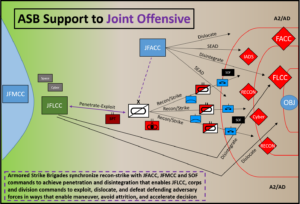
The Armored Strike Brigade provides combatant commands with enhanced capacity to sequence windows of superiority across all domains. The brigade’s organic integration with joint and multinational targeting networks bridges Army ‘deep fight’ methodologies to more expansive joint horizons. This integration enables the execution of accelerated operational approaches in ways that avoid paralyzing attrition and preserve optionality. The ASB’s recon-strike profile offer a unique covering force to enable combatant command readiness. Combinations of light, medium and heavy armor ensures expeditionary potential and the Army’s singular armored contributions to the joint force. Residing in the Army mechanized or armored division enables commonality of sustainment. These habitual relationships and training standards preserves its intended core function of enabling the main body to succeed.
This joint integration remains central to making the Armored Strike Brigade. The ASB is a modernization asset that moves beyond legacy reconnaissance and security mentalities and into more aggressive recon-strike approaches. Armored warfare leaders apply expanded vision and systems thinking to synchronize the ASB with air and maritime components. Leaders can seamlessly integrate data from service and coalition partners. This integration provides targeting data, protects joint bases, and facilitates cross-domain convergence across continental and archipelagic environments. Its persistent and survivable posture also allows joint force commanders to signal resolve while preserving credible combat capability.
Flexible for the Global Fight
The ASB would hold obvious value for strengthening NATO warfighting potency against potential Russian aggression in Europe. Its unique construct would prove critical in the Indo-Pacific theater where Chinese and North Korean forces continue to threaten instability. The brigade’s enhanced networks, long-range drone and rocket fires, and organic capacity to distribute postures and concentrate effects would allow it to unleash sea denial in ways that would dramatically increase joint force sea control. This is far cry from cumbersome ABCTs that stress force projection. The reconnaissance-centric ASB would provide modular versatility to deploy lighter platforms with sensors and fires tied to dominating magazine depth.
Forward‑postured ASBs would consequently contribute directly to combatant command ability to deter adversaries and assure allies in threatened regions. Regionally assigned brigades would develop tailored expertise, enduring partnerships, and habitual joint relationships. This alignment will increase coalition readiness, compliment partner strengths, and mitigate potential vulnerabilities. Their visible readiness and combat credibility, signaling concrete commitment to maintain American national interests in contested zones. ASBs would impose structural costs on potential adversaries by complicating enemy planning and reducing opportunities for sudden fait accompli actions.
The Future is Armored Strike
The Armored Strike Brigade addresses a central operational challenge: defeating adversary standoff fires and drone-enabled reconnaissance networks. These systems seek to deny U.S. forces freedom of maneuver before decisive combat begins. Across the globe, potential adversaries invested heavily in layered sensing, long-range precision fires, and unmanned systems. Systems designed to degrade and disrupt friendly forces at range and impose systemic paralysis. The ASB leverages emerging technologies to revolutionize mission command, robotic first contact, and targeting at echelon. The ASB provides a purpose-built formation designed to disintegrate recon-strike networks and disrupt enemy systems.

For Army divisions, corps and JTFs, the ASB serves as a critical reconnaissance and strike organization. ASBs ensure operational depth, accelerates fighting tempo, and preserves formation cohesion. By operating persistently across extended frontage, the brigade degrades enemy drone networks, fixes and exposes fires systems. These actions force adversaries to risk command-and-control nodes. This enables commands to apply systems thinking to defeat enemy networks, synchronize operations, and maneuver with confidence. Standoff fires does not have to be an immutable condition of the modern battlefield. The ASB enables offensive operations with full robotic and algorithmic integration. This capabilities will collapse the adversary’s system of systems through integrated fire and maneuver a protected and sustained support architecture.
New Leaders for New Formations
The Armored Strike Brigade consequently requires a new kind of technologically empowered leader. It requires an all arms expert who understands how to maneuver capabilities across domains and integrate joint capabilities. These leaders fight from forward, dispersed command posts with AI-enabled synchronization. They understand that all-arms maneuver requires massing effects without massing capabilities while operating within an accelerated, machine-enabled, decision-advantaged environment. Robotics and artificial intelligence enhance the human leader. However, it will never replace their ability to assess situations, use critical thinking and intuition, solve problems, and drive solutions.
Looking forward to a new era of warfare, the modernized Armored Strike Brigade empowers higher commands to unleash cross-domain destruction in contested theaters where the U.S. military must avoid debilitating attrition while inflicting unsustainable losses against implacable adversaries. Mechanized scouts orchestrate robots, drones, rockets, and joint fires to disrupt the enemy during large-scale combat’s opening hours. The brigade suppresses enemy air defenses, protects key terrain, and creates temporal superiority for air and maritime forces. Competition will likely intensify as the character of warfare evolves. The ASB could ensure that American landpower remains prepared to fight, and ultimately win, in the crucible of combat.
