

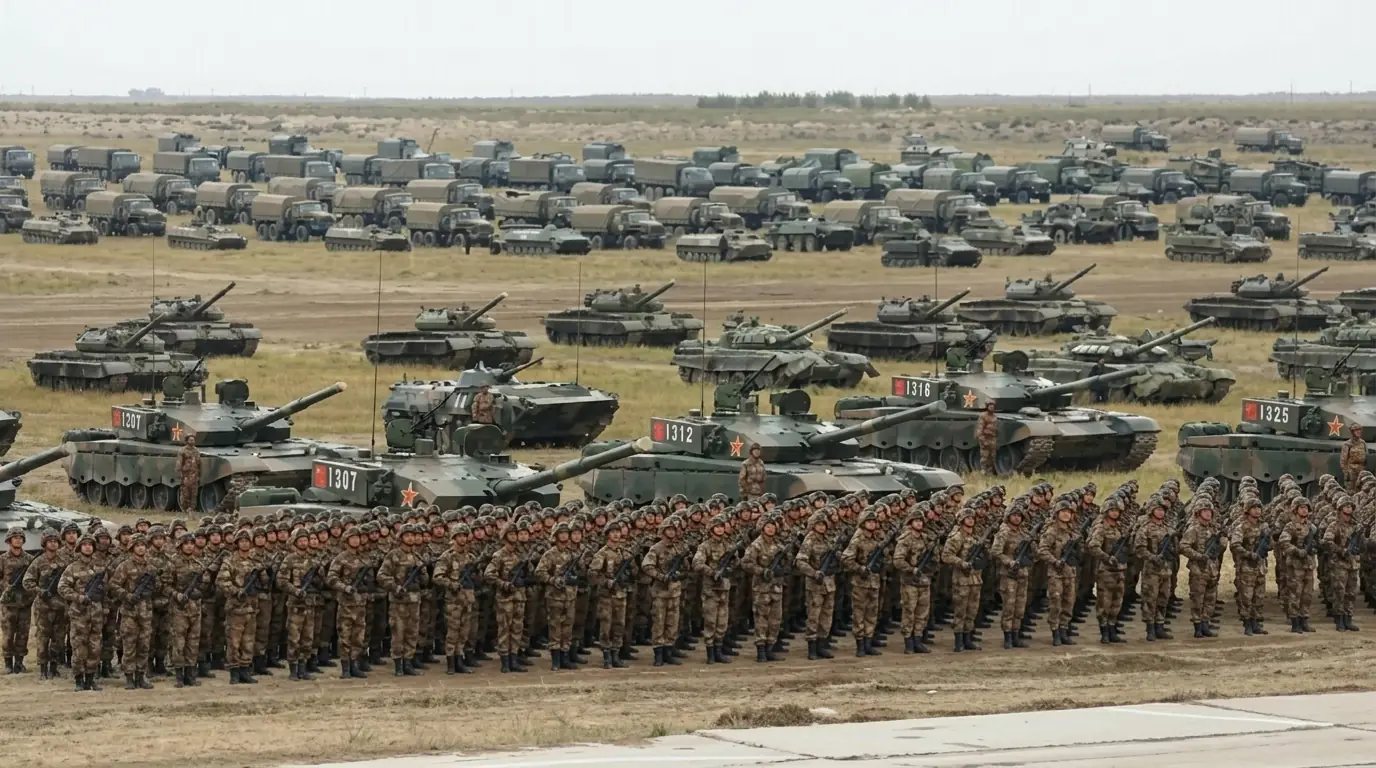
If you lined up the world’s biggest active military forces by headcount, the gap at the top is striking. China has more than two million active personnel, while the other four countries each maintain forces of roughly 1.3–1.4 million. These numbers make the top five a particularly interesting group: some rely on huge population pools, others on conscription, and others on a globally deployed professional force.
For this ranking, the key measurement is active military personnel, people considered to be serving in active status and available for military duties. Global Firepower’s 2026 data places China first with about 2,035,000 active personnel, followed by India, the United States, Russia, and North Korea.
The figures are estimates, not a perfectly precise headcount. That matters because countries do not all publish military personnel data in the same way or on the same schedule. In some cases, analysts must estimate force levels from available public information.
There is also an important wrinkle: the largest army is not automatically the strongest military. Global Firepower’s separate 2026 military-strength ranking, for example, puts the United States first, Russia second, China third, and India fourth after considering more than 60 factors beyond manpower.
So, think of the table above as a headcount rather than a scoreboard of who would “win.” It tells us who maintains the biggest active forces, not who has the most advanced weapons, best logistics, or greatest global reach. Those are very different questions, and they become especially clear when we look at each country individually.
How Are the Largest Armies in the World Ranked?
A military ranking can look wonderfully precise, 2,035,000 here, 1,431,000 there, but don’t let the extra zeroes fool you. Military personnel figures are estimates, not a universal live headcount. The first question to ask is much simpler: What exactly is being counted?
For this article, the ranking uses active military personnel as the primary measurement. These are people currently serving in the armed forces rather than those who are simply available for mobilization. Using one consistent category makes comparisons between the largest armies in the world much more meaningful.
The distinction becomes important when reserve and paramilitary forces enter the picture.
| Personnel category | What it generally means |
| Active personnel | Military members currently serving on active duty |
| Reserve personnel | Trained personnel who can potentially be called into service |
| Paramilitary forces | Organizations with military-style roles that may sit outside regular armed forces |
| Total military manpower | A broader figure that may combine several categories |
Imagine comparing two football teams. One reports only the players currently on the field, while another adds everyone sitting on the bench and former players who could return. Both numbers might be accurate, but they answer different questions.
The same problem appears in military statistics. Some countries publish relatively detailed personnel information, while others provide limited or outdated figures. Researchers may therefore rely on official documents, defense assessments, government statements, or analytical estimates.
That is why rankings can shift slightly from one source to another. Differences in reporting dates, definitions, and estimation methods can move countries up or down by a position, particularly when their personnel totals are close.
Read also: Top 5 Largest Air Forces in the World Ranked by Fleet Size
For a 2026 ranking, the safest approach is to state the methodology clearly, identify the source and date of the figures, and avoid pretending that an estimate is an exact count.
In other words, the ranking tells you who has the largest active manpower pool, not who has the most powerful military.
1. China — The World’s Largest Active Military Force
China sits at the top of the list of the largest armies in the world, with an estimated 2.035 million active military personnel in 2026. That figure alone is hard to visualize. It is roughly equivalent to the population of a large city, and it represents only personnel on active duty, not the full pool of reserves and other forces.
The bulk of this manpower belongs to the People’s Liberation Army (PLA), which includes the PLA Army, Navy, Air Force, Rocket Force, and other components.

The PLA is therefore much more than a conventional ground army. Its structure reflects China’s attempt to build a military capable of operating across land, sea, air, space, cyberspace, and the electromagnetic domain.
But here’s the interesting part: China’s military story isn’t simply about putting more people in uniform. Beijing has spent years pursuing military modernization and greater technological sophistication, including advanced aircraft, naval vessels, missiles, drones, electronic warfare systems, and space capabilities. The result is a force increasingly designed around technology and joint operations rather than sheer manpower alone.
Read also: How Strong Is China’s Military? Power Breakdown
China’s population also gives it an enormous recruitment pool. With more than 1.4 billion people, even a relatively small proportion of the population in active service can produce a military numbering in the millions.
Yet maintaining such a large force is expensive, which helps explain the emphasis on modernization, efficiency, and restructuring.
| Measure | China, 2026 |
| Active military personnel | 2,035,000 |
| Approximate population | 1.4+ billion |
| Primary military organization | People’s Liberation Army |
| Global active-force rank | 1st |
The important takeaway is that China’s position at number one reflects manpower, not a simple measurement of overall military power.
Its real significance lies in how that manpower is combined with an expanding industrial base, increasingly sophisticated equipment, and a military strategy built for a very different era from the mass armies of the 20th century.
2. India — One of the World’s Largest Standing Armies
India ranks second among the largest armies in the world, with approximately 1.431 million active military personnel in 2026. That puts its active force well above one million people, an enormous organization even before reserve personnel are counted.
The centerpiece is the Indian Army, supported by the Indian Navy and Indian Air Force as part of the wider Indian Armed Forces. India’s military manpower is shaped partly by geography.

The country has a vast landmass, long borders, and security interests stretching from the Himalayan frontier to the Indian Ocean. Keeping a substantial force available is therefore less about having an impressive number on paper and more about maintaining personnel across very different strategic environments.
India also has one of the world’s largest population pools, with more than 1.4 billion people. That creates a deep potential manpower base, although population size alone does not determine how many people actually serve. Recruitment policies, military requirements, training capacity, and government budgets all influence the final figure.
| Measure | India, 2026 |
| Active military personnel | 1,431,000 |
| Approximate population | 1.4+ billion |
| Global active-force rank | 2nd |
| Main land force | Indian Army |
Numbers, however, tell only part of India’s military story. The country has been working to modernize its armed forces while maintaining a large personnel base. New aircraft, naval platforms, missiles, drones, artillery systems, and domestically produced defense equipment are increasingly important alongside traditional manpower.
There is a useful way to think about India’s position: personnel are the foundation, but modernization determines how effectively that foundation can be used. A large force must still be equipped, trained, supplied, and connected across thousands of kilometers.
That balance is particularly important for India. Its military must maintain substantial manpower while also adapting to warfare in which satellites, precision weapons, unmanned systems, intelligence, and rapid communications can matter just as much as the number of boots on the ground.
3. United States — A Large Military With Global Reach
The United States ranks third among the largest armies in the world, with about 1.333 million active military personnel in 2026. That is a smaller active force than China or India, yet the raw headcount misses something important: the U.S. military is designed to operate far beyond its own borders.
The American armed forces consist of six service branches: the Army, Marine Corps, Navy, Air Force, Space Force, and Coast Guard.

Together, they form a global military network capable of supporting operations across multiple regions rather than concentrating most of its personnel around one geographic frontier.
That worldwide role helps explain why manpower alone can be misleading. A U.S. service member may be stationed at home, deployed overseas, assigned to a ship, operating an aircraft, maintaining a satellite system, or supporting logistics thousands of miles from the continental United States.
The force therefore requires a substantial support structure in addition to combat personnel.
| Measure | United States, 2026 |
| Active military personnel | 1,333,030 |
| Global active-force rank | 3rd |
| Service branches | 6 |
| Active-force position vs. China | About 702,000 fewer personnel |
The United States also illustrates why the largest army is not necessarily the strongest military. Military capability depends on far more than troop numbers. Advanced aircraft, nuclear forces, aircraft carriers, submarines, precision weapons, intelligence networks, satellites, logistics, training, and defense spending all contribute to a country’s ability to project power.
There is an almost counterintuitive lesson here. The U.S. military can rank below China and India in active manpower while still ranking at the top of many broader assessments of military capability. Its strength is partly rooted in what each service member can access, technology, transportation, intelligence, communications, and logistical support, not simply how many people wear the uniform.
So when comparing the world’s biggest military forces, the American example is a useful warning: counting personnel tells you the size of the machine, but not necessarily what the machine can do.
4. Russia — A Large Active Force Shaped by Security Demands
Russia ranks fourth among the largest armies in the world, with an estimated 1.32 million active military personnel in 2026. While its active force is slightly smaller than that of the United States, the difference is relatively modest. In practical terms, both countries maintain military organizations numbering well over a million active personnel.

Russia’s armed forces are built around the Ground Forces, Navy, Aerospace Forces, Strategic Rocket Forces, and several specialized branches. The country’s immense geography plays a major role in shaping its military. Spanning eleven time zones and sharing borders with numerous countries, Russia must maintain forces capable of operating across forests, mountains, Arctic regions, and vast open plains.
Unlike some countries that rely solely on volunteer recruitment, Russia combines professional soldiers with conscription, allowing it to sustain a sizeable standing force.
Reserve personnel can further expand the military during periods of mobilization, although reserve numbers are tracked separately from active-duty troops and should not be confused with the figures used in this ranking.
| Measure | Russia, 2026 |
| Active military personnel | 1,320,000 |
| Global active-force rank | 4th |
| Primary land component | Russian Ground Forces |
| Personnel system | Professional service and conscription |
One challenge when discussing Russia is that personnel estimates can vary between reputable sources. Military organizations do not always release detailed or frequently updated figures, and analysts may use different reporting periods or methodologies.
As a result, you’ll often see slightly different numbers depending on the source. The overall picture, however, remains consistent: Russia possesses one of the world’s largest standing military forces.
It’s also worth remembering that modern warfare has changed dramatically. Even with more than a million active personnel, success depends on factors such as logistics, command systems, precision weapons, intelligence, and industrial capacity.
Russia continues investing in these areas while maintaining a large manpower base, illustrating that today’s military power is measured by a combination of people, equipment, and the ability to sustain operations over time, not by troop numbers alone.
5. North Korea — One of the World’s Most Militarized States
North Korea rounds out the five largest armies in the world, with an estimated 1.32 million active military personnel in 2026. Put that number beside the country’s population of roughly 26 million, and the scale becomes much easier to appreciate. North Korea maintains an unusually large military establishment relative to the size of its population.

The country’s armed forces are organized under the Korean People’s Army (KPA), with major components covering ground, naval, and air forces alongside strategic and specialized capabilities. Its military posture is heavily influenced by the unresolved security situation on the Korean Peninsula and the country’s long-running confrontation with South Korea and the United States.
Read also: How Strong is the North Korean Military? An In-Depth Analysis
North Korea’s large active force is also closely connected to its system of military service and mobilization.
However, active personnel should not be confused with the country’s much larger pool of reserve and paramilitary forces. Depending on which categories a source includes, estimates of North Korea’s total military manpower can therefore look dramatically different.
| Measure | North Korea, 2026 |
| Active military personnel | 1,320,000 |
| Approximate population | 26 million |
| Global active-force rank | 5th |
| Main military organization | Korean People’s Army |
The ratio is what makes North Korea especially interesting. China has a vastly larger population, yet its active force is only around 1.5 times North Korea’s estimated total. In other words, North Korea dedicates an unusually large share of its human resources to military purposes.
That doesn’t mean its military is automatically more capable than the larger forces above it. Troop counts cannot measure the quality of equipment, readiness, logistics, training, or technological sophistication.
North Korea’s military is better understood as a force built around deterrence, territorial defense, and maintaining substantial manpower despite the country’s limited economic resources.
And there’s an important caveat: North Korean military statistics are particularly difficult to verify independently. Public estimates can differ, so the 1.32 million figure should be treated as an estimate rather than an exact headcount. That uncertainty is one reason military rankings are best read as snapshots, not permanent scorecards.
Final Thoughts
The largest armies in the world reflect more than just impressive troop numbers; they reveal how different nations approach security, defense, and military readiness.
In 2026, China, India, the United States, Russia, and North Korea continue to field the world’s largest active military forces, but each does so for very different strategic reasons. Population size, geography, defense policy, and regional security challenges all play a role in shaping these forces.
At the same time, it’s important to remember that a larger army does not automatically mean a stronger military. Modern warfare relies on advanced technology, intelligence, logistics, training, industrial capacity, and the ability to sustain operations over time. A country with fewer personnel can still possess greater overall military capability if those elements are in place.
As military modernization accelerates and geopolitical priorities evolve, troop numbers may rise or fall in the years ahead. That’s why rankings like these should be viewed as a snapshot of active manpower at a specific point in time, useful for comparison, but only one piece of the much larger picture of global military power.
