

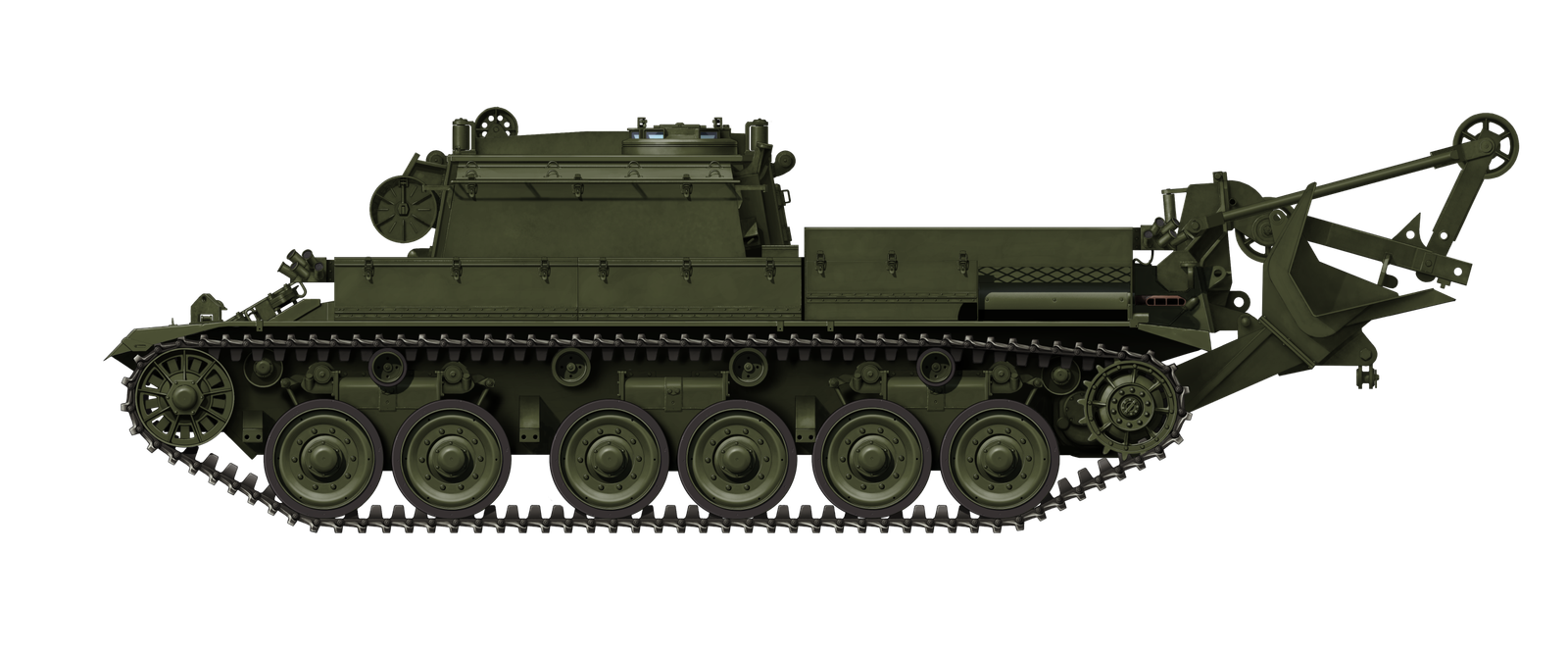
United Kingdom (1956-1994)
Armored Recovery Vehicle – 345 Built
The development of armored recovery vehicles is a crucial yet overlooked element of modern warfare. The advancement of tank design during WW2 and the early stages of the Cold War rendered previous recovery vehicles obsolete due to the increasing weight of new tanks. With the increase in weight of the Centurion, British demands on recovery vehicles were increasing, and experience had shown that recovery was important to the functioning of an army. Without adequate recovery vehicles, tanks were at risk of being abandoned even in situations in which there was otherwise little wrong with them. This led to the Tugs and Towers, which served as a proof of concept for the Centurion ARV Mk.1, which further proved the concept that brought the Centurion ARV Mk.2. This ARV would remain in place throughout most of the Cold War and until its end.


🔥What’s inside?
✔ All 12 issues in one bundle
✔ Available in PDF and EPUB formats
✔ Enjoy instant access to articles prepared by our team of dedicated writers and illustrators, covering the history of armoured vehicles from the 19th century to the present day, in-depth armored warfare analysis, rare vehicles, prototypes, and much more.
👉 Use promo code SPOOKYTANK25 at checkout for 25% off!
New Tank, Old Problems
Early on 19 August 1942, a 6,050-personnel multinational force attacked the German-occupied port of Dieppe with 27 Churchill tanks alongside ships and aircraft. Eventually, Allied forces were pushed back and forced to retreat, suffering losses. The landing occurred on shingle beaches made of small stones, which stripped the tracks from Churchill tanks, leaving them as sitting ducks for anti-tank guns. Some tanks advanced beyond the beach but retreated and were also lost there.
The disaster at Dieppe taught the British various lessons, including the need for engineering vehicles, including Armoured Recovery Vehicles (ARV). The vehicles to receive the wartime ARV Mk.1 Conversion were the M3 Lee, M4 Sherman, Churchill, Ram, Cromwell, Crusader, and Centaur. The ARV Mk.1 Conversion did not have a winch, but did carry tools, an A-frame, and towing cables. The ARV Mk.2 Conversion was built on the M4 Sherman, Churchill, and Ram. They had the same features as the ARV Mk.1 Conversion, but with a false turret housing a winch.
When the Centurion entered service in 1945, LADs (Light Aid Detachments) and REME (Royal Electrical and Mechanical Engineers) units were outfitted with truck-based recovery vehicles, a small number of ARV Mk.1 Conversions, the Churchill ARV Mk.2s, and a small number of US-supplied M32 Tank Recovery Vehicles. Some units, especially Royal Artillery (RA) or Territorial Army (TA) units, did not even have any recovery vehicles. TA units had to make do with turretless M5 Stuart Light Tanks for any recovery mission. The old Churchill ARVs were proving inadequate. While they could tow a Centurion, they could not travel at speeds above 22.5 km/h (14 mph) and were prone to breakdowns.


The Centurion
The Centurion was initially developed to fulfill the need for a long-term project for a Cruiser tank. Its requirements were to have a level of protection, firepower, and reliability that exceeded previous designs in British service. The result was a tank which was capable of engaging in combined arms operations with infantry while being able to engage other tanks. The Centurion was, arguably, one of the first main battle tanks. The first Centurions appeared slightly too late for World War Two, but would be mainstay in Korea, the British Army of the Rhine (BAOR), and Suez.
The first two Centurions marks, the Mk.1 and Mk.2, used a longer hull than the next tanks in the series and a 17-pdr gun. The Centurion Mk.1 used a cast turret front while the rest was welded steel plate, the main gun was unstabilized and the Besa machine gun was in a ball mount. The Centurion Mk.2 used a full cast turret with thicker armor and the same hull as the Centurion Mk.1. The 17-pdr was stabilised and the Besa machine gun was in a coaxial mount. The Centurion Mk.3 was a Centurion Mk.2 with around 400 improvements, the most important of which was the addition of the 20-pdr gun and enhanced gun systems. The Centurion Mk.5’s main improvement over the Centurion Mk.3 was the use of Browning machine guns instead of Besas.

Additional marks up to the Centurion Mk.13 would continue in production until 1962. Aside from several armored recovery vehicles variants, Centurion tanks were converted into bridgelayers and combat engineer vehicles, in addition to multiple prototype vehicles. The Centurion saw service with 17 other nations, with modified versions still deployed by Israel, Jordan, and South Africa as of 2026.

Predecessors
Centurion Recovery
The 8th King’s Royal Irish Hussars’ Centurions were deployed to Korea from 14 November 1950 to 15 December 1951 to fight in the Korean War as part of the newly-created United Nations’ force assembled to stop North Korean aggression. These had a new gun control system which was deemed of such a value that it could not be allowed to fall into Communist hands. As such, the 8th King’s Royal Irish Hussars submitted an Emergency Operational Statement of User Requirement stating the need for an ARV which could recover a Centurion.
| British WW2 tanks and Centurions Weight Comparison | |||
|---|---|---|---|
| Tanks | Weight | Tanks | Weight |
| Churchill Mk VII | 40.7 tonnes (40.1 tons) | Centurion Mk.1 | 43.2 tonnes (42.5 tons) |
| Cromwell | 28 tonnes (27.6 tons) | Centurion Mk.2 | 48.8 tonnes (48 tons) |
| Comet | 36 tonnes (35 tons) | Centurion Mk.3 | 50.8 tonnes (50 tons) |
As a temporary measure, damaged gun tanks were sent to the Japan Reinforcement Base Depot at Kure (Hiroshima, Japan) for repair and conversion into Tugs. It took 10 days to repair the Centurion, then the turret and ammunition stowage bins were removed to create the Centurion Tug. The first was dispatched in late June 1951, and it proved successful, so at least two more were converted. A Centurion Tug was issued to each squadron and to each regimental headquarters. The Centurion Tugs would mainly serve as supply vehicles, carrying ammunition and supplies to exposed positions on hilltops where wheeled vehicles could not access or that were under attack, while the gun tanks supported them. The task of recovering vehicles was secondary in action, although this was its main doctrinal goal. The Centurion Tug lacked winches and could not easily extract vehicles which had been bogged down.

Outside of Korea, to create an interim ARV, the 27th Command Workshops REME in Warminster (Wiltshire, England) and 7th Armoured Division Workshops REME of the BAOR in West Germany created the Centurion Tower (pronounced Tow er, meaning to tow, the er is pronounced the same way as fighter or writer). This new design was similar to the Centurion Tugs, but with a more refined structure on the turret ring. Confusingly, they too were also sometimes known as tugs.
The first Centurion Tower, based on the Centurion Mk.2 or Centurion Mk.3, entered service with BAOR in 1952. It carried a drum for 100.6 m (330 ft) of steel rope. Each squadron and regimental HQ received a Centurion Tower. The Centurion Tower performed well, but lacked a winch, so had to use its own power to tow immobile vehicles, and if that alone were not enough, it would need help from a Caterpillar D8 bulldozer or several Scammells trucks. This demonstrated to REME teams the need to have a better recovery vehicle, particularly in forward areas where a group of vehicles was cumbersome to use and potentially a liability. After the introduction of the Centurion ARV Mk.1, Centurion Towers would become ammunition carriers or hulks, but one would become the Centurion BARV prototype.

Centurion ARV Mk.1
In 1951, the 13th (later 43rd) REME Command Workshops at Aldershot (Hampshire, England) began developing an interim ARV before a more advanced one could be completed. It took the core concept of the Churchill ARV Mk.2 and quickly recreated it for the Centurion. It had a simple false turret and an 18.3-tonne (40,320 lbs) winch. They were produced from 1951 and were officially designated as Tank, ARV, Centurion, Mk.1 (Aldershot Pattern). Eight of the first 11 Centurion ARV Mk.1s produced went to Korea with the 5th Royal Inniskilling Dragoon Guards and went on to serve with various units throughout the war. By 1957, around 180 Centurion ARV Mk.1s were built, some from former Centurion Towers. Centurion ARV Mk.1s would also be deployed to Suez and with BAOR, before being phased out by the end of the 1950s.


Creating a new Centurion ARV
In 1951, the Fighting Vehicle Proving Establishment (FVPE) was established, and the prototype of the definitive Centurion ARV, ‘03 ZR 52’, was completed by Garner Motors of Acton (West London) on New Year’s Eve 1952. Testing was carried out from February 1953 to July 1954. It used a winch generator with an electric winch motor built by Crompton Parkinson of Chelmsford (Essex, England), intended for a Toronto Omnibus Company trolleybus. This was powered by a Rolls-Royce B80 engine. The winch drums were weak and became distorted in use, but were strengthened using ribs. Other issues included poor auxiliary engine cooling, and movement of the ARV under load, but these were solved. Lessons were learned from the ARV Mk.1: the upper superstructure was made more substantial, the storage was increased, and the earth anchor was made much larger.
After the prototype’s problems were solved, production began in 1955 at Vickers-Armstrongs (Newcastle-upon-Tyne) and the Royal Arsenal Factory No. 1 in Woolwich (London). The prototype and first production vehicle were tested between May 1955 and May 1956. The conversions were mostly based on used Centurion Mk.1, Mk.2, and Mk.3 tanks, with some new Centurion Mk.5 hulls also in the mix. The Centurion ARV Mk.2 entered service in 1956 and was officially designated as the FV4006 Tank, ARV, Centurion, Mk.2 (FV4006 Centurion ARV Mk.2). Various additional pieces of equipment were designed, including a jib which mounted to the front of the glacis, and wading gear.
Production began in 1954, initially for foreign customers, as Britain was in less need given the end of the Korean War and the fact the Centurion ARV Mk.1 was still in production, in addition to Britain’s status as a major arms exporter with the Centurion Tank. By 1959, when production ended, 345 Centurion ARV Mk.2s had been produced.
| Centurion ARV Mk.2 Production | ||||||
|---|---|---|---|---|---|---|
| United Kingdom | Netherlands | Sweden | Canada | Switzerland | Year total | |
| 1954 | 28 | 24 | 9 | 61 | ||
| 1955 | 127 | 5 | 2 | 134 | ||
| 1956 | 16 | 16 | ||||
| 1957 | 72 | 10 | 82 | |||
| 1958 | 42 | 42 | ||||
| 1959 | 10 | 10 | ||||
| Nation total | 267 | 28 | 29 | 9 | 12 | 345 |
| Source: Christopher F Foss and Peter McKenzie, The Vickers Tanks | ||||||


Design
Based on the hulls of the Centurion Mk.1, Mk.2, Mk.3, and Mk.5, the Centurion ARV Mk.2’s hull was mostly unchanged from gun tanks. The turret and related systems were removed and the turret opening expanded by cutting out the upper superstructure. The hull front consisted of two sloping plates. The lower one had the vise plate, and the upper plate had spare track links, pulleys, and towing eyes. Above this was the driver’s hatch with two periscopes.
The suspension system dominated the sides of the tank, including bogies, return rollers, idlers, and sprockets. Above these were the fenders with storage boxes, exhausts, portable fire extinguishers, and smoke grenade launchers. If they were fitted, the side plates were mounted to the fenders. The rear mounted the large earth anchor, which also had rollers for the cable. An unmodified engine deck dominated the rear of the hull.
The longer-hull Centurion Mk.1- and Centurion Mk.2-based Centurion ARV Mk.2s were 8.97 m (353 in) long, while the shorter hulled Centurion Mk.3 and Centurion Mk.5-based Centurion ARV Mk.2s were 8.85 m (348.5 in) long. Both were 2.9 m (108 in) tall, width was 3.39 m (132 in), and the width over the tracks was 3.24 m (128 in). The unladen weight was 50.3 tonnes (110,880 lbs) for the Centurion Mk.1- and Centurion Mk.2-based vehicles and 47.2 tonnes (104,160 lbs) for Centurion Mk.3 and Centurion Mk.5-based vehicles, giving a NATO bridge classification of 50 which was used to classify bridges for vehicles which was the norm for Centurion-based vehicles.


The Centurion ARV Mk.2’s upper superstructure was box-shaped, and was dominated by stowage compartments on the left and right sides. The front had three stowage boxes and a roller. The rear had two jerry cans, a fire extinguisher, and a hatch. The top of the upper superstructure had a hatch on the top left, a channel down the centre for the cable to feed through, and, on the top right, was the cupola with an M1919 machine gun, labelled as .30 Browning M.G. on the stowage diagram.


To allow the Centurion ARV Mk.2 to wade and recover vehicles, a snorkel was developed, and the crew were also given breathing apparatus. There was also a pulley and guide rollers to recover vehicles from water, and the driver had a detachable hatch that could act as an emergency air bubble.


Engine and Suspension
The Centurion ARV Mk.2 was powered by the Meteor Mk.4b or Mk.4B/1 650 bhp petrol engine. The engine was cooled by a pressurised, closed-circuit system with two gilled-tube radiators. The main fuel tank, located in the rear, held 546 l (120 imp gal). Normally, top speed was 34.46 km/h (21.5 mph) with a range of 100.6 km (62.5 mi) on road and 53.3 km (32.5 mi) cross-country. While towing, the top speed was limited to 16.1 km/h (10 mph), with a listed maximum range of 136 km (85 mi). Maximum range also depended on the terrain. Mileage over normal terrain was 11.8 l/km (5 gal/mi). Over rough terrain, such as experienced in Vietnam by the Australians, mileage could increase to 23.6 l/km (10 gal/mi) or 35.4 l/km (15 gal/mi). The electrical system on board a Centurion ARV Mk.2 was 24 V, powered by four 6 V batteries with a 150 Ah capacity, charged from a Morris USHNM Mk.2 or Mk.2/1.

The Centurion ARV Mk.2’s suspension consisted of six AEC/Rackham-type bogies, three on each side. Each unit had four solid rubber road wheels on two arms. These were regulated by horizontal springs. Above each bogie was a guide wheel. On the rear of the suspension system was a sprocket, while the front had an idler wheel. When new, each track was 108 links long, and each link was 61 cm (24 in) wide. The tracks were steel or steel and rubber.

Recovery Equipment
The Centurion ARV Mk.2’s upper superstructure housed a winch powered by an auxiliary Rolls-Royce B80 No 1 Mk.2P or Mk.5P engine. The B series engines were standard across the armed forces, with parts being widely available. They saw service into the 1990s and beyond with other countries. The B80 provided electrical power by driving an electric generator which supplied power to the electric winch.
The winch could pull 30.5 tonnes (67,200 lbs) or 91.4 tonnes (201,600 lbs) with a 3:1 tackle. The winch held 137.2 m (450 ft) of 28.6 mm (1.125 in) thick improved plough steel cable, known as ‘rope’ to the crews. To stop the winch, it had two internal expanding brakes which could stop the winch under any load. The winch was fitted with a cutoff; if the force exceeded 30.5 tonnes (30 tons) at the winch (using blocks amplifies the force applied by the winch), the rope would be cut to ensure the winch did not go beyond its capacity. To ease winch maintenance, the roof of the superstructure was removable.


The earth anchor on the Centurion ARV Mk.2’s rear was designed to prevent the ARV from being dragged during heavy pulls to the rear. An eye was welded to side plates to act as an anchor for 20.3 tonnes (44,800 lbs) of pull, especially useful for bogged-down light vehicles. There was a channel on the top of the superstructure enabling self-recovery and front pulls. A wooden bar was available for pushing a vehicle. When it was used, it was mounted on the lower plate.


The Centurion ARV Mk.2 was provided with a 10.2 tonnes (22,400 lbs) two-piece aluminum jib. There was also the provision for a frame mount, which could lift 30.5 tonnes (67,200 lbs) or 12.2 tonnes (26,880 lbs) when towing. The frame mount was mounted to the front of the hull, secured by lines secured to the back corners of the upper superstructure and the front corners of the hull. The winch line was then fed out over the top of the superstructure, over onto the frame. The crews disliked these because they limited the vehicle’s mobility due to the swing they imposed, which could damage or break the jib. The jib also reduced space for other pieces of equipment. Other stowage was in the lockers scattered around the vehicle. Tools included cutting and welding torches, corresponding gases, gun planks, ground anchors, vise, and pulling equipment.


During 1962, a number of Centurion ARV Mk.2s had their track guards and the above stowage modified to carry gun barrels. The goal was to reduce the number of vehicles needed for maintenance. However, the impact was limited, as it only eliminated the trucks that carried the barrels. The Centurion ARV Mk.2 lacked a lifting gear, so a FV434 Armoured Repair Vehicle or a half-track with a lifting gear was still needed. The barrel was also badly-placed for lifting. All of these factors meant the converted vehicles were eventually returned to their original configuration and the removed stowage was restored.

Crew
The Centurion ARV Mk.2 had a crew of four: driver in the hull front; commander in the upper superstructure; and two winch crew, one in the upper superstructure and another in the hull front, who likely acted as mechanics. The crew had two 9 mm Sten guns, but these were likely later replaced with Sterling submachine guns. Their working compartment was cramped, and the commander’s field of view was limited by the center channel.


Armament
The Centurion ARV Mk.2s was armed with a 7.62 mm (0.3 in) Browning machine gun on the commander’s cupola, which could elevate from -15° to 45°. The vehicle had four five-barreled smoke grenade launchers.


Adventures of a Centurion
The Centurion ARV Mk.2 entered service in 1956 and was manned by REME personnel. Each Royal Armoured Corps Armoured Regiment had four ARVs, one at the regimental headquarters and one in each of the three sabre squadrons.
During its service, crews made widespread unofficial modifications, including mounting the headlights on the track guards, adapting the rear searchlight sockets to accept boiling vessels for cooking and washing, and installing a canvas cover over the engine deck to create a more comfortable working or living space. The auxiliary charging engine and batteries could be used to power televisions, while the auxiliary engine provided heat (to the envy of other British tank crews, who never received a heater until the Challenger 1). Inconveniently, the side plates prevented maintenance on the suspension and also allowed mud to get trapped in the sides, so most crews just took them off. Nevertheless, thanks to its reliability, overall, crews liked the Centurion ARV Mk.2.

The first combat deployment was in 1956 to the Suez Canal Zone during the Suez Crisis, the joint British, French, and Israeli invasion of Egypt following the nationalisation of the Suez Canal by Egyptian President Gamal Abdel Nasser.

Due to the nature of its deployment throughout the Cold War, the Centurion ARV Mk.2 saw limited noteworthy service. It was withdrawn from service in BAOR during 1979, but many were still in British service a decade later in 1988.
Gulf War
In spite of the gradual retirement from service, some Centurion ARV Mk.2s were once again deployed during the Gulf War in 1991 to support the 12 Centurion AVREs (Armoured Vehicle Royal Engineers) of the 26th and 31st Armoured Engineer Squadrons. Twelve vehicles being deployed suggests between one to three ARVs depending on the ratio of ARVs to AVREs desired. Deployment during the Gulf War, roughly 35 years after the initial entry into service, led them to be known as ‘The Antiques Roadshow’, in reference to the well-known British television program that values and identifies antiques brought in by the public.
Like the Centurion AVREs, the Centurion ARV Mk.2s did not see conflict. The Centurion AVRE’s most-notable incident was an explosion of two AVREs during a refueling spill. Assisted by the US Graves Service, the 12 Centurion AVRE’s cleared vehicle wrecks in the Multa Pass in the north of Kuwait in case there were explosives in the vehicles that could cook off. The Centurion ARV Mk.2s likely also took part in cleanup efforts, as the winch and recovery tools would have been invaluable.
Replacement
The Centurion as a whole, including the Centurion AVRE and Centurion ARV Mk.2, was retired in 1994 with the end of the Cold War. The exception was the Centurion BARV, which remained in service until 2003.
Prior to this, there had been two attempts to replace the Centurion ARV, neither of which was fully successful. The first was the FV4013 Centurion ARV Mk.3, which would have been based on the Centurion Mk.7, but the design never left the drawing board. Later, with the introduction of the Chieftain in the early 1960s, there was the need to introduce new ARVs on the more modern platform. Nevertheless, as the Centurion AVRE remained in service, so did the Centurion ARV Mk.2 until the post-Cold-War defence cutbacks.
Other Users
Australia
Australia used a variety of Centurion and Centurion-based armored vehicles. In February 1952, Australia ordered 60 Centurion Mk.3s. This was followed by 51 Centurion Mk.5s and 4 Centurion ARV Mk.2s in 1954, 6 more Centurion Mk.5s, and 4 Centurion Mk.7 Bridgelayers in 1961. In 1968, New Zealand sold 7 Centurion Mk.5s and a Centurion ARV Mk.1 to Australia. Australia bought a final 15 Centurion gun tanks from British Army stocks in 1971.
Australian Centurions would remain in frontline service until 1971 with the Australian withdrawal from Vietnam, where they had been deployed since 1967. During the Australian campaign in Vietnam, the 1st Independent Armoured Workshop operated a pair of bridgelayers, a pair of Centurion Mk.5/1 tank dozers, a pair of Centurion ARV Mk.2s, and an ex-New Zealand ARV Mk.1 from 29 January 1968 to 30 September 1971.


Canada
Canada purchased nine Centurion ARV Mk.2s in 1954. They were used by a variety of units including the Corps of Royal Canadian Electrical and Mechanical Engineers (RCEME) and 4 Engineer Support Regiment at CFB Gagetown in Oromocto, New Brunswick. After a service that also saw deployments to West Germany, the Canadian Centurion ARV Mk.2s were replaced in 1990 by the Leopard 1-based Badger Armoured Engineering Vehicle

Denmark
In 1952, Denmark purchased 600 Centurion Mk.3s, followed by 200 more Centurion Mk.3s in 1953. For a few years, Denmark used their M32 ARVs to support their Centurion fleet, before 16 Centurion ARV Mk.2s were acquired in 1957. The Danish Centurions used a 12.7 mm (0.5 in) M2 HB Browning machine gun. The Centurions remained in service until the 1980s, when they were replaced by the Leopard Bergepanzer.

Egypt
Egypt received Centurions and Centurion ARV Mk.2s but few details are known about the Centurion ARVs.
Israel
The Israel Defence Force used a few Centurion ARV Mk.2s, possibly captured from Egypt. Unfortunately, no more information is known at the time of writing.

India
India received 245 Centurion Mk.7s and 16 Centurion ARV Mk.2s which were operated by the Corps of Electrical and Mechanical Engineers personnel, including within the 1st Armoured Division.
Netherlands
In 1953 and 1954, the Netherlands Army bought 591 Centurion Mk.3s under the Mutual Defense Assistance Program (MDAP), followed by 44 Centurion ARV Mk.2s from 1956 to 1958 again with US assistance. This is noteworthy, as MDAP was a US program which was largely used to arm and equip their allies with US military hardware. The Dutch Centurion ARV Mk.2s had registration numbers ranging from ‘KX-06-51’ to ‘KX-07-16’.
The Browning machine guns were replaced with Mitrailleur 7.62 mm MAG machine guns (Dutch designation for the FN MAG), and the vehicles also received infrared vision and new radios. From the 1970s, Leopard 1s would be adopted alongside the Centurion. In 1978, the Dutch Army ordered Leopard 2s to replace previous tanks, however, they wanted to continue using the Centurion ARV. This, however, proved impractical; Leopard ARVS were ordered, and from 1982 to 1987 the entire Centurion fleet was retired. After retirement, a small number of vehicles were used as ‘ballast’ tanks for truck drivers (effectively hulks to tow and transport). or were used as range targets.

South Africa
During 1952, South Africa ordered 87 Centurion Mk.3s, 115 Centurion Mk.5s, and 17 Centurion ARV Mk.2s. In South African service, the Centurion ARV Mk.2s replaced M32B1 Tank Recovery Vehicles. Later, 10 Centurion ARV Mk.2s were sold to Switzerland, likely alongside other Centurions. When South Africa upgraded their Centurions to Oliphants, the remaining Centurion ARV Mk.2s were upgraded to Oliphant configuration with a more powerful engine and changed engine deck in the 1970s. The further upgraded Centurion-based Olifant ARVs resemble the original which is still in service.


Sweden
Before 1954, Sweden had bought 88 Centurion Mk.3s, which were locally designated as the Stridsvagn 81. More followed in 1954 and 1958. In 1960, a batch of Centurion Mk.10s, locally designated as the Stridsvagn 101, was acquired. These were upgraded in 1962 with 105 mm guns and designated as the Stridsvagn 102. In 1956 and 1961, Sweden procured an unknown amount of Centurion ARV Mk.2s, which were designated Bargninstanvagn 81, to support their Centurion fleet.


Switzerland
In March 1955, 100 Centurion Mk.5s, designated locally as the Panzer 55, and 10 Centurion ARV Mk.2s, designated as the Entpannugspanzer 56, were purchased alongside 170 French AMX-13s. This was followed by an order for ten more on 25 March 1956, possibly alongside 100 Centurion Mk.7s. The final ten were ordered on 5 October 1960. These were modified with MG 51 machine guns, 8.05 cm 1951 smoke dischargers, SE 407 radios, and new lights. The vehicles received the numbers ‘M+78601’ to ‘M+78630’. From 1988, ten tanks were disposed of, and after 1991, 19 were sold to Sweden. The remaining vehicle, ‘M+78613’, was placed in the Historical Material Collection of the Swiss Army and ‘M+78602’ would later be exhibited in Switzerland’s Military Museum Full.


Conclusion
The Centurion ARV Mk.2’s development reflected recognition that the battlefield was changing, with heavier tanks becoming the new normal and the old ARVs becoming inadequate. Early vehicles, such as the Tug and Tower, were regular Centurions which had their turrets removed and a small amount of equipment added. These proved successful and provided valuable service, but highlighted the need for an ARV. The interim Centurion ARV Mk.1 further proved the concept which would lead to the Centurion ARV Mk.2. The Centurion ARV Mk.2 served the other Centurion tanks well and outlasted them, remaining in service until the end of the Cold War and beyond with the Gulf War. Aside from British service, the Centurion ARV Mk.2 saw service with 10 other nations, and was deployed during the Vietnam War.


| ||
| Dimensions (L/w/h) | Mk.1 and Mk.2 based hulls 8.97 m (353 in) long 3.39 m (132 in) wide 2.9 m (108 in) tall | Mk.3 and Mk.5 based hulls 8.85 m (348.5 in) long 3.39 m (132 in) wide 2.9 m (108 in) tall |
| Unladen weight | Mk.1 and Mk.2 hulls 50.3 tonnes (110,880 lbs) | Mk.3 and Mk.5 hulls 47.25 tonnes (104,160 lbs) |
| Crew | four: commander, driver, and two winch crew who likely acted as mechanics | |
| Engine | Meteor Mk.4b or Mk.4B/1 | |
| Suspension | six AEC/Rackham-type bogies | |
| Top speed | 34.46 km/h (21.5 mph) | |
| Range (road) | 100.6 km (62.5 mi) | |
| Armament | 7.62 mm (0.3 in) Browning machine gun | |
| Armor | Steel 17 to 76.2 mm (0.75 to 3 in) | |
| Total production | 345 | |
Sources
- Bill Munro, The Centurion Tank, Crowood Press, Wiltshire, 2005
- Brian S Baxter, Breakdown: A History of Recovery Vehicles in the British Army, HMSO, London, 1990
- Christopher F Foss and Peter McKenzie, The Vickers Tanks, Patrick Stephens Limited, Northamptonshire,
- David R. Higgins, M48 Patton vs Centurion Indo-Pakistani War 1965, Oxford, Osprey Publishing, 2016
- Dr Dewald Venter, South African Armoured Vehicles, Helion & Company Limited, Warwick, 2020
- Harold A Skarrup, Canadian Armour: Centurion Armoured Recovery Vehicle (ARV), Publishing date Unknown, and Viewing date July 2026
- Micheal Osborne, Shortest Gap, Trackpad Publishing, Surrey, 2026
- Pat Ware, In National Service, Warehouse Publications, Croydon, 1995
- Pierre Lowe Victor, Development of the Olifant ‘Elephant main battle tank, VEG issue 7
- Simon Dunstan, British Battle Tanks Post-War Tanks 1946-2016, Oxford, Osprey Publishing, 2020
- Simon Dunstan, Centurion, Ian Allan, 1980
- Simon Dunston, Centurion Main Battle Tank: 1946 to Present, Haynes Publishing UK, 2017
- Stephen Tunbridge, Centurion, Squadron Signal, Michigan, 1976
- User Handbook for Tank, ARV, Centurion, Mk.2 1958
- Urs Heller Entpannungspanzer 56 Centurion Mk 2 ARV, Entp Pz 56 – Entpannungspanzer – Raupenfahrzeuge | militärfahrzeuge.ch Publishing date Unknown, and Viewing date 4 September 2026
- Unknown, Untitled, Publishing date Unknown, Viewing date 12 June 2026
