

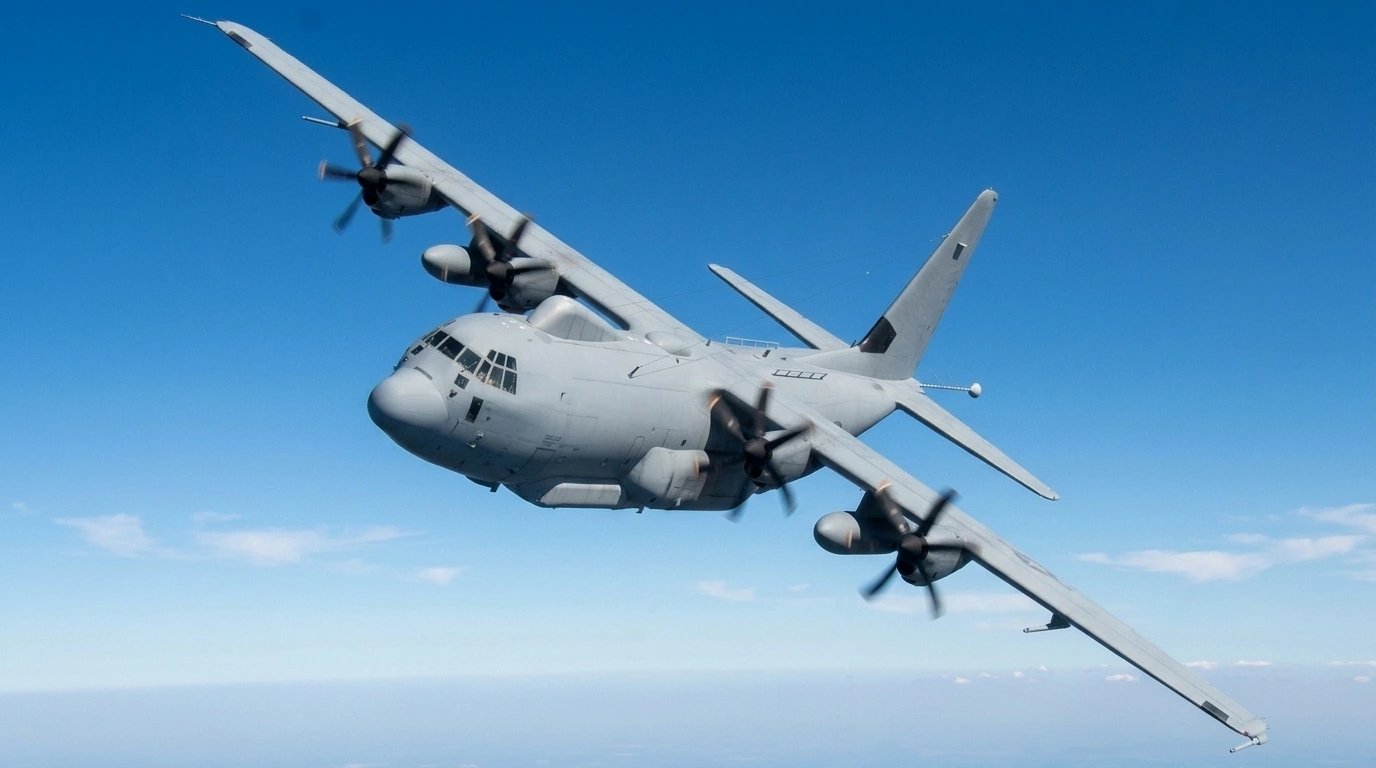
Imagine a national crisis unfolding while America’s most powerful military communications networks are suddenly disrupted. Submarines are operating deep underwater, waiting for instructions. Military commanders need reliable information, and national leadership must retain the ability to communicate with strategic forces. In such a situation, losing contact is not an option.
This is the environment the E-130J Phoenix II is being designed to operate in.
Developed for the U.S. Navy, the E-130J Phoenix II will become a central component of America’s airborne Nuclear Command, Control, and Communications (NC3) network.
Its primary mission is known as TACAMO, short for Take Charge and Move Out. The aircraft is intended to maintain secure communications between national leadership and strategic military assets, particularly ballistic missile submarines operating beneath the ocean.
Unlike conventional military aircraft, the E-130J Phoenix II does not depend on carrying weapons or detecting enemy targets to deliver its strategic value. Its most important capability is something less visible: keeping critical communication channels available when conventional infrastructure may be unreliable.
The aircraft is based on Lockheed Martin’s C-130J-30 Super Hercules, a proven military transport platform adapted for a highly specialized mission. Northrop Grumman leads the aircraft’s development and mission-system integration, while other defense contractors contribute essential communications technologies.
The project represents more than an aircraft replacement. It reflects America’s effort to modernize a nuclear communications network that must remain dependable for decades.
So, what makes the E-130J Phoenix II different from its predecessor, the E-6B Mercury? And how can a turboprop aircraft help preserve one of the most important links in America’s nuclear deterrence system? Let’s examine the technology and mission behind it.
What Is the E-130J Phoenix II and Why Is It Being Developed?
The E-130J Phoenix II is a next-generation airborne communications aircraft being developed for the U.S. Navy. Its primary responsibility is to support America’s Nuclear Command, Control, and Communications (NC3) network through a mission known as TACAMO.
The name TACAMO stands for Take Charge and Move Out. It describes an aircraft mission built around maintaining communication between national leadership and U.S. strategic forces, especially nuclear-powered ballistic missile submarines. These submarines operate underwater for extended periods, making reliable communication a particularly demanding challenge.
But why does the Navy need another aircraft for this job?
The answer lies partly in the age of the existing fleet. For decades, the E-6B Mercury has performed the TACAMO mission using a modified Boeing 707-derived airframe. Although the aircraft remains an important part of America’s nuclear command architecture, maintaining an aging platform becomes increasingly complicated as components, support requirements, and modernization demands accumulate.
The E-130J Phoenix II is intended to address that challenge. It will use the C-130J-30 Super Hercules as its base platform, bringing a modern production airframe into a mission previously associated with the larger E-6B. The Navy selected the name Phoenix II in August 2025, reflecting the return of the TACAMO mission to the Hercules aircraft family.
Its development also involves several major defense contractors. Northrop Grumman serves as the prime contractor and mission-systems integrator, while Lockheed Martin provides the C-130J-30 platform. Specialized communications equipment is being incorporated into the aircraft to support its strategic role.
One distinction matters here: the E-130J Phoenix II is not designed to launch nuclear weapons or replace America’s nuclear bombers. Its job is to help preserve the communication links that allow authorized leaders to command strategic forces. In nuclear deterrence, that responsibility is enormously important.
How Does the E-130J Phoenix II TACAMO Mission Work?
A nuclear submarine can remain hidden beneath the ocean for months, but staying connected to national command authorities presents a difficult technical challenge. Radio signals cannot easily penetrate seawater. This creates a unique communications problem for the United States: how do commanders transmit critical instructions to submarines that deliberately avoid exposing their positions?
The E-130J Phoenix II is being developed to help solve that problem through the TACAMO mission.
TACAMO stands for Take Charge and Move Out. Its purpose is to maintain a reliable communication link between national leadership and U.S. strategic forces, particularly the Navy’s ballistic missile submarines. These submarines form the sea-based component of America’s nuclear triad, providing a highly survivable deterrent capability.
The process involves more than simply transmitting radio messages. During a national emergency, authorized command authorities may need to communicate instructions through secure military networks. The TACAMO aircraft provides an airborne communications platform capable of relaying those messages to forces operating far from conventional infrastructure.
One important element is the Emergency Action Message (EAM). These highly protected communications carry instructions associated with national military command. The aircraft’s mission is to support the transmission of such messages through designated communications systems.
Why use an aircraft instead of relying entirely on ground stations?
Mobility and redundancy. An airborne platform can operate across different regions, providing another communications pathway if terrestrial infrastructure becomes unavailable or compromised. It also helps maintain contact with submarines operating across vast ocean areas.
This is particularly important because nuclear deterrence depends on more than possessing powerful weapons. It also requires dependable command authority and communication.

The E-130J Phoenix II will inherit this demanding responsibility from the E-6B Mercury. Its success will ultimately be measured by something unusual for military aviation: whether critical instructions can still reach their intended recipients when circumstances are at their worst.
E-130J Phoenix II Specifications and Aircraft Capabilities
The E-130J Phoenix II combines a proven military transport aircraft with highly specialized nuclear communications equipment. Its foundation is the C-130J-30 Super Hercules, an extended version of Lockheed Martin’s widely operated C-130J platform.
This choice gives the Navy an established airframe rather than requiring an entirely new aircraft design. However, the E-130J Phoenix II will be substantially modified to accommodate its TACAMO mission, including specialized communications equipment and associated onboard systems.
At the heart of its propulsion system are four Rolls-Royce AE 2100D3 turboprop engines. Each engine drives a six-bladed propeller, providing the aircraft with the performance needed for military transport operations and extended missions.
Here are some publicly available specifications of the underlying C-130J-30 platform.
E-130J Phoenix II Specifications
| Specification | Details |
| Aircraft designation | E-130J Phoenix II |
| Base aircraft | C-130J-30 Super Hercules |
| Manufacturer | Lockheed Martin |
| Prime contractor | Northrop Grumman |
| Aircraft category | Airborne nuclear communications |
| Engines | 4 × Rolls-Royce AE 2100D3 |
| Maximum speed | Approximately 410 mph |
| Maximum payload | 44,000 lb |
| Length | Approximately 112 ft 9 in |
| Wingspan | Approximately 132 ft 7 in |
| Primary mission | TACAMO |
| Communications role | Nuclear command and control |
One important detail deserves attention. The E-130J Phoenix II’s final mission-specific performance figures have not been fully disclosed publicly. Its operational range, endurance, maximum weight, and internal equipment configuration may differ from the standard transport aircraft.
That distinction matters. The E-130J Phoenix II is not simply a cargo aircraft with different paint. Its modifications are intended to support a demanding strategic communications mission, where reliability and system integration matter far more than carrying capacity alone.

Inside the E-130J’s VLF Communications and Antenna Systems
The most distinctive feature of the E-130J Phoenix II may not be visible from a distance. Its real importance lies in the specialized communications equipment designed to connect national command authorities with submarines operating beneath the ocean.
One technology makes this possible: Very Low Frequency (VLF) communications.
VLF radio operates within the 3–30 kHz frequency range. Unlike conventional high-frequency communications, these signals can penetrate seawater to a limited depth, making them particularly useful for transmitting information to submerged submarines.
There is a catch, though. VLF signals require large antenna systems and relatively low data rates. They are not designed for sending enormous amounts of information. Instead, their value comes from delivering essential, relatively short messages when submarines cannot surface or expose their positions.
This is where a trailing-wire antenna becomes important.
The existing E-6B Mercury uses long wire antennas that can be deployed behind the aircraft during communications missions. By trailing an extended antenna through the air, the aircraft can create an effective transmitting system for very low-frequency signals. The arrangement allows the aircraft to maintain communications while remaining airborne and mobile.
The E-130J Phoenix II is being developed with a modernized communications architecture. Collins Aerospace has been associated with its VLF communications subsystem, which is intended to support the aircraft’s specialized TACAMO responsibilities.
But VLF is only part of the picture.
Modern strategic communications also depend on secure networks, satellite connectivity, and alternative transmission pathways. These technologies help ensure that information can move between different command elements without relying on a single communications channel.
Think of the E-130J Phoenix II as an airborne communications relay station with a very specific responsibility. It does not need to transmit everything. It needs to ensure that the right message reaches the right strategic force when conventional communication options may be unavailable.
Advanced Avionics and Mission Systems of the E-130J Phoenix II
The E-130J Phoenix II is being designed around a mission that demands more than reliable engines and long-range flight capabilities. Its most important equipment will be the specialized avionics and communications systems responsible for maintaining America’s airborne nuclear command network.
Unlike a conventional military transport aircraft, the E-130J Phoenix II must function as a highly specialized communications platform. Its onboard systems need to receive, process, and transmit sensitive information through multiple communication pathways while supporting continuous mission operations.

One important component is its Very Low Frequency (VLF) communications subsystem. This technology enables the aircraft to support communications with submerged ballistic missile submarines, providing a critical link within the Navy’s TACAMO mission.
However, VLF is not the only communication method involved.
The E-130J Phoenix II’s developing architecture also incorporates modern satellite communications capabilities.
In October 2026, ThinKom announced that its multi-orbit satellite communications antennas had been selected for the E-130J Phoenix II program. This technology is intended to provide connectivity through different satellite networks, expanding the aircraft’s communications options.
Secure communications are equally important. Information associated with nuclear command and control requires strict protection against unauthorized access, interference, and disruption. Consequently, the E-130J Phoenix II’s mission architecture must support secure information handling and dependable communications across different operational environments.
Another important consideration is system integration. The aircraft must bring together its flight avionics, communications equipment, antenna systems, and mission controls into one coordinated platform. These components cannot operate as isolated technologies. They must work together reliably throughout demanding missions.
The E-130J Phoenix II’s exact avionics configuration and onboard workstation arrangement have not been fully disclosed publicly. Nevertheless, its development reflects a broader modernization effort: moving beyond an aging communications platform toward an aircraft designed around contemporary military networking requirements.
Ultimately, E-130J Phoenix II effectiveness will depend on how reliably these systems function together. In this mission, a sophisticated aircraft is only as valuable as the communications network it can maintain.
Nuclear Survivability, Cybersecurity and Strategic Communications
Operating an aircraft that supports America’s nuclear command network comes with responsibilities far beyond ordinary military aviation. The E-130J Phoenix II must be capable of maintaining critical communications in an environment where conventional infrastructure could be disrupted, damaged, or deliberately targeted.

One major concern is electromagnetic pulse (EMP).
An EMP can interfere with or damage electronic equipment, potentially affecting communications, navigation, and command systems. For an aircraft supporting nuclear command and control, protecting sensitive electronics against electromagnetic effects is an important design consideration.
However, EMP protection is not simply about shielding individual components. It also involves ensuring that electrical systems, communication equipment, and mission networks can continue functioning reliably under demanding conditions. The E-130J Phoenix II’s specific EMP protection configuration has not been fully disclosed publicly.
Cybersecurity presents another challenge.
Modern military aircraft depend heavily on interconnected digital systems. Communications networks must therefore protect sensitive information against unauthorized access, manipulation, and other forms of cyber interference. For a TACAMO aircraft, maintaining the integrity of transmitted instructions is particularly important.
Redundancy is equally valuable. Relying on a single communication method would create an unnecessary vulnerability. The E-130J Phoenix II’s developing architecture incorporates different communication capabilities, including VLF and satellite connectivity, helping support alternative pathways for strategic communications.
There is also the question of operational endurance. An airborne communications platform must remain available when needed, supported by reliable maintenance, trained personnel, and secure infrastructure. Its effectiveness depends on the entire system, not just the aircraft itself.
This is what makes the E-130J Phoenix II different from a conventional military transport aircraft. Its strategic value comes from preserving communication between national command authorities and forces operating across enormous distances.

In a nuclear crisis, maintaining that connection is essential. The aircraft does not need to control the entire battlefield. It needs to help ensure that America’s command structure remains connected when the stakes are highest.
E-130J Phoenix II Development, Cost and Future Operational Timeline
The E-130J Phoenix II represents a major investment in America’s long-term nuclear command infrastructure. However, turning a standard military transport aircraft into a specialized strategic communications platform is a complex engineering project.
The aircraft must integrate advanced antennas, secure communications equipment, and mission systems without compromising operational reliability.

Northrop Grumman leads the program as the prime contractor and mission-systems integrator. Lockheed Martin provides the C-130J-30 airframe, while Collins Aerospace contributes specialized communications technology, including the VLF subsystem. Other industry partners support the aircraft’s developing communications architecture.
In January 2025, the U.S. Navy awarded Northrop Grumman a development contract valued at approximately $3.5 billion. The funding supports the engineering, development, and integration work required to transform the C-130J-30 into an operational TACAMO aircraft.
A significant milestone followed in October 2026, when the first C-130J-30 airframe was delivered to the Navy. This marked progress toward the E-130J Phoenix II program, although the aircraft still requires specialized modifications, systems integration, and testing before becoming operational.
The planned procurement includes six developmental aircraft and 25 production aircraft, according to program reporting. This would provide the Navy with a dedicated fleet for sustaining its airborne TACAMO capability.
However, the development process is not without challenges. Integrating complex communications systems into an aircraft requires extensive testing, particularly when those systems support nuclear command functions. The Government Accountability Office has also highlighted schedule and integration risks within the program.
The E-130J Phoenix II’s future therefore depends on more than completing aircraft construction. Its communications equipment must demonstrate reliability, security, and compatibility with America’s wider NC3 architecture.
When it eventually enters operational service, the Phoenix II will help carry forward a mission that rarely attracts public attention but remains fundamental to U.S. nuclear deterrence: keeping the country’s strategic forces connected when communication matters most.
