

Key Points
- Erez Defense Solutions, based in Hod HaSharon, Israel, completed field experiments testing a capsule and launch mechanism for an aerial defense system.
- The company said testing focused on physical limits, operational feasibility, and basic reliability of the core system components.
A small Israeli defense startup has put a mystery device through a brutal round of real-world stress testing, and the company is being unusually candid about exactly which parts still need work.
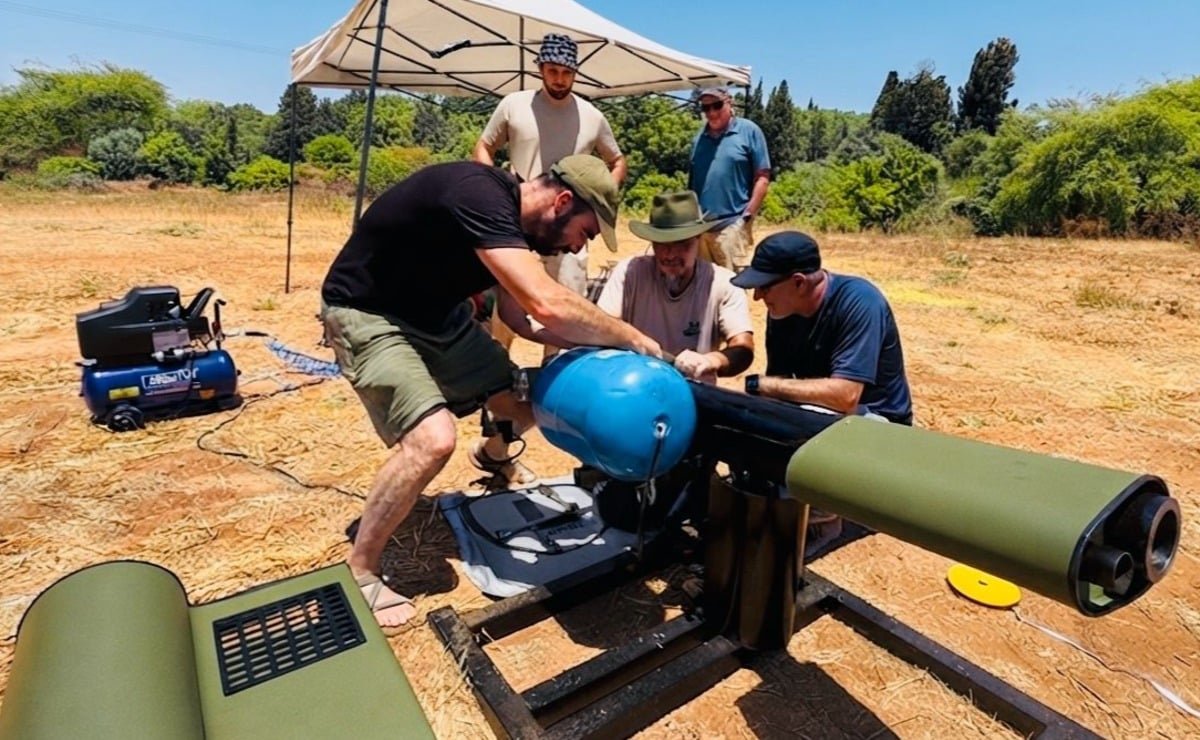
Erez Defense Solutions, a company based in Hod HaSharon, a city in central Israel roughly 20 kilometers (12 miles) northeast of Tel Aviv, announced that it completed another round of intensive field experiments this week focused on what it describes as an aerial defense solution, a system designed to counter airborne threats such as hostile drones. The company said the latest testing round zeroed in specifically on two components it calls core to the entire system: a proprietary capsule and the mechanism that launches it.
What exactly that capsule does once launched, and what threat it is ultimately meant to intercept or neutralize, remains unclear from the company’s public statement, and Erez did not specify in its post whether the system is designed to physically capture a drone, disable it electronically, or destroy it outright. The company did make clear that this round of trials centered on programming and integration work tied to the capsule and its launch hardware, language suggesting the system relies on some kind of physically ejected or fired payload rather than a purely software-based jamming or spoofing approach, though without additional technical detail from Erez, that remains an informed inference rather than a confirmed specification.
– ADVERTISEMENT – CONTINUE READING BELOW –
The broader category Erez is working in, generally known as counter-unmanned aircraft systems or C-UAS, has become one of the most active corners of the defense industry worldwide as cheap, widely available drones have turned into a persistent threat on battlefields and around sensitive infrastructure. Defenses against that threat generally split into two families: hard-kill systems that physically destroy a drone through methods like gunfire, missiles, or lasers, and soft-kill systems that disable a drone without destroying it, often through jamming its control signals, spoofing its navigation, or physically capturing it using nets or similar entanglement devices. Israel’s defense industry has produced several notable soft-kill entrants in this space in recent years, including systems from established players that use net-launching technology to snare hostile drones out of the sky with minimal risk of debris or collateral damage falling on the people below, a design philosophy that matters particularly for defending crowded urban areas or civilian infrastructure where a missed hard-kill shot could cause damage of its own.
Erez framed its decision to prioritize physical field trials over computer simulation as a deliberate response to the specific demands of the C-UAS and electronic warfare space, arguing that the messy unpredictability of real-world conditions simply cannot be replicated inside a lab.
“Field testing is the heartbeat of our innovation. In the world of Electronic Warfare and Counter-Unmanned Aircraft Systems (C-UAS), theory is one thing, but reality is another. No simulation, however advanced, can replace the complex dynamics of the real world,” Erez said.
The company laid out three specific goals it said this particular round of testing was designed to achieve, treating the exercise as a deliberate, staged validation process rather than a single pass-or-fail demonstration.
“At this stage, these trials allow us to: Push Physical Limits: Test the launch hardware and capsule under extreme conditions. Verify Operational Feasibility: Confirm the integrity of the ballistic and mechanical launch sequence in real-field conditions. Ensure Basic Reliability: Verify that the core system operates consistently and predictably,” Erez said.
That staged framing matters for understanding where Erez likely sits in its development timeline. Testing described as confirming basic reliability and verifying that a launch sequence holds together mechanically points to a system still working through foundational engineering validation rather than one preparing for imminent battlefield deployment or a formal military procurement decision, a distinction the company itself seemed to acknowledge by describing the results as yielding critical insights and a significant leap forward in programming and integration rather than declaring the system complete or combat-ready.
Israel’s defense sector has invested heavily in counter-drone technology over the past several years, driven by a drone threat that Israeli officials have repeatedly described as expanding across every front the country faces, from cross-border incursions to attacks originating from Iran-aligned groups operating in multiple directions around Israel’s borders. That threat environment has fueled rapid growth for Israeli C-UAS startups generally, with newer entrants frequently building on know-how developed through decades of work on Israel’s larger, more established air defense systems, though it remains unconfirmed whether Erez itself draws on any specific prior program or personnel pedigree, since the company’s own announcement did not address its founding history, funding backers, or how long it has been developing this particular system.
What Erez did make explicit is that this milestone represents progress rather than completion, crediting its engineering and development teams for what it described as continuous work rather than a finished product ready for customers.
“The current success is a testament to the hard and precise work of our engineering and development teams, who never stop researching, learning, and improving,” Erez said.
“We are moving forward full steam ahead to deliver a leading and reliable solution to the market,” Erez added.
