

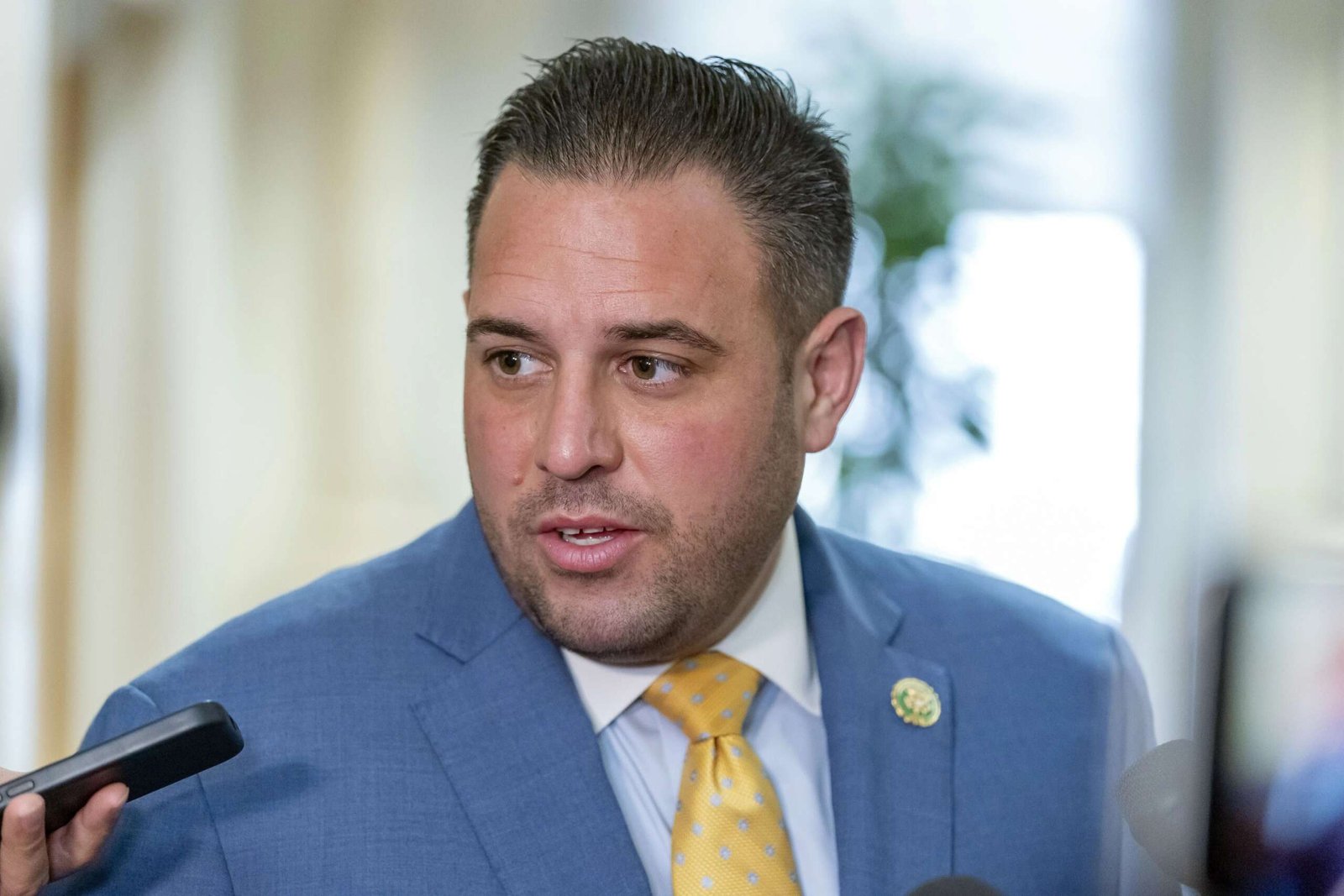
Terry Gerton You have had one of the more interesting career paths to your current position. You spent over 15 years as a detective in the New York Police Department. You were a town councilman. You were an elected member of the House of Representatives. How on Earth did you find your way back to the executive branch — as an IG, no less?
Anthony D’Esposito To be honest, you know, serving as an inspector general, I think that there is a lot of benefits to someone, especially now and the war that we have on fraud — not saying that it wasn’t always there, but I think that the renewed commitment to the war on fraud and the fact that the administration is pressing prosecutors throughout the country in order to begin to prosecute types of fraud, regardless of how much or how little it is — I think that it’s critically important that these IG offices have career or decorated law enforcement professionals. People who have been on the streets, who have conducted investigations, who have hunted criminals, who have sat across the interview table from, you know, whether it was gang members or people who have murdered individuals or people who have committed fraud. I think that having the ability to talk to people, to oversee investigations, to speak to your investigators throughout the nation and hear what they’re doing, what their interview processes are, what their routines are when it comes to surveilling individuals and how these investigations start — I think having someone with the ability to look at it from a law enforcement lens is really important. And I think that, at least from what I’ve heard and what I’ve seen, our investigators, our agents throughout the nation are pretty excited that they have someone who is now leading the agency who has put the uniform on, who has been in the locker room and geared up. Not only been a street cop, but taken hundreds of illegal firearms off the street, dismantled gangs, was a highly decorated effective, and someone who knows how to put cases together present the prosecutors for the best possible outcome. So I think that our investigators are excited, and I’m looking to learn from the things that they’ve done, and I know that they’re certainly looking to find out from me what it is that I could bring to them, not just in personal knowledge but in resources, in education and training, in equipment that they need in order to move forward. And then when it comes to the government political side of it, I was a councilman in the town of Hempstead — and for those not familiar with the town of Hempstead, the town of Hempstead is actually the largest town in the United States of America. We’re bigger than seven or eight states by population, a budget of about $600 million, 3,500 full-time employees. So, you know, serving as deputy supervisor of America’s largest town and operating a budget that large and being responsible for full-time employees, I think that it really gives you an opportunity to understand and to see how sometimes difficult it is to lead a group of that large. And I think that’s going to be extra beneficial in leading this agency. And then obviously serving as a member of the House of Representatives, you know, we all know that getting things done not just is about commitment and hard work, but it’s about relationships. And I think that as someone who served in the House of Representatives, a conservative Republican from New York who was pro-labor, was voted I think the 10th- or 11th-most bipartisan member of the House of Representatives; I was a member of the Problem Solvers Caucus, which is a caucus with equal amount of Democrats and Republicans who try to work hard to find solutions to problems facing this nation. I think that highlights my relationships on both sides of the aisle. So I think that when it comes to, again, getting things done, when it comes to raising awareness, when it come to bringing resources back to this agency, having those relationships not just in the House, but with the Senate side, and obviously the administration, is important.
Terry Gerton Well, you stepped into your role as the IG at the Department of Labor back in January. As you’ve been getting oriented, what has stood out to you the most about the scope of DOL’s programs and the oversight responsibilities attached to them?
Anthony D’Esposito It’s tremendous. I think that one of the things that probably surprised me the most was the expansive portfolio of many of our agents and our auditors and our civilians. I mean, the work that this team does each and every day should really be applauded. I mean they — you know, the battle of fraud and the war on fraud has taken headlines recently. I’m proud of that, but I think that these individuals here have been trying to tackle and been at front lines in the war on fraud for a long time. I think the difference now is we have, like was mentioned just a couple of minutes ago, right now we have prosecutors and we have a commitment from the administration that they want to move these cases forward. Starting to visit all of the regional offices throughout the nation, I hear frequently from the agents who said, “you know, we worked six, seven, eight months, a year, over a year on an investigation, and we presented it to a prosecutor who said that $2 million in fraud doesn’t really meet the threshold that we need.” Well, the way I look at it is, $2 million is a lot of money. And as Ronald Reagan said — a million here, a million there, and before you know it, you’re talking about real money. And I think that that’s what we’re dealing with now. I was recently named to the President’s Fraud Task Force; to have an administration that’s committed to fraud and rooting out fraud and has made it clear that they will make every resource available to help do that, and obviously use their influence to make sure that the prosecutors know that these are cases that we want to move forward. So I think, going back to the original question, what has surprised me is really the scope, the broad scope that these agents and auditors have. I mean, there’s so much work that can be done. I think that also one of the things that the agents and auditors are happy to hear is when I’m visiting these regional offices and they say, “Over the last four or five years we’ve presented a case about, you know, human trafficking or sex trafficking and we were told that that’s not really our role. How do you feel about that?” And the way I look at it is, we’re law enforcement professionals and we should be hunting down criminals, however and wherever we can. So I’m looking forward to not only embracing the expansive scope that the Department of Labor has, but expanding that scope. Obviously still meeting our mission and fitting our mission, but to give our agents and auditors sort of a bigger threshold for them to find and tackle and facilitate cases that they are interested in working.
Terry Gerton You’ve mentioned the fraud issue a couple of times so far, and recent DOL IG work has highlighted ongoing risks around unemployment insurance fraud. You mentioned child labor enforcement challenges, grant oversight. Where have you asked your team of auditors to focus first?
Anthony D’Esposito I think that with the statute of limitations on some of the pandemic fraud kind of withering away each and every day, I’ve tried to use my relationships recently. Obviously, there’s a piece of legislation that came out of the Ways and Means Committee that has extended the statute limitations for pandemic-era fraud. We’re hoping that it will make its way to the floor of the Senate. It’s something that I mentioned both at the first fraud task force meeting, and we had a follow-up phone call just this Thursday. And I’ve mentioned it both times of how important it is. So I think that right now, just because of the timing, one of the things that we are still focused on is that pandemic-era fraud. Recently, we put out a financial memo where our auditors have identified close to $1 billion, with a B, still sitting on prepaid debit cards issued during the pandemic. So right now we’re focused on trying to find a way both to extend the statute of limitations so we can continue to prosecute these cases, and then B, find a ways to work with the Treasury to claw this money back and get it back into the hands of the American people. And then obviously there’s the fraud that’s been focused so much on TV, which is the medical — Medicaid, but still a lot of that kind of reaches back right into the pandemic-era fraud. We were in California on Wednesday and Thursday, announcing a takedown with the U.S. attorney there and Dr. Oz, shutting down over 200 hospices, all with ties leading back to some sort of labor investigation, whether they were utilizing money that was spent by labor unions, or other investigative processes that led us to these hospices. We’re working with our federal and local partners to shut them down and to put people in handcuffs and hold them accountable.
Terry Gerton I’m speaking with Anthony D’Esposito. He’s the Inspector General for the U.S. Department of Labor. Mr. D’Esposito, the Trump administration has plans to transfer billions of dollars of grant programs from the Department of Education to the Department of Labor. As you’re thinking about that, what is your office doing to help build the anti-fraud governance and control mechanisms on the front end so that hopefully the investigations are fewer on the back end?
Anthony D’Esposito It was one of the reasons as to why I fully embraced and was proud to be named to the Fraud Task Force. The president and his team and the vice president have recently nominated and was Senate-confirmed Colin McDonald, who’s going to be sort of the fraud czar and focus in the U.S. Attorney; he’s going be the U.S. Attorney in charge of fraud. And within a couple of hours of being confirmed, he sent a memo out that he is establishing a federal fraud database. So what we’re going to do is we’re going to take all of our caseload — whether it’s suspects, whether it’s perpetrators, whether it’s Social Security numbers and information that we’ve gathered that we think is linked to fraud — and we are going to start entering that into one central location so that the information that now comes over from the Department of Education, or any other department, that it’s in a central location that can be utilized to one, make sure that this fraud doesn’t continue and again, we stop it right where it is right now; and two, grow this partnership so that we’re not being duplicative in the investigative and audit work that we are doing. There’s no reason for the Department of Labor to be conducting an audit that’s extremely similar to an audit being done in the Department of Education. Having this central workplace and being able to share intelligence and information will not only make our job more efficient, but it will make sure that we can place resources where they need to be, move personnel into different places so that they can be as effective as possible. So I think that making sure that the sharing of information is continuous is really important. I think that, while so many law enforcement agencies work together every single day, I will say as someone who came from the NYPD, many law enforcement professionals hold their intelligence pretty close to the vest, right? Because you want to make sure that you keep it tight, that you the information to your team so that you can do the best work that you can. But in a case like this, where so much of fraud investigation has to do with raw data, I think that sharing that raw data is important and will only benefit the prosecution of fraudsters in the future.
Terry Gerton How do you balance this intense focus on fraud detection and prevention with the other side of the IG coin, which is program evaluation, program delivery and effectiveness? How do you keep those two in balance?
Anthony D’Esposito I think that they are able to work parallel. I think there our auditors are focused each and every day on making sure that the programs that are available to the American people are running efficiently and are supporting the efforts that they were put in place for. And when those programs are no longer doing the intent that they were developed for, I think then that’s when we step in and try to find or suggest alternative measures. And I think that having a collaboration and making sure that the civilians and the auditors and the investigators are working really in tandem and at a parallel is what’s important. And it’s one thing that, you know, I firmly believe that we will be most effective, we will find the best prosecution possibilities and we will be most successful if our team works together. And that’s one of the reasons as to why I’ve worked with my new deputy, Mike Dillinger, who is also a career law-enforcement individual, in sort of, reprogramming and re-imagining this IG’s office. I think that there’s a reorganization in place not just because we want to move people into different places, but because coming from decades in government and politics and having a career in law enforcement, and him having a career in law enforcement and working in other IG’s offices, we know what works and we know doesn’t work. And I think that while many of the things may have worked here in the past, one of the terms that I think drives me the most insane is, “we’ve always done it this way.” And that doesn’t always mean that it’s the right way to do it. So I think our reorganization of this IG’s office is going to play a critical role in really building and molding the agency into one of the most effective inspectors general offices that this federal government has. I mean, I’m sitting in my office and I have a complete flow chart of every member of our team across the nation and here in D.C., and it is something that each day we look at, we find out who would be more helpful somewhere else. Who do we think personally would shine better in a different position? So I think that work is ongoing and I think that balance is important.
Terry Gerton And as you’re pursuing that agency reorganization, how are you and your deputy then establishing expectations for the office while still making sure that you maintain that objective independence that is so important for the IG’s work?
Anthony D’Esposito We recently put out a message to all of our staff — politicals, careers, auditors, civilians, agents — we put a survey out and it was pretty simple. We want to know what’s working. We want know what not working. We want to know what you thought was successful with the last IG and his team, and what do you think could change? And I think that, first of all, giving the entire team the ability to anonymously tell you what it is they think is working and not working has provided real insight into the work that we’re doing. I think that a lot of the changes that we’ve already made has been embraced by the team and they’re happy to see that there’s changes being made there. I know that, not just visiting sites throughout the country and hearing, wow, you know, it’s great to have our IG here, I do my best, when there are press conferences that are announced for the great work that’s being done across the country, I’ve really done my best to, any one that I’m invited to, I get on that next plane and go out there. Not because it’s an opportunity for me to get in front of a camera, but it’s opportunity for me to tell the story of the great work that our agents are doing throughout this nation. And I think that having the leader of the agency there rooting them on means a lot. It’s one thing to send an email and say, “great work.” It’s another thing to shake that person’s hand and say, “job well done.” So that’s something that we are trying to do. And I think when you talk about taking the input and the insight from people that have been here, whether they’ve been here for 40 years or whether they’ve been here for four days, all of that information matters. For me, remaining independent, it is pretty simple. I can be a conservative Republican. I can be someone who was nominated by President Trump. I can be someone who served as a Republican member of Congress. And I can obviously have my opinions. But I also served as a New York City detective in probably one of the most dangerous neighborhoods in the United States of America. And I worked, always, in a team atmosphere. And every day when I got out of the car, you know, take an illegal gun or place a murder suspect in handcuffs, I did it with individuals of different color skin, of different economic background, of different religions and certainly different political ideologies. But their life depended on me and my life depended on them. And that’s the same thing I bring to this office — it’s that you never respond to a 911 call and first ask the person what political party are they from. And the way that I look at it is many of the things that the administration believes in, this war on fraud, while yes, it’s coming from a Republican president and a Republican vice president, and yes the Republicans control the House and the Senate, I think that the war on fraud is not a Republican or Democrat issue, it’s an American issue. Quite frankly we should all be rooting out fraud and we should be doing our best to make life more affordable. I say it often because I believe it: I think that fraud is a tax on the American people, and we should be working to eliminate it.
Copyright
© 2026 Federal News Network. All rights reserved. This website is not intended for users located within the European Economic Area.
