


Armada’s Curran Papers articles are written by electromagnetic spectrum specialists and practitioners. The series is named after Dr. Joan Curran, the Welsh physicist known for her pioneering work developing the chaff anti-radar countermeasure during the Second World War. We hope the series honours her memory by showcasing innovative perspectives relevant to Electronic Warfare (EW) and Electromagnetic Spectrum Operations (EMSO).
Much of today’s defence debate is rightly focused on cognitive electronic warfare; Intelligence, Surveillance, Target Acquisition and Reconnaissance (ISTAR), artificial intelligence, sensor fusion, data convergence, and the ability to build faster and more intelligent kill chains.[1] These are essential themes. Without rapid sensing, classification, decision support and cross-domain coordination, no modern naval force can operate effectively in a contested electromagnetic environment.[2]
Yet one fundamental issue is often treated as secondary: the immediate self defence of the individual ship: In naval operations, the protected unit is not just another platform inside the network. A warship may be the command node, the air defence node, the intelligence collector, the missile magazine, the aviation platform, or the high value asset around which the wider maritime operation is built. If that ship is disabled, the operational architecture around her may degrade very quickly. Cognitive Electronic Warfare (EW), ISTAR, and networked warfare therefore matter not only because they improve the force’s ability to see, decide, and strike; they also matter because, in the final analysis, they must help the ship survive the last seconds of an incoming threat engagement.[3]
This is especially true in point defence. At long range, the force may have time to detect, classify, assign, and engage. At short range, the problem becomes brutally compressed. The ship must decide whether to manoeuvre, radiate, jam, deploy decoys, launch hard kill weapons, coordinate with consorts, or combine several actions at once.[4] In that final defensive window, survivability depends not only on the sophistication of the wider network, but on whether the ship can create a credible, timely and safe defensive effect around herself.[5]
The cost and geometry problem
Recent operations in the Red Sea and Gulf of Aden have reinforced this point. The growing use of one-way attack Uninhabited Aerial Vehicles (UAVs), anti-ship cruise missiles, anti-ship ballistic missiles and mixed threat profiles have shown how maritime forces may face both advanced and comparatively low-cost threats in the same operational environment.[6] This creates not only a tactical challenge, but also an economic one: If a defender is forced to use expensive kinetic interceptors against large numbers of cheaper effectors, the cost exchange ratio may become unfavourable over time.[7] The problem is not that hard kill is obsolete. It is not. The problem is that hard kill alone may become insufficient, expensive, or tactically inefficient when a force faces mass, mixture, deception and short reaction timelines.[8]
There is also a geometry problem. A ship may possess excellent hard kill and soft kill systems, but defensive success still depends on where the defensive effect is created.[9] Chaff, flares, shipborne jammers, towed decoys and hard kill interceptors all have geometry constraints. A decoy in the wrong place may fail to seduce the seeker. A jammer in the wrong place may invite home-on-jam behaviour against the wrong object. A defensive manoeuvre that protects one ship may complicate the safety of another. A soft-kill effect that draws the seeker away from the protected unit must not create an unsafe missile path through a consort, merchant vessel or other high value unit.[10] This is why future naval self defence should be understood not only as a weapon problem, but as a controlled effects problem.[11]
From Soft Kill to SMART Kill
The SMART Kill concept (Spectrum Measures Against Radio Frequency Threats) provides a useful way to frame this discussion.[12] It argues for an effects-based approach in which Radio Frequency (RF) threats may be defeated, degraded, deceived, or displaced through non-kinetic means such as RF jamming and deception, while kinetic effectors are conserved for the threats that truly require them.[13]
SMART Kill is not simply a new label for traditional soft kill. It seeks to bring together electromagnetic support measures, electronic countermeasures, and electromagnetic protection measures into a more coherent defensive framework.[14] It also challenges the stove-piped separation between kinetic and non-kinetic responses. A ship should not be forced into a rigid choice between hard kill and soft kill. She should be able to combine, sequence and assign them according to the threat, tactical situation and desired defensive effect.[15] This approach requires a shift in thinking: The aim is not always to destroy the incoming threat immediately. In some situations, the more efficient defensive effect may be to confuse it, seduce it, draw it away, deny it a reliable track or force it into a position where a hard kill system has a better engagement opportunity.[16] That is the logic behind off-board SMART Kill.
The case for off-board decoys
Within this broader context, the use of UAVs as off-board soft kill effectors deserves serious examination. A UAV can potentially carry a radar reflector, an RF jammer, a Digital Radio Frequency (DRFM) like attraction payload at concept level, an Infrared (IR) attraction source or a combination of payloads. More importantly, an uninhabited aircraft is not fixed to the launcher position. Unlike a chaff cloud, flare, or ship-mounted jammer, it can potentially be positioned in a controlled location relative to the ship, the incoming threat, the formation and the predicted seeker geometry.[17]
This is where the conceptual value of SMART Kill lies. A UAV-based decoy should not be understood simply as ‘flying chaff’ or as a small airborne jammer. Its real value is the possibility of creating a controlled off-board attraction point. That attraction point could be moved away from the ship, positioned outside dangerous formation sectors, aligned with soft kill geometry, and coordinated with the vessel’s Combat Management System (CMS) and EW system.[18] In other words, the UAV is useful not only because of what it carries, but because of where it can carry it.
This is the direction behind an idea the author is currently developing, called the Drone Decoy Launcher System (DDLS). At this stage, DDLS should not be presented as a complete product, a proven operational system or a replacement for existing naval self defence. It is better understood as a conceptual exploration of how UAV-based off-board effectors could support naval point defence and platform protection.
RF, IR, and multi-spectral effects
In the RF role, a UAV could act as a radar-reflector platform, increasing its apparent radar signature and offering a more attractive off-board object than the protected ship. In an active RF role, it could carry a jammer or deception payload designed to support off-board attraction. In an IR role, it could support an off-board thermal or infrared source where the threat seeker logic makes that relevant.[19]
In a multi-spectral role, the key challenge would be consistency. The RF and IR cues must appear tactically credible and mutually coherent otherwise a modern seeker may reject the decoy.[20] A radar-bright object with no plausible thermal behaviour may not be convincing against a dual-mode seeker. A hot object with no credible RF relationship may also fail. The point is not merely to create energy in the battlespace but to create a believable off-board object at the correct time and place.[21]
This is why the UAV-based approach should be treated as a systems-integration problem, not simply as a payload problem. The payload matters, but the decisive questions are operational and tactical: Where is the UAV placed, when is it activated, what signature does it present, how does the seeker perceive it, does the geometry protect the ship and does the resulting missile path remain safe for the rest of the formation?[22]
A UAV carrying a reflector, jammer, or IR source is only useful if the combat system can employ it coherently. Without CMS and EW system coordination, the drone risks becoming just another isolated gadget. With coordination, it becomes a candidate off-board effector in the ship’s point defence architecture.[23]
Command authority and human oversight
The connection with SMART Kill is direct: A UAV-based off-board decoy layer gives the CMS and EW systems another effector to consider during threat evaluation and countermeasure assignment.[24] If a hard kill response is required, the ship still uses missiles or guns. If a non-kinetic or lower-cost effect is sufficient, the ship may attempt deception, seduction, jamming, or multi-spectral attraction first, or in coordination with hard kill, depending on doctrine and safety constraints.[25] The purpose is not to replace the missile, gun or operator. The purpose is to increase the defensive options available before the threat reaches the ship.[26]
The cognitive EW dimension is also important. Modern EW cannot rely only on pre-planned responses and static libraries.[27] Cognitive EW literature describes the use of situation assessment, decision-making, machine learning, planning, optimisation, scheduling, and in-mission learning to support operations in complex and rapidly changing electromagnetic environments.[28]
This matters because UAV-based soft kill would require rapid decision support. A ship defending herself against missiles or mixed salvos cannot afford long manual deliberation. The system must rapidly evaluate the threat, own ship manoeuvre, available hard kill and soft kill options, UAV position, formation geometry, the RF/IR environment and the safest countermeasure effect.[29]
The purpose is not to remove the human commander but to reduce cognitive overload and compress the decision timeline. Human authority remains essential. The machine may assist with sensing, prioritisation, timing and option generation, but the engagement logic must remain governed by doctrine, rules of engagement and command responsibility.[30]
This point is consistent with previous open work on naval CMS and cognitive EW integration, which argued that artificial intelligence support becomes important when the decision maker must coordinate hard kill and soft kill options under short reaction timelines in a dense electromagnetic environment.[31] In such conditions, the ship’s self defence problem is not merely a question of weapon range. It is a problem of sensing, prioritisation, geometry, timing, resource assignment and tactical safety.[32]
Practical challenges
The concept should not be oversold. A UAV-based off-board self defence layer would require serious engineering work before it could be considered operationally credible. Payload miniaturisation, flight control reliability, shipboard launch and recovery, electromagnetic compatibility, secure control links, cyber protection, safety logic; CMS and EW system integration; doctrine, modelling, simulation, and testing would all be required. The maritime environment is unforgiving. A concept that works on a diagram must still survive salt water, wind, ship motion, electromagnetic interference, deck handling, combat system constraints and the operational tempo of a real ship.[33]
There are also tactical questions: How many UAVs would be required? How quickly could they launch? How should they be recovered? Should they be reusable, attritable or expendable? How should the system behave if the control link is degraded? How should it avoid interfering with friendly radars, missiles, helicopters, UAVs or other ships? How should the CMS decide whether to use an uninhabited aircraft, a traditional decoy, an onboard jammer, a hard kill system or a combined response?[34] These are not insignificant questions. They are precisely why the concept should be treated as a subject for structured experimentation rather than as a finished solution.
Conclusion
The main argument is not that DDLS already solves naval missile defence. That would be premature. The stronger argument is that naval self defence needs more flexible off-board options, and UAV-based effectors may provide a practical path for experimentation.[35] In that sense, DDLS is an idea under development: a proposed way to study how uninhabited aircraft could support ship point defence as jammers, anti-IR attraction sources, radar reflectors and controlled off-board decoys. DDLS belongs within the broader movement from traditional soft kill toward off-board SMART Kill: A future in which naval self defence is not only about shooting down the threat, but also about confusing, seducing, displacing, or denying the threat before it reaches the ship.[36]
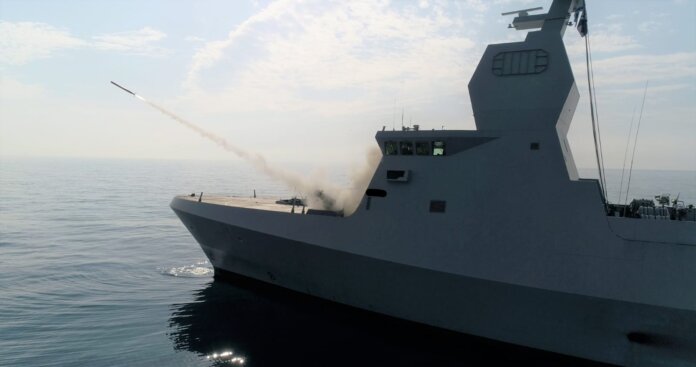
There is also a practical naval advantage that should not be ignored. A recoverable UAV-based decoy would not only help the ship’s defensive geometry; it might also spare the crew the traditional post-launch ceremony of chipping, cleaning, and repainting everything the rocket launcher has just enthusiastically redecorated. Sailors, being deeply committed to operational effectiveness and paint preservation in equal measure, would no doubt receive such progress with measured professional approval.
About the Author
Vito Pesare is a former Italian Navy EW specialist with extensive operational experience in shipborne EW, platform protection, EW training, operational intelligence, and the tactical employment of electronic support and countermeasure concepts. During his naval career he served in operational, instructional and EW staff roles, with experience in maritime self defence, electronic support, electronic attack, and force protection. He is the author of Electromagnetic Warfare: All Your Need to Know; COMINT: All Your Need to Know and Electromagnetic Counter Measure: All Your Need to Know. Mr. Pesare’s public domain work includes co-authored papers with Dr. Richard NM Rudd-Orthner on naval CMS architecture, cognitive EW, platform protection, generic threats, proactive countermeasures, EW operational support cycle reduction and electronic countermeasure representation concepts. His current research interests include naval self defence, cognitive EW, CMS integration, platform protection, SMART Kill concepts, and UAV-enabled off-board soft kill effectors. His current DDLS work explores, at conceptual and unclassified level, how UAVs could support ship point defence as off-board jammers, anti-IR attraction sources, radar reflectors and controlled decoy nodes. The information provided in this article is intended solely for professional discussion and informational purposes. Any opinions expressed herein are those of the author.
Endnotes
[1] Gilchrist, A, ‘From Soft Kill to SMART Kill’, Journal of Electromagnetic Dominance, (Alexandria, VA: Association of Old Crows, April 2026); Andrusenko, J, Haigh, KZ, Cognitive Electronic Warfare: An Artificial Intelligence Approach, Second Edition, (London: Artech House, 2025).
[2] Andrusenko, J, Haigh, KZ.
[3] Andrusenko, J, Haigh, KZ; Pesare, V, Rudd-Orthner, RNM, ‘A Naval Combat Management System (CMS) Architecture to Enable Cognitive Electronic Warfare in Platform Protection’, 28th September 2023 @ consulted 26th May 2026.
[4] Pesare, V, Rudd-Orthner, RNM.
[5] Gilchrist, A; Pesare, V, Rudd-Orthner, RNM.
[6] Gilchrist, A.
[7] Ibid.
[8] Andrusenko, J, Haigh, KZ; Pesare, V, Rudd-Orthner, RNM.
[9] Pesare, V, Rudd-Orthner, RNM.
[10] Andrusenko, J, Haigh, KZ.
[11] Gilchrist, A: Pesare, V, Rudd-Orthner, RNM.
[12] Gilchrist, A.
[13] Ibid.
[14] Ibid.
[15] Gilchrist, A; Pesare, V, Rudd-Orthner, RNM.
[16] Ibid.
[17] Pesare, V, Rudd-Orthner, RNM.
[18] Ibid.
[19] Ibid.
[20] Ibid.
[21] Ibid.
[22] Ibid.
[23] Ibid.
[24] Gilchrist, A; Pesare, V, Rudd-Orthner, RNM.
[25] Ibid.
[26] Ibid.
[27] Andrusenko, J, Haigh, KZ; Al-Harbi, M, Fontain, M, Pesare, V, Rudd-Orthner, RNM, ‘The Rise of the Generic Threat, as a Proactive Generic Countermeasure, and the ECM Codec’, 5th December 2023 @ consulted 26th May 2026.
[28] Andrusenko, J, Haigh, KZ.
[29] Andrusenko, J, Haigh, KZ; Pesare, V, Rudd-Orthner, RNM.
[30] Gilchrist, A; Andrusenko, J, Haigh, KZ; Pesare, V, Rudd-Orthner, RNM.
[31] Pesare, V, Rudd-Orthner, RNM.
[32] Ibid
[33] Pesare, V, Rudd-Orthner, RNM.
[34] Ibid.
[35] Gilchrist, A; Pesare, V, Rudd-Orthner, RNM.
[36] Gilchrist, A; Pesare, V, Rudd-Orthner, RNM.
