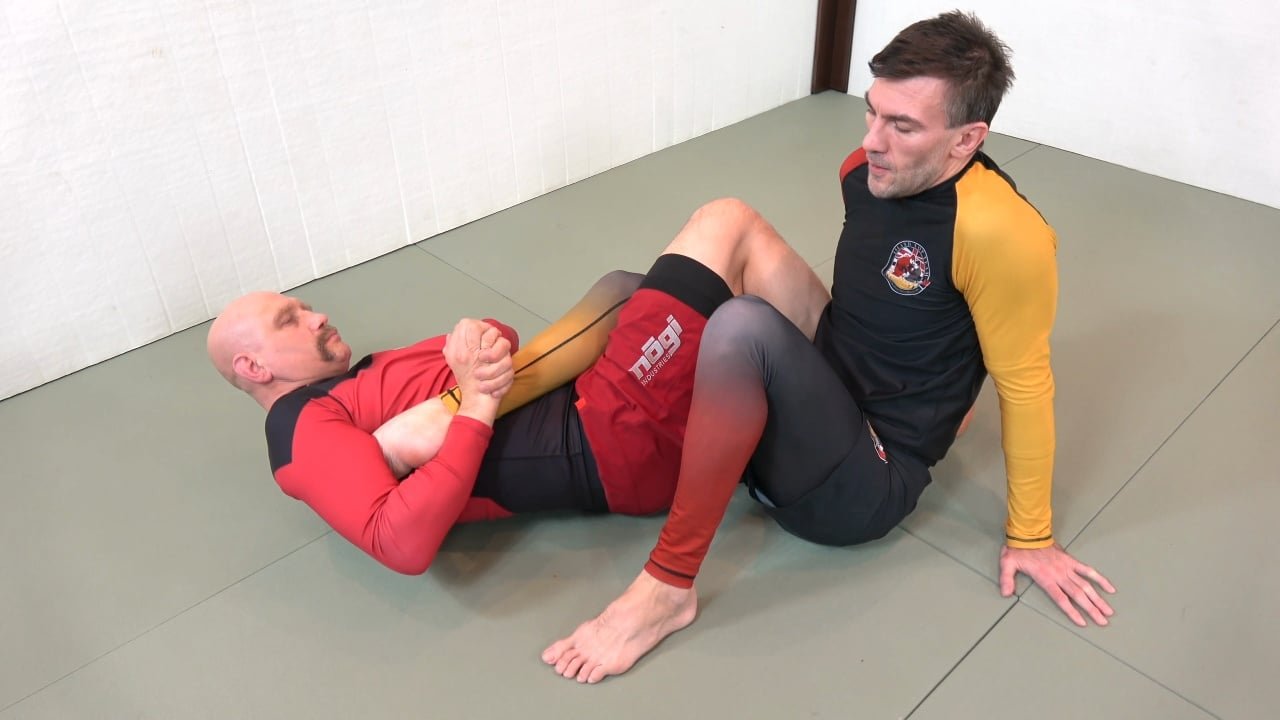
It’s true that I’ve been using leglocks since the 1990s, long before they became popular, and that my fascination with them continues to this day.
In fact, I think that any teacher who doesn’t teach them is doing his students a HUGE disservice.
But it’s ALSO true that I feel physically ill when I see how some schools train leglocks in sparring.
Watching two guys trading toehold for toehold, or attempting to counter a heel hook with another, more violently applied heel hook… well… it makes my cojones want to climb deep into my abdomen.
I have no problem aggressively fighting to get into a leglock control position like standard ashi, kneebar control, or the 411.
But when it comes to actually finishing the technique and trying to tap out your opponent, you have to go from scramble speed to slow motion.
This should now be a technical battle where you’re asking your opponent a question (e.g. do you know what to do if I’m trying to expose your heel?) and see if he has an answer. This is now a slow and almost collaborative project between two training partners, not an explosive fight between mat rivals.
If you’re rolling with someone whose answer to finishing the leglock is to BRIDGE ARCH AND RIP with all his strength, then it’s inevitable that you’re eventually going to get severely injured.
Even if you’re a lot better than him and can counter his wild leglock attack 99% of the time, eventually he’s going to get lucky, or you’re going to mess up, and then before you even get a chance to tap – RIIIIPPP!!!!! – and now you’re looking at surgery to repair ligaments and cut off chunks out of your meniscus.
Training leglocks intelligently comes from the top down. Your instructor and the senior belts have to set the tone and enforce a zero-tolerance policy for people engaging in full-force leglock shootouts or spastic, dynamic applications of breaking mechanics.
Unfortunately, if your instructor isn’t ruthless about enforcing a safe style of training leglocks, then some testosterone-addled, ego-driven maniac will ALWAYS reach the conclusion that harder and faster leglocks are the way to tap out more people, regardless of the shredded knees and ankles they leave in their wake.
Both you and your partner are best served by fighting, fighting, fighting for the leglock position, and then switching into slow-motion precision mode – almost a conversation – about getting to the actual finish.
If you can’t trust your training partner then don’t roll with him.
And especially refuse to roll with that guy who rips leglocks, regardless of whether you’re better than him.
And if you’re a senior belt, then take those maniacs aside and explain to him in no uncertain terms why they shouldn’t be doing that.
I hope this email gives you permission to do something you were probably already thinking about!
Cheers,
Stehan Kesting
Resource 1 – if you’re unsure of what I mean by the term “leglock position” then check out this Leglock Position PDF that I put out as part of the Modern Leglock Formula launch a few years ago.
That Modern Leglock Formula is still a great instructional, btw, if you want to get good at (safe) leglocks and leglock training methods!

Modern Leglock Position Cheatsheets
Resource 2 – check out my latest podcast with Chris “The Villain” Paines, where we talk a LOT about increasing safety and reducing injuries in training.
Controversially, he thinks that being able to hold a submission position for 5 seconds should count as a submission in most circumstances, even if you never apply force into the joint. It’s great food for thought.