

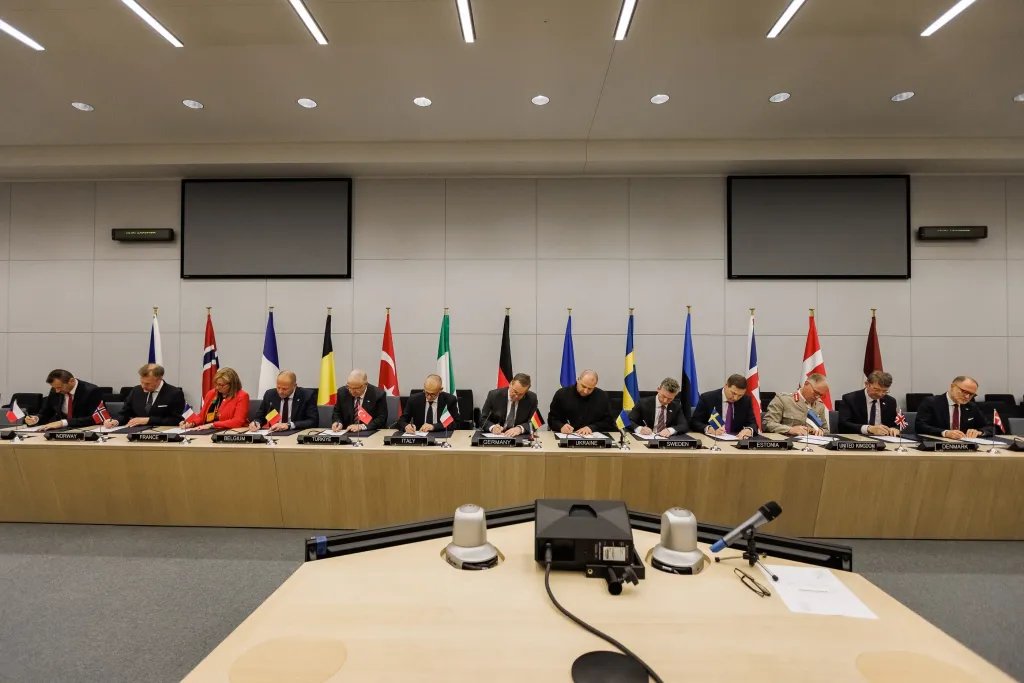

Officials from the Electronic Warfare Capability Coalition updated delegates on the organisation’s progress at this year’s EW Europe conference and exhibition.
The Association of Old Crows’ annual Electronic Warfare Europe conference and exhibition was hosted in Helsinki between 19th and 21st May. The conference programme included a presentation by officials from the multinational Electronic Warfare Capability Coalition (EW CAPCO). Formed in 2025, the EW CAPCO comprises Belgium, Czechia, Denmark, Estonia, France, Germany, Italy, Lithuania, Latvia, Norway, Poland, Sweden, Türkiye, Ukraine and the United Kingdom.
A key goal of the coalition is to intensify electronic warfare support for Ukraine as she continues her efforts to expel Russian forces from her territory. The EW CAPCO has grown by five nations (Belgium, Estonia, Italy, Sweden and Türkiye) over the past year. All member nations have the same status within the coalition. The EW CAPCO forms one strand of the wider Coalition of the Willing established in February 2025. The Coalition of the Willing provides “long-term support for the Armed Forces of Ukraine, which remain the first line of defence against Russian aggression”, in the organisation’s own words.
EW CAPCO representatives told delegates that $4.4 billion has been allocated to electronic warfare expenditure for Ukraine via the coalition for 2026 alone. The coalition procures EW capabilities on behalf of Ukraine including ground jamming systems, Satellite Communications (SATCOM) monitoring and jamming stations, Global Navigation Satellite System (GNSS) Position, Navigation and Timing (PNT) electronic attack apparatus and EW systems to protect critical national infrastructure. Additional materiel being procured includes Counter-Uninhabited Aerial Vehicle (CUAV) detection and jamming equipment. A key task of the EW CAPCO is to coordinate the procurement of this kit and to avoid duplication.
A key benefit of the EW CAPCO is that participants gain valuable insight into how Ukraine employs EW systems on the battlefield, allowing them to digest key lessons learned therein. Knowledge gained from the war may include the need to modify or change national EW policy and doctrine, or to modify local EW capability procurement methods.
Organisation
Subordinate to the EW CAPCO’s leadership is its steering group and the plenary comprising the membership. All three of these bodies form the capability coalition’s secretariat. Subordinate to the secretariat are several subgroups each of which is responsible for key tasks. These tasks include systems procurement; development and implementation; training and education, and policy and doctrine. Germany and Ukraine comprise the systems procurement group. The group procures EW capability sourced either by adapting existing national procurement efforts or initiating new procurements on the EW CAPCO’s behalf. For example, if one country is actively procuring CUAV detection and jamming systems, and/or GNSS PNT attack apparatus, this purchase could be enlarged to accommodate additional systems for Ukraine. Alternatively, a nation may decide to procure several systems that Ukraine needs on her behalf via the former’s national defence procurement organisation.
Ukraine and the United Kingdom are the two nations forming the development and implementation subgroup. This subgroup evaluates EW capability destined for Ukraine initially via laboratory testing. Once the equipment passes the testing stage it is deployed in proximity to the frontline for further evaluation. Assuming the equipment is successful at this stage it is then deployed in combat with the Ukrainian armed forces. The training and education subgroup is the responsibility of Sweden and Ukraine which aims to enhance the electronic warfare intellectual power of the latter by continually improving EW instruction. Finally the policy and doctrine subgroup, presently the responsibility of Ukraine which maybe soon joined by another EW CAPCO member, ensures that member EW policies and doctrines are fit for purpose by reflecting on relevant lessons from the Ukraine theatre of operations.
Deterrent effect
As one EW CAPCO representative articulated during the presentation the participation of Ukraine is essential as it enables “a two-way conversation where we try to exact as much relevant information and insight as we can from Ukraine to help prepare ourselves for future competition with Russia in the electromagnetic spectrum”. Despite its short existence, one could argue that the EW CAPCO is already showing results. As reported in late May, Russia’s rate of battlefield advance is slowing, while Ukraine is enjoying tactical success by commencing limited land force manoeuvre. Operational and strategic gains are being made by striking Russian politico-military, industrial and critical national infrastructure targets at range. Meanwhile, successful Russian suicide uninhabited aerial vehicle and surface-to-surface/air-to-surface missile attacks against similar Ukrainian targets are reducing. Tightly coordinating Ukrainian third-party EW capability provision via the EW CAPCO while improving EW policy, doctrine and procurement approaches may also have an important deterrent effect regarding Russia’s bellicose posture towards Europe: The latter sends the Kremlin a message of “don’t mess with us” as the representative continued.
by Dr. Thomas Withington
