

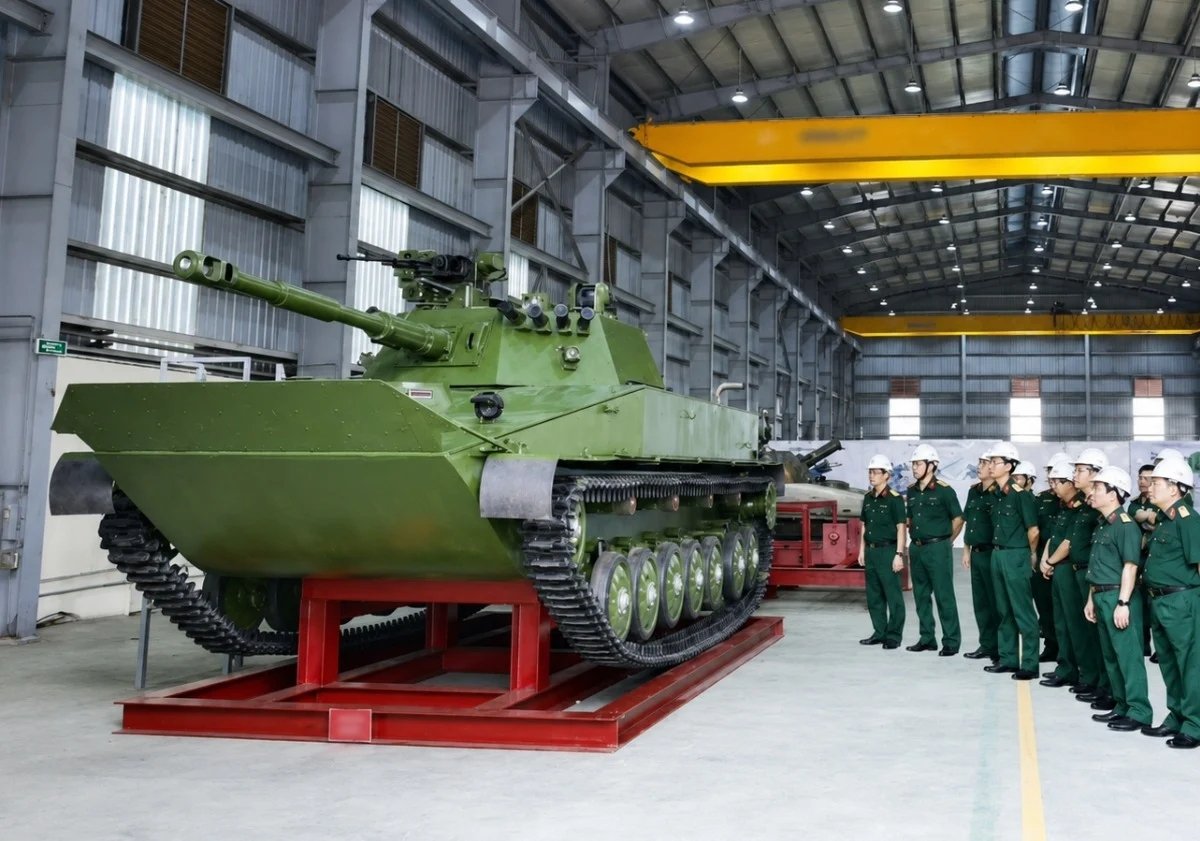
The Vietnam People’s Army’s (VPA) newspaper recently described a public review by senior military leadership of the T-1 amphibious light tank currently being developed by Factory Z125 of the Ministry of National Defence.
Externally a facsimile of the original Soviet PT-76, Vietnam nonetheless claims the T-1 is an entirely indigenous design and part of a larger programme to both modernise the VPA and to reduce dependence on foreign suppliers.
The T-1 is intended to replace Soviet-supplied PT-76 and China-supplied Type 63 light tanks that have been fielded by the VPA since the 1970s.
The T-1, like the PT-76 and Type 63, considers the geography and conditions of Vietnam, including the state of its road network, rice paddies, jungles, rough terrain and waterways.
It is lightweight at 18.6 tonnes, yet its 470hp engine and extended length (featuring seven road wheels each side) provide the favourable power-to-weight ratio and low ground pressure needed to maximise mobility. The benefits of these attributes in Vietnam had been well established by the T-1’s predecessors during the Vietnam War.
An amphibious capability is inherent to the design, with its buoyancy enhanced by the additional length of the T-1 over the PT-76, despite an additional four tonnes of weight. Like the PT-76, the T-1 uses dual water jets to propel itself and to steer in water.
Although not officially stated, one assumes the T-1’s waterborne speed is at least equivalent to the PT-76’s 11.2km/h, and possibly slightly better. The T-1’s water range is also likely similar at around 100km.
Although the T-1 is amphibious, its ability to operate offshore is limited to relatively calm wave and surf conditions. The 76mm main cannon is stabilised and it can effectively engage targets while afloat.
The T-1 takes advantage of current technologies such as an autoloader with a 15-round magazine capacity for the 76mm main gun. A two-man turret enhances efficiency, as the commander no longer needs to load the main gun. In addition to incorporating digital fire controls and more advanced optics, the T-1 has an independent panoramic sight.
A coaxial machine gun is provided, as is a remotely controlled 12.7mm heavy machine gun on the roof. The T-1’s armour protection is typical of light tanks, likely resistant only to smaller-calibre autocannons. However, the T-1 can reportedly be equipped with laser detectors, soft-kill active protection and explosive reactive armour.
The role of the T-1 is to provide support to ground forces, including fire support during river and water crossings. The primary projectile for the main gun is high explosive, with high-explosive anti-tank rounds also available for countering opposing light armoured vehicles.
The timeline for production of the T-1 is targeting initial vehicles to be available for final testing in 2026. It is expected the T-1 will be formally displayed at the VIDEX exhibition in Hanoi from 10-13 December 2026.
by Stephen W. Miller
