

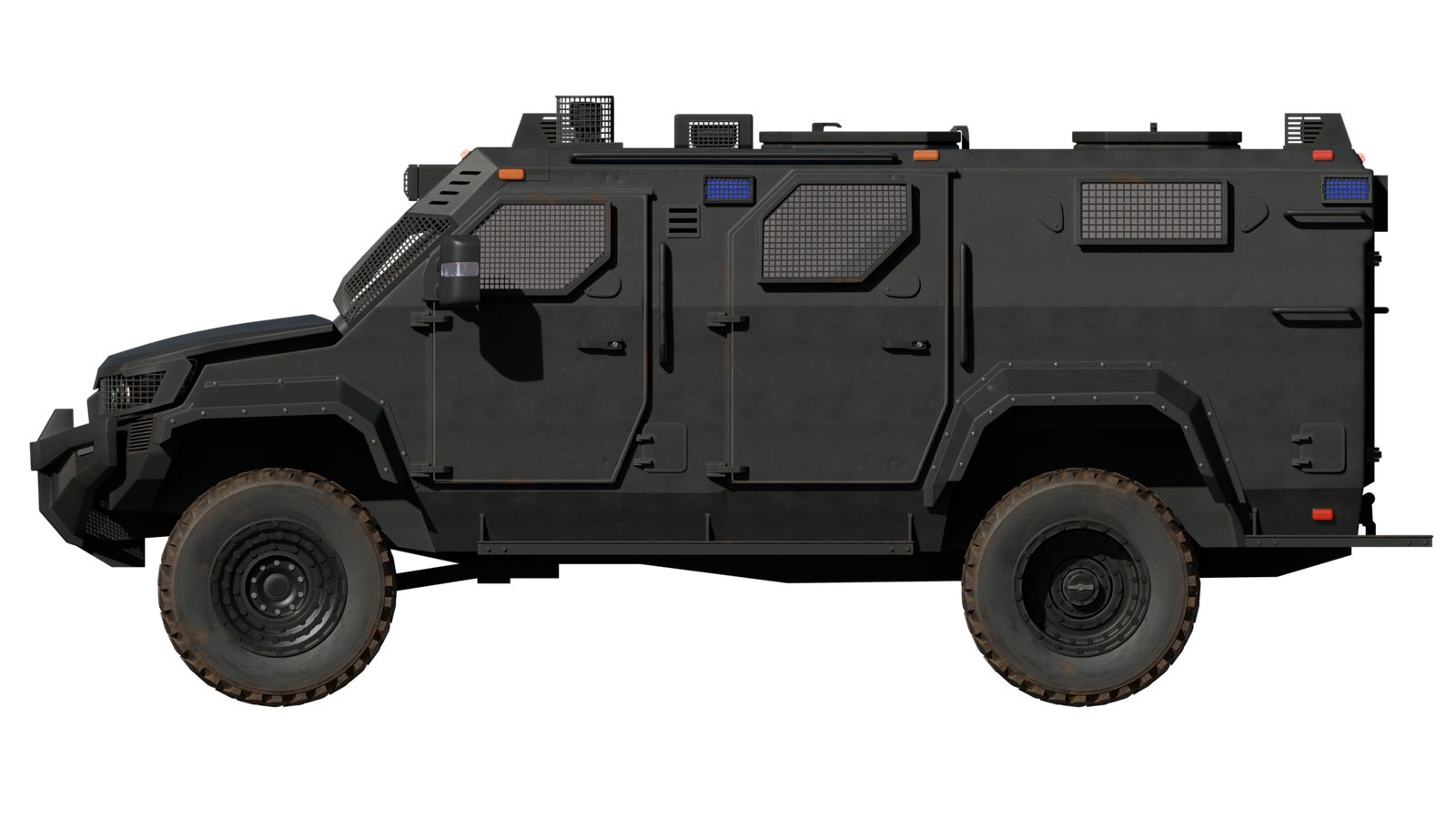
 Italian Republic/Canada (2017-Present)
TAV – 2 Built
 Italian Republic/Canada (2017-Present)
In 2017, the small Italian startup Italian Armoring Solutions (IAS) launched the Testudo, a tactical armored vehicle design based on a US-made Ford F-550 chassis. Despite international marketing, only two vehicles were ever sold to police forces in Chile. Interestingly, these vehicles were manufactured by a subcontractor in Canada. The lack of sales of the Testudo must have been one of the contributing factors why the IAS company deadpooled in the early 2020s.


🔥What’s inside?
✔ All 12 issues in one bundle
✔ Available in PDF and EPUB formats
✔ Enjoy instant access to articles prepared by our team of dedicated writers and illustrators, covering the history of armoured vehicles from the 19th century to the present day, in-depth armored warfare analysis, rare vehicles, prototypes, and much more.
👉 Use promo code SPOOKYTANK25 at checkout for 25% off!
IAS
In late 2016, the company Italian Armouring Solutions (IAS) was established as an innovative startup, based in Scorzè, a comune in the Metropolitan City of Venice in the Veneto region. Its business was the design and production of armored vehicles, specializing in discrete armored luxury, VIP, and security vehicles. In 2017, they also began offering a fully-armored vehicle for police and military purposes, naming it Testudo. In classical Latin, this name means tortoise, but historically, it has also been used to refer to a protected battering ram or a Roman military tactical formation where soldiers would use their shields to form a collective cover for a group.

The Testudo was not built in Italy, but in Canada by some kind of subsidiary that briefly operated under the name IAS Canada. On its website, IAS referred to having a partnership agreement with IAS Canada, providing the address to a small warehouse located at 3379, 9th Line, Innisfil, Ontario. Historical satellite imagery shows barely any activity at this site during 2017. In early 2018, the driveway in front of the office was resealed, but more activity was minor and if IAS Canada ever moved in is unconfirmed. If they had, they vacated the facility possibly already by the end of 2018, as in 2019, a tire company called Tritek Tire Inc. operated from the facility.

Instead, it seems like IAS Canada was more of a shell company, as the manufacture of the Testudo was subcontracted to another company. The only two Testudos ever made were actually built by the company Stark Group Limited, located at 31 Saunders Road, Barrie, Ontario, only 3 km to the north of the warehouse where IAS Canada was registered. Founded in 2010, Stark Group mainly focuses on the design and manufacturing of discrete civilian armored cars. In 2018, it acquired the Ukrainian-registered armoring company Armoured VIP, which also had a presence in Ireland. Also in 2018, Stark Group was subcontracted to assemble the Testudo. Interestingly, Stark Group had earlier built an armored car in cooperation with the Canadian company Cadex Armor, a division of Cadex Defence Inc. This vehicle was advertised by Cadex as the HTA-1. After Stark Group built the Testudo, Cadex replaced this design with the new Testudo design under the same name. Cadex Armor also offers the Emirati Harrow Oskar as the HTA-2.
Additional information on IAS and IAS Canada, or their relation with Cadex Armor and the Stark Group is, unfortunately, limited. IAS entered a highly competitive market and it appears the company did not become particularly successful. Around late 2023, the company’s website was taken offline and it was considered deadpooled by 2024. Regardless, the vehicle is still presented on the Cadex Armor website. Stark Group does not offer the vehicle for sale, but uses images of it in some promotional material.


Design
In 1999, Ford introduced the F-Series Super Duty pick-up truck, consisting of the F-150, F-250, F-350, F-450, and F-550. The latter two were included in the line-up to bridge the gap between the lighter vehicles and the much larger F-650 and F-750 medium duty trucks. Both the F-450 and F-550 were only available as a chassis cab with dual rear wheels and a GVWR up to 8,845 kg (19,500 lb). The combination of the heavy-duty frame and powertrain made the F-550 an ideal platform for the mounting of a completely armored body. In 2017, the fourth generation of the F-550 was launched. It featured a series of improvements in rigidity, versatility, and power, also including cosmetic changes and a modernized interior. Various configurations were available regarding engine and transmission options, the wheelbase, and interior components.

General Layout
The Testudo is based on a 3690 mm (145 in) wheelbase F-550 and has a length of 6365 mm, a width of 2,438 mm (excluding rearview mirrors), and a height of 2,425 mm, or 2,540 mm when including the various accessories mounted on the roof. Empty weight is given between 6.8 tonnes to 7.3 tonnes. Combined with a payload of 2 tonnes, the gross vehicle weight is rated at 8.8 tonnes. The lowest point of the chassis is the drive axle, providing a ground clearance of 430 mm.
The basic layout of a regular Ford F-550 is retained in the Testudo design, featuring a front-mounted engine accessible from the top by opening the hood. Behind it is the driver’s compartment with the driver seated to the left, and the co-driver to the right. The dashboard and seating remains mostly unchanged from a regular F-550, but a control panel has been added between the seats. The windshield is separated in two pieces which is not only cheaper to manufacture, but also allows the placement of one firing port between the two windows. Smaller windows were installed in each side door, with shooting ports located next to them.


The troop compartment is a straight extension of the driver’s compartment with no internal division. Inside, there is space for eight personnel, with two seated on foldable chairs installed to the backs of the driver’s and co-driver’s seats. Two cushioned 3-seater benches run along each side of the troop compartment, also having some storage space underneath. The compartment can be entered through three doors, one located on each side and one on the rear. Windows are located in each side door, with three pairs of two smaller windows placed in each side and in the rear door. Firing ports are located next to each window, eight in total.
All the windows are covered by mesh to protect them from thrown projectiles, such as rocks. To allow the crew to easily enter or exit the Testudo, or ride with it on the outside, running boards are mounted to the sides and around the rear. Grab bars are placed next to the doors and around the rear. Located on the roof are emergency lights, a strobebar, two halogen Golight Model 5149 spotlights, and three hatches, one for the commander and two emergency escape hatches. IAS did mention that a turret was optional, but designs for this are unknown.

Drivetrain
The Testudo is powered by a liquid-cooled 6.7 L Power Stroke 32-valve turbocharged Diesel V8 engine, producing 330 hp at 2,600 rpm. It has a torque of 1,017 N⋅m at 2,000 rpm. The engine is paired with an automatic 6-speed transmission with power transferred to the front and rear axles by driveshafts. All wheels were equipped with US-made military grade Hutchinson wheel assemblies, including run-flat tires.
The winch on the front, rated at 4.5 tonnes, is powered by an electrical 12V motor.
Protection and Armament
The monobloc armored body is welded from certified ballistic steel, likely with a thickness somewhere between 6 to 8 mm. Although still quite thin, it protects against most small caliber fire. The transparent armor is made of layered glass and polycarbonate at 40 mm thick. The floor protects against blasts equal to two DM-51 German ordnance hand grenades. In all, the vehicle reaches CEN safety level B6 (VPAM 7, NIJ III).
The vehicle has no fixed armament, however, the troops can deploy their personal weapons through the eleven firing ports facing to each side of the vehicle. These firing ports are closed with springs and can be opened by pushing them outwards or closed by turning them into their slots. Furthermore, weapons can be deployed on the flat roof with a bipod.

Chile
On 26 December 2017, the Department of Logistical Support (DAL) of the Policía de Investigaciones de Chile (PDI) (Eng. Investigations Police of Chile) launched a tender for two armored vehicles for use by the Brigada de Reacción Táctica Metropolitana (BRTM) (Eng. Metropolitan Tactical Reaction Brigade). This specialized unit was particularly founded to intervene in high-risk operations and support sophisticated police investigations, involving interventions such as deepwater diving. The armored vehicles would make it safer to intervene in armed operations. The bidding was open for one month, until 25 January 2018, and a budget of US$885,000 was made available by the Gobierno Regional de la Región Metropolitana de Santiago (Eng. Santiago Metropolitan Regional Council). The following requirements were set out:
- based on a Ford F-550 or similar commercially available chassis
- crew of at least one driver, one co-driver, and eight personnel
- powered by a 6.7 L V8 turbodiesel engine, producing at least 300 hp at 2,800 rpm and a minimum torque of 1017 Nm at 1,600 rpm
- vehicle dimensions should not exceed 6.7 m length, 2.5 m width, and 2.6 m height
- a gross weight of 9,850 kg with a payload of 1,800 kg
- power-assisted steering
- electronic and automatic 6-speed gearbox
- reinforced suspension
- monobloc-type armored body, bolted to the chassis with damping bushings
- four side doors, one rear door
- one shooting port on the front, four on either side, two in the rear
- three hatches in the roof, including two emergency escape hatches
- armor around the driver’s compartment, troop compartment, and fuel tank, should be according to NIJ III, BR6 ratings
- bulletproof glass should be at least 39 mm thick, and the floor armor should protect against simultaneous explosion of two hand grenades
- two front seats, two folding seats behind these, two sets of three seats running along the side, optionally benches with storing space underneath
- electrical winch, rated at 9,500 pounds, coupled to a 12V motor
- a Federal Signal siren, or equivalent (power 200 watts)
- Motorola APX2500 radio or equivalent
- Federal Signal Quadra Flare lights with eight blue leds and two Model 5149 Golight halogen spotlights, or equivalent
By the time the tender closed, seven responses were received. Five of these were approved for consideration. The other two options by the companies SAT Internacional S.A. and Voin Solutions SpA, lacked proper documentation regarding guarantees. Although the specific models these two companies offered was not specified, based on later offers, these likely concerned the Israeli Plasan Sandcat and the Emirati Streit Group Spartan, respectively.
Considering the five options, the DAL dismissed the options by Conversiones San José, Servicios Informáticos Santiago SpA, and Tecnove Security S.L. as not all specifications were met. This left Tecnofase with the IAG Guardian and WLP with the IAS Testudo for consideration in the economic evaluation. Although not battle-proven like the IAG Guardian, the IAS Testudo appealed due to its lower price. In March 2018, the DAL announced it chose the IAS Testudo, paying US$841,000 instead of the earlier projected US$707,000. Delivery was expected in October.
WLP
The company responsible for delivery was Worldwide Latest Products (WLP), based in the Chilean capital Santiago. It specializes in the delivery of specialized vehicles and equipment, particularly firefighting and mining equipment. WLP was established no later than 2014 and is still in business as of mid-2026.

Delivery
In November 2018, the two completed vehicles arrived in Chile and were handed over to the PDI. The new operators received a brief training course. A few months later, on 28 February 2019, an official ceremony was organized by the PDI and the regional government of Santiago. Attending were the Director General of the PDI, Héctor Espinosa, the commander of the BRTM, Commissioner Alexander Muñoz, and the Intendant of the regional government of Santiago, Karla Rubilar.
The two PDI vehicles were painted black, received yellow PDI markings on the front side doors, and got the registration plates ‘KY·BH·13’ and ‘KY·BH·14’ in the private plate format with black letters on a white background, as usual for PDI vehicles. The yellow PDI markings were later removed. Further information regarding deployments of the vehicles is limited, but they were regularly spotted on the streets of Santiago.
Reportedly, since around early 2024, the Testudos suffered some mechanical malfunctions. Combined with the need for a somewhat smaller vehicle to ease operations in the narrow streets of Santiago, powered by a gasoline engine instead of diesel, a tender was launched in late 2024 for the purchase of two new armored vehicles, but all bids failed to comply with the requirements. In 2025, the PDI decided to launch two separate tenders to solve the equipment issues. On 26 June 2025, a tender was launched for the purchase of six discretely-armored station wagons for the BRTM. On 31 July, a second tender followed for the purchase of two tactical armored vehicles. In October, it became clear that the company Comercial Raptor SpA won both tenders and was contracted for delivery of six armored Chevrolet Tahoe station wagons, as well as two Canadian-made Roshel Senator ERVs. The Roshel contract was worth US$996,000 with delivery expected by March 2026. Although delivery is still unconfirmed as of May 2026, they will likely replace the Testudo in frontline service during the year.


The Nigerian Connection
Although sales did not occur, the Testudo was also actively advertised on the Nigerian market by Secpro Africa Ltd. This Nigerian-based company is one of many organized under the Secpro Holding corporation based in the United Arab Emirates. Secpro Holding also has official connections with the Italian company Eli Group, which is specialized in marine electrical systems. The Secpro Africa Ltd division specializes in security and defense matters and also acts as an intermediary for armored vehicle procurement. In this capacity, Secpro Africa Ltd. partnered with IAS already in 2018, offering the vehicle on the Nigerian market under the name Patroller.

Conclusion
Vehicles like the Testudo are popular thanks to the favorable performance of their well-proven Ford chassis, combined with an imposing design of the armored body. However, the Testudo itself was not particularly successful. The Testudo signifies the degree of internationalization in commercial armored vehicle manufacturing. As an Italian design, it was built in Canada involving at least three companies, and was then sold to Chile through a Chilean company, and marketed in Africa through a Nigerian company that was part of a larger holding based in the United Arab Emirates. These connections usually make it notoriously hard to track armored vehicle sales, especially those to non-military security agencies.

| |
|---|---|
| Dimensions (LWH) | 6,365 x 2,438 x 2,425 mm |
| Weight | 6,845 kg |
| GVW | 8,845 kg |
| Crew | 2+8 (driver, co-driver, 8 personnel) |
| Propulsion | 6.7 L Power Stroke 32-valve turbocharged Diesel V8 engine, rated 330 hp@2,600 rpm, torque 1,017 N⋅m@2,000 rpm |
| Transmission | Automatic, 6 forwards, 1 reverse |
| Wheelbase | 3,690 mm |
| Ground clearance | 430 mm |
| Angle of approach | 40° |
| Protection | CEN Level B6 (VPAM 7, NIJ III) |
| Armament | personal weapons, 11 firing ports |
