

 Germany/USSR/USA (WWII)
Heavy Tank

 Germany/USSR/USA (WWII)
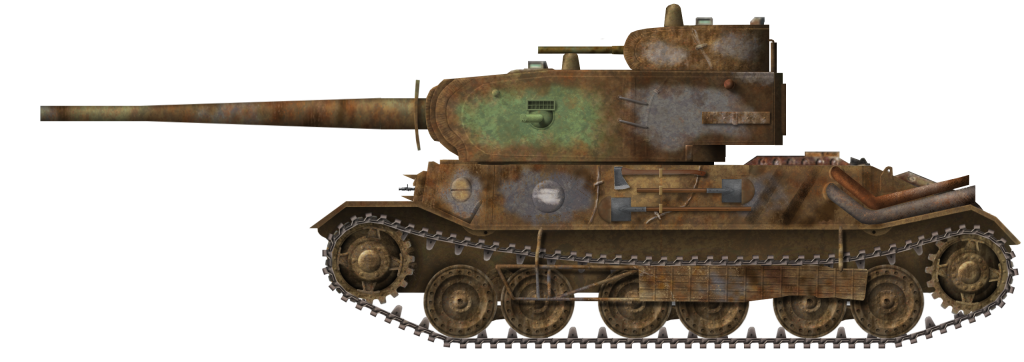
Nowadays, Wargaming’s mobile version of its flagship title, World of Tanks Blitz, is no stranger to presenting less authentic or fictional vehicles. The first of these, however, was something rather unusual and original. During the 2015 Halloween event, players who completed a series of special in‑game missions could unlock the Tankenstein, a Tier VII heavy tank with premium benefits. This vehicle was assembled from components of real tanks from several nations, echoing the fictional creature of Dr Frankenstein in Mary Shelley’s novel, Frankenstein.

🔥What’s inside?
✔ All 12 issues in one bundle
✔ Available in PDF and EPUB formats
✔ Enjoy instant access to articles prepared by our team of dedicated writers and illustrators, covering the history of armoured vehicles from the 19th century to the present day, in-depth armored warfare analysis, rare vehicles, prototypes, and much more.
👉 Use promo code SPOOKYTANK25 at checkout for 25% off!
Mary Shelley
Mary Wollstonecraft Shelley (1797–1851) was born in London to philosopher William Godwin and feminist advocate Mary Wollstonecraft, who died eleven days after her birth. Raised by her father in an intellectually stimulating environment, Mary received an unusual education for a young woman of her time, with access to his extensive library and circle of prominent intellectuals, including English philosopher Samuel Taylor Coleridge and American Vice President and Senator Aaron Burr.

Source:
In 1814, at sixteen, Mary began a clandestine romance with Percy Bysshe Shelley, a radical poet already married to another woman. Together with her stepsister Claire Clairmont, they eloped to France and traveled through Europe. In 1816, Percy’s first wife, Harriet, committed a suicide; it was, allegedly, caused by Mr. Shelley’s affair with Mary. The couple got married in December 1816. The couple’s relationship was marked by intellectual partnership, radical political ideals, and personal tragedy – Mary endured the deaths of several children, including a prematurely born daughter and two children who died in Italy from illness.
Mary conceived Frankenstein during the summer of 1816 at Lake Geneva, where she stayed with Percy Shelley, Lord Byron, and John Polidori. During a period of rainy confinement, discussions about the nature of life sparked her imagination, and she began what she assumed would be a short story. Encouraged by Percy, she expanded it into her groundbreaking novel Frankenstein, published anonymously in 1818. Beyond Frankenstein, Shelley authored numerous other works, including historical novels (Valperga, Perkin Warbeck), the apocalyptic The Last Man, biographical essays for Lardner’s Cabinet Cyclopaedia, and later novels (Lodore, Falkner), demonstrating her range and sustained literary output throughout her life.
In 1822, Percy Shelley drowned in a sailing accident near Italy, leaving Mary a widow at twenty-four. She devoted herself to raising their surviving son, Percy Florence, and to a professional writing career. Financially constrained by her father-in-law’s limited allowance, Mary worked prolifically as an author and editor. She devoted considerable energy to editing and promoting her husband’s poetry, producing the definitive 1839 edition that established his literary reputation. Her editorial work and biographical writings, though sometimes constrained by Victorian propriety and familial restrictions, became influential in shaping literary history. Mary Shelley died in 1851 at fifty-three, likely from a brain tumor, leaving behind a legacy that extended far beyond Frankenstein – one of consistent political engagement, feminist principles, and diverse literary achievements that scholars have only recently fully appreciated.
Frankenstein, or, The Modern Prometheus
N.B.: This section discusses the plot of Mary Shelley’s Frankenstein novel and may contain spoilers. The author strongly recommends reading the novel first, as the original text is far richer than any synopsis.
Mary Shelley’s novel employs a complex narrative structure featuring Captain Robert Walton, an Arctic explorer, who takes the dying Victor Frankenstein aboard his ship. Walton records Victor’s account, which forms the novel’s central narrative. Victor recounts how, as a young student at the University of Ingolstadt, he became obsessed with understanding the principle of life itself. Driven by ambition and a desire to unlock the secrets of creation, he conducted years of grueling research, ultimately discovering a method to animate dead matter.

Source: Tate Britain. Private collection, Bath via wikimedia.com
Using human body parts gathered from graves and dissecting rooms, Victor constructs a creature of gigantic proportions. However, the moment his creation awakens, Victor is horrified by its hideous appearance and abandons it in revulsion. The lonely creature, intelligent and sensitive but rejected by society, seeks to understand the world through observation and reading. After discovering Victor’s journal, the creature realizes he was created by Victor and demands that his maker create a female companion for him. When Victor destroys the partner he began constructing for him in fear that she might bear monstrous offspring, the creature vows vengeance swearing, “I shall be with you on your wedding night.”
The creature systematically destroys everyone Victor loves – murdering his closest friend Henry Clerval, his beloved Elizabeth on their wedding night, and finally his father. Driven to madness by grief and desperate for justice, Victor pursues his creation across the frozen Arctic wasteland. When Victor dies aboard Walton’s ship, the regretful creature, mourning his creator, disappears into the Arctic darkness.
Dr. Frankenstein’s Creature in Modern Culture
Mary Shelley’s Frankenstein, published in 1818, lay dormant in popular culture for over a century before the creature truly became a household icon. The first dramatic adaptation appeared just five years after publication, in 1823, with a stage play titled ‘Presumption; or, the Fate of Frankenstein’, but it was not until film technology emerged that Frankenstein’s monster achieved its legendary status.

Source: courtesy University of Massachusetts, Amherst via nlm.nih.gov
Edison Studios produced the first film adaptation in 1910, yet the creature remained relatively obscure until 1931, when Universal Studios released James Whale’s Frankenstein, featuring Boris Karloff in his most famous role. This film arrived during the Great Depression and resonated deeply with audiences, outperforming Universal’s simultaneous release of Dracula. Within weeks, the film had become a phenomenon, establishing the now-iconic visual template for the creature: the flat-topped head, bolts protruding from the neck, lurching gait, and greenish complexion. This particular aesthetic was created by makeup artist Jack Pierce rather than derived from Shelley’s novel, and became so embedded in Western consciousness that it fundamentally redefined how the creature was understood across nearly all future media.

Source: Classic Hollywood HQ via facebook.com
By the mid-twentieth century, Frankenstein’s monster had become inseparable from Halloween itself. In 1957, Universal syndicated 52 of their pre-1948 horror films for television, dramatically expanding the monster’s reach into American homes and solidifying its association with seasonal celebrations. Today, the creature ranks among the most instantly recognizable Halloween costumes globally, so pervasive that August 30th – Mary Shelley’s birthday – has been officially designated as ‘Frankenstein Day’ in honor of the character.
The cultural dominance of Frankenstein’s monster extended far beyond horror films. Universal’s original series spawned increasingly absurd sequels, including the Bride of Frankenstein (1935), Son of Frankenstein (1939), Ghost of Frankenstein (1942), and ultimately Abbott and Costello Meet Frankenstein (1948), in which the creature was relegated to comic relief. This trajectory reflected the creature’s transformation into a versatile cultural commodity capable of inhabiting multiple genres.

Source: photo courtesy of Universal Pictures via www.sgn.org
The 1975 film The Rocky Horror Picture Show reimagined the entire Frankenstein narrative as a musical parody, while Saturday Night Live featured Phil Hartman’s recurring comedic portrayal of the monster in the early 1990s, delivering the iconic line, ‘Fire bad!’ These comedic reinterpretations paradoxically reinforced rather than diminished the creature’s cultural significance; by the 1980s and 1990s, Frankenstein’s monster had become sufficiently embedded in popular consciousness that it could be either terrifying or hilarious depending on its context.

Source: ‘Weekend Update: Frankenstein on Congressional Budget Cuts’ (SNL) via www.youtube.com
In recent decades, the creature has experienced a remarkable rehabilitation in family-oriented media. The Hotel Transylvania animated franchise, which debuted in 2012, features Frankenstein as a sympathetic, even endearing character voiced by Kevin James. In the film, the monster is not a tragic outcast but rather one of Dracula’s most valued guests at his monsters-only resort, a safe haven where horror movie creatures can escape human persecution. During the franchise’s climactic szequence, Frankenstein appears at a human ‘Monster Festival’, where the assembled crowds greet him with wild applause and adoration – a narrative inversion that transforms the creature from a figure of revulsion into one of beloved celebrity. This shift reflects broader changes in how contemporary audiences view the horror genre in general, and famous horror movie monsters. While these characters were once exclusive to movies with an older target demographic, now they are able to appear in comedy films aimed at teaching children to be kind and welcoming to others.

Source: newsweek.com
The 2025 release of Guillermo del Toro’s Frankenstein on Netflix represents perhaps the most ambitious and visually elaborate adaptation of Shelley’s novel in the streaming era. Del Toro, who described the project as a ‘dream’ he would ‘kill to make’, spent nearly two decades developing an approach that honors both Shelley’s original text and the creature’s cinematic legacy while charting its own artistic course. Starring Oscar Isaac as Victor Frankenstein and Jacob Elordi as the Creature, the film runs over two and a half hours – a runtime equivalent to watching both the 1931 and 1935 Universal films consecutively.

Source: Netflix
Del Toro’s adaptation draws inspiration from Bernie Wrightson’s 1983 illustrated edition of the novel, creating a visual aesthetic distinct from Karloff’s iconic portrayal while maintaining reverence for the Gothic tradition Whale established nearly a century earlier. Critics noted that del Toro’s film represents perhaps the most visually consequential Frankenstein adaptation of the twenty-first century, demonstrating that Shelley’s narrative continues to generate major studio investment and directorial ambition even in an era saturated with superhero franchises and intellectual property remakes.

Source: Netflix, photo by Frank Ockenfels
Frankenstein’s monster to varying degrees continues to function as a cultural archetype representing anxieties about scientific overreach, the dangers of unchecked ambition, and society’s treatment of the marginalized and different. The creature appears in comic books, video games, television shows ranging from The Simpsons to Scooby-Doo, academic analyses, parodies, and reimaginings too numerous to catalog.
The character’s trajectory from Shelley’s tragic, articulate creation to Universal’s silent, sympathetic creature, to contemporary interpretations as family-friendly holiday mascot reflects evolving cultural values and anxieties. Unlike other Gothic monsters – vampires, werewolves, witches – which have experienced periodic resurgences and declines in popularity, Frankenstein’s monster maintains a steady, almost ubiquitous presence throughout Western culture. This consistency stems partly from the creature’s visual distinctiveness and partly from the enduring resonance of Shelley’s themes regarding responsibility, isolation, and the consequences of unchecked technological ambition. In contemporary discourse, ‘playing God’ through genetic engineering, artificial intelligence, and biotechnology frequently invokes Frankenstein as a cautionary reference point, ensuring the novel and its creature retain cultural relevance well beyond entertainment contexts.
‘Frankentanks’ Used in Real-Life Warfare
Like Wargaming’s Tankenstein, in real life, necessity, and availability has led to many vehicles composed of an amalgamation of parts from other vehicles. A common combination, used by both the German and Soviet armies during the WWII, was to rearm captured vehicles with domestic guns. The Red Army drew up such proposals for almost every major type of German tank in service: the Panzer 38(t) (the 38T ‘Praga’ with a 20 mm ShVAK or 45 mm 20K), Panzer III (T-III-45), StuG III (SG-122, SU-76i, and SU-85i), Panzer IV (T-IV-76), Panther (T-V-85), and Tiger I (T-VI-100).

Source: Zinoviy Alexeev Design Bureau, drawn by Andrej Sinyukovich, based on CAMD RF 81-12038-775.
However, none of these concepts progressed beyond the design stage, whereas their German counterparts were more successful. The Wehrmacht rearmed at least one captured KV-1 heavy tank with the 7.5 cm PaK 40, fitted KV-2s with standard German commander’s cupolas, and even proposed mounting captured 85 mm 52-K anti-aircraft guns, rebored to 8.5/8.8 cm calibre, in T-34-85s and SU-85s.

Source: ‘Padomju Latvija’ Nr. 5/6,
Another type of historical conversion was the combination of hulls and turrets from different vehicles. At least two variants of a vehicle combining the hull of an R-35, a French light tank, with the turret of a T-26, a Soviet light tank, are known to exist. The first, fitted with a conical turret, was produced by the Wehrmacht and is unofficially designated Panzerkampfwagen 35R 731(f) mit T-26 Turm. The second employed a cylindrical turret instead and is believed to be Romanian. The turret ring of the Soviet tank was only slightly wider than the French one at about 20 cm, making the functionality of the hybrid possible. Although the operational history of these vehicles remains unclear, they were likely improvised conversions, created to compensate for losses and fill gaps in the ranks of the defending forces.

Source: ‘The Use of Captured Equipment in the Red Army and the Wehrmacht’ (rus. ‘Использование трофеев в РККА и Вермахте’) , p. 81 // by Leonidych67 – March 21st, 2019 – SmolBattle Historical Research Forum;
‘Frankentanks’ continued to be developed during the Cold War. The United Kingdom, Canada, and the United States collaborated closely during the emerging Cold War era on a variety of military projects, and tank design was among them. Work between the United States, the United Kingdom, and Canada, known as the ‘ABC’ countries (America, Britain, and Canada), had achieved a degree of interchangeability and standardisation for tank programmes by 1957. Among the programmes were the standardisation of the British 105 mm gun, the British 120 mm gun, an American version of the British 120 mm gun, and two projects related to the FV4201 ‘Chieftain’ and T95 Medium Tank: mounting the FV4201 turret on the T95 chassis, and mounting the American T95 turret on the FV4201 chassis.

Source: Hunnicutt Richard Pearce, ‘Abrams: A History of the American Main Battle Tank’, Vol. 2, Reprint ed. // Echo Point Books & Media – September 15th, 2015 – 324 p.
Starting in the Cold War period, many countries began working on another type of proposal that might be considered ‘Frankentanks’. These are multipurpose standardised chassis designed from the outset to be converted into vehicles serving various roles: light tanks, self-propelled guns, armored personnel carriers, self-propelled anti-aircraft guns or missile launchers, reconnaissance vehicles, tank destroyers and anti-tank guided missile launchers, sometimes even main battle tanks. Many such platforms were developed and continue to be developed to this day, including the West German PumA Armored Combat Vehicle by Krauss-Maffei and Diehl (not to be confused with the Puma IFV), British RO2000 program, Spanish Triana and Pizarro families of vehicles, and modern Russian Armata Universal Combat Platform.

Source: ‘The Former ACV-Puma’ forum thread // August 15th, 2017 – Mechanized Warfare topic – Sturgeon’s House forum;
These standardized platforms are marketed as cheap, easy-to-produce solutions and are often intended for export. However, very few of these concepts, including the aforementioned PumA, RO2000, Triana, and Armata, progress beyond the prototype or small-series production stage. Major tank-manufacturing powers, such as China, France, Germany, Russia, and the United States, tend to operate vehicles built under individual projects, whereas smaller countries with tighter military budgets struggle to produce even these standardized platform vehicles, often ending up adopting just one member of the family, like a light tank or an IFV.
Towards the Abyss: ‘Frankentanks’ Created by Wargaming
In the first years of its existence, the World of Tanks online game – including the console, mobile and Russian versions World of Tanks Console, World of Tanks Blitz and Mir Tankov respectively – positioned itself as featuring historical combat vehicles from the 20th century; However, even then, its designers took the liberty to alter historical parameters of the real vehicles and to add non-historical modules (turrets, guns, engines) as upgrades, resulting in numerous ‘Frankentanks’ in game.

Source: created by Pablo Escobar (Zinoviy Alexeev Design Bureau), based on screenshot from World of Tanks online game
Today, in 2026, the vast majority of vehicles being introduced to the game are based very loosely on historical ideas if they are not completely fictional. Moreover, World of Tanks now possesses its own established lore – an alternative history, within which these fictional vehicles exist. Unfortunately, the reputation of a historical game misleads some players to believe that upcoming vehicles share something with real history, causing some heated discussions among fans.
Name
Depending on the game region, the vehicle’s name was altered by combining the word ‘tank’ with different parts of the surname ‘Frankenstein’: in English-language versions, it is called ‘Tankenstein’, whilst in Russian it was designated ‘Frankenstank’ (Rus. ‘Франкештанк’), or ‘Frankentank’. This article uses the English version of the name.
Design
The World of Tanks developers created a fictional backstory for the tank’s origins.
“In the German-esque town of Middleburg, Doctor Tankenstein devised plans to construct a monstrous, fire-breathing weapon of unequalled strength and power. By assembling components from some of history’s most formidable tanks, he created Tankenstein.”
The vehicle is essentially an amalgamation of components from three states – Nazi Germany, the United States, and the Soviet Union. The hull is German, derived from Porsche’s concept submission for the Tiger I competition, the turret is Soviet, taken from one of the KV-4 designs created by G.N. Moskvin, and the main armament is presented in two options: either the 105 mm T5E1 gun from the American T29 Heavy Tank concept, or the 130 mm B-13-S2 gun from the Soviet SU-100Y self-propelled gun prototype.

Source: World of Tanks Blitz
Mounting the 105 mm gun provides the tank with increased frontal turret armour, as the T29’s thick gun mantlet is also incorporated. The 130 mm gun offers greater firepower in game; however, it lacks the aforementioned mantlet, which reduces the vehicle’s frontal turret armor protection.
The vehicle is adorned with numerous abnormal features, including ventilation piping on the right side of the turret, two large sickles in place of pioneering tools on the right of the hull, metal ‘stitches’, a Vickers machine gun mounted in a ball turret on the left side of the turret, spiked rivets, spiked drive and idler wheels, makeshift Schürzen-style side skirts covering the road wheels, and a large hot-rod-style exhaust pipe at the left rear, which emit flames when the engine is running.
Hull and Chassis
The overall layout of the Tankenstein’s hull and chassis remained largely consistent with that of the original Tiger Porsche prototype, comprising a forward compartment for the crew and a rear compartment for the engine and transmission.
The vehicle had an externally mounted suspension. It featured a front idler sprocket and a rear drive sprocket, along with six large road wheels, on each side. The latter were arranged in pairs, each independently suspended, which were supported by longitudinal torsion bars. For shock absorption, the all-metal road wheels also incorporated internal springs.
The front idler sprocket and rear drive sprocket looked nearly identical. This was done primarily to simplify the production, though the toothed idler also helped to prevent track shedding, a particular concern for the vehicle considering the hull’s length and the absence of return rollers. Both sprockets were 920 mm in diameter and consisted of two toothed rings with 19 teeth. The 600 mm wide tracks were joined by single pins.

Source:
Assuming the vehicle relied on the original VK45.01(P) chassis, it would have been powered by a petrol-electric drive system. This consisted of two Typ 101 engines (producing 310 hp at 2,500 rpm each) coupled to two Siemens generators. These generators supplied power to two Siemens Typ 1495a direct-current electric motors (rated at 230 kW each), which drove the rear sprockets via electromechanical final drives.
In real life, the original VK45.01(P) drive train proved overly complex and unreliable. Consequently, the VK45.01(P)-based Ferdinand tank destroyer had the petrol-electric system replaced by two Maybach HL 120 TRM petrol engines, each delivering 265 hp at 2,600 rpm.

Source:
In the game, the vehicle has a fictional ‘Stein Type 1’ engine (550 hp) and top speed of 35 km/h. This, in fact, is equivalent to the 2x Porsche Typ 100/1 Ausf. A 550 hp engine, an option for the in-game Porsche Tiger. This was a real engine, developed for the Porsche Typ 100 heavy tank, also known as VK30.01(P) ‘Leopard’. The VK30.01(P) was powered by two Typ 100 10-cylinder gasoline engines, each producing 210 hp at 2,500 rpm each.
Turret
The turret of the Tankenstein is based on a real Soviet proposal, developed within G.N. Moskvin’s variant of the KV-4 heavy tank.
The turret for KV-4 by Moskvin was very large. This was necessary to accommodate not only the large 107 mm main gun, but also the turret ring of the auxiliary turret, mounted at the rear. The 107 mm main gun’s ammunition, as well as the secondary gun’s, was placed underneath the main turret ring.

Source: Kolomiets Maxim, «Stalin’s Supertanks: IS-7 and Others. Super-Heavy Tanks of the USSR» (Rus. «Супертанки Сталина ИС-7 и др. Сверхтяжелые танки СССР») // Eksmo, Moscow – 2015 – 144 p;
The mantlet was placed on the frontal curved armor plate. It was additionally protected by two ‘fins’ on its sides, hiding the internal mechanism from the outside. The mantlet’s armor plates were curved, providing effective protection frontally as well. The auxiliary turret, armed with a 45 mm 20-K gun, featured a commander’s cupola with an unspecified amount of periscopes.
The main armament of the Tankenstein was borrowed from two in-game vehicles, both built in metal in real life: the 105 mm T5E1 from the American Super-Heavy Tank T28 and Heavy Tank T29, and the 130 mm B-13 from the Soviet SU-100Y self-propelled gun.
Armament, Option I: 105 mm T5E1
The 105 mm Gun T5E1 originates from the Anti-Aircraft 105 mm Gun T4 and was selected as the main armament for several prospective US heavy tanks. These included M6A2E1, T28/T95, and T29. It provided significant anti-concrete performance, which was essential for armored vehicles intended to destroy bunkers and other heavy fortifications. T5E1 also possessed excellent armor-piercing capability, which was important in late stages of the World War, when the heavily armored German vehicles, such as the Tiger II, Jagdtiger, or prospective Panzerkampfwagen Maus, started approaching the battlefield.

Source: Couderc Nicolas, ‘T28 105 mm Super Heavy Tank’ // Tank Zone («Blindés – Canons – Moteurs»), No. 7 – Histoire & Collections.
The T5E1’s predecessor, the 105 mm Gun T5, was in fact an attempt to adapt the T4 anti-aircraft gun for tank use. It featured a shortened 48-calibre version of the original 65-calibre barrel; however, its performance was significantly inferior to that of T4. Therefore, with the goal of improving the new tank gun’s characteristics to meet or exceed those of the T4, the new 65-calibre T5E1 was developed in late 1944. The T5E1’s muzzle velocity was the same as that of the T4. In order to manage recoil and improve the crew’s view after firing, the 105 mm Gun T5E1 was fitted with a double-baffle Muzzle Brake T10.

Source: US National Archives via imgur
The 105 mm T5E1 gun was of monobloc construction with uniform right‑hand rifling. It used a vertical sliding‑wedge breech block, and three recoil cylinders were mounted on top of the gun cradle, which was installed on the T123 gun mount. The T5E1 used two‑piece ammunition, with the cartridge case and projectile loaded separately.
| 105 mm T5E1 parameters | ||||||||||||||||||||
|---|---|---|---|---|---|---|---|---|---|---|---|---|---|---|---|---|---|---|---|---|
| Shell type | APHEBC | APBC | APCR | HE | ||||||||||||||||
| Designation | T13 | T32 | T29E2 | T30E1 | ||||||||||||||||
| Mass | 18.59 kg | 17.7 kg | 11.2 kg | 15.2 kg | ||||||||||||||||
| Muzzle velocity | 899 m/s | 914 m/s | 1128 m/s | 945 m/s | ||||||||||||||||
| Charge load & explosive type | 0.181 kg charge (0.1774 TNT eq.) | – | – | 1.55 kg TNT | ||||||||||||||||
| Penetration | 219 mm kinetic + 15 mm explosive | 258 mm kinetic | 377 mm kinetic | 32 mm explosive | ||||||||||||||||
| 6 rpm | Parameters of penetration are given for 0 m and 0°. | |||||||||||||||||||
| Source: ZA DB, Pablo Escobar’s gun catalogue N.B. Explosive penetration is the approximate armor thickness that a shell can break using blast effect rather than direct kinetic penetration. It is estimated from field tests with real shells, which typically perforate armor about one-third of their calibre, and fail to perforate armor that is around 1.5-2 times less than their calibre in thickness. | ||||||||||||||||||||
The mantlet of the real T29 Heavy Tank also included two coaxial 12.7 mm M2HB machine guns, which are not functional in game. It featured a dual-power T143E1 telescope, adjustable from 4x to 8x magnification, derived from the T122/M83 telescope used with the 90 mm gun.
Armament, Option II: 130 mm B-13
The 130 mm B-13 naval gun, officially known as the 130 mm L/50 Naval Gun B-13 Model 1935, was a Soviet artillery piece developed in the 1930s primarily for naval use on destroyers and other vessels. It featured a high muzzle velocity of around 870 m/s, enabling effective ranges up to about 25 km, but early models suffered from rapid barrel wear, limiting lifespan to roughly 130 rounds before improvements extended it to over 1,100. The gun weighed approximately 5 tonnes and used separate-loading ammunition, including semi-armor-piercing and high-explosive shells, with a rate of fire between 7-8 rounds per minute depending on the mount.
| 130 mm B-13 L/50 parameters | |||||
|---|---|---|---|---|---|
| Shell type | SAPHEBC | SAPHE | HE | ||
| Designation | PB-46A | PB-46 | OF-46 | OFU-46 | |
| Mass | 33.5 kg | 33.4 kg | 34.17 kg | ||
| Muzzle velocity | 870 m/s | ||||
| Charge load & explosive type | 2.35 kg TNT | 1.72 kg charge (2.6488 kg TNT eq.) | 3.58 kg TNT | 2.79 kg charge (4.2966 kg TNT eq.) | |
| Penetration | 225 mm kinetic + 37 mm explosive | 196 mm kinetic + 38 mm explosive | 42 mm explosive | 45 mm explosive | |
| 7-8 rpm | Parameters of penetration are given for 0 m and 0°. | ||||
| Source: ZA DB, Pablo Escobar’s gun catalogue N.B. Explosive penetration is the approximate armor thickness that a shell can break using blast effect rather than direct kinetic penetration. It is estimated from field tests with real shells, which typically perforate armor about one-third of their calibre, and fail to perforate armor that is around 1.5-2 times less than their calibre in thickness. | |||||
The B-13 evolved from efforts to modernize the older 130 mm L/55 Naval Gun model 1913 (B-7) by shortening the barrel and adapting it for submarines and destroyers, entering service in 1936 after testing. Production ramped up to equip fleets during World War II, with over 850 units made by 1939, serving on ships like the Leningrad and Gnevny-class destroyers. A notable land adaptation occurred with the SU-100Y self-propelled gun prototype, developed in 1940 during the Winter War to breach Finnish fortifications; it mounted the B-13 on a modified T-100 tank chassis, creating a 64-tonne vehicle with up to 60 mm armor in front and a crew of six.

Source: parkpatriot.ru
The B-13’s fate extended beyond naval roles, as it was repurposed for coastal defense, railway guns, and even monitors during and after WWII. Post-war, it remained in Soviet coastal artillery service into the 1980s and beyond. Thus, in 1970, following the border clashes on Damansky Island (also known as Zhenbao Island), 90 B-13 guns organized into 20 batteries were deployed on the Muravyov-Amursky Peninsula to defend Vladivostok from a possible Chinese invasion.
Decommissioned guns were sometimes transferred to allies or preserved in museums like the Polish Army Museum in Warsaw. The SU-100Y prototype, never mass-produced due to design flaws and shifting priorities toward KV-series tanks, was used briefly for training during the war and is now displayed at Patriot Park in Kubinka, Russia.
Other Halloween Events in World of Tanks
Every year, World of Tanks online game offers its players a Halloween event with unique vehicles, decorated maps, spooky atmosphere, and even exclusive lore.
One of the most memorable of these events was released in 2017, when players had a chance to operate fictional multi-turreted vehicles – Franken and Stein, inspired by Mary Shelley’s novel and real French Interwar FCM F1 and FCM 2C heavy tanks, respectively. This event was introduced with a following message to players:
“World of Tanks is under attack! Leviathan, ruler of the armored afterlife, is about to storm the Gate between this world and the land of fallen tanks, and only you can stop its army! The ghostly onslaught begins October 27 as hordes of Leviathan’s minions march toward the Gate. Answer the call to protect the mortal world and stop Leviathan from unleashing the Apocalypse! With just a day left before mayhem begins, let’s not waste any time and brief you on the upcoming battle.
Led by an insatiable hunger for power, Leviathan and its evil minions are launching an unending attack on the Great Gate between worlds. Many guardians have fallen, but their brave squads keep protecting the final barrier on the Dark Crucible. As their ranks shrink, Leviathan’s army only grows stronger, pushing the guardians to retreat.
Your mission is stopping Leviathan’s attack and expelling its troops from the Gate. With every new battle, Leviathan devises a smarter plan. You never know where its army will spawn as they take a new route toward the Gate with every attack.”

Source: November 2017 Wallpaper: Leviathan // Wargaming.net – November 2017 – World of Tanks Asia;
Even though players hoped this was the preview and public test of the multi-turreted vehicles in game, it never ended up that way. As of the time of writing, fully functional multi-turreted vehicles still have not appeared in the game. The FCM 2C was released as a tier III heavy tank in PC version, with only one operable turret. On the other hand, console World of Tanks, which does not enjoy popularity compared to the PC version and differs rather significantly in terms of content, has announced a branch of French multi-turreted heavy tanks, starting from FCM 1A on tier II and leading to FCM F1 on tier VIII, eventually merging with original AMX 50 line on tier IX. This was the first appearance of researchable multi-turreted vehicles in World of Tanks that actually had more than one functional turret.

Source: World of Tanks game
Another Halloween event that deserves attention is based on a fictional lore of the Mirny-13 town, “a small oil-producing town, where numerous anomalies have appeared”. The full event lore description was as follows:
“A major emergency has occurred in Mirny-13, a small oil-producing town, where numerous anomalies have appeared. Amid growing panic in Mirny-13, it was decided to evacuate the town and completely close it to the outside world. High Command sent us here on a reconnaissance mission, but we had no clear knowledge of what we were going to encounter.
Rumors are spreading amongst our troops that this emergency has something to do with the military testing ground in Arzagir, located just 21 km from Mirny-13. Despite our repeated requests, Command remains silent and stubbornly denies the occurrence of any anomalies.”

Source: Mirny: Hope // Wargaming.net – October 19th, 2021 – Worldoftanks.eu
The map for this event, like Kharkov, draws inspiration from another Soviet location, this time in the southern part – Central Asia. It is based on a standard ‘Ghost Town’ map from regular World of Tanks battles, which itself was inspired by the real Aralsk-7, also known as Kantubek, a closed and subsequently abandoned settlement located in present-day Uzbekistan.
Aralsk-7, located on Vozrozhdeniye Island in the Aral Sea, was a secretive Soviet biological weapons testing site established in the mid-20th century. Originally a remote island with a small fishing settlement, it was transformed in the 1930s and fully operational by 1954 as a key facility for developing and testing deadly pathogens like anthrax, smallpox, plague, and tularemia, often in open-air experiments on animals. The site included a closed town housing up to 1,500 residents, including scientists and military personnel, and was part of a massive Soviet bioweapons program that emphasized weaponized, antibiotic-resistant strains.

Source: stalkers.info
Operations peaked from the 1960s to 1980s but were marred by accidents, such as a 1971 smallpox outbreak that killed several people and a 1988 anthrax burial following a leak elsewhere. The facility was abandoned in 1992, after the USSR’s collapse, with equipment relocated to Russia, leaving behind contaminated ruins. Environmental disruption from the Aral Sea’s drying due to Soviet irrigation projects turned the island into a peninsula by the early 2000s, raising contamination risks that prompted the US-funded cleanup efforts in 2002. Today, the site remains a hazardous ghost town in the Aralkum desert, split between Uzbekistan and Kazakhstan.
The Mirny-13 event has become annual and took place 5 times since 2020. It features a Cold War setting. Battle maps offer progressive immersion in the netherworld, marked by darker sky and more severe enemies.
Enemies are supernatural armored objects with paranormal capabilities, based on real WWII-era vehicles: Object 008-R ‘Rabbit’ (based on Panzer II L ‘Luchs’), Object 0019-S ‘Guard’ (Black Prince), Object 0009-H ‘Hunter’ (Panzer V Panther) and Object 0010-M ‘Mosquito’ (KV-2). Another interesting antagonist vehicle is the ‘Hedgehog’, a spherical tracked mine, inspired by Soviet spherical tank proposals. The main antagonist is Object 000-I ‘Immortal’, a giant landcruiser, inspired by German E-series tanks. All antagonist vehicles are driven by artificial intelligence.
Most of the protagonist vehicles, operable for players, are based on real vehicles as well: Hornet (French AMX-13-90), Cerberus (Centurion Mk.7/1), Malachite (Soviet T-54), Grenadier (American T49 Light Tank), Goliath (American M103 Heavy Tank)Two, the Doublet and the Legio Ferrata, on the other hand, are based on fake Soviet IS-3-II and Italian Progetto C50 mod. 66 heavy tanks.

Source: ‘The Most Unusual Events in the History of World of Tanks and Mir Tankov: From Steel Hunter to White Tiger’ (rus. ‘Самые необычные ивенты за историю World of Tanks и Мира танков: От Стального охотника до Белого тигра’) // by PAVUK – August 28th, 2023 – PayGame
All this makes Mirny-13 event a decent example of the bleak sci-fi genre with a detailed lore, quasi-scientific and academic style of presenting information.
Conclusion
Wargaming’s Tankenstein epitomizes the whimsical pinnacle of Wargaming’s fictional vehicles, grotesquely fusing the Tiger (P) hull with the KV-4 turret and experimental guns like the SU-100Y’s 130 mm or T29’s 105 mm T5E1. This mechanical abomination, unlocked via Halloween 2015 missions, is utterly impossible in reality: engineering nightmares created by incompatible dimensions, top-heavy turrets, and stylistic touches render it a pure flight of fantasy, far beyond wartime improvisation. Yet, its creation echoes authentic ‘Frankentanks’ born of desperation, where captured equipment is used to plug frontline gaps.


| |
|---|---|
| Crew | 5 (Commander, Gunner, Driver, Radio Operator, Loader) |
| Mass | 66.5 t |
| Propulsion | Stein Type 1 550 hp engine |
| Primary Armament | 105 mm T5E1 or 130 mm B-13 |
| Hull armor (mm) | 200/80/80 |
| Turret armor (mm) | 150/120/80 |
| Top speed | 35 km/h |
Sources
Books & Magazines
- Couderc Nicolas, ‘T28 105 mm Super Heavy Tank’ // Tank Zone («Blindés – Canons – Moteurs»), No. 7 – Histoire & Collections.
- Hunnicutt Richard Pearce, ‘Abrams: A History of the American Main Battle Tank’, Vol. 2, Reprint ed. // Echo Point Books & Media – September 15th, 2015 – 324 p.
- Kolomiets Maxim, «Stalin’s Supertanks: IS-7 and Others. Super-Heavy Tanks of the USSR» (rus. «Супертанки Сталина ИС-7 и др. Сверхтяжелые танки СССР») // Eksmo, Moscow – 2015 – 144 p
Forums & Discussions
- ‘Tiger (P)’ // Girls und Panzer Wiki (Fandom)
- ‘The Former ACV-Puma’ forum thread // August 15th, 2017 – Mechanized Warfare topic – Sturgeon’s House forum
