

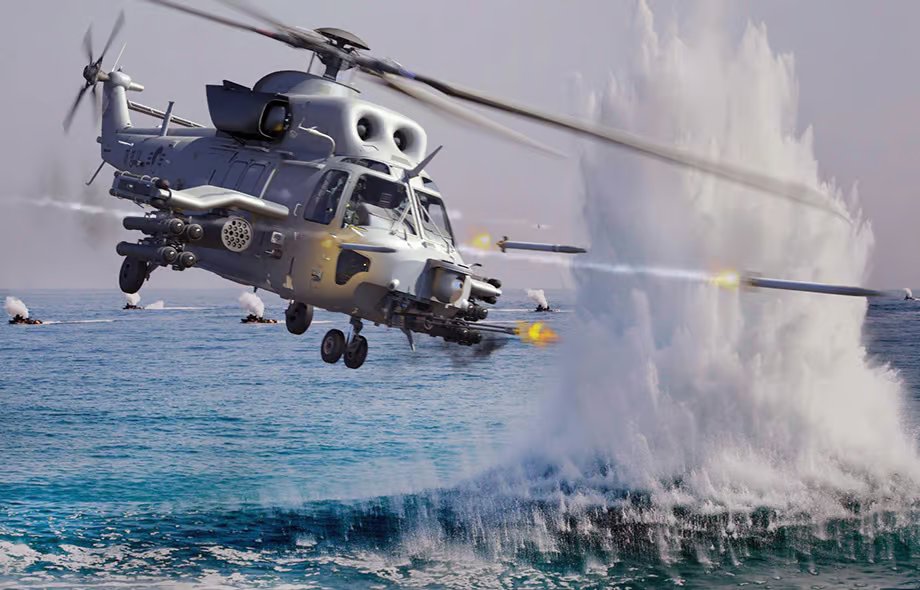
South Korea’s Defense Acquisition Program Administration (DAPA) announced on 28 October 2026 that the development of the Marine Attack Helicopter (MAH) has been completed.
It successfully passed a combat suitability evaluation in July, before achieving airworthiness certification in August. KAI is understood to have built three prototype MAHs.
Once series production commences next year, it will enter service in the Republic of Korea Marine Corps (ROKMC). Around 24 MAHs are expected to be manufactured, with delivery slated to be completed by 2031.
The helicopter, based on the preceding KUH-1 Surion and follow-on MUH-1 Marineon, was developed by Korea Aerospace Industries (KAI). Its first flight occurred in December 2024.
The MAH reportedly has 96% commonality with the MUH-1, which should “reduce the budget and improve air operational capability,” according to KAI.
A key feature of the MAH is its ability to carry a range of weapons: a 20mm chin-mounted Gatling-type gun, 70mm guided/unguided rockets, Mistral ATAM air-to-air missiles and TAipers/Cheongeom air-to-ground missiles.
In fact, these are the same weapons already integrated onto KAI’s Light Armed Helicopter (LAH), which is called Miron in ROK Army service.
The Marine Attack Helicopter will be able to support amphibious operations by escorting Marineons and offering fire support to ground troops.
DAPA officially commenced this KRW438.4 billion (US$307 million) MAH project on 27 October 2022.

While the MAH is cheaper than a dedicated tandem-seat attack helicopter purchased from overseas, the MAH has neither the manoeuvrability nor protection of a dedicated attack helicopter. It therefore remains to be seen whether the MAH will perform adequately in this role.
In other news relating to KAI, the company announced on 8 October that it had signed a long-term maintenance contract with DAPA to support the MUH-1 fleet. The Marineon entered ROKMC service in 2017, and it provides tactical troop transport, ship-to-shore manoeuvre and logistical support during amphibious operations.
The KRW1.145 trillion performance-based logistics contract will run through till December 2031.
KAI stated, “Through this project, KAI will ensure stable operation during the lifecycle of the aircraft, and establish an efficient follow-up support system that proactively manages and supplies the parts and maintenance elements required for MUH-1 operations in a timely manner.”
by Gordon Arthur
