

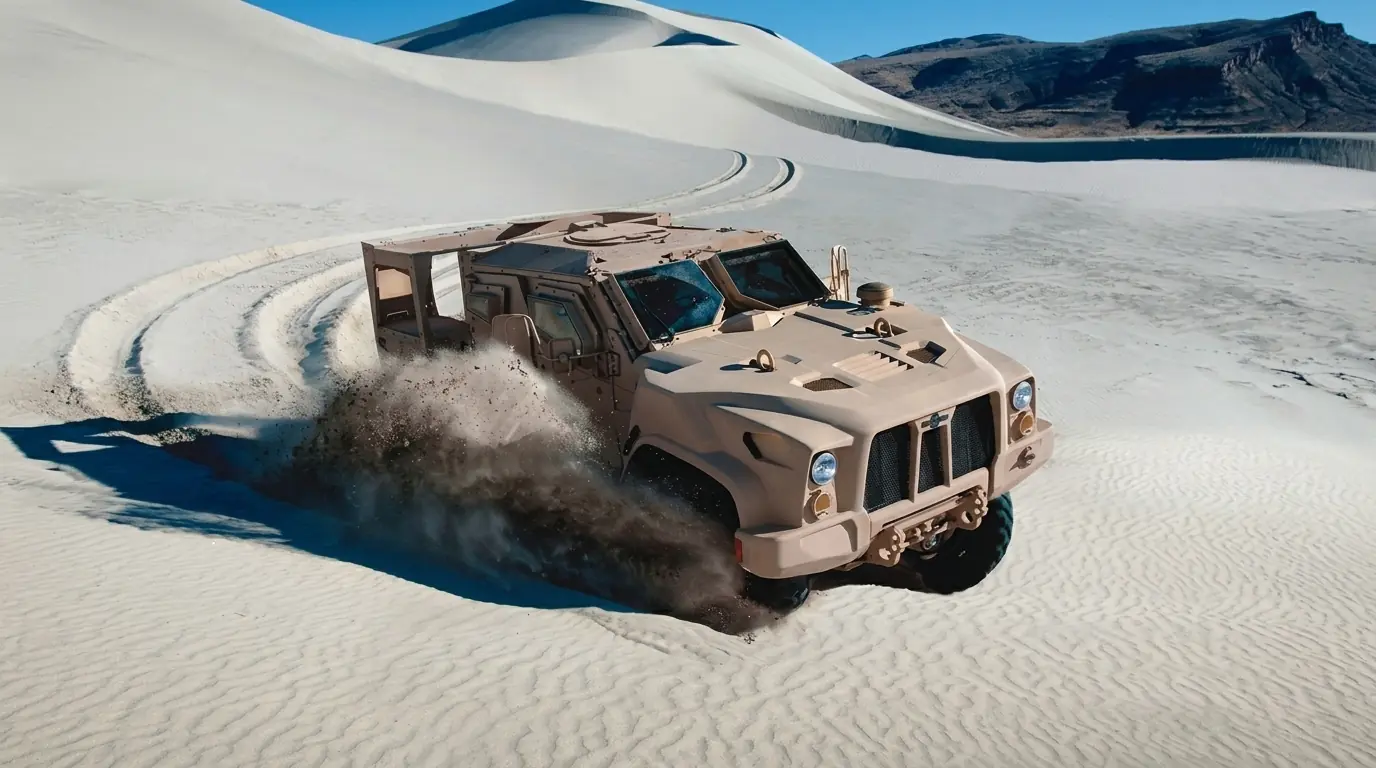
Picture a military vehicle crossing a rocky trail, carrying its crew and equipment while navigating ground that would challenge an ordinary truck. Now add another requirement: the people inside must remain protected against battlefield threats.
That is the engineering challenge behind the Oshkosh L-ATV, the vehicle design selected for the U.S. military’s Joint Light Tactical Vehicle (JLTV) program in 2015.
Developed by Oshkosh Defense, the L-ATV was designed to address a difficult balance. Military planners needed better crew protection without sacrificing the mobility, payload, and transportability required for modern operations. More armor alone wasn’t enough. A heavier vehicle could become harder to maneuver, consume more fuel, and place greater demands on transport aircraft.
The answer was a combination of specialized engineering, adaptable protection, and advanced suspension technology. One of its defining features, the TAK-4i independent suspension system, was designed to help the vehicle maintain mobility across uneven terrain.
But the Oshkosh L-ATV’s story extends beyond its mechanical design. Its selection shaped the JLTV program, which aimed to modernize the U.S. Army’s and Marine Corps’ light tactical vehicle fleets.
It’s also important to understand the distinction between the two names. The L-ATV was Oshkosh’s proposed design, while JLTV refers to the broader military program and its production vehicle family.
So, what makes this vehicle technologically distinctive? How does its suspension work, what protection does it offer, and how can one platform support different military missions?
Let’s examine the engineering behind the Oshkosh L-ATV and explore how its design helped shape a major U.S. military vehicle modernization effort.
What Is the Oshkosh L-ATV?
The Oshkosh L-ATV, short for Light Combat Tactical All-Terrain Vehicle, is a military vehicle designed to combine crew protection, off-road mobility, and operational flexibility. Developed by Oshkosh Defense, it became the foundation of the company’s entry in the U.S. military’s Joint Light Tactical Vehicle (JLTV) program.
To understand its purpose, consider the demands placed on modern military transport. Troops need vehicles that can move across rough terrain, carry essential equipment, and support different mission requirements. At the same time, crews need better protection from battlefield hazards. Meeting all these demands in one platform requires more than simply reinforcing a conventional truck.
The Oshkosh L-ATV was developed to address that challenge. Its design combined a protected crew compartment with a specialized suspension system and a chassis engineered for demanding terrain. Rather than focusing on a single mission, the platform was intended to support a range of tactical roles through different vehicle configurations.
Oshkosh’s design gained national attention in August 2015, when the U.S. Army selected it for the JLTV production contract. The program aimed to introduce a new generation of light tactical vehicles for the Army and Marine Corps, improving protection and mobility while retaining the versatility required for military operations.
It’s important to distinguish the Oshkosh L-ATV design from the JLTV program itself. L-ATV identifies Oshkosh’s vehicle design, while JLTV refers to the wider U.S. military modernization program and the resulting family of vehicles. The names are closely connected, but they do not mean exactly the same thing.
Read also: Oshkosh M-ATV: How Does It Protect Troops From IEDs?
The platform’s adaptability is another defining feature. Depending on configuration, JLTV vehicles can support general-purpose transport, utility tasks, and specialized mission equipment. This approach allows military units to use a shared vehicle family across different operational needs.
Ultimately, the Oshkosh L-ATV is significant because it brought together several competing requirements in a single design. Its importance lies not just in its rugged appearance, but in the engineering choices intended to balance protection, mobility, and mission flexibility.
Oshkosh L-ATV Specifications and Performance
The Oshkosh L-ATV was engineered to carry military personnel and equipment across demanding terrain without compromising its protective design. Its performance depends on several interconnected systems, including the engine, drivetrain, suspension, and adaptable vehicle configuration.
At the heart of the production Oshkosh L-ATV is a 6.6-liter V8 turbocharged diesel engine paired with an automatic transmission. This powertrain provides the torque needed to move the vehicle across uneven ground while carrying personnel, armor, and mission equipment. The exact configuration and performance figures can vary across vehicle variants and production arrangements.

The vehicle also uses a four-wheel-drive system designed to support mobility on challenging surfaces. Combined with its independent suspension, this setup helps the Oshkosh L-ATV navigate obstacles that can limit conventional tactical trucks. Its design prioritizes practical battlefield mobility rather than road speed alone.
Oshkosh L-ATV specifications at a glance
| Specification | Details |
| Vehicle designation | Light Combat Tactical All-Terrain Vehicle (L-ATV) |
| Manufacturer | Oshkosh Defense |
| Military program | Joint Light Tactical Vehicle (JLTV) |
| Engine | 6.6-liter V8 turbocharged diesel |
| Drivetrain | Four-wheel drive |
| Transmission | Automatic |
| Suspension | TAK-4i independent suspension |
| Vehicle configurations | General-purpose, utility, close-combat weapons carrier, and heavy-guns carrier |
| Primary design priorities | Crew protection, mobility, payload, and mission flexibility |
Specifications describe the production JLTV family associated with Oshkosh’s L-ATV design. Exact figures depend on variant, equipment, and configuration.
Balancing payload, protection, and mobility
One of the most important performance considerations is payload capacity. A tactical vehicle must carry its crew, communications equipment, supplies, and sometimes additional mission systems. However, adding equipment increases weight and can affect handling, fuel consumption, and transport requirements.
The JLTV family addresses this challenge through multiple configurations rather than relying on one fixed layout. A general-purpose vehicle can support personnel and equipment transport, while weapons-carrier variants accommodate heavier mission systems.
Vehicle dimensions and weight also matter when units need to transport equipment over long distances. The JLTV was designed with military transport requirements in mind, although its suitability for a particular aircraft or transport arrangement depends on the vehicle’s configuration.
Ultimately, the Oshkosh L-ATV’s performance comes from how its systems work together. Its engine provides power, its drivetrain transfers that power to the wheels, and its suspension helps maintain mobility across difficult terrain. These engineering choices establish the foundation for its tactical capabilities.
TAK-4i Suspension and Off-Road Mobility
A military vehicle can have a powerful engine and still struggle when the ground beneath it becomes unpredictable. Loose sand, rocky trails, deep ruts, and uneven slopes place enormous demands on a vehicle’s suspension. For the Oshkosh L-ATV, one of the key engineering solutions is the TAK-4i independent suspension system.
Developed by Oshkosh, TAK-4i is designed to improve wheel movement, ground contact, and ride control across challenging terrain. Its independent suspension allows each wheel to respond to surface irregularities with less direct influence on the opposite wheel. This helps the vehicle maintain traction while moving over uneven ground.

How does TAK-4i suspension work?
In a conventional solid-axle arrangement, movement at one wheel can affect the position of the opposite wheel. Independent suspension gives each wheel more freedom to move vertically as the vehicle crosses obstacles.
That flexibility is valuable in tactical environments. When one wheel drops into a rut or climbs over a rock, the suspension can help the other wheels maintain contact with the surface. Better contact can improve traction and reduce the likelihood of losing momentum on difficult ground.
The TAK-4i system also uses adjustable suspension technology. This allows the vehicle’s ride height to be changed to suit different operating requirements. Greater ground clearance can help when crossing obstacles, while a lower setting can be useful when vehicle height must be reduced for transport or other constraints.
Why off-road mobility matters
The Oshkosh L-ATV’s mobility is not simply about traveling faster. It affects how military units reach their destinations, carry essential equipment, and move across terrain where established roads may be limited.
Several design elements contribute to this capability:
- Independent wheel movement: Helps the tires follow uneven surfaces.
- Adjustable ride height: Provides flexibility for different terrain and operating conditions.
- Four-wheel drive: Distributes engine power to support traction across challenging surfaces.
- Suspension travel: Helps the vehicle negotiate dips, ridges, and obstacles while maintaining wheel contact.
These features work together rather than operating in isolation. Suspension performance depends on tire selection, vehicle weight, driving technique, and the surface itself.
TAK-4i does not make the Oshkosh L-ATV unstoppable, nor does it eliminate the risks of difficult terrain. Instead, it gives the vehicle a more capable mechanical foundation for demanding operations. Combined with its powertrain and protected chassis, the system helps explain why mobility was central to the Oshkosh L-ATV’s design.
Armor Protection, Blast Resistance and Crew Safety
A tactical vehicle must do more than carry personnel across difficult terrain. It also needs to help protect them from battlefield hazards without becoming too heavy to maneuver effectively. This balance is central to the design of the Oshkosh L-ATV and the wider Joint Light Tactical Vehicle (JLTV) family.
Earlier generations of military vehicles faced growing concerns about roadside explosives, mines, and small-arms threats during operations in Iraq and Afghanistan. These experiences highlighted the importance of protecting the crew while preserving mobility. The JLTV program was developed partly to address these operational lessons.

How does the L-ATV protect its crew?
The Oshkosh design combines a protected crew compartment with a vehicle structure intended to manage battlefield hazards. Its protection approach emphasizes the vehicle’s overall architecture, rather than relying solely on thicker armor plates.
The crew compartment is designed to provide ballistic protection, while the vehicle’s lower structure and underbody contribute to blast protection. These elements are intended to reduce the risks associated with certain explosive threats and improve the chances of crew survival.
However, protection levels depend on the vehicle’s specific configuration and armor package. Exact resistance varies according to the threat, impact location, and test conditions. It would therefore be misleading to suggest that every Oshkosh L-ATV offers identical protection against every battlefield hazard.
Blast protection and crew safety systems
Protection extends beyond the vehicle’s exterior. The Oshkosh L-ATV incorporates several systems designed to reduce injury risks during hazardous incidents.
- Blast-protected seats: Designed to help reduce the forces transferred to occupants during an underbody blast.
- Scalable armor: Allows protection levels to be adjusted to mission requirements, helping balance survivability against vehicle weight.
- Automatic fire suppression: Helps address fires inside the vehicle, adding another layer of crew protection.
- Protected crew compartment: Forms part of an integrated approach to managing ballistic and blast threats.
Oshkosh identifies these features as elements of the Oshkosh L-ATV’s crew protection system.
The key principle is that survivability depends on multiple systems working together. Armor alone cannot eliminate every threat, and blast protection does not guarantee that occupants will escape injury.
Why protection must remain balanced
Adding armor increases vehicle weight, which can affect acceleration, fuel efficiency, payload, and off-road performance. The Oshkosh L-ATV’s adaptable protection approach is intended to help military units manage these competing requirements.
Ultimately, the Oshkosh L-ATV demonstrates how modern tactical vehicle design treats crew safety as an integrated engineering challenge. Its combination of protective structure, blast-mitigating features, and adjustable armor supports survivability while preserving the mobility needed for military operations.
Oshkosh L-ATV Variants, Payload and Mission Configurations
The Oshkosh L-ATV was designed as more than a single-purpose military vehicle. Its platform supports different configurations, allowing military units to transport personnel, carry equipment, and accommodate specialized mission systems. This flexibility became a defining feature of the Joint Light Tactical Vehicle (JLTV) family.

Rather than developing an entirely separate vehicle for every task, the program uses a common platform with configurations tailored to different operational requirements. This approach can simplify fleet management while giving commanders more options when organizing missions.
The four main JLTV configurations
The production JLTV family includes four principal configurations. Each serves a distinct role, although the exact equipment and capabilities depend on the specific vehicle.
| Variant | Primary role |
| JLTV General Purpose (GP) | Transports personnel, communications equipment, and general mission supplies. |
| JLTV Utility (UTL) | Supports utility duties and the movement of equipment required for military operations. |
| JLTV Close Combat Weapons Carrier (CCWC) | Accommodates weapon systems intended to support close-combat units. |
| JLTV Heavy Guns Carrier (HGC) | Carries heavier weapon systems and associated equipment. |
These configurations allow the same vehicle family to support different tasks without requiring every unit to operate an identical layout.
Payload capacity and mission flexibility
Payload is a critical consideration for any tactical vehicle. Personnel, armor, communications equipment, weapons, ammunition, and supplies all contribute to the vehicle’s total weight. As that weight increases, it can affect mobility, braking, fuel consumption, and suspension performance.
The JLTV’s configuration-based approach helps address these competing demands. A general-purpose vehicle can prioritize personnel and equipment transport, while a weapons-carrier configuration allocates space and structural capacity for specialized systems.
However, payload capacity is not unlimited. The usable allowance depends on the vehicle’s configuration, armor package, installed equipment, and applicable weight limits. Adding mission systems can reduce the capacity available for other cargo.
The distinction matters when evaluating published specifications. A vehicle’s maximum payload figure should not automatically be treated as the amount available after armor, crew equipment, and mission-specific installations are accounted for.
Why a shared platform matters
A common vehicle family can reduce the complexity of training, maintenance, and spare-parts management. Crews and technicians can become familiar with shared systems, even when vehicles perform different roles.
For military planners, this flexibility provides a practical advantage: one vehicle family can support several mission requirements while retaining a common engineering foundation.
Advanced Technology and Tactical Capabilities
The Oshkosh L-ATV combines mechanical engineering with onboard systems designed to support modern military operations. Its tactical value comes not from one advanced feature, but from how mobility, communications, vehicle electronics, and mission equipment work together.
As the foundation of the Joint Light Tactical Vehicle (JLTV) family, the platform was developed to support changing operational requirements. Military units need vehicles that can move personnel and equipment while integrating communications systems and mission-specific hardware. The Oshkosh L-ATV’s adaptable architecture helps address these needs.

Vehicle electronics and onboard systems
Modern tactical vehicles rely on more than engines and suspension. Electrical power, electronic controls, and system integration all influence how effectively a vehicle performs its assigned role.
The JLTV platform can accommodate mission equipment such as communications hardware, navigation tools, and other electronic systems. The exact installation depends on the vehicle’s configuration and the requirements of the operating unit.
This flexibility matters because military missions rarely involve identical equipment loads. A vehicle assigned to transport personnel may have different onboard systems from one configured to carry specialized equipment.
Reliable electrical power is also important. Communications equipment and other electronic systems need a stable supply of energy, particularly when a vehicle must remain operational away from established support facilities.
Integrating mission equipment
One of the JLTV family’s advantages is its ability to accommodate different mission configurations. Depending on the variant, vehicles can carry weapon mounts, communications equipment, and other specialized systems.
Weapons-carrier configurations can support mounted systems, while general-purpose vehicles can prioritize personnel transport and operational equipment. This modular approach allows military planners to adapt vehicle assignments without requiring a completely different platform for every task.
However, not every JLTV includes the same technology. Equipment availability depends on the variant, procurement configuration, and upgrades selected by the military customer.
Mobility as a tactical advantage
The vehicle’s advanced suspension and four-wheel-drive system also contribute to its operational capabilities. By helping maintain traction across uneven ground, these systems can expand the range of terrain where crews can operate.
Mobility is especially important when units need to move beyond paved roads or navigate routes with limited infrastructure. Nevertheless, terrain, weather, vehicle loading, and maintenance conditions all influence actual performance.
The platform’s protective design also supports its broader tactical role. Crew protection, suspension performance, and onboard systems are intended to function together, rather than as isolated capabilities.
Supporting modern military operations
The Oshkosh L-ATV reflects a wider shift in military vehicle design. Today’s tactical platforms must combine physical durability with the flexibility to integrate changing equipment and mission requirements.
Its technological value lies in this combination of systems. The engine and suspension provide the mechanical foundation, the protected structure supports crew survivability, and onboard equipment helps units carry out their assigned tasks.
The result is a vehicle family designed to accommodate diverse operational needs. Its long-term effectiveness, however, depends on maintenance, training, equipment compatibility, and continued investment in upgrades.
