

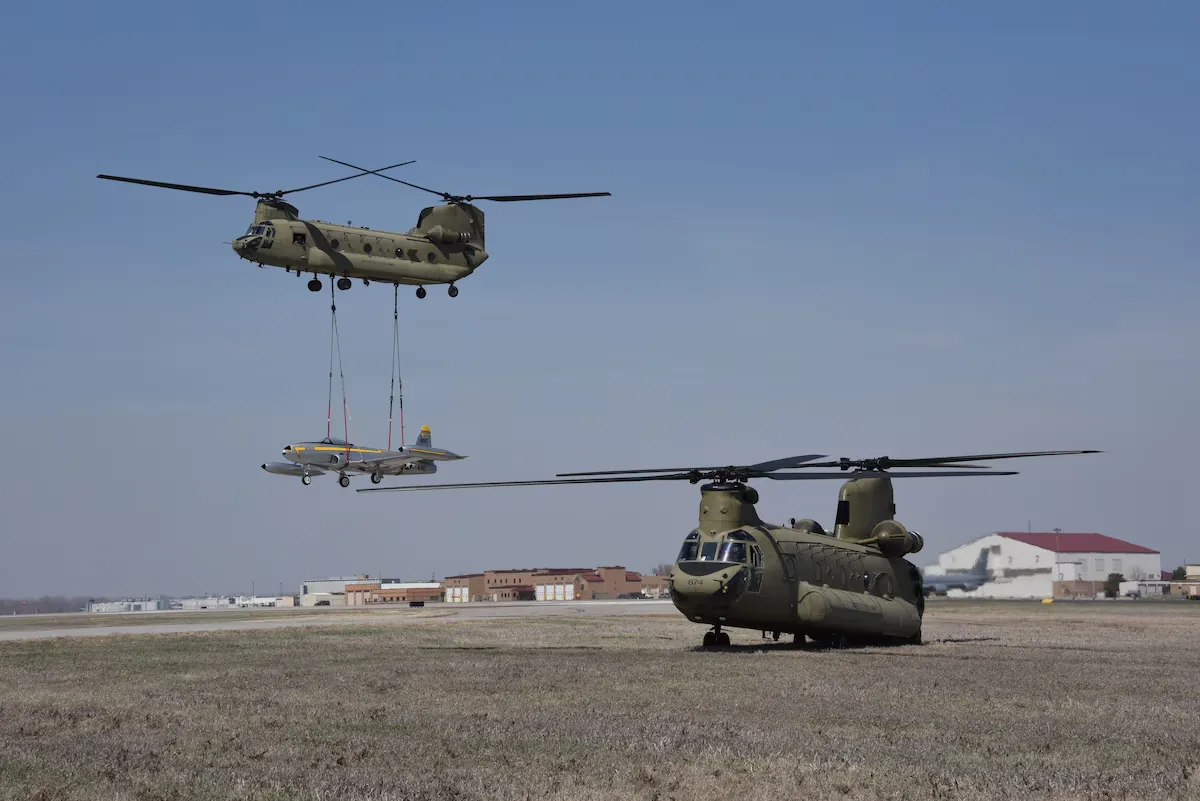
Defense Feeds, Fort Campbell – The U.S. Army has achieved a transformative milestone in helicopter automation. A CH-47F Chinook completed its first fully automated approach and landing using Boeing’s Approach-to-X autonomy software, executing a precise touchdown with zero pilot intervention.
The successful flight demonstrates supervised-autonomy capability that reshapes how transport helicopters operate in contested environments while preserving complete human control over tactical decisions.
Initial flight testing began in January 2026. Since then, the U.S. Army Chinook autonomous landing system has already performed more than 150 automated approaches, achieving sub-five-foot positional accuracy with remarkable consistency. That repeatability is crucial for operational reliability. Modern warfare demands capability that works reliably under extreme stress and demanding conditions.
The Boeing Approach-to-X system embodies a deliberate philosophy: enhance crew effectiveness rather than displace human judgment. Pilots retain complete authority over mission parameters including landing zone selection, approach angle, and terminal altitude. The aircraft autonomously manages flight control inputs, but pilots can override any maneuver in real time.
Advanced Control Architecture and Precision Landing
The U.S. Army Chinook autonomous landing capability builds on Boeing’s upgraded Digital Automated Flight Control System architecture. The system integrates advanced control laws refined through iterative feedback from test pilots, operational units and Boeing engineers. This human-centered engineering approach ensured that automated behaviors align with pilot expectations during high-stress tactical maneuvers.
Technically, the system leverages precision navigation inputs, sophisticated flight control algorithms and real-time trajectory adjustments to guide the tandem-rotor platform through complex descent profiles. The demonstrated ability to maintain less than 1.5 meters of positional error proves especially significant for operations in confined or degraded landing zones, where spatial margins are minimal and pilot workload traditionally peaks.
The U.S. Army Chinook autonomous landing system’s critical feature is adaptability in dynamic combat environments. While the system automates baseline approach procedures, pilots retain full ability to modify glide path and course inputs in real time.
That responsiveness to emerging threats, obstacles or last-minute mission changes preserves tactical flexibility entirely. Crews can focus outward on threat environment while the aircraft manages precise flight control requirements—a fundamental shift in how transport helicopter operations distribute pilot attention and cognitive resources.
Testing revealed that the system performs effectively across degraded visual environments and during night operations. These conditions traditionally demand intense pilot concentration and sustained physical workload. Automation that works reliably during low-visibility landings extends operational capability into previously challenging scenarios. That expanded operational envelope translates directly into increased mission availability and force effectiveness.

Fleet Integration and Operational Transformation
For the CH-47F Chinook fleet, this represents transformational capability through incremental enhancement rather than revolutionary airframe redesign. The U.S. Army Chinook autonomous landing upgrade leverages existing airframes, modernizing capability through software-driven improvements.
This approach accelerates fielding timelines while controlling costs—priorities that align perfectly with Pentagon directives to deliver capability gains through modular upgrades across existing platforms.
The CH-47F itself remains the operational backbone of Army air mobility and logistics operations globally. Twin Honeywell T55-GA-714A engines power the platform’s distinctive dual-rotor configuration. Advanced digital cockpit systems and comprehensive airframe upgrades enable the aircraft to transport troops, artillery, vehicles and supplies across demanding environments.
Primary roles including air assault, troop movement, medical evacuation, humanitarian assistance and heavy equipment resupply occur in settings where landing precision directly determines mission success.
U.S. Army Chinook autonomous landing capability dramatically reduces pilot workload during approach and landing phases—traditionally the most intensive operational phases of any flight. In high-threat environments where reaction time and situational awareness are critical, enabling crews to focus outward while the aircraft manages complex flight tasks fundamentally redefines how heavy-lift helicopters deploy in future conflicts.
Using this scenario, single pilots can concentrate entirely on threat monitoring while the aircraft executes landing procedures with sub-meter accuracy.
