

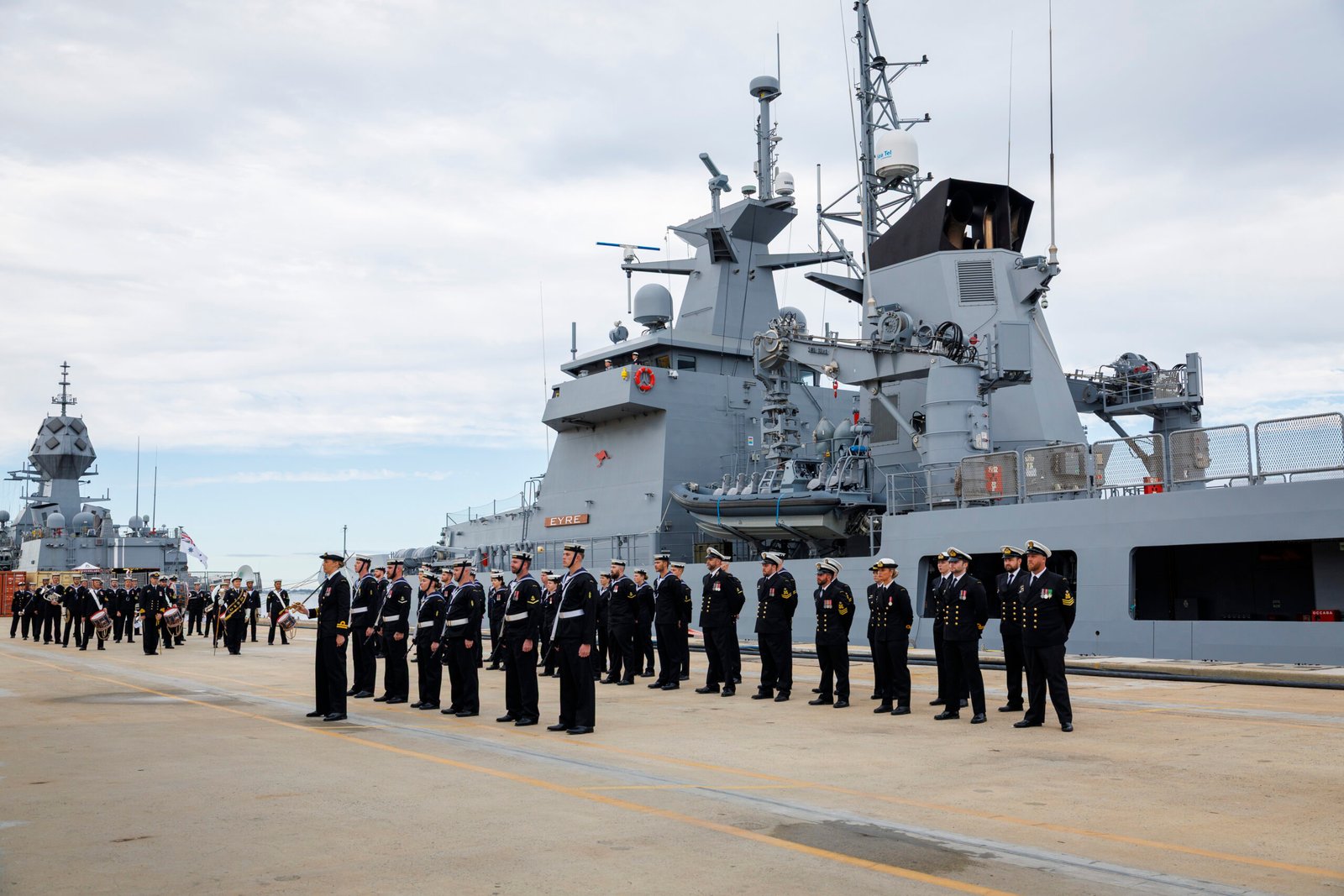
At a ceremony at the Western Australian naval base of HMAS Stirling on 30 May, the Royal Australian Navy (RAN) commissioned the second of its six Arafura-class offshore patrol vessels (OPV).
Civmec Defence Industries completed construction of this vessel, HMAS Eyre, at the Osborne Naval Shipyard in South Australia. Luerssen Australia had commenced the project, before it abandoned the Australian market.
The Arafura class measures 80m long and displaces 1,640 tonnes. They have a creditable 4,000nm range.
Vice Admiral Mark Hammond, Chief of Navy, described the OPVs, being procured under Project Sea 1180, as a “force multiplier, performing a number of roles in a variety of missions”.
He elaborated: “HMAS Eyre will conduct maritime surveillance interdiction, and was purpose built to embark containerised mission systems as part of an integrated capability. I’m very much looking forward to seeing all six of these flexible ships in the hands of our capable Royal Australian Navy sailors.”
Well he might, for the RAN these vessels are being delivered far behind schedule. For instance, the first-of-class HMAS Arafura was commissioned on 28 June 2025, a whole 3.5 years behind schedule.
The four remaining OPVs are under construction at the Henderson Shipyard near Perth.
Sea 1180 was struck a mortal blow in 2024 when the “Enhanced Lethality Surface Combatant Fleet” review halved the class of OPVs from twelve to six. That review lamented, “The OPV is an inefficient use of resources for civil maritime security operations and does not possess the survivability and self-defence systems to contribute to a surface combatant mission.”
Commodore Terence Morrison, the RAN’s Commander Surface Forces, explained to Asian Military Review: “Since the surface fleet review, we shifted the composition of our vessels, and we’re keeping Evolved Cape patrol vessels – eight of those – to do constabulary operations, primarily Operation Resolute to the north of Australia. The OPVs will supplement that – they’ll bring another level of capability into that operation. So that’s where the Arafuras are going to be operating, north of Australia, performing primarily constabulary operations in Operation Resolute.”
Morrison said the first vessels are being based in Western Australia, but the OPV fleet will eventually transition to northern Australia, being based out of Darwin and Cairns.
He added that the class “is designed to be able to organically and unload containers, and we can use other external cranes to do that as well. They have a mission module system that we can then bring on board. At the moment we’re looking at using that in the constabulary role as its primary mission, so we’ll have containers to support that mission.”
He said there is no designated requirement to change those mission modules right now, but these could be altered in the future for different roles if required.

It is difficult to pinpoint why the Arafura programme was so heavily delayed – after all, OPVs are a rather straightforward naval platform. Certainly, things were not helped by the government stipulating that construction be split between Osborne and Henderson.
The RAN then flip-flopped over armaments, deciding to forego a Leonardo 40mm bow-mounted naval gun and to instead use recycled Typhoon 25mm weapons from decommissioned Armidale-class patrol boats. Other factors that affected the schedule were COVID-19, the resulting supply chain disruption, commercial issues between Luerssen and Civmec, and competition for skilled labour.
The Australian National Audit Office noted that a support system detailed design review was delayed till September 2021, which caused knock-on effects. Furthermore, Defence identified changes in 2022 that it deemed necessary to meet Australian regulatory standards, such as structural fire protection.
Some commentators have called for the Arafura class to be better protected and armed. Responding to these criticisms, Rear Admiral Stephen Hughes, Australia’s Head of Navy Capability, told AMR: “[It] doesn’t need to be! I’m happy with that.”
He said the OPVs are “not designed to go into harm’s way. I mean, of course I’d love to put a gun on that – every ship should have a gun. But that’s not the purpose of it, right? It was always designed to be a constabulary vessel, it was always designed to do the border protection force, sovereign borders role.”
by Gordon Arthur
