

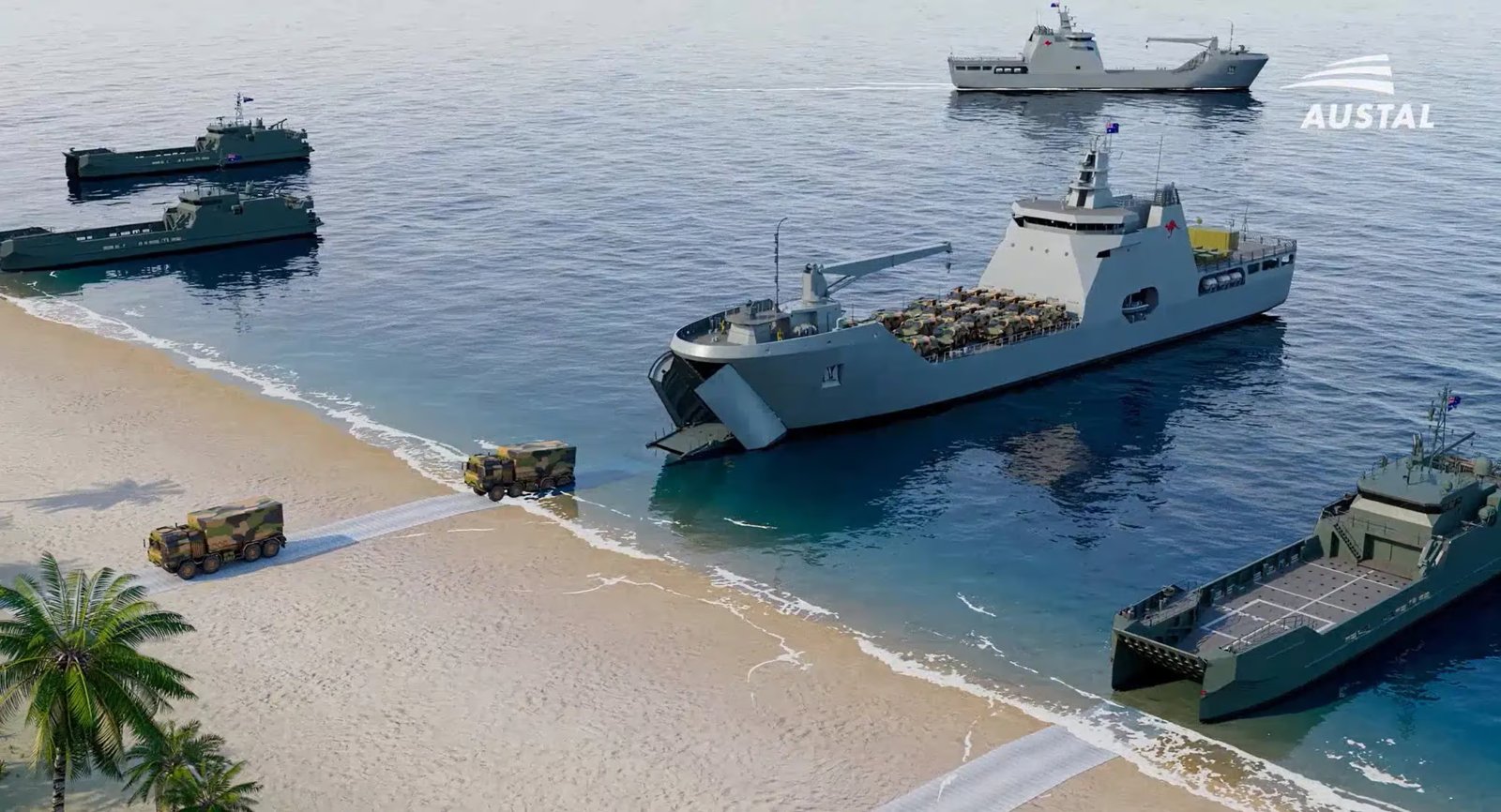
The Australian government announced on 11 November 2026 that construction had commenced on the initial Landing Craft Heavy (LCH) for the Australian Army, with first steel cut in late October.
Austal is building eight of these LCHs, as well as 18 Landing Craft Medium (LCM), under contracts cumulatively worth approximately A$5 billion (US$3.4 billion). These Project Land 8710 Phases 1A and 2 efforts represent the biggest recapitalisation of army amphibious capabilities since World War II.
Minister for Defence Industry Pat Conroy remarked, “Progress in constructing army’s landing craft fleet marks the transition from design into delivery, and an important step in building a critical capability for the Australian Defence Force.”
Notably, Austal began construction of the LCMs one month earlier, on 29 September 2026. This means it has two major shipbuilding projects under way simultaneously.
This overlap has been caused by delays in moving from design to construction in the smaller landing craft programme, for which the contract had been awarded in December 2025. The first LCM was supposed to be finished this year.

It will also require Austal to make use of the Common User Facility at the Henderson Defence Precinct in order to give it the construction space it needs. Austal then plans to move construction to an as-yet, unbuilt production facility. The LCHs are supposed to be completed by 2038.
These amphibious craft contribute to the army’s pivot towards a littoral force. The aim is for the Australian Army to be able to move assets to littoral and archipelagic regions north of Australia, to secure strategic terrain and to hold an adversary at risk through long-range strike.
In support of this pursuit, the army created the Littoral Manoeuvre Group in March this year. The group comprises the Brisbane-based Littoral Manoeuvre Group Headquarters and the 1st Landing Craft Battalion.
The Littoral Manoeuvre Group will eventually possess three landing craft battalions, each with four LCMs and two LCHs. Existing littoral units – the 35th Water Transport Squadron and Littoral Riverine Survey Squadron – have transitioned to the new group.
The 4,000-tonne LCH platform is based on the Damen’s LST 100 design, whereas the 500-tonne LCM is derived from a Birdon platform.
Also last month, Canberra announced an A$245 million loan to Austal via its National Reconstruction Fund Corporation to assist the shipbuilder in constructing and fitting out LCH facilities within the Australian Marine Complex.
The government claimed the two landing craft projects will create 1,100 direct jobs and more than 2,000 indirect jobs in Western Australia.
by Gordon Arthur, Abu Dhabi
