

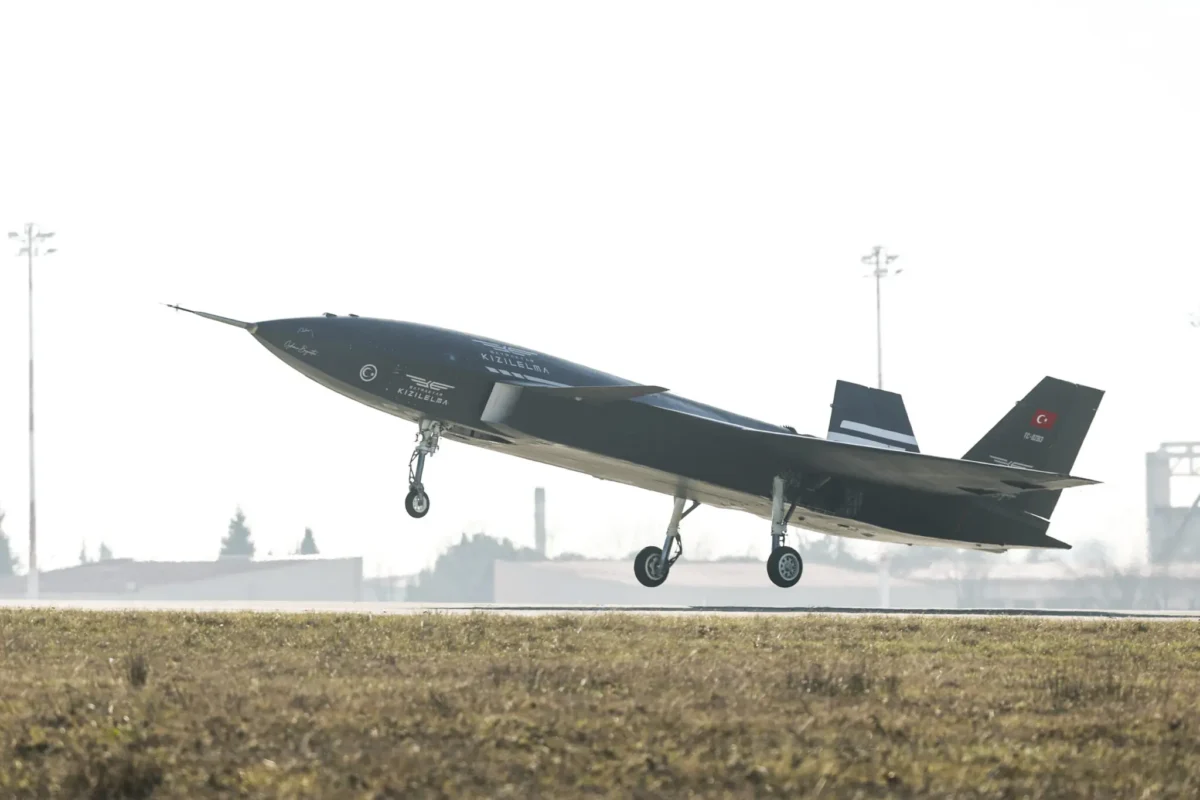
Imagine a fighter aircraft taking off without a pilot, tracking another aircraft, and launching an air-to-air missile. No cockpit. No onboard pilot. Just sensors, software, and a jet engine working together. This is the concept behind Bayraktar Kızılelma, Türkiye’s ambitious attempt to move unmanned aviation into the fighter aircraft category.
Developed by Turkish defense company Baykar, Bayraktar Kızılelma represents a significant shift in the country’s drone development strategy.
Türkiye already has considerable experience with armed unmanned aircraft, including the Bayraktar TB2. But Kızılelma is designed for a different kind of mission. It is intended to operate in contested airspace, conduct air-to-air engagements, and support manned fighter aircraft.
And its capabilities are no longer limited to promotional specifications.
In November 2025, a Kızılelma prototype reportedly used an ASELSAN MURAD AESA radar to guide a GÖKDOĞAN air-to-air missile against a jet-powered aerial target. Subsequent tests in 2026 demonstrated additional weapon integrations, including internal weapons-bay releases and a supersonic air-to-ground missile. These milestones offer a glimpse of what the aircraft could eventually achieve.
However, impressive demonstrations don’t automatically make an aircraft combat-ready. Operational reliability, electronic warfare resilience, communications, and sustained performance in hostile environments remain critical questions.
So, how powerful is the Bayraktar Kızılelma?
Its published specifications provide a useful starting point. The aircraft is advertised with a maximum speed of Mach 0.9, a combat radius of 500 nautical miles, and a payload capacity of 1,500 kilograms. It also features an AESA radar, infrared sensors, and autonomous flight systems.
Those numbers tell only part of the story. The more interesting question is how these technologies work together and whether they can change the way air forces approach future combat operations.
What Is Bayraktar Kızılelma and Why Is Türkiye Developing It?
Türkiye’s drone industry has already attracted international attention. The Bayraktar TB2 demonstrated how relatively affordable unmanned aircraft could support surveillance and precision-strike missions. But Baykar wanted to pursue something more ambitious: an unmanned aircraft capable of performing fighter-like missions.
That ambition became Bayraktar Kızılelma.
Developed by Baykar, Kızılelma is an unmanned combat aircraft designed to operate in more demanding air environments than conventional armed drones. Its development reflects Türkiye’s effort to expand its domestic aerospace capabilities and reduce dependence on foreign combat aircraft technologies.
The aircraft made its first flight on December 14, 2022. This was an important milestone, but the programme’s objectives extend well beyond simply demonstrating autonomous flight. Kızılelma is being developed for air-to-air combat, precision strikes, reconnaissance, and operations alongside conventional fighter aircraft.
Think of the difference this way. A conventional armed drone generally focuses on observing targets and delivering weapons against ground positions. Kızılelma is intended to engage threats in the air as well. That requires a more sophisticated combination of radar, flight control, sensors, communications, and weapons integration.
Its development also has a maritime dimension. Baykar has highlighted the aircraft’s potential for operations from short-runway naval platforms, including Türkiye’s amphibious assault ship, TCG Anadolu. This could eventually provide the Turkish Navy with an additional aviation capability without relying entirely on conventional carrier-based fighters.
There is a strategic calculation behind the programme, too. An unmanned fighter could perform dangerous missions without placing a pilot inside the aircraft. It could also operate as part of a larger formation involving manned fighters, extending their reach and tactical options.
However, Bayraktar Kızılelma remains a developing platform. Successful flight and weapons demonstrations are meaningful achievements, but they do not establish full operational readiness. Testing, integration, and validation still matter.
For Türkiye, the objective is clear: develop an unmanned aircraft that moves beyond traditional drone missions and enters the increasingly complex world of fighter aviation.
Bayraktar Kızılelma: Technical Specifications and Flight Performance
A fighter aircraft’s performance cannot be measured by speed alone. Range, endurance, payload, and operating altitude determine how effectively it can perform missions. The Bayraktar Kızılelma combines these characteristics in a relatively compact unmanned platform.
Baykar’s February 2026 technical brochure provides the following published specifications.
| Specification | Published figure |
| Manufacturer | Baykar |
| Aircraft type | Unmanned fighter aircraft |
| Maximum takeoff weight | 8,500 kg |
| Maximum payload | 1,500 kg |
| Maximum speed | Mach 0.9 |
| Cruise speed | Mach 0.6 |
| Combat radius | 500 nautical miles |
| Endurance | More than 3 hours |
| Operational altitude | 25,000 ft |
| Service ceiling | Up to 45,000 ft |
| Wingspan | 10 metres |
| Length | 14.5 metres |
| Height | 3.5 metres |
Turbofan Engine and Flight Performance
Unlike propeller-driven surveillance drones, Bayraktar Kızılelma uses a turbofan engine. This gives it the propulsion characteristics needed for higher-speed operations and more demanding flight profiles.
Its advertised maximum speed reaches Mach 0.9, while cruise speed is approximately Mach 0.6. That’s still below the speed of sound, but considerably faster than many conventional armed drones.
The distinction matters. Higher speed can shorten transit times and help an aircraft respond to changing tactical situations. However, it also affects fuel consumption and mission endurance.

Operational Range, Endurance, and Payload
Bayraktar Kızılelma has a published combat radius of 500 nautical miles, equivalent to approximately 926 kilometres. This is not its maximum ferry range. It represents the advertised radius for a combat mission under specified conditions.
Its payload capacity reaches 1,500 kilograms. That provides room for a combination of guided weapons and mission equipment, depending on configuration.
Autonomous Flight and Communication Systems
The aircraft is designed for autonomous takeoff, landing, taxiing, and flight operations. Baykar also lists line-of-sight and beyond-line-of-sight communications.
One specification deserves attention: the manufacturer’s online page lists a 40,000-foot service ceiling, while its February 2026 brochure gives 45,000 feet. The difference should be treated as a published specification discrepancy, not a confirmed performance upgrade.
How Powerful Is Kızılelma’s AESA Radar and Sensor Suite?
A combat aircraft can carry sophisticated weapons, but those weapons are only useful when it can find and identify targets. This is where the Bayraktar Kızılelma’s AESA radar becomes particularly important.
The aircraft is designed to use the ASELSAN MURAD active electronically scanned array (AESA) radar. Unlike traditional mechanically scanned radar, AESA technology directs its beams electronically. It can shift attention between different areas without physically moving the antenna.
That brings several advantages. The radar can support air surveillance, target tracking, and engagement functions while responding quickly to changing situations. It also provides greater flexibility when monitoring multiple contacts.
However, an important detail remains undisclosed: the exact detection range of Kızılelma’s MURAD radar. Publicly available information does not establish a verified maximum range. Any precise figure circulating online should therefore be treated cautiously.
MURAD AESA Radar and Beyond-Visual-Range Engagements
The radar’s importance became clearer during a November 29, 2025 test. A Kızılelma prototype reportedly used its MURAD AESA radar to support the engagement of a jet-powered aerial target with a GÖKDOĞAN beyond-visual-range air-to-air missile.
The test demonstrated an important combination: onboard radar, target tracking, and missile guidance working together. It was more than a routine flight demonstration. It provided evidence that Bayraktar Kızılelma’s air-to-air combat concept could progress beyond theoretical integration.
Still, one successful test does not establish performance across every combat scenario. Detection against different target types, electronic interference, and operational reliability require further evaluation.
EO, IRST, and Sensor Fusion
Radar is only one part of the aircraft’s sensing architecture. Baykar also lists electro-optical targeting systems and infrared search-and-track (IRST) sensors.
These systems offer different ways to observe the surrounding airspace. EO sensors can support visual identification and targeting, while IRST detects heat signatures without relying on radar emissions.
Combined, these sensors could give Bayraktar Kızılelma more flexibility when operating in contested environments. The real advantage will depend on how effectively its systems share information and maintain situational awareness under pressure.

What Weapons Can Bayraktar Kızılelma Carry?
An unmanned fighter becomes considerably more interesting when its sensors are connected to a credible weapons package. The Bayraktar Kızılelma is designed to carry both air-to-air and air-to-ground weapons, giving it a broader mission profile than conventional armed drones.
According to Baykar, the aircraft can integrate air-to-air missiles, precision-guided bombs, and various standoff weapons. Its advertised payload capacity reaches 1,500 kilograms, although the actual combination depends on mission requirements and aircraft configuration.
Several Turkish defence companies are contributing to this weapons ecosystem.
| Weapon | Manufacturer | Intended role |
| GÖKDOĞAN | TÜBİTAK SAGE | Beyond-visual-range air-to-air missile |
| TEBER-82 | ROKETSAN | Precision-guided bomb kit |
| TOLUN | ASELSAN | Precision-guided munition |
| JET-230 | ROKETSAN | Supersonic air-to-ground missile |
Air-to-Air Missiles: GÖKDOĞAN Integration
One of Bayraktar Kızılelma’s most significant demonstrations involved the GÖKDOĞAN air-to-air missile. On November 29, 2025, a prototype reportedly achieved a direct hit against a jet-powered aerial target during a beyond-visual-range engagement.
The test demonstrated the potential combination of onboard radar and an air-to-air weapon. It also marked an important step toward giving an unmanned aircraft a role in aerial engagements.
But a successful test should not be confused with a fully validated operational capability. Further trials must establish reliability across different conditions.
Precision Strike and Internal Weapons Carriage
Bayraktar Kızılelma has also demonstrated its ground-attack potential. In July 2026, its S2 serial-production model conducted successful firing tests involving ROKETSAN’s TEBER-82 and ASELSAN’s TOLUN.
These tests took place using the aircraft’s internal weapons bay. That’s significant because internal carriage can reduce the radar signature associated with externally mounted weapons.
Another milestone came on July 13, 2026, when Bayraktar Kızılelma successfully tested ROKETSAN’s JET-230 supersonic air-to-ground missile. The reported engagement involved a target more than 120 kilometres away. That figure describes the missile test’s engagement distance, not the aircraft’s combat radius.
Together, these demonstrations show how Kızılelma’s weapons architecture is evolving. Its eventual effectiveness, however, will depend on integration maturity, targeting accuracy, and performance under operational conditions.

How Stealth Technology Makes Kızılelma More Difficult to Detect
Speed and weapons determine what an aircraft can do. But survivability often depends on something less visible: how easily an enemy can detect it. The Bayraktar Kızılelma addresses this challenge through a design that incorporates low-observable features.
Baykar describes Bayraktar Kızılelma as having a low radar cross-section (RCS). This means its design aims to reduce the amount of radar energy reflected toward hostile detection systems. It does not mean the aircraft is invisible.
That distinction matters. Radar detection depends on several variables, including target size, viewing angle, radar frequency, distance, and environmental conditions. Even an aircraft designed for reduced observability can be detected under certain circumstances.
Internal Weapons Bay and Radar Signature
One of Bayraktar Kızılelma’s notable design features is its internal weapons bay. Conventional combat aircraft often carry missiles and bombs beneath their wings or fuselage using external pylons.
These external stores can increase radar reflectivity. Placing compatible weapons inside the aircraft helps maintain a cleaner external profile during certain missions.
The significance became more tangible in July 2026. Kızılelma’s S2 model conducted successful internal weapons-bay tests involving the TEBER-82 precision-guidance kit and ASELSAN’s TOLUN munition.
This demonstrated that internal carriage was moving beyond a design feature toward practical weapons integration.
Low Observability Is More Than Aircraft Shape
Reducing radar signature requires attention to multiple design elements. Aircraft geometry, surface treatments, component placement, and weapons configuration can all influence detectability.
However, publicly available information does not provide Bayraktar Kızılelma’s measured radar cross-section. There is therefore no reliable basis for assigning it a specific stealth rating or comparing its signature quantitatively with established fifth-generation fighters.
There is another operational consideration. Reduced radar observability does not automatically protect an aircraft against infrared sensors, passive detection systems, or electronic surveillance.
Bayraktar Kızılelma’s low-observable design should be understood as one element of a wider survivability approach. Its effectiveness will ultimately depend on how its radar, sensors, communications, flight profile, and weapons work together.

Can Kızılelma Operate From Aircraft Carriers and Work With Fighter Jets?
A combat aircraft designed for land bases has one set of requirements. A naval aircraft faces another entirely. Limited deck space, short takeoff distances, changing sea conditions, and demanding recovery procedures make carrier operations particularly challenging.
The Bayraktar Kızılelma is being developed with these requirements in mind. Baykar has highlighted its potential to operate from short-runway naval platforms, including Türkiye’s TCG Anadolu amphibious assault ship.
This ambition could give Türkiye another option for expanding its naval aviation capabilities. Rather than relying exclusively on conventional carrier-based fighters, the Turkish Navy could eventually operate unmanned combat aircraft from suitable amphibious vessels.
However, there is an important distinction. Carrier compatibility is a development objective, not proof of an established operational capability. Deck handling, autonomous recovery, and reliable operations in maritime conditions require extensive testing.

Autonomous Operations at Sea
Autonomous flight systems are central to this concept. Kızılelma is designed to perform functions such as takeoff, landing, taxiing, and flight control with limited direct pilot intervention.
At sea, these capabilities could reduce some of the workload associated with operating aircraft from a moving platform. But autonomous software alone cannot solve every challenge. Navigation accuracy, communications reliability, deck integration, and recovery procedures remain essential.
Working Alongside Manned Fighter Aircraft
Bayraktar Kızılelma is also intended to operate alongside conventional combat aircraft through manned-unmanned teaming (MUM-T).
The concept is straightforward. A piloted fighter could coordinate with unmanned aircraft performing surveillance, extending sensor coverage, or carrying additional weapons. This arrangement could allow human pilots to manage broader missions without personally entering every high-risk situation.
There have already been demonstrations of this direction. On December 27, 2025, Kızılelma prototypes PT3 and PT5 reportedly completed an autonomous close-formation flight.
Baykar has also conducted tests involving cooperation with F-16 fighters, including simulated radar and missile engagement scenarios. These demonstrations provide useful evidence of progress, although they do not establish a fully operational teaming system.
The long-term goal is an aircraft that does not need to replace manned fighters. Instead, it could become another component in a coordinated air combat formation.
Why Bayraktar Kızılelma Matters for the Future of Air Warfare
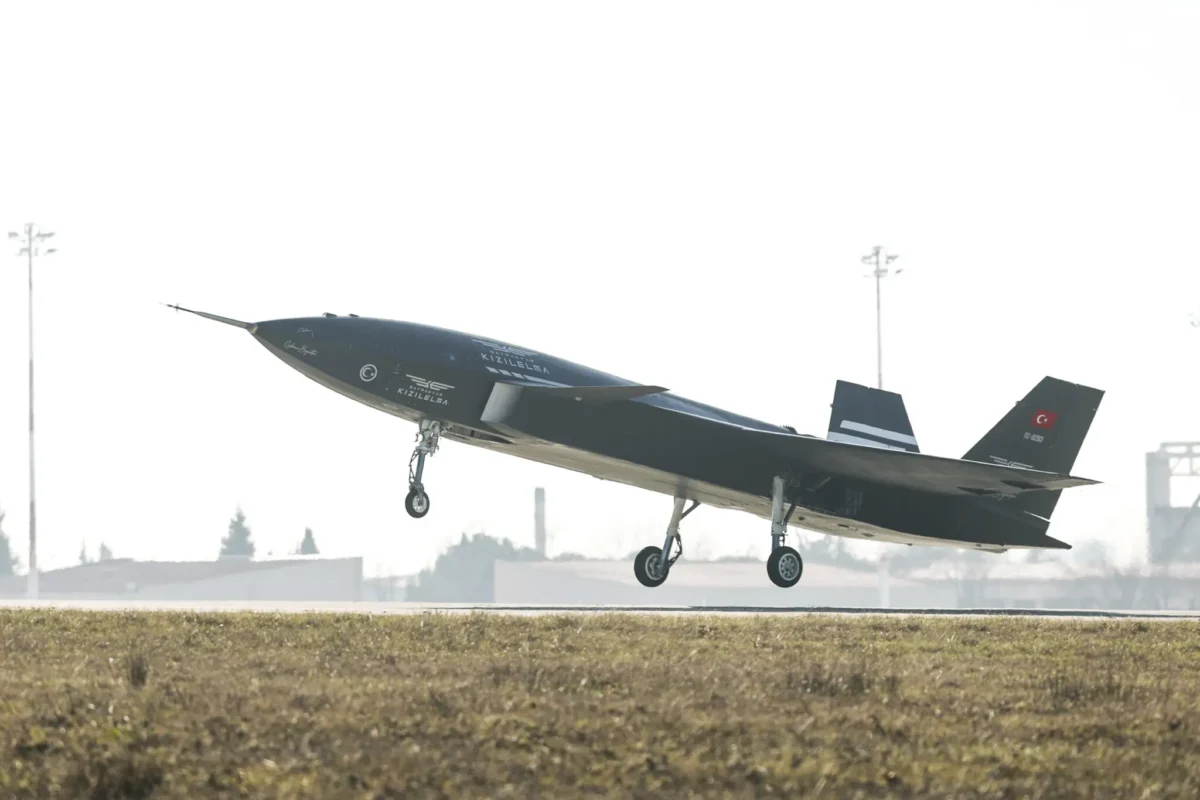
The arrival of unmanned combat aircraft could gradually change how air forces organize their operations. For decades, fighter development focused on improving aircraft flown by human pilots. Now, programmes such as Bayraktar Kızılelma are exploring another possibility: aircraft that can perform increasingly complex missions without an onboard crew.
For Türkiye, the programme carries significance beyond the aircraft itself. It represents an effort to develop domestic capabilities across radar technology, precision weapons, autonomous flight systems, and advanced aerospace engineering.
That broader industrial picture matters. A modern combat aircraft depends on an entire network of technologies. Developing Bayraktar Kızılelma could help Turkish companies gain experience integrating these systems into a single operational platform.
Expanding the Role of Unmanned Aircraft
Traditional armed drones have generally focused on surveillance and ground-attack missions. Bayraktar Kızılelma introduces a more ambitious concept by incorporating air-to-air engagement capabilities.
Its November 2025 GÖKDOĞAN missile test illustrated this direction. Meanwhile, the 2026 internal weapons-bay demonstrations showed progress in precision-strike integration.
These developments suggest that unmanned aircraft could eventually contribute to more demanding air combat missions. They might support surveillance, engage selected aerial targets, or carry additional weapons alongside manned fighters.
But there is a practical limitation. An unmanned fighter must still maintain reliable communications, process complex sensor information, and respond to electronic warfare threats. Autonomy does not eliminate those challenges.
Türkiye’s Defence Industry and Strategic Ambitions
The Bayraktar Kızılelma also supports Türkiye’s broader ambition to strengthen its domestic defence industry. Its development brings together companies and institutions working on engines, radar, sensors, missiles, and flight-control technologies.
If the programme reaches operational maturity, Türkiye could gain greater flexibility in designing future air combat systems. It may also create opportunities for defence exports, although international demand will depend on performance, price, political considerations, and customer requirements.
The aircraft’s ultimate value will not be determined by impressive demonstrations alone. Reliability, maintainability, production capacity, and integration with existing forces will matter just as much.
TheBayraktar Kızılelma is therefore more than another drone project. It is a test of whether unmanned aviation can move into the fighter domain and whether Türkiye can build the supporting technology ecosystem to make that transition practical.
