

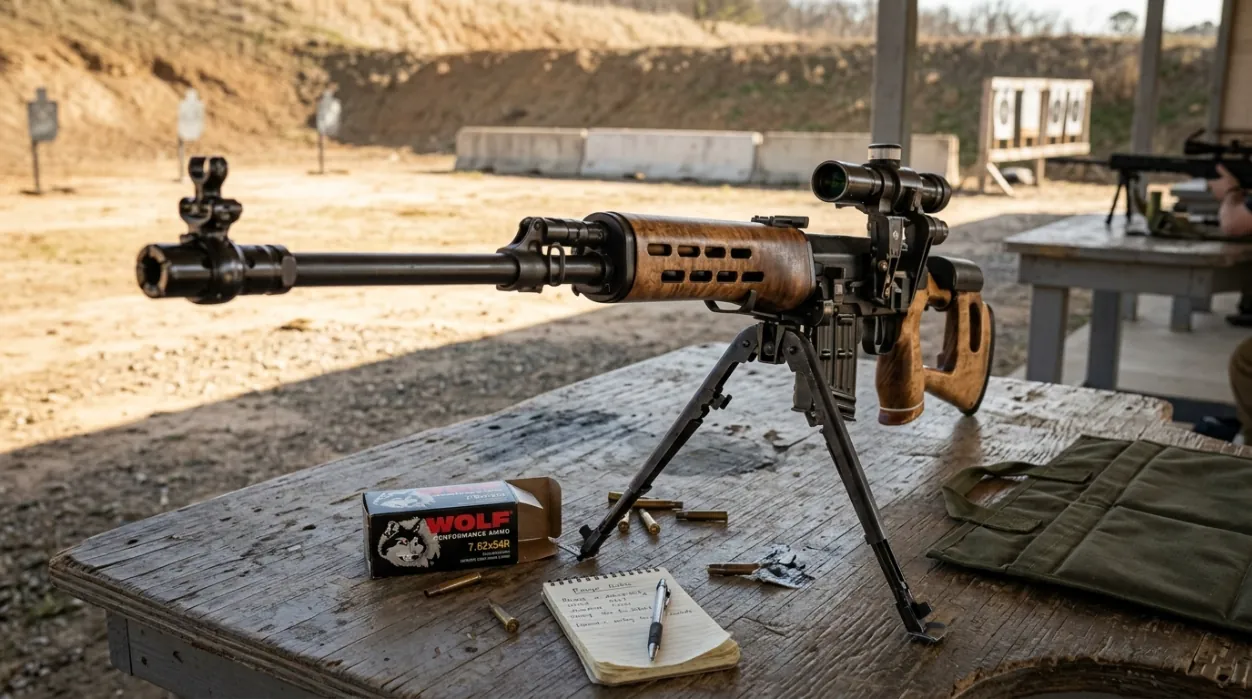
Call the SVD Dragunov a sniper rifle and most people will know exactly what you mean. But that label misses an important part of the story.
When the Soviet Union adopted the SVD in 1963, it was not intended to turn ordinary infantrymen into dedicated snipers. The rifle was designed to give selected soldiers within an infantry squad greater reach than the standard assault rifles carried by their comrades. In that sense, the SVD occupied a space between the conventional rifleman and the specialized sniper.
Designed by Yevgeny Dragunov, the rifle uses the Soviet 7.62×54mmR cartridge and a semi-automatic action. Its adoption came after a competition that also included designs from Aleksandr Konstantinov and Sergei Simonov.
More than six decades later, the SVD Dragunov remains one of the most recognizable Soviet-era military rifles, with modernized versions still appearing alongside newer Russian marksman weapons.
So why has a Cold War rifle remained relevant for so long?
The answer starts with its original purpose. The SVD wasn’t really designed to replace the AK. It was designed to give the AK-equipped infantry squad something the standard rifle couldn’t provide.
What Is the SVD Dragunov?
The SVD Dragunov is a Soviet-designed semi-automatic rifle chambered for the 7.62×54mmR cartridge. Its Russian designation, Snayperskaya Vintovka Dragunova, translates roughly to Dragunov Sniper Rifle, reflecting the role it was given in Soviet service.
But the word “sniper” can be misleading today.
The SVD was designed primarily to serve as a squad-level designated marksman rifle, giving selected infantrymen greater reach and precision than the standard assault rifles of their units. U.S. Army reference material describes it as a weapon intended to provide infantry with longer-range capability while remaining semi-automatic.
Its design is also quite different from the AK family, despite the visual similarities. The SVD uses a short-stroke gas piston and rotating bolt, with a detachable 10-round magazine. It was built around the full-power 7.62×54mmR cartridge, which had already been in Soviet and Russian service for decades before the SVD appeared.
That combination gave Soviet infantry something useful: a rifle that could remain relatively mobile while extending the squad’s engagement capability beyond what the 7.62×39mm AK could comfortably provide.
The distinction matters because modern sniper rifles are often built around very different priorities, including extreme precision, specialized optics and longer-range ammunition. The SVD was never intended to occupy exactly that niche.
Instead, think of it as the longer-reaching member of the infantry squad. One soldier carried a weapon optimized for a different job while remaining part of the same overall formation.
That simple concept explains much of the SVD’s unusually long military career — and why its influence extends well beyond the Soviet Union.
Read more: Top 5 Best Sniper Rifles in the World Ranked by Performance
History and Development of the SVD Dragunov
The story of the SVD Dragunov begins in the late 1950s, when Soviet military planners faced a problem created partly by their own success. The widespread adoption of assault rifles such as the AK gave infantry excellent firepower at short and medium distances, but it also left a gap at longer ranges.
The Soviet answer was not to replace the AK. Instead, planners wanted a dedicated rifle that could give selected soldiers greater reach while remaining part of the infantry squad. The SVD development program ran from 1957 to 1963, with three competing design groups led by Sergei Simonov, Aleksandr Konstantinov and Yevgeny Dragunov.
Dragunov’s design eventually won the competition after extensive testing in different environmental conditions. The Soviet military officially accepted it on July 3, 1963, giving the new rifle its place in Soviet infantry doctrine. An initial pre-production batch of about 200 rifles was assembled for evaluation, followed by serial production at Izhmash from 1964.
That timeline reveals something important about the rifle. The SVD wasn’t created as a luxury precision weapon for a small team of elite snipers. It was designed around a much broader battlefield requirement: putting a longer-reaching marksman capability inside the regular infantry formation.
In many ways, that was the clever part. The Soviet Army didn’t need every rifleman to shoot farther. It needed a few soldiers who could, without abandoning the mobility and semi-automatic fire of the infantry unit around them.
That basic idea would eventually make the Dragunov one of the most widely recognized designated-marksman rifles of the Cold War era.
SVD Dragunov Specifications
The SVD Dragunov was built around the full-power 7.62×54mmR cartridge, giving it a different character from the intermediate-caliber AK rifles carried by most Soviet infantry. Its dimensions also reflect the rifle’s intended role: substantial enough to support longer-range fire, but still practical for a soldier operating within an infantry formation.
| Specification | SVD |
| Origin | Soviet Union |
| Caliber | 7.62×54mmR |
| Operating system | Short-stroke gas piston |
| Action | Semi-automatic |
| Bolt | Rotating bolt |
| Barrel length | 620 mm |
| Overall length | Approx. 1,220–1,225 mm |
| Magazine capacity | 10 rounds |
| Weight with scope and empty magazine | Approx. 4.3 kg |
| Muzzle velocity | Approx. 830 m/s |
| Combat firing rate | Up to 30 rounds/min |
Official Russian export documentation lists the SVD at approximately 4.3 kg with its optical sight and empty magazine, with a 620 mm barrel and an overall length of around 1,220 mm. It also gives a maximum sighting range of up to 1,300 meters when using the rifle’s telescopic sight.
That last figure needs some context, though. Sight range isn’t the same thing as practical effective range. The SVD was designed to extend the reach of an infantry squad, not to compete directly with specialized modern precision rifles operating at extreme distances.

Its 10-round detachable magazine also reflects that philosophy. The rifle was expected to provide controlled, accurate fire while remaining lighter and more mobile than a dedicated heavy precision system.
Another important detail is the 7.62×54mmR cartridge itself. It was already an established Soviet military round when the SVD entered service, meaning the rifle could draw from an existing ammunition ecosystem rather than introducing an entirely new cartridge.
These specifications help explain the SVD’s position on the battlefield: larger and longer than a standard assault rifle, but still designed to move with the infantry rather than operate as a separate precision team weapon.
Read more: Top 5 Best Assault Rifles and What Makes Them Stand Out
SVD Dragunov Variants
The original SVD Dragunov became the foundation for a surprisingly broad family of rifles. Over the decades, Soviet and Russian designers modified the platform for airborne troops, modern optics, compact configurations and different operational requirements.
The SVDS was one of the most important developments. It introduced a folding stock and a shortened 565 mm barrel, making the rifle easier to transport for airborne and mobile forces. Russian export documentation lists its folded length at approximately 875 mm, significantly reducing its footprint compared with the standard SVD.
The SVDM represents the modernized direction of the family. It incorporates a heavier barrel, folding stock, updated furniture and modern accessory and sighting interfaces. Russian forces have continued introducing the SVDM as an upgraded alternative to older SVD rifles, particularly within airborne and specialized formations.

Another unusual branch is the SVU, which moved the SVD concept into a bullpup configuration. By relocating the action and magazine behind the trigger, designers reduced the rifle’s overall length while retaining the basic 7.62mm concept.
The SVDK went in another direction entirely, using the larger 9.3×64mm cartridge. It was developed for situations where greater projectile energy was considered desirable, creating a much heavier weapon than the standard SVD.
There are also night-capable SVDN-series configurations, which combined the rifle with specialized optical equipment for low-light operations.
It’s important, however, not to lump every similar-looking rifle into the SVD family. The Romanian PSL and Yugoslav Zastava M76, for example, are often described as Dragunov-style rifles but have different development histories and internal designs.
That variety is part of the SVD’s story. The original rifle established the basic concept, while later variants kept reshaping it around changing military requirements.
SVD Dragunov Military Users and Operators
The SVD Dragunov spread far beyond its Soviet origins, becoming one of the most widely recognized squad-level marksman rifles of the Cold War. Its appeal was straightforward: countries already operating Soviet-style small arms could introduce a longer-range semi-automatic rifle without building an entirely new infantry weapons ecosystem.
The Soviet Union and Russia remain the most important users. The rifle entered Soviet service in 1963 and became a standard squad-support weapon across Soviet and Soviet-influenced forces. U.S. Army reference material notes that the SVD subsequently became standard in several countries, particularly across the former Warsaw Pact.

Its international distribution was extensive. The SALW Guide records the SVD in countries including Ukraine, Belarus, Kazakhstan, India, Vietnam, China, Romania, Iran, Iraq and numerous former Warsaw Pact states. Some countries produced licensed or unlicensed versions, further expanding the rifle’s footprint.
China is an interesting case. Rather than receiving Soviet SVDs, it developed its own versions after reverse-engineering examples, eventually producing rifles such as the Type 79 and Type 85.
Vietnam also remains associated with the platform, while Russia continues producing SVD rifles more than six decades after the original design was introduced. In 2024, Rostec’s Kalashnikov Concern announced that SVD production had continued for more than 60 years and that output was being increased under new contracts.
That longevity is the more remarkable part of the SVD story. It wasn’t merely exported widely during the Cold War; the rifle became embedded in military structures that continued using Soviet-era equipment long after the Soviet Union itself disappeared.
The SVD Dragunov in Modern Military Service
More than six decades after its introduction, the SVD Dragunov has not disappeared. Instead, it has followed a familiar military pattern: older weapons are often modernized when their basic capability remains useful, even as newer designs are developed alongside them.
Russia’s SVDM is the clearest example. The modernized rifle retains the SVD’s basic operating architecture while adding features better suited to contemporary military equipment, including a heavier barrel, folding stock, updated furniture and modern sight and accessory interfaces. U.S. Army analysis has reported SVDM deliveries to Russian airborne and special-purpose formations.
The continued use of the SVD is also partly about familiarity. A military that already has decades of experience with a particular rifle doesn’t necessarily gain enough from replacing it outright. Modern optics, improved accessories and updated configurations can extend the useful life of an established platform without completely rebuilding the system around a new weapon.

At the same time, Russia has been developing the Chukavin SVCh, a newer marksman rifle intended to eventually complement or replace older SVD-family weapons. That development is significant because it shows both sides of the equation: the SVD remains useful, but its underlying architecture has limitations that modernization alone cannot solve forever.
The result is a transitional period where old and new systems coexist. The SVD continues to serve while newer rifles gradually expand into the same general role.
That may actually be the best measure of the Dragunov’s longevity. The question isn’t whether it is still the most advanced marksman rifle available. It clearly isn’t. The more interesting question is whether its basic capability remains valuable enough to keep upgrading.
For the SVD, the answer has so far been yes.
Why the SVD Dragunov Still Matters
The SVD Dragunov’s greatest legacy isn’t simply that it became one of the world’s most recognizable military rifles. Its bigger contribution was helping establish a role that has become familiar in modern infantry formations: giving selected soldiers a dedicated rifle capable of reaching beyond the practical range of standard assault rifles.
When the Soviet Union adopted the SVD in 1963, the concept was relatively distinctive. The rifle wasn’t intended to replace the AK or compete directly with specialized sniper teams. Instead, it extended the capabilities of the infantry squad while retaining a semi-automatic action and manageable battlefield mobility.

That concept proved remarkably durable. The SVD spread across the Soviet sphere, remained in service after the collapse of the USSR and eventually produced generations of derivatives, from the folding-stock SVDS to the modernized SVDM.
Its influence can also be seen in the broader evolution of designated marksman rifles. Many modern militaries now recognize the value of giving infantry units a weapon that sits between the standard assault rifle and a dedicated precision rifle. The exact designs have changed, but the underlying idea is familiar.
There is also something almost unusual about the SVD’s longevity. It has survived not because it remained technologically untouched, but because militaries repeatedly found ways to make an old concept useful in a new environment.
That is why the Dragunov still matters.
It may no longer represent the cutting edge of precision rifle technology, but its basic idea remains relevant: sometimes an infantry squad doesn’t need another sniper team. It needs one soldier who can simply reach a little farther.
