

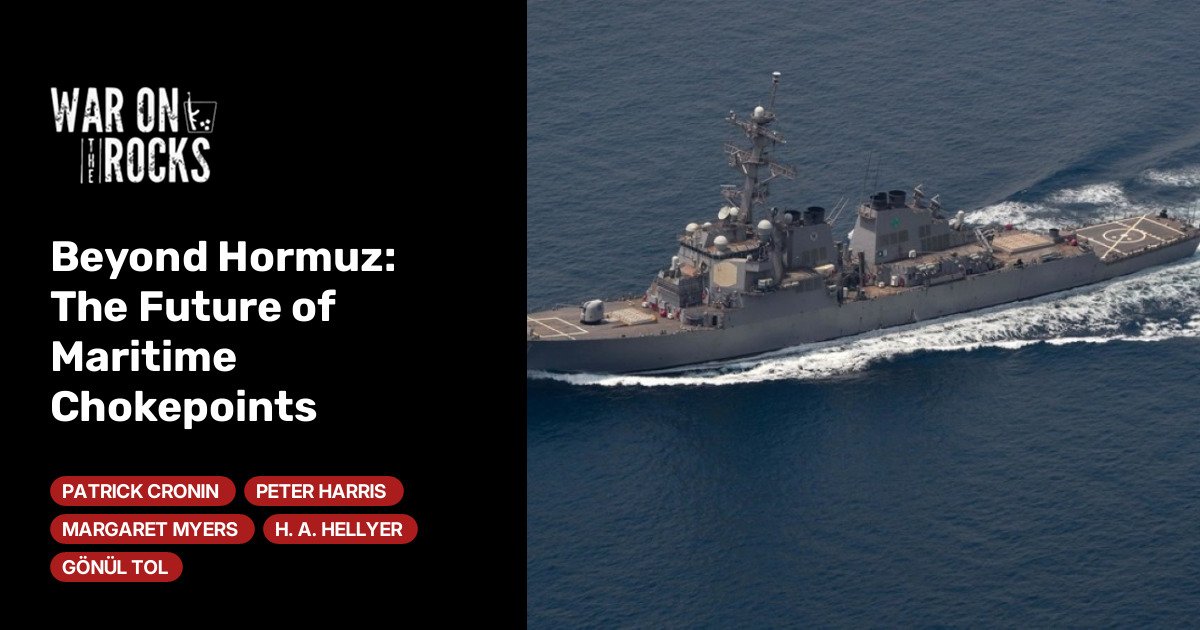
Iran’s closure of the Strait of Hormuz and efforts to extract payments for safe passage — plus, more recently, the Houthis’ move to attack Saudi shipping through the Bab el-Mandeb Strait — have highlighted the risks of maritime chokepoints to global shipping and raised questions about the future for freedom of navigation. The impacts extend beyond the Persian Gulf and the Red Sea, so we asked five experts to consider the implications for several other crucial waterways: the Strait of Malacca, the Taiwan Strait, the Panama Canal, the Suez Canal, and the Turkish Straits.Read more below.Patrick M. CroninAsia-Pacific Security Chair at the Hudson InstituteScholar in Residence at the Carnegie Mellon Institute for Strategy and TechnologyCan China escape the “Malacca dilemma” while preparing to disrupt U.S. naval and commercial shipping in a crisis? That is Beijing’s strategic challenge. Modern technology has made global shipping increasingly vulnerable. For the engineers who dominate today’s party-state, maritime chokepoints reverse the Venturi effect: Instead of accelerating flow through a narrow passage, military threats slow or halt commercial and naval traffic, magnifying gray-zone coercion and wartime costs.The Strait of Hormuz’s leverage stems from Gulf energy exports to Asia, much of which transits through the Malacca Strait. That vulnerability has long shaped Beijing’s strategy. Since 2013, Chinese leader Xi Jinping has sought to reduce China’s reliance on Malacca through diversified supply routes, larger strategic reserves, renewable energy, and overland corridors. Yet, overland alternatives cannot fully replace maritime transport, leaving Beijing to hedge across multiple networks. The result is a strategy of asymmetry designed to preserve open sea lanes in peacetime while retaining the ability to threaten chokepoints in wartime.Peter HarrisAssociate Professor of Political Science at Colorado State UniversityThe closure of the Strait of Hormuz has not significantly altered the level of geopolitical and geoeconomic risk in the
Members-Only Content
This article is reserved for War on the Rocks members. Join our community to unlock exclusive insights and analysis.
Iran’s closure of the Strait of Hormuz and efforts to extract payments for safe passage — plus, more recently, the Houthis’ move to attack Saudi shipping through the Bab el-Mandeb Strait — have highlighted the risks of maritime chokepoints to global shipping and raised questions about the future for freedom of navigation. The impacts extend beyond the Persian Gulf and the Red Sea, so we asked five experts to consider the implications for several other crucial waterways: the Strait of Malacca, the Taiwan Strait, the Panama Canal, the Suez Canal, and the Turkish Straits.Read more below.Patrick M. CroninAsia-Pacific Security Chair
