

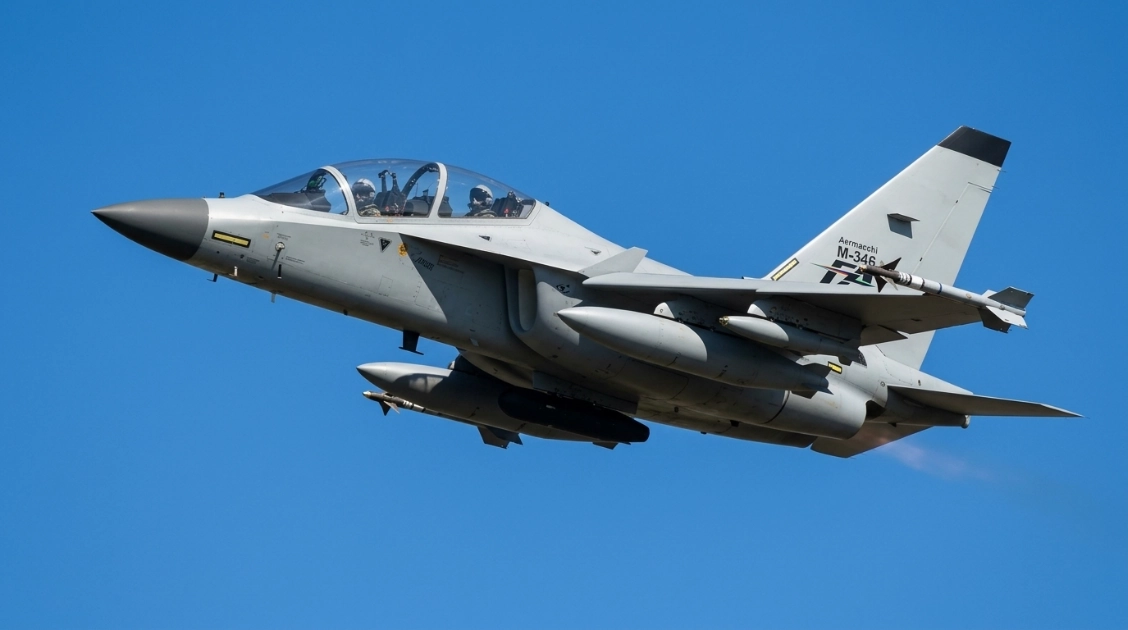
A jet built to train fighter pilots is becoming something more.
The Leonardo M-346 Master started as an advanced jet trainer, designed to prepare pilots for the demands of modern combat aircraft. But the latest M-346F Block 20 adds systems that push the aircraft into a much broader role, including AESA radar, Link 16 and electronic countermeasures.
That shift is attracting fresh attention in 2026.
In July, Indonesia signed a contract for 12 M-346F Block 20 aircraft, becoming the first Asian customer for the latest standard. Leonardo says the wider Leonardo M-346 Master program has already passed 170 aircraft ordered and more than 170,000 flight hours.
The appeal is easy to understand.
Training a fighter pilot on a frontline aircraft is expensive. Those aircraft also have limited flight hours and demanding maintenance schedules. An advanced trainer can take on much of the training burden while giving pilots a cockpit, flight profile and tactical environment closer to what they will encounter later.
The Leonardo M-346 Master takes that idea further.
Its twin Honeywell F124 engines give it a top speed of around Mach 1.1, while its training system connects live flying with ground-based simulation. The newer Block 20 adds tactical equipment that gives the aircraft selected operational roles.
But calling it a “cheap fighter” would miss the point.
The Leonardo M-346 Master is interesting because it sits between categories. It can train pilots for high-end fighters, support advanced tactical exercises and, in the right configuration, perform light-combat missions.
That combination explains why air forces are paying closer attention to the aircraft now.
What Is the Leonardo M-346 Master?
The Leonardo M-346 Master was built to solve a practical problem: how do you prepare a pilot for a modern fighter without putting that pilot straight into one?
The answer is an advanced jet trainer that behaves much more like a frontline aircraft than the trainers that came before it.
The Leonardo M-346 Master is a twin-engine, two-seat aircraft powered by Honeywell F124-GA-200 turbofans. It can reach roughly Mach 1.1 and operate at about 45,000 feet, giving student pilots experience with the speed and altitude of modern tactical aircraft.
But the aircraft itself is only part of the story.
Read also: Top 5 Best Military Trainer Aircraft and What Makes Them Effective
Leonardo designed the Leonardo M-346 Master around an integrated training system. Pilots can fly real missions while working with ground-based simulation and other virtual training elements. That means the aircraft can teach more than basic handling.
It can help build tactical habits.
This matters because fighter training becomes expensive as soon as pilots move into frontline aircraft. Every training sortie consumes fuel, maintenance hours and airframe life on a platform that may be needed for operational duties.
The Leonardo M-346 Master offers another step in the ladder.
A student can learn advanced aircraft handling and tactical procedures before moving onto a more complex fighter. The instructor also sits directly behind the student, allowing training to happen in the same aircraft rather than through a remote simulation alone.
Leonardo says the Leonardo M-346 Master program has accumulated more than 170,000 flight hours, showing how established the platform has become.
And the aircraft’s role is no longer limited to training.
The newer M-346F and Block 20 versions add equipment for tactical missions, which is where the story gets much more interesting.
Leonardo M-346 Master Specifications and Performance
The Leonardo M-346 Master was designed around one idea: give future fighter pilots a jet that behaves like a serious combat aircraft without using a frontline fighter for every training hour.
Its performance reflects that goal. The Leonardo M-346 Master uses two Honeywell F124-GA-200 turbofan engines, giving the aircraft enough power to reach roughly Mach 1.1. It can also operate at around 45,000 feet, putting it firmly in the advanced jet trainer category rather than the basic training class.
Here are the core figures commonly associated with the Leonardo M-346 Master:
| Specification | Leonardo M-346 Master |
| Manufacturer | Leonardo |
| Primary role | Advanced jet trainer |
| Engines | 2 × Honeywell F124-GA-200 |
| Maximum speed | About Mach 1.1 |
| Service ceiling | About 45,000 ft |
| Crew | 2 |
| Length | About 11.5 m |
| Wingspan | About 9.7 m |
| Configuration | Twin-engine, two-seat |
Those numbers don’t tell the whole story.
The Leonardo M-346 Master’s real strength is how its flight performance fits into the training pipeline. A pilot can practice high-speed handling, tactical maneuvers and advanced mission work on an aircraft designed for repeated training use, instead of consuming hours on a much more expensive frontline fighter.
The two-seat cockpit is crucial here. An instructor can sit directly behind the student while both operate within a cockpit designed around modern fighter workflows.

And the Leonardo M-346 Master isn’t limited to simple flight drills. Its training system can connect the aircraft with ground-based simulation and other simulated participants, allowing pilots to practice more complex scenarios without putting every aircraft into the sky.
One common mistake is to look at the Mach 1.1 figure and call the Leonardo M-346 Master a fighter. Speed alone doesn’t make one.
The aircraft’s value comes from the combination of performance, training systems and a cockpit built to prepare pilots for the next aircraft in their career. The newer M-346F Block 20 takes that concept further by adding equipment aimed at tactical missions.
How Does the Leonardo M-346 Master Train Future Fighter Pilots?
The real strength of the Leonardo M-346 Master isn’t just its speed. It’s the way the aircraft connects live flying with simulated combat training.
That matters because modern fighter training can become expensive very quickly. A pilot doesn’t need to spend every advanced training hour inside an F-16, Rafale or another frontline aircraft to learn tactical skills. The Leonardo M-346 Master can provide much of that experience on a platform built specifically for training.
Leonardo’s system uses a Ground Based Training System (GBTS) alongside the aircraft. It also supports Live, Virtual and Constructive (LVC) training, allowing pilots in the air to interact with simulated aircraft, threats and other training elements.
This changes what a training sortie can look like.
Instead of simply practicing takeoffs, turns and landings, a pilot can work through tactical scenarios while the aircraft’s systems reproduce many of the cues found in modern fighter operations. The instructor can then assess the pilot’s decisions rather than just judging how smoothly the aircraft was flown.
That’s a big distinction.

The textbook view of an advanced trainer is often “a cheaper aircraft before the real fighter.” The M-346 is more useful than that description suggests. It acts as part of a broader training system, with the aircraft, ground simulation and instructor tools working together.
The two-seat cockpit helps too. An instructor can monitor the student during demanding sorties and intervene when needed, without putting a frontline fighter at risk.
Leonardo says the Leonardo M-346 Master program has accumulated more than 170,000 flight hours, showing that this training concept has moved well beyond a development project.
And there is another benefit.
Pilots can build advanced tactical habits before moving onto more expensive combat aircraft.
The Leonardo M-346 Master doesn’t replace the final stage of fighter training. It makes that stage more focused, because pilots arrive with a much stronger foundation already built.
What Makes the M-346F Block 20 Different?
The M-346F Block 20 is where the Leonardo M-346 Master stops looking like only a trainer and starts looking like a tactical aircraft.
The biggest change isn’t the airframe. It’s the equipment packed around the pilot.
Leonardo’s Block 20 configuration adds a Large Area Display, AESA radar, Link 16 and electronic countermeasures, giving the aircraft a much more modern mission system than the basic trainer configuration.
The AESA radar is particularly significant. Unlike older mechanically scanned radars, an active electronically scanned array can steer its radar beam electronically without physically moving the antenna. That allows the system to manage multiple tasks more quickly and gives the aircraft a radar architecture closer to what pilots encounter on modern combat aircraft.
Then there’s Link 16.

For a pilot, this matters because modern air operations depend heavily on sharing information between platforms. Link 16 allows compatible aircraft and other forces to exchange tactical data, helping pilots build a clearer picture of what is happening around them.
The Block 20 cockpit also gets a Large Area Display, replacing the idea of a trainer cockpit built around many small instruments with a more integrated digital workspace.
And electronic countermeasures add another layer. The aircraft is no longer simply teaching pilots how to fly a fast jet. It can also expose them to the type of sensors and electronic threats they may encounter later.
This is where calling the M-346F Block 20 “just a trainer” falls short.
But calling it a full replacement for a frontline fighter goes too far in the other direction.
Its real value sits between those categories. The Block 20 gives air forces a platform that can train pilots with modern tactical systems while also supporting selected operational missions.
That middle ground is exactly what makes the latest Leonardo M-346 Master configuration so interesting.
Can the Leonardo M-346 Master Really Operate as a Light Fighter?
Yes, but calling the Leonardo M-346 Master a full fighter misses where the aircraft makes the most sense.
The M-346FA and newer M-346F configurations are built to handle selected combat tasks while keeping the aircraft’s training roots. Leonardo markets the M-346FA as a multirole light fighter, with roles that include air-to-air missions, air-to-surface work and tactical reconnaissance.
That gives smaller air forces another option.
A country doesn’t need to send a heavyweight fighter into the air every time it needs a relatively simple patrol or training sortie. A lighter aircraft can handle some missions while preserving more expensive fighters for tasks that demand their full capability.
The distinction matters, though.
The Leonardo M-346 Master isn’t designed to replace an F-35 or another high-end fighter across the board. Its smaller size, lighter payload and different sensor suite place clear limits on what it can do against a well-equipped opponent.
And that’s not a flaw in the concept.

The useful question is whether an air force actually needs a heavy fighter for every mission. If the answer is no, the M-346FA becomes much easier to understand.
Its fighter-like cockpit and advanced training system also create an interesting overlap. A pilot can train on the same basic aircraft family that may later perform operational missions. That can simplify the path between training and frontline duties.
The aircraft can also carry external stores, while the M-346FA adds radar and other mission equipment needed for tactical operations. The exact weapons and configuration depend on the customer and aircraft standard, so generic claims about a fixed weapons load can be misleading.
That middle position is the real story.
The Leonardo M-346 Master isn’t a “mini F-35.” It’s a lighter platform built around a different cost and mission equation.
For countries trying to expand pilot training while adding useful combat capacity, that combination can be more relevant than raw fighter performance alone.
Why Did Indonesia Order 12 M-346F Block 20 Aircraft?
Indonesia’s decision to buy 12 M-346F Block 20 aircraft puts the Leonardo M-346 Master into a very different regional context.
The contract, signed in July 2026, makes Indonesia the 23rd M-346 customer and the first Asian country to select the Block 20 standard. Deliveries are expected to begin in 2030.
The choice also makes sense when viewed through Indonesia’s training needs.
An air force needs more than frontline fighters. It needs a steady pipeline of pilots who can learn advanced tactics before moving onto more complex combat aircraft. The M-346 was built around that training problem, while the Block 20 adds systems that can support operational missions.
That combination gives Indonesia more flexibility from one aircraft family.
The aircraft is also linked to plans to replace older Hawk aircraft used by the Indonesian Air Force. Janes reported that the M-346F purchase will support the replacement of aging Hawk fleets while expanding Indonesia’s advanced training and light-combat options.

There is a practical point here that often gets missed.
Buying a light fighter does not mean Indonesia is trying to replace every heavier fighter with the M-346. The more realistic use is to divide missions between aircraft according to what each platform can do.
A Block 20 M-346 can handle advanced training while also offering tactical capability. That can reduce the number of training hours placed on more expensive frontline aircraft and give the air force another option for less demanding missions.
Leonardo has also highlighted plans for local support, training and maintenance activity tied to the Indonesian program.
For Indonesia, then, the M-346F Block 20 is not just another aircraft purchase.
It connects pilot training, fleet renewal and selected combat capability in one program.
And that’s probably the most useful way to understand why the M-346 is attracting attention well beyond Europe.
Why Is the Leonardo M-346 Master Gaining Attention?
The Leonardo M-346 Master is gaining attention because it solves two problems with one aircraft: advanced fighter training and selected light-combat missions.
That combination is becoming more useful as air forces face the rising cost of operating frontline fighters. A pilot still needs hours in the air, but not every training sortie needs to consume the life of an expensive combat aircraft.
The Leonardo M-346 Master offers a different path.
Its training system already has a substantial record, with Leonardo reporting more than 170 aircraft ordered and over 170,000 flight hours across the program. The newer Block 20 configuration then adds systems such as AESA radar, Link 16, electronic countermeasures and a Large Area Display, giving customers a more modern tactical platform.
Recent orders show where the interest is coming from.

Indonesia signed for 12 M-346F Block 20 aircraft in July 2026, becoming the first Asian customer for that standard. Canada has also selected the M-346T Block 20 for advanced fighter-pilot training, while other operators continue using the aircraft as part of their training systems.
But the Leonardo M-346 Master shouldn’t be sold as a cheap substitute for every fighter.
That’s the wrong comparison.
A better comparison is between missions. For advanced pilot training, tactical exercises and selected lower-end combat tasks, a lighter aircraft can make more sense than sending a high-end fighter into the air every time.
The Block 20 strengthens that case by giving pilots access to systems that resemble those found on modern combat aircraft.
That may be the Leonardo M-346 Master’s biggest advantage.
It’s not trying to win the fighter market by being the fastest or most heavily armed aircraft. It’s building a niche around training, modern avionics and light combat capability in one platform.
For air forces planning their next decade of pilot training, that’s a combination worth watching closely.
