

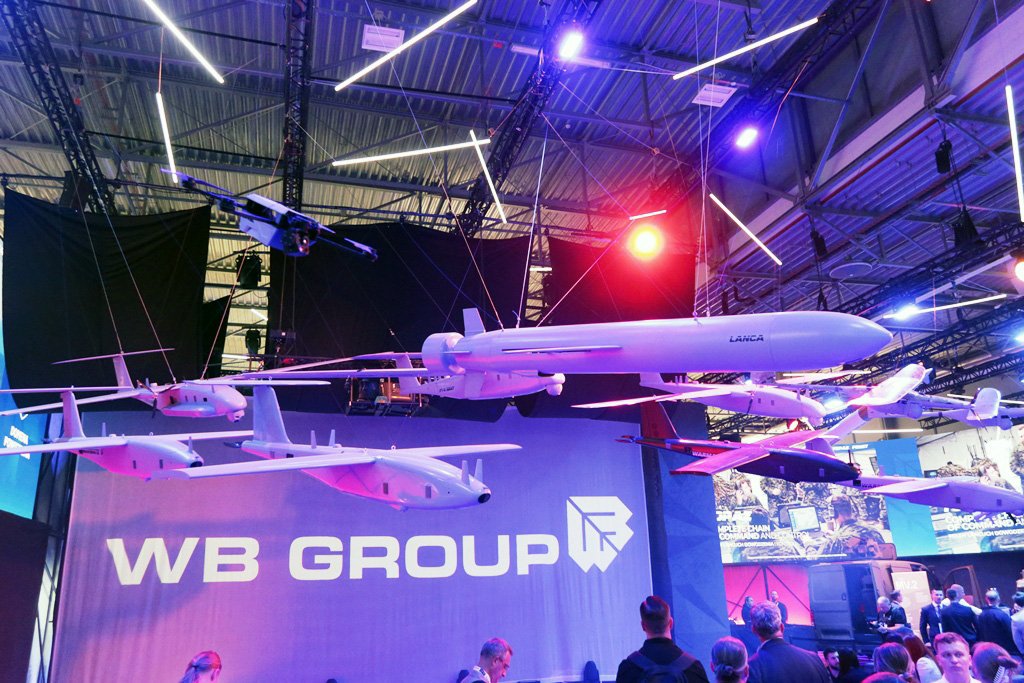
In the Polish defence industry ecosystem, WB Group comes second in terms of size after PGZ, but is by far the biggest privately owned player, not only in defence but considering the whole Polish industry. Since 2014 WB started exporting its systems in Ukraine, and in the last 12 years it developed close links to the armed forces of that country, which allows its companies to have first-hand feedback from the battlefield, allowing the Polish group to continuously evolve and improve its products
WB was established in 1997 by two engineers, Piotr Wojciechowski and Adam Bartosiewicz, the President and Vice-President of the group, who still own respectively 45.49% and 28.07%, while since November 2017 the remaining 26.44% is in the hands of the PFR (Polski Fundusz Rozwoju, Polish Development Fund). The group controls several companies, the four key ones being Radmor, active in the tactical radio communications and unmanned surface platforms, Arex, which is developing and producing weapon control systems and power and energy systems, WB Electronics, which provides C4I systems and land platform systems integration, and Flytronic, the specialist in unmanned aerial systems.
In the last five years the group saw a 10 time increase in revenues, from 100 million US$ in 2021 to over 1 billion US$ in 2025, the order backlog being 9 billion US$, which covers the next four years. Fifty per cent of its business comes from export; the first foreign customer was the United States, and now it exports its products in over 10 countries in North America, Europe and the Far East, one of the latest flags pinned on the world map being Japan. Looking at the revenue split by product category in 2025, 58% came from C4I systems, 20% from unmanned systems, 14% from armament systems, and 8% from other systems. Born from engineers, WB Group remains a largely engineer company, as half of its 3,000 employees are engineers.
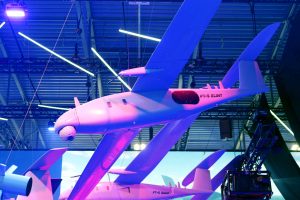
At MSPO EDR On-Line met Jean-Christophe Le Guellec, a project manager at WB Electronics who has been working in what used to be the Ukraine Office, which has since become a department dedicated to strategic partnerships, which EDR On-Line understood includes Ukraine, India, and France.
“Since 2014, we’ve been in Ukraine, so in terms of the Ukrainian frontline we are pioneers. This allowed us to develop our products, with the added complexity of all the jamming and spoofing on that front,” Le Guellec said, explaining that in some comparative trials where competing drones were tested in an electronic warfare challenging environment, most of the could not carry out their mission. WB drones are made of composite materials and are fitted with carbon fibre propellers. “Every week we receive videos from Ukraine showing our drones returning from the front with tails or wingtips heavily damaged, flying back for over 40 km controlled by the pilot,” he said, EDR On-Line understanding that 80% of them are repaired and return to service in a matter of days or weeks.
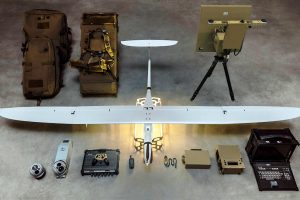
A reconnaissance drone such as the FlyEye carries a valuable payload, i.e. the GS4 gyro stabilized gimbal which hosts daylight and infrared cameras and features a target-lock function; to avoid damaging the payload this is dropped just before landing and comes to the ground suspended to a parachute, while the now much lighter airframe makes a U-turn and lands normally. A feature even more important should the airframe be damaged. The FlyEye is one of the reconnaissance and observation UAVs mostly used in Ukraine, according to WB, and although the data sheet mentions a 4.5-hour autonomy, experienced Ukrainian operators capable to exploit at best favourable thermal winds managed to extend the mission over 10 hours, record time being over 12 hours. Beside reconnaissance missions aimed at precisely locating targets that are then handed over to Warmate 3 and Warmate 5 loitering munitions, FlyEyes play a key role in battle-damage assessment, sending streaming videos back to base to allow decisionmakers to eventually reiterate the attack mission, should the target not be sufficiently damaged. New systems will be deployed on the Ukrainian front soon, EDR On-Line was told.
WB developed a computer feedback system in which Ukrainians connect to a platform, and the company receives all the information, feedback, damages and notes directly from the ground. WB can then streamline all the information, knowing exactly the status of every single piece of equipment which makes the company technical support much more efficient.
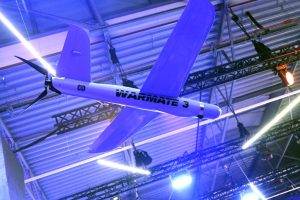
Exact numbers of drones provided to Ukraine by WB remain classified: “We have sold several thousand systems and trained hundreds of operators,” is what we managed to get, first deliveries of drones from Poland dating back to 2014. Since August 2025 WB started mass producing FlyEye drones in Ukraine. The high number of systems deployed on the battlefield, hence the experience acquired in terms of lessons learned in real environment, allowed WB to evolve electronic warfare systems as well as software in terms of effectiveness, but also in terms of ease of use by the operator on the ground. The experience also allowed improving training and optimising aspects, such as the deployment time, which are vital in a drone infested area.
In late August 2026 a fire was started at night at the WB warehouse and production facility in Skarzysko-Kamienna, 150 km south of Warsaw, hopefully without causing serious damage; investigation is underway to establish if it was a case of sabotage or not. If yes it would be a further proof of the effectiveness of FlyeEye and Warmates on the Ukrainian front.
Photos by P. Valpolini
