

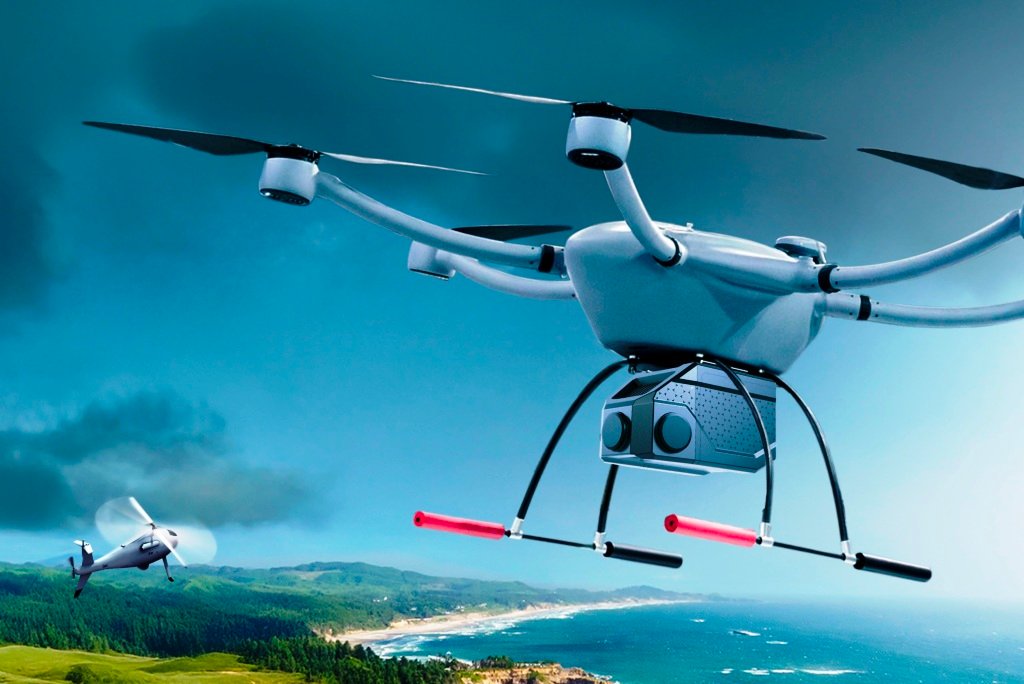
Known as BeamTracker, a new lightweight, low-power radar electronic support measures (RESM)/electronic intelligence (ELINT) solution sized for deployment from unmanned air vehicles (UAVs) and other uncrewed platforms, has been unveiled by the electronic warfare business of Thales DMS France, with low-rate initial production having commenced in advance to first contracts
BeamTracker is a vehicle-agnostic, low-size, weight and power (SWaP) radar EW payload designed to support early warning, situational awareness and intelligence gathering for Class 1 and Class 2 UAVs. Thanks to its specific architecture and data treatment knowledge coming from more than 60 years of experience developed by Thales, BeamTacker combines long-range detection in complex and congested electromagnetic environments with real-time radar emission analysis and filtering of data of operational interest, thanks to a fully digital architecture, reducing operator cognitive workload and speeding up decision-making.
Based on the latest technology allowing for unprecedented compactness, BeamTracker was designed to be mounted on any type of uncrewed platform operating in the air, at sea and overland, with the mission to sense the electromagnetic (EM) environment and to provide real-time tactical electronic information over a wide range of frequencies. BeamTracker has a mass of approximately 5 kg, a 10 litres volume and 130 watts of power consumption. Its high-performance sensor leverages on the work and processing capabilities already developed and proven in the company’s Sentinel digital RESM product, which represents the latest high-end addition to Thales naval portfolio and is already in service with French and foreign naval forces. Evolved from CURCO (Charge Utile R-ESM Compacte or compact radar electronic- support-measures payload) technology demonstrator previously tested during exercises performed in 2024 and 2025 in partnership with the French Navy, the BeamTracker covers the 1-18 GHz frequency range “as most of the radar threats are there” the Thales representative said. Offering an instantaneous bandwidth of 3 GHz and an instantaneous field of view of 100°, the system uses three antennas to provide full performances and coverage through this sector, as shown by the system installed under a Class 1 UAV. It uses amplitude-comparison direction finding, with Thales claiming a root-mean-square (RMS) bearing error of 3°. Passive localisation of signal threats is conducted by cross fix and multiple collaborative units.
In terms of signal processing, the latter is shared between the drone itself, which performs the digital signal processing, able to initiate the tracking of threats of interest, and the ground station, where the data is sent by data link and is being processed and compared with radar signal libraries in a quick way. The split in terms of processing between the payload and the ground station is requested in order that critical and sensitive information such as data libraries are not stored in the payload, due to the potential loss of the platform due to operational causes or UAV malfunctions. Artificial intelligence algorithms are used both in the payload and in the ground station, to provide quick information on the detected radar of interest, to reduce time and the skills needed by the operator. The BeamTracker is easy to use with minimal training requirements, not requesting the skills of an EW specialist, and was designed to give the information to higher echelons in the quickest way without analysing any kind of signal. The idea behind it is to provide info in less than one minute, the Thales representative explained.

According to the company, the ground station includes its 5th generation data processing as well as Thales EW cockpit and engine powered by SERI and Golden AI artificial intelligence software packages. According to the company, the latter offers a major evolution towards cognitive EW, thanks to two innovative functions that enable the data collected by RESM systems such as the BeamTracker to be analysed up to four times faster. Firstly, it enables the training of AI models from the databases of capitalised radar electromagnetic interceptions. Secondly, it also enables the analysis of electromagnetic interceptions recorded during a mission, to identify the types of the corresponding radars and to enrich the database. By standardising and accelerating analysis, this tool significantly reduces operators’ workload, while improving the accuracy of interception reports.
As part of further developments, the new system is planned to incorporate a spoofing capability, providing some false target to saturate the enemy radar, but not high-power jamming.
Asked about the current development stage of the system, the Thales representative said it is ready for demonstration having already completed the development. The company has already launched the manufacturing of the first batch of units to anticipate potential sales as BeamTracker has received a lot of interest from national and international customers, with a delivery availability between late 2027 and mid 2028.
Photo and graphics courtesy Thales
