

The Senate on Friday confirmed in a 51-47 party-line vote multiple executive branch nominees, including several involved in government oversight and federal employee matters.
Justice Department Inspector General
Since President Donald Trump fired nearly 20 of the agency watchdogs at the start of his second term, most of the individuals who have been approved as replacements previously worked in the first or second Trump administration, which government oversight advocates argue threatens the independent nature of IG offices.
But Don Berthiaume, the newly confirmed watchdog at DOJ, is a career IG employee. Most recently, he served as a senior adviser in the office he now leads and had a stint as acting DOJ IG from October 2025 through January 2026 but was limited by rules for how long an individual can serve in an acting position.
During his confirmation hearing before the Senate Judiciary Committee, Berthiaume testified that he has a personal appreciation for whistleblowers, as he himself was one while at the Drug Enforcement Administration.
“That experience taught me that whistleblowers are not abstractions, they are public servants who often take personal and professional risks to bring forward information the government needs to hear. It also taught me that the OIG functions best when it is operationally independent, but not isolated,” he said. “The OIG must retain full authority over what it reviews, how it conducts its work and what conclusions it reaches. But effective oversight also benefits from good information sharing, open lines of communication and professional engagement with the components it oversees.”
The DOJ IG has historically taken on high-profile cases. For example, Berthiaume has worked on a review of the FBI’s use of Foreign Intelligence Surveillance Act authorities against Trump 2016 campaign staffers. And he told senators that he is aiming to complete an audit of the DOJ’s compliance with the Epstein Files Transparency Act within one year.
Federal Labor Relations Authority General Counsel
A backlog of hundreds of cases has piled up at this agency, which manages labor-management relations for the civil service, due to there not being a Senate-confirmed general counsel.
But many federal employee unions opposed the nomination of Charlton Allen, a conservative lawyer, arguing that he lacks experience in labor relations and pointing out that, while running for a state elected position in 2012, he said public employees shouldn’t be allowed to unionize.
The unions also flagged that Allen, while a student at the University of North Carolina Chapel Hill in the early 1990s, ran a student publication that featured racist attacks.
During his confirmation hearing, Democratic senators asked Allen about a cover of that publication, which featured a Jewish candidate for student body president with horns and a pitchfork. The nominee said that the cover was a “mistake” but that it was referencing UNC’s rival — the Duke University Blue Devils.
Special Counsel
While he was confirmed on Friday, Charles Baldis is not new to the Office of Special Counsel, which protects feds from prohibited personnel practices — including retaliation for whistleblowing. Baldis, a former Senate staffer, has been the designee of the agency’s acting chief since spring 2025 while also serving as OSC’s chief counsel.
The president’s first OSC nominee, Paul Ingrassia, withdrew in October 2025 following objections from Senate Republicans over reports of sexual harassment accusations and racist text messages. In March 2025, Trump removed the incumbent special counsel — Hampton Dellinger, who was appointed by former President Joe Biden — before the end of his five-year term.
Federal Emergency Management Agency Administrator
The government’s disaster response and recovery agency now has a Senate-confirmed leader for the first time since the start of the second Trump administration.
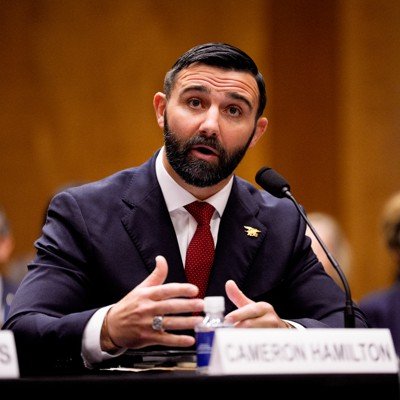
Cameron Hamilton, the new chief, served as acting administrator at the start of 2025 but was fired after testifying to Congress that he did “not believe it is in the best interest of the American people to eliminate [FEMA].” The president and other administration officials have proposed axing the agency.
The White House-backed FEMA Review Council in May recommended reducing the size of the agency while giving state and local governments a larger share of responsibilities following emergencies.
The Government Accountability Office recently reported that FEMA pushed thousands of its employees out in 2025 and 2026 without considering the impact that doing so would have on fulfilling the agency’s mission.
Merit Systems Protection Board Chairman
James Woodruff, who has been a Republican member of the MSPB since October 2025, is now the chairman of the agency, which hears appeals for federal employee disciplinary actions.
Henry Kerner, the board’s other GOP member, had been serving as acting chairman.
The MSPB is led by three board members, but no more than two can be from the same political party. Trump last year fired Cathy Harris, a Democratic member of the board, for no specified reason. While she appealed her removal, the Supreme Court in June ruled in a separate case that the president can fire bipartisan board members of independent agencies without cause.
Office of Management and Budget Deputy Director
Hal Duncan, who already holds a senior position in the White House budget office, was confirmed as the agency’s number two leader. During his hearing, Democratic senators criticized a proposed OMB rule to overhaul the federal grantmaking process, including by requiring political appointees to approve awards to ensure they advance the president’s priorities.
The bipartisan Senate agreement to avoid a government shutdown on Oct. 1 includes language that would temporarily freeze OMB’s proposed rule. As of Friday afternoon, it’s unclear if senators will vote on the continuing resolution before the start of a five-week recess.
