

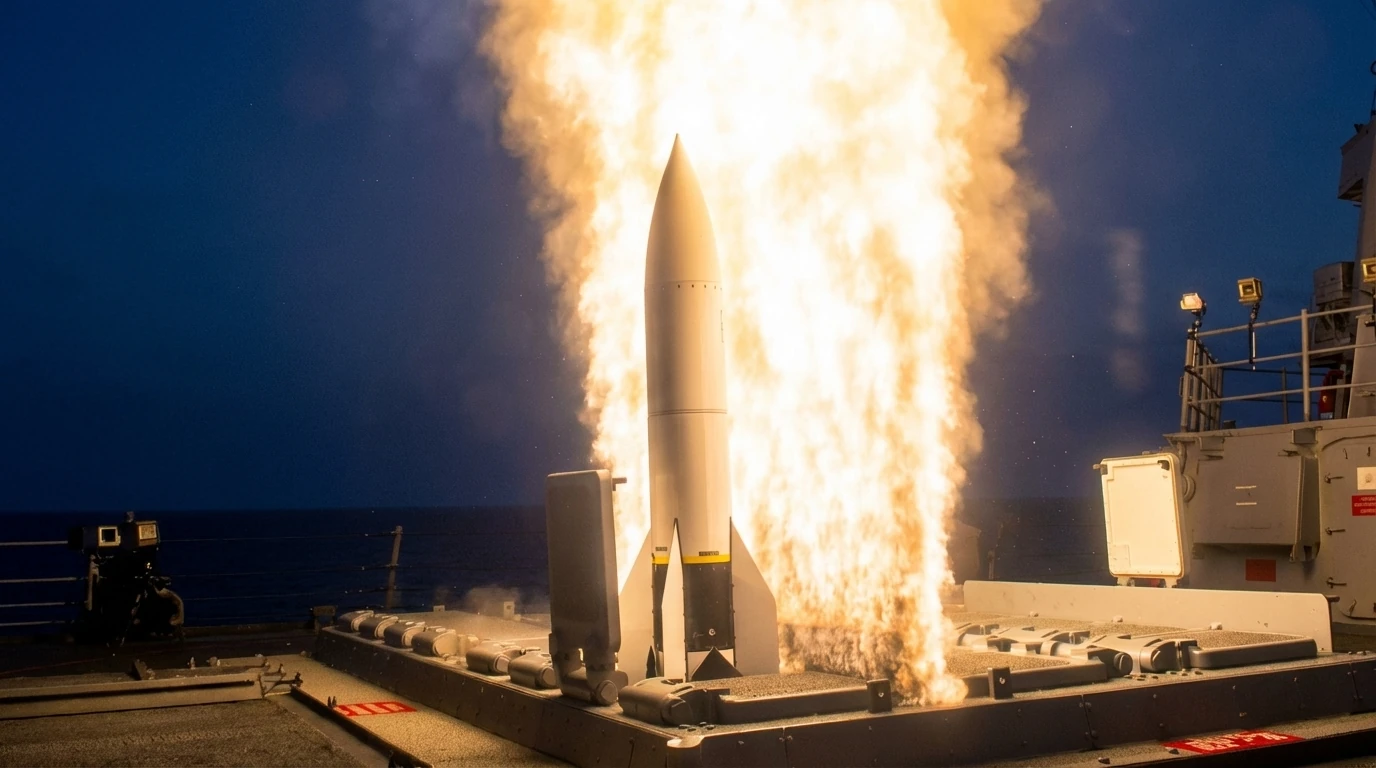
There’s a moment in modern naval warfare where everything changes, when a single missile doesn’t just do one job, but three… maybe more. That moment? It’s largely defined by the Standard Missile-6.
At first glance, the Standard Missile-6 (SM-6) might sound like just another piece of military hardware tucked into the vast arsenal of the U.S. Navy. But spend a few minutes with it, and you start to realize, this isn’t just a missile. It’s more like a Swiss Army knife traveling at over three times the speed of sound.
Here’s the twist: most missiles are built with a single purpose. Some chase aircraft. Others intercept ballistic threats. A few go after ships. The SM-6? It blurs those lines. In real-world terms, that means a destroyer armed with SM-6s doesn’t need to guess what kind of threat is coming next, it’s already prepared.
And that flexibility is not just impressive, it’s strategic. In an era where threats evolve fast (drones one day, hypersonics the next), adaptability is currency.
So what exactly makes the SM-6 missile so different? Why do defense analysts keep calling it a “game-changer”? And how does it actually work when deployed in real combat scenarios?
What Is the Standard Missile-6?
If you strip away the acronyms and defense jargon, the Standard Missile-6 (SM-6) is essentially a long-range, ship-launched missile designed to handle multiple types of threats, sometimes all in the same mission window. Its official designation, RIM-174, doesn’t exactly roll off the tongue, but it hints at its place in the long-running “Standard Missile” family used by the U.S. Navy.
Now here’s where it gets interesting. Unlike older missiles that rely heavily on guidance from the ship after launch, the SM-6 missile carries its own active radar seeker, borrowed and adapted from air-to-air missile technology.
Translation? Once it’s in the air, it can think a bit more for itself. That independence opens the door to engaging targets far beyond the launching ship’s radar horizon.
Let’s ground this with some core specs:
| Specification | Approximate Value |
| Length | ~6.6 meters |
| Range | ~370+ km |
| Speed | Mach 3+ |
| Warhead | ~64 kg blast fragmentation |
| Launch Platform | Mk 41 VLS (Vertical Launch System) |
But specs alone don’t tell the full story. What really defines the Standard Missile-6 is its role as a multi-mission interceptor. It can target aircraft, cruise missiles, ballistic missiles in their terminal phase, and even surface ships. That’s a wide net, and not something most missiles can claim.
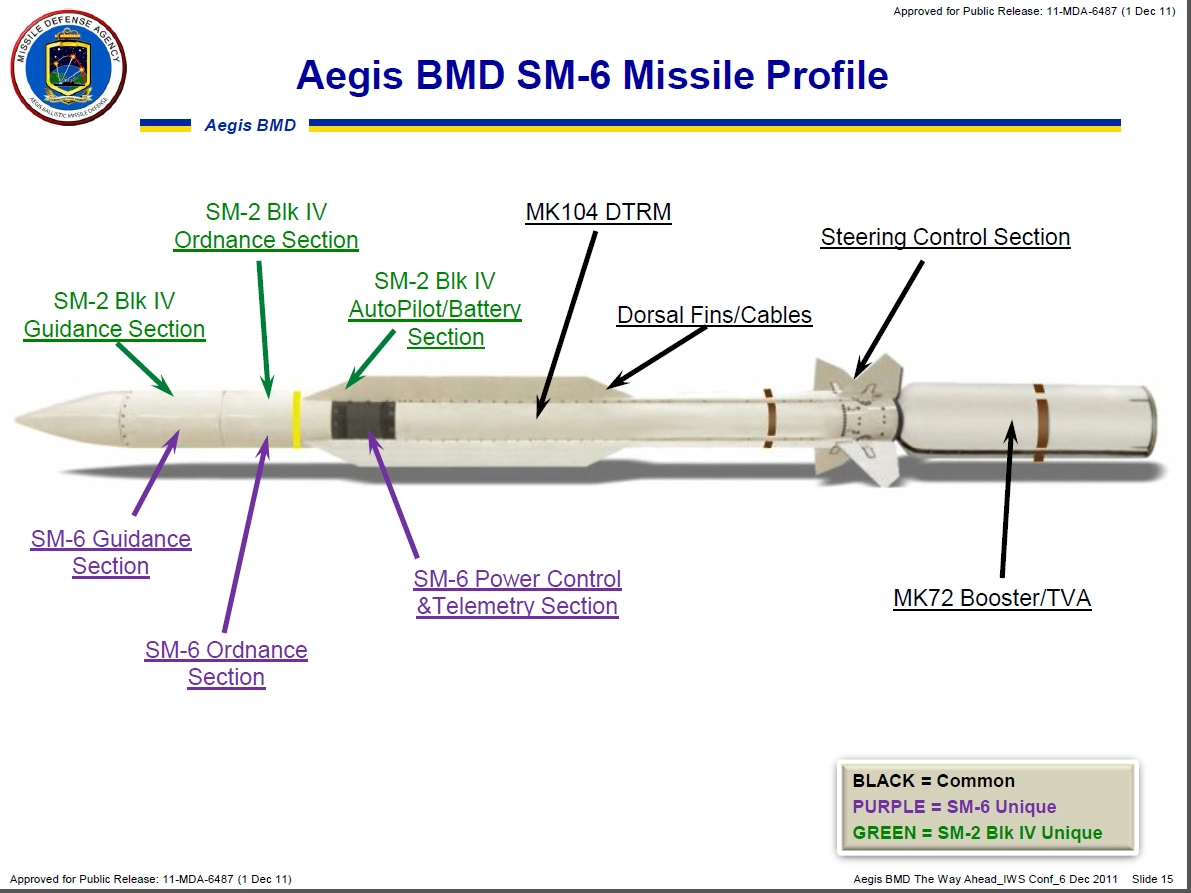
Think of it this way: instead of carrying three different tools into a high-stakes situation, naval forces bring one, and it adapts on the fly.
And yes, that adaptability comes at a cost (literally and operationally), but we’ll get into that later.
SM-6 Capabilities: What Makes It So Versatile
Let’s get something straight, the Standard Missile-6 isn’t impressive because it’s fast or long-range. Plenty of missiles tick those boxes.
What sets it apart is how it switches roles mid-conversation, almost like a multitool reacting to whatever threat pops up next.
1. Anti-Air Warfare (AAW)
At its core, the SM-6 missile is still a top-tier air defense weapon. It can intercept:
- Fighter jets
- Surveillance aircraft
- Cruise missiles
- Even low-flying drones that try to hug the horizon
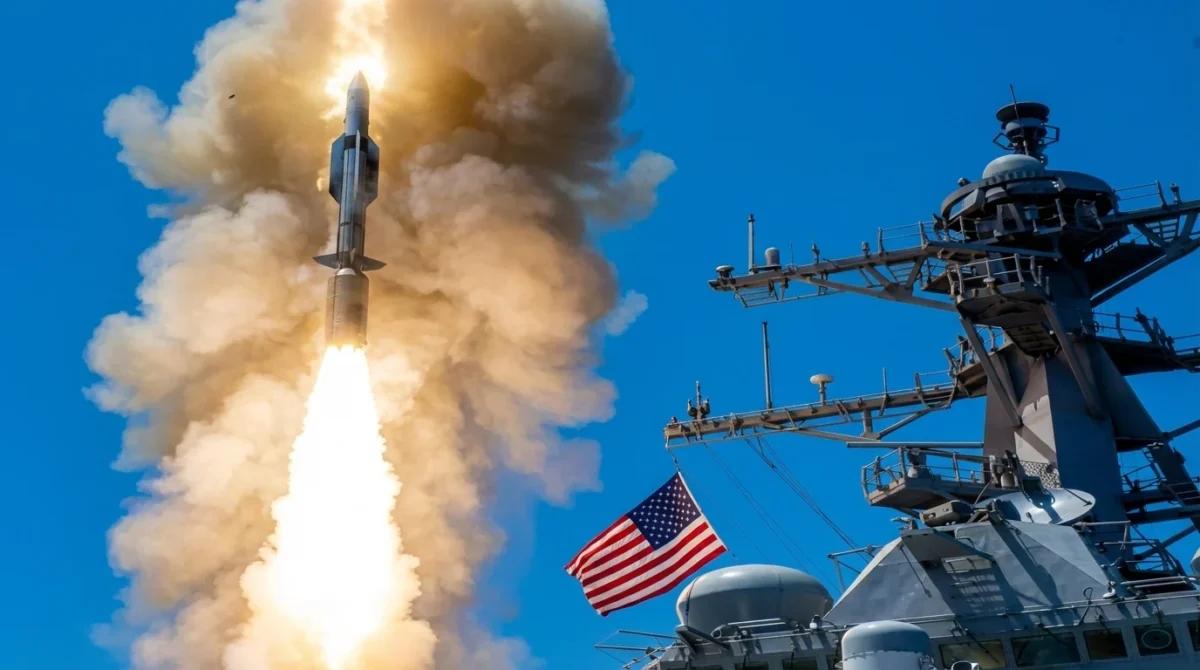
And it does this at serious distances, well beyond what earlier naval missiles could comfortably reach. That extended reach buys time. In warfare, time equals options.
2. Ballistic Missile Defense (Terminal Phase)
Here’s where things get a bit more intense. The Standard Missile-6 can intercept ballistic missiles, but not in space like some specialized systems. Instead, it targets them during their terminal phase, when they’re screaming back toward Earth.
Read also: Aegis Missile Defense System: Can It Really Stop Hypersonic Missiles?
That’s a narrow window. Fast, chaotic, unforgiving. Yet the SM-6 has demonstrated the ability to hit those targets, which adds a critical extra layer to naval missile defense.
3. Anti-Surface Warfare (Anti-Ship Role)
This one surprised a lot of analysts. The SM-6 can also strike enemy ships.
Now, it’s not a dedicated anti-ship missile with a massive warhead. Think of it more as a precision disruptor. It can disable radar systems, damage critical components, or create enough chaos to neutralize a vessel without outright sinking it.
A “mission kill,” as they call it.
4. Over-the-Horizon Engagement
This is where things start to feel almost sci-fi.
Using networked targeting systems, the SM-6 can hit targets it cannot directly see. Another platform, maybe a drone, maybe an aircraft, feeds targeting data. The missile launches anyway… and finds its mark.
It’s not just a weapon. It’s part of a much bigger, connected battlefield.
How the Standard Missile-6 Works
Trying to understand how the Standard Missile-6 works is a bit like following a relay race where the baton keeps changing hands mid-sprint, except here, the runner is moving at over Mach 3 and the baton is targeting data.
It all begins inside a warship’s Mk 41 Vertical Launch System, where the SM-6 missile sits sealed and waiting. The launch itself is abrupt, no buildup, no warning. A booster ignites, and the missile is hurled upward before sharply tilting toward its target. Within seconds, it’s already covering serious distance.

Now, here’s where things get less traditional.
As the missile flies, it doesn’t rely on a single stream of information. Early in its flight, it may be guided by the launching ship’s radar. But that’s just one voice in a much larger conversation. Data can also come from airborne early warning aircraft, nearby ships, or other sensors scattered across the battlefield. The missile listens, adjusts, recalculates. It’s not locked into one perspective.
Midway through, the propulsion system takes over in full force. After the initial booster burns out, a dual-thrust rocket motor keeps the Standard Missile-6 moving at sustained high speed, fast enough to close gaps quickly, but also controlled enough to make fine adjustments as the situation evolves.
Then comes the final phase, the moment where things get personal.
The missile activates its own onboard radar seeker, effectively becoming self-guided. At this point, it no longer depends on external tracking. It sees the target, tracks it, and makes split-second corrections to ensure interception.
It’s not just speed or power that defines the SM-6. It’s this layered, almost collaborative way of operating, part independent hunter, part team player in a much bigger system.
Standard Missile-6 Variants and Upgrades
The Standard Missile-6 didn’t arrive fully formed as the multi-role powerhouse we talk about today. It evolved, quietly at first, then with increasingly ambitious upgrades that stretched what a naval missile could realistically do. Think of it less like a single product and more like a platform that keeps learning new tricks.
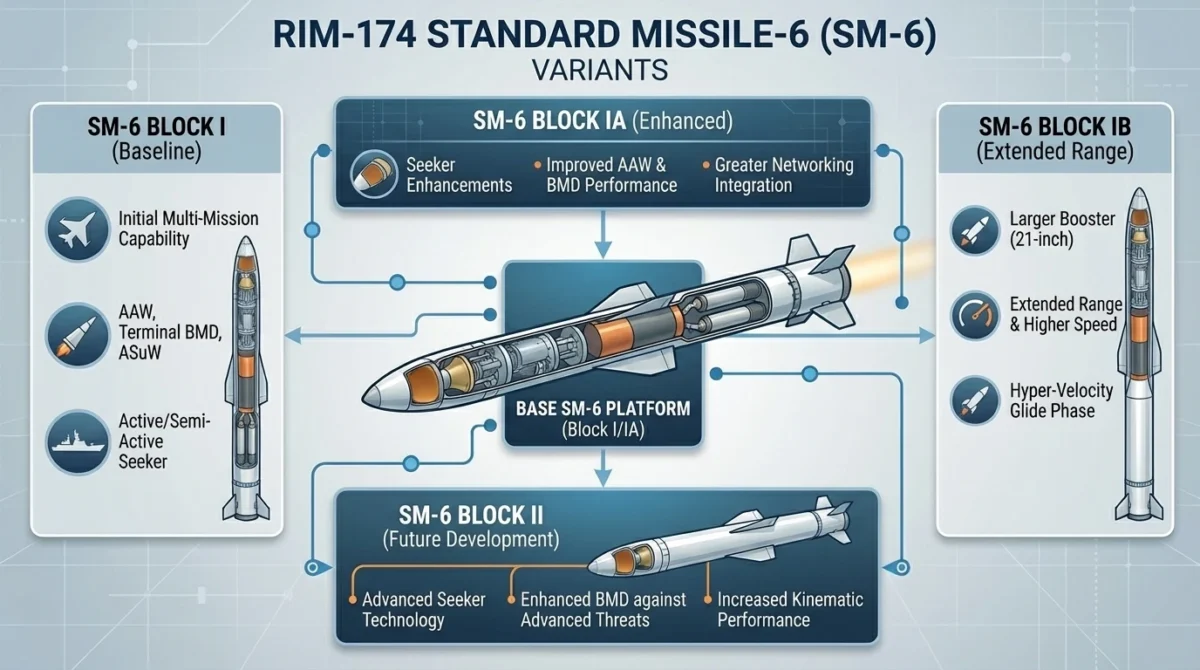
The earliest operational version, often called Block I, entered service around 2013. At that stage, the SM-6 missile was primarily focused on extended-range anti-air warfare. Already impressive, it could hit targets far beyond older systems, but still somewhat “specialized” compared to what came next.
Then came a shift.
The Dual I configuration added something big: the ability to engage ballistic missiles in their terminal phase. That wasn’t a minor tweak; it fundamentally expanded the missile’s role from air defense into missile defense. Suddenly, ships equipped with the Standard Missile-6 weren’t just protecting themselves from aircraft, they were part of a broader shield against incoming missile threats.
From there, incremental upgrades started stacking up. Improved software, better targeting logic, refined guidance. The kind of changes that don’t always make headlines but quietly increase effectiveness in real-world scenarios.
Now, attention has shifted to the Block IB variant, which is where things get especially interesting. This version is expected to feature a larger rocket motor, translating into greater range and potentially higher speeds. In practical terms, that means earlier intercept opportunities and more flexibility in how the missile is deployed.
Here’s a quick snapshot:
| Variant | Key Upgrade | Impact |
| Block I | Baseline multi-mission capability | Long-range air defense |
| Dual I | Added ballistic missile defense | Expanded mission scope |
| Block IA | Guidance and software improvements | Better accuracy |
| Block IB | Enhanced propulsion (in development) | Longer reach, higher performance |
And the story’s not finished. If anything, the SM-6 feels like it’s still mid-evolution.
SM-6 Role in Modern Warfare
The Standard Missile-6 didn’t just add another layer to naval defense, it quietly reshaped how naval warfare is thought about. Not in a flashy, headline-grabbing way. More like a slow shift in mindset: fewer specialized tools, more adaptable systems that can pivot mid-conflict.
Picture a modern destroyer out at sea. Space is limited. Every missile cell matters. In the past, commanders had to make trade-offs, load more anti-air missiles or prioritize ballistic missile defense? Maybe carry dedicated anti-ship weapons instead? The SM-6 missile blurs those decisions. One slot, multiple roles. That’s not just efficient, it’s strategically liberating.
And then there’s the network side of things.

Modern warfare isn’t fought in isolated bubbles anymore. It’s layered, connected, sometimes messy. The Standard Missile-6 fits neatly into this environment because it doesn’t rely solely on its launching platform. It plugs into a wider system, ships, aircraft, sensors, all feeding into a shared picture of the battlefield.
This idea, often tied to network-centric warfare, means a ship can launch at a target it never actually sees. A surveillance aircraft spots something over the horizon, relays the data, and the SM-6 does the rest. It’s almost counterintuitive, engaging threats based on someone else’s eyes, but it works. And it extends reach in a way that used to be impossible.
Strategically, that changes deterrence. Adversaries now have to assume they’re being tracked, even when they think they’re not.
The result? The SM-6 isn’t just a missile sitting in a launch cell. It’s part of a distributed, flexible defense web… one that’s getting harder to predict, and even harder to counter.
Advantages and Limitations of the SM-6
The Standard Missile-6 has a reputation for being a do-it-all system, and to be fair, it earns that reputation. But like anything built for multiple roles, it comes with trade-offs. Some are obvious. Others only show up when you look a little closer.
Let’s start with what it does exceptionally well.
One of the biggest advantages of the SM-6 missile is its multi-mission flexibility. Instead of loading different missiles for different threats, naval forces can rely on a single system that adapts. That translates into better use of limited space on ships and faster decision-making under pressure. No second-guessing what’s in the launch cell, it’s already capable.
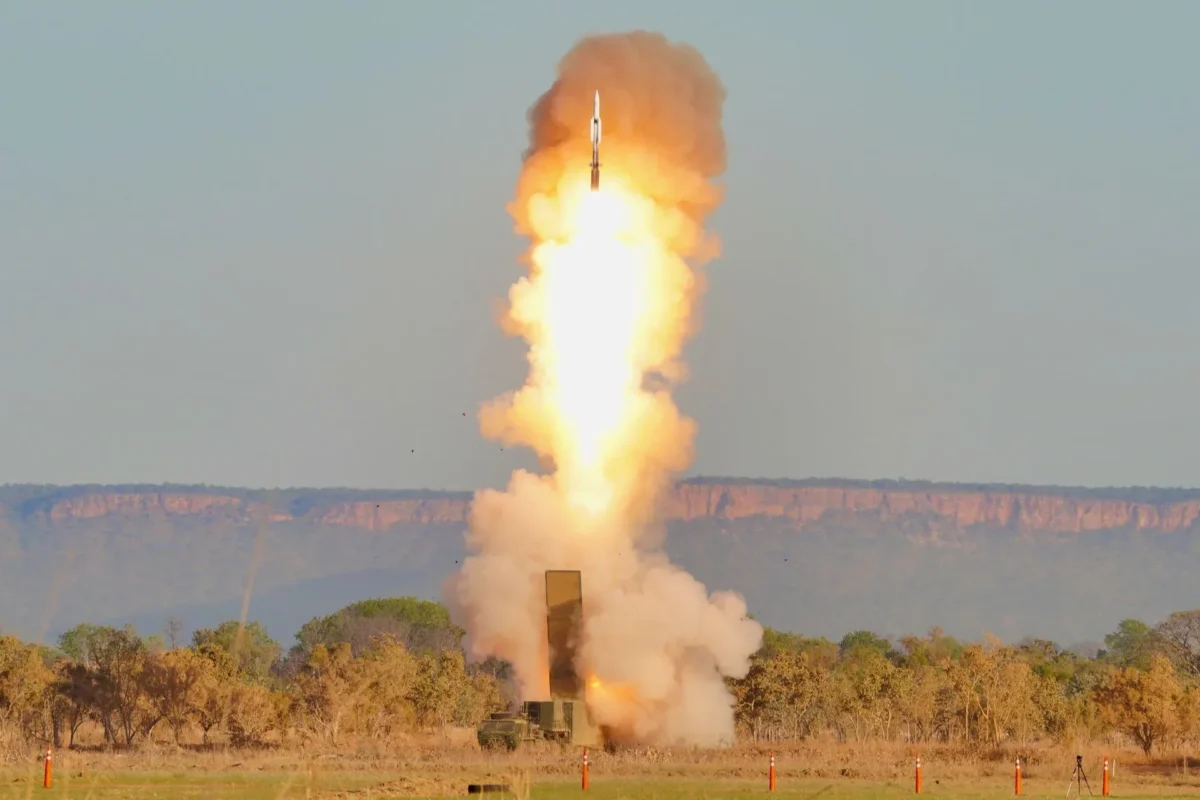
Then there’s range and speed. With engagement distances pushing beyond 300 km and speeds above Mach 3, the Standard Missile-6 gives commanders something invaluable: time. Time to detect, decide, and act before threats get too close.
And quietly, almost understated, is its network integration. The ability to receive targeting data from multiple platforms means it’s not easily blinded if one sensor goes down. It’s resilient in a way older systems simply weren’t.
But, there’s always a “but.”
The warhead size is relatively modest compared to dedicated anti-ship missiles. So while it can disable or damage a vessel, it’s not designed for dramatic, ship-splitting strikes. It’s more surgical than destructive.
Cost is another factor. Estimates often place each SM-6 missile in the $3.5–$4 million range. That’s not something you fire casually. Every launch is a calculated decision.
So yes, the Standard Missile-6 is versatile. Almost unusually so. But it’s not limitless, and that tension is exactly what makes it interesting.
SM-6 vs Other Missiles
Comparing the Standard Missile-6 to other systems is where its personality really shows. On paper, it sits in the same “family” as older Standard Missiles, but in practice, it behaves more like a hybrid that refuses to stay in its lane.
Take the SM-2, for example. Reliable, widely used, and very good at traditional air defense. But it depends heavily on ship-based radar for guidance.
The SM-6 missile, by contrast, brings its own active seeker into the fight. That one upgrade changes everything, it can chase targets farther out and finish the job without constant hand-holding.
Then there’s the Standaed Missile-3, which operates in a completely different realm. It’s built for exo-atmospheric ballistic missile interception, essentially hitting targets in space using kinetic energy (no explosive warhead).
The Standard Missile-6 doesn’t go that high, but it fills the gap closer to Earth, targeting threats in their final descent. Think of them as layered defense: SM-3 for the upper tier, SM-6 for the last line.
Here’s a quick comparison:
| Missile System | Primary Role | Key Strength | Limitation |
| SM-2 | Air defense | Proven, reliable | Limited autonomy |
| SM-3 | Ballistic missile defense | Space-based interception | Single-role focus |
| SM-6 | Multi-mission | Flexibility + active guidance | Higher cost |
What stands out? The Standard Missile-6 isn’t the best at just one thing, it’s the only one that can credibly do all of them.
