

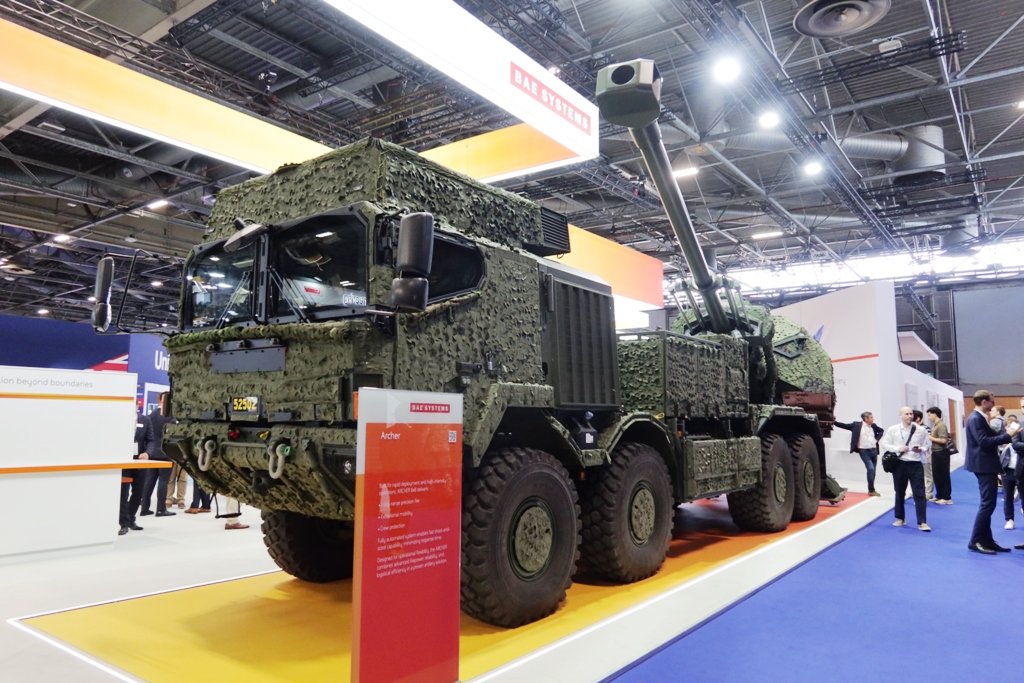
BAE Systems took advantage of the Paris exhibition to take stock of its artillery programmes, listing ongoing contracts as well as potential future successes
Starting from the Archer self-propelled 155/52 mm system, this is now in service with Ukraine, Sweden, Sweden having provided 26 systems from its Army stocks. These were in the original configuration, based on the Swedish Volvo A30D 6×6 chassis. More than 66 howitzers are currently on order, the main contract is the Swedish one for 48 Archers, plus 18 more that will be handed over to Ukraine. In 2025 Latvia signed a Letter of Intent for 18 howitzers, BAE Systems still waiting for the firm contract. Latvia personnel is however already training in Sweden to move to the left IOC date when hardware will be delivered. All those new Archers are based on the Rheinmetall MAN RMMV HX2 8×8 chassis, the Volvo-based solution remaining an option, should a customer opt for it. Sweden received the first of its new Archers on February 1st, 2026, 18 extra new built systems being earmarked for Ukraine.
Lessons learned from the Ukrainian front underlined that ease of training and putting it into service were much appreciated, as well as the low visual signature, the Archer being smaller than conventional SP howitzers due to the limited number of ammunition carried, 21 versus 42 of an M109, which also allows greater mobility and manoeuvrability, BAE Systems representatives underlined. According to the company the reduced number of available rounds can be overcome thanks to the ammunition handling system that allows a rapid reload of the Archer.
BAE Systems is now looking at the other side of the Atlantic. “The first target is the US Army Mobile Tactical Cannon, MTC in short, a wheeled 155 mm self-propelled howitzer that will replace in-service M777 towed howitzer of the same calibre,” Brian Gathright, VP Business Development Platforms and Services told EDR On-Line. The US Army aims at deploying the MTC first of all within Striker Brigade Combat Teams, and then in Mobile and Infantry Brigade Combat Teams. Overall, the estimated requirement is for 498 systems, a bid that is attracting the interest in the industrial artillery community, BAE Systems facing at least four competing teams: Hanwha Defense USA with the K9 Mobile Howitzer, the wheeled version of the K9 built on the Tatra Force 8×8 chassis; KNDS, partnered with Leonardo DRS, presenting the CAESAR; AM General. Together with Kalyani Strategic Systems, a subsidiary of Bharat Forge Limited of India, proposing the MArG 52; and Elbit America with Oshkosh Defense and Anduril as US partners, proposing the Sigma on a 10×10 chassis. The MTC is the first real ground vehicle example of the faster US acquisition system. The RFI was issued in January 2026, followed by the RFP in March, bid submission in April, and the Army is targeting down selection as early as July. Six systems plus up to 12 more howitzers will be provided to the service for evaluation purposes, something to which BAE Systems can easily answer considering the system being in full production, which makes the company confident that its proposal might succeed. “Over the last years we demonstrated the Archer to the US military more than once, US Army officials visiting Sweden in 2024, and the system is now also fully combat proven,” Gathright underlined. For the time being the Archer has been a European product, however BAE Systems has an extended network of artillery-related suppliers in the United States, where its tracked SP howitzers are produced, and has an assembly and testing facility at Elgin, Oklahoma, where the M109 family is produced.
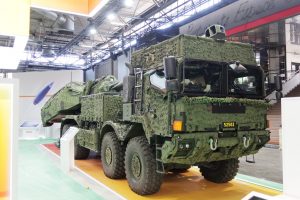
Another north American country targeted by BAE Systems for its Archer is Canada, which IFM (Indirect Fires Modernization) programme includes the purchasing of 80-98 self-propelled 155 mm howitzers, beside mortars and rocket launchers. Canada is currently leading a NATO Multinational Brigade in Latvia, which includes around 2,000 Canadian soldiers, the Latvia decision to acquire the Archer being a potential boost for a similar decision from Ottawa.
BAE Systems invested and ramped up its production capacity to be able to meet current demand and to anticipate a potential considerable increase should it succeed in the US or the Canadian bid. The company is looking for the right balance between Sweden-produced elements and locally produced items, on order to answer the industrial localisation requirements.
An artillery system terminal effect is provided by the ammunition it fires; BAE Systems considers the Archer- HVP (Hyper Velocity Projectile) combination a strong point for its proposal. The Archer is fully JBMOU compatible, therefore it can fire all NATO standard 155 mm ammunition, however it has a bigger chamber that allows adding an extra charge when using the modular charge system.
“The HVP is a system level approach to solve an operational problem,” Gathright explained, the aim being to provide a significantly extended range with precision guided capability to deliver effects well beyond what conventional artillery can do today, the company aspiration being to deliver the effects of a missile at a much lower cost.
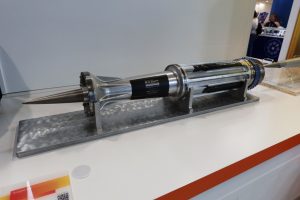
At Eurosatory we could see the HVP as well as one of its latest precision guide munitions, the Scorpio-XP, a sub calibre round that fits both a naval 127 mm round as well as a land 155 mm round. Born to allow naval guns to extend the ship-to-shore range, it has then been developed in the bigger calibre, and has now been selected by the US Army as one of three entrants for the ERPA (Extended Range Artillery Projectile) programme. “We have seen through various testing that it is highly effective as well in the counter-UAS and counter-missile environment. We are in the first phases of demonstrating that capability for the US Army,” Gathright said. The round can be purely kinetic or can be fitted with energetic material, and it could re-balance the economics of the C-UAS equation.
The US Navy is effectively doing operational relevant testing of HVP today and BAE Systems is scaling its production levels to meet their demand, so the 127 mm version can be considered TRL 8 to 9. “The 155 mm version is more TRL 6, although the air body is TRL 9 as it was tested, deployed and fired. We are focusing on continued development with the US Army in a multi-phase programme, mostly centred on the 155 mm guidance, which will provide two options to the customer, a radio-link or an on-board seeker solution, the latter being less prone to jamming,” Brian Gathright told us. The two solutions have different mission sets and would be used in different operational environments.
On-board guidance will allow trajectory-shaping which, together with a marginally higher muzzle velocity, and a better aerodynamic coefficient compared to standard 155 mm shells allowing maintaining a higher speed along the trajectory, will double the range of a 52 calibre gun in a surface-to-surface engagement, the company talking about 80-90 km. BAE Systems has not yet fired the HVP with an Archer system, but it demonstrated the compatibility, the live firing being the next step, no specific date being established, the company awaiting the request from a customer.

From indirect fire to ground-based air defence artillery: at Eurosatory 2024 BAE Systems unveiled the Tridon Mk2. Since June 2024 BAE Systems received two orders, one in February 2026 for systems to be donated to Ukraine, financed by Sweden and Denmark for a total of nearly US$ 290 million, the second in April, worth around US$ 180 million from Sweden. “We have been able to move from those first demonstration units that we showed at Eurosatory to live testing with Sweden, first deliveries starting later this year,” Gathright told EDR On-Line. No details were provided about the carrier, which should however be an 8×8 truck, possibly from Scania.
When developing the Tridon Mk2 BAE Systems main focus was to develop a system capable to deal with the drone threat at short range, keeping the engagement cost as low as possible, combining a system based on existing building blocks with its 3P ammunition. BAE Systems’ 3P (Pre-fragmented, Programmable, Proximity-fused) ammunition is available in 40mm and 57mm calibres. Its fuse features six different modes, time, gate proximity, proximity, impact, delayed impact and function-optimised, and is effective against missiles, drones and lightly armoured targets. Considering ammunition consumption data coming from Ukraine, BAE Systems is about to ramp up from tens of thousands of rounds a year to perhaps as much as 100,000 rounds.
The Tridon Mk2 is now in full production, BAE Systems having demonstrated on the range the capacity to shoot down Class 1, 2 and some Class 3 drones at ranges up to 10-12 km. “We have been able to take Swedish and Ukrainian soldiers and train them to be able to deliver that effect with the 3P munition,” Gathright said. EDR On-Line understood that six Tridon Mk2 will be delivered to Sweden before year end to be then forwarded to Ukraine, the total number of the systems financed within the framework of the Swedish Military’s 18th, 19th and 20th support packages to Kiev, ranging between 32 and 48.
The Tridon Mk2 will be an entry for BAE Systems into the UAS Marketplace; on Day 3 of Eurosatory 2026, US Army Secretary Dan Driscoll has signed a statement of intent with Sweden, Denmark, Norway, France, Poland, the United Kingdom, the Netherlands, Italy and Lithuania to expand access to the service’s Uncrewed Aircraft System (UAS) Marketplace, providing participating nations a path to acquire battle-tested counter-drone capabilities. “The marketplace is a way to make procurement more transparent and responsive by letting vendors from participating nations compete in a single environment, gathering feedback directly from soldiers using the equipment and scaling the systems that perform,” Driscoll said. The Amazon-like UAS Marketplace was launched in May 2025, reached initial operational capability in February 2026 and until last June had completed four purchases totalling $13 million.
Shortly before Eurosatory BAE Systems announced the launch of its Next Generation Fire Control System (NG-FCS), but the company is looking for a trade name), which according to the company was designed to provide a flexible and future-ready foundation for artillery operations. Considering how the artillery business has evolved, especially in the light of new threats such as FPV drones and alike, the NG-FCS can sensors, command networks and artillery platforms through a scalable digital architecture.
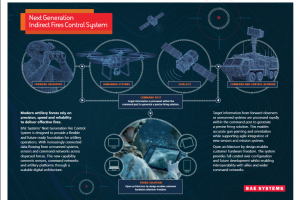
At the lower level we find a gun-agnostic fire control and pointing system installed on the weapon system, which was modernised based on lessons learned from Ukraine and current and future use of artillery assets, increasing speed and accuracy. Its open architecture makes it easier to integrate it with a wide range of artillery platforms and supporting technologies, something not available nowadays according to the company. The NG-FCS is being designed with the today open architecture standards, the customer being offered full control over configuration and future development whilst enabling interoperability with allies and wider command networks. It will have maximum flexibility in the way customers want to manage the whole artillery kill-chain, from incoming data to gun aiming, EDR On-Line understood.
Customers can choose a fully automatic system that allows automatic gun-laying, or intermediate options compatible with legacy effectors whilst increasing speed of action.
The NG-FCS is currently running on VPX hardware and is not yet qualified. BAE systems will probably be able to install it on a real gun by late 26-early 27, EDR On-Line understood, as some development work is still ongoing. At Eurosatory the company aimed at illustrating what will be the path forward rather than the current status; it will start as a one-to-one replacement for elements such as navigation and pointing systems on guns, to expand into a CONOPS-related platform, based on customers’ requirements and on doctrinal evolution. The aim being to automate as much as possible the kill-chain to reduce sensor-to-shooter time, bringing it from minutes to seconds; human control still being there but moving to the man-on-the-loop level.
Graphics and photos courtesy BAE Systems and P. Valpolini
