

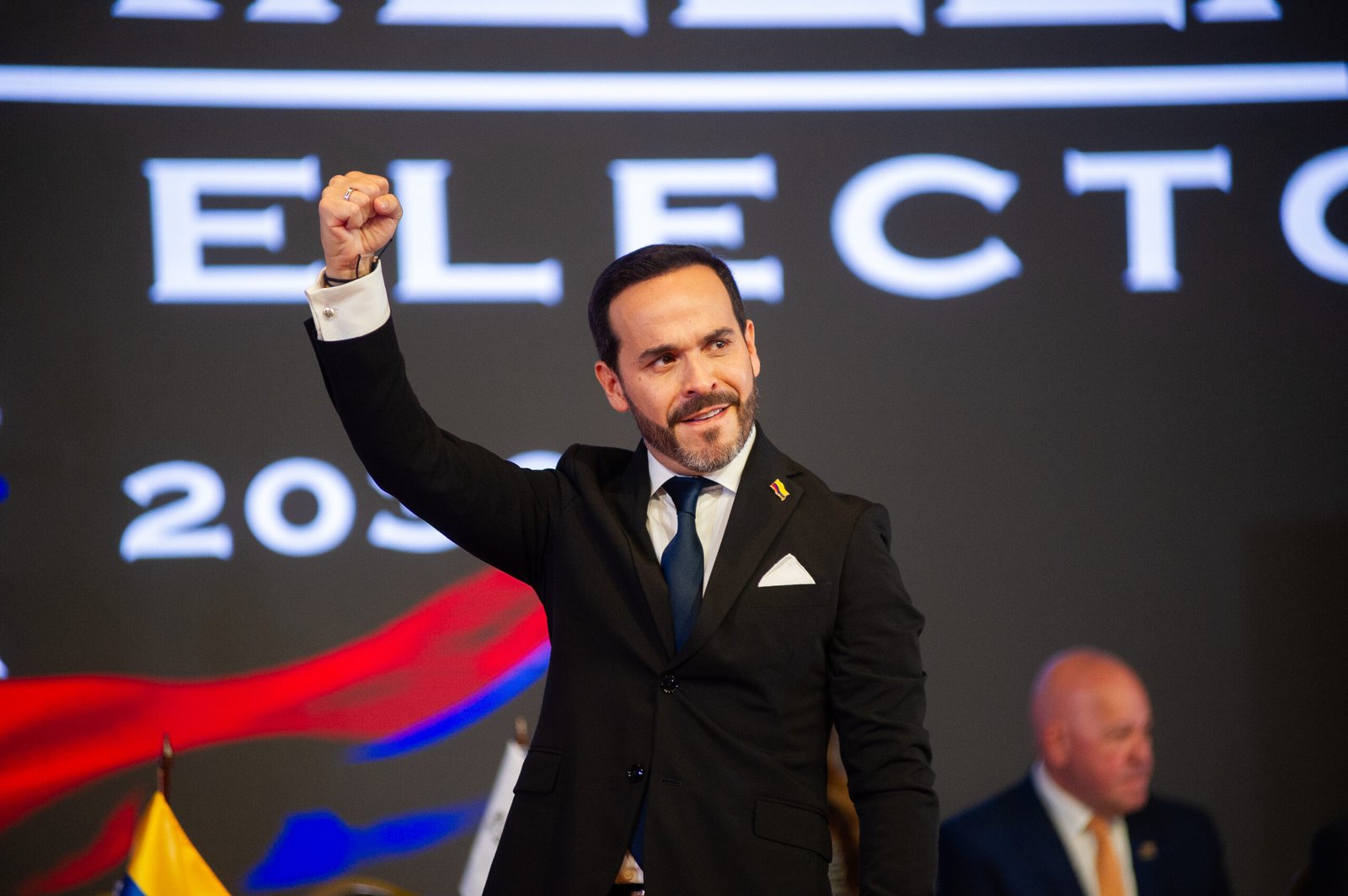
WASHINGTON—Abelardo de la Espriella, Colombia’s president-elect, will take office on August 7, after a campaign in which he called the United States “our most important trading partner and our main military ally.” In Washington, his victory is widely seen as a strategic reset of one of the hemisphere’s most important partnerships and, for many years, a bipartisan cause. This reset feels especially important after four years of diplomatic friction between the countries, in part created by Colombia’s outgoing president, Gustavo Petro, and his erratic management of foreign relations.
Tensions between Colombia and the United States in recent years were driven by ideological differences, with Petro coming from the hard left and Trump from the right of the political spectrum. Despite the resulting frictions, US firms continued to export to Colombia, though investment levels declined, as an Adrienne Arsht Latin America Center issue brief described in 2025. Given the size of Colombia’s market, the free-trade agreement in place, and more than twenty years of bipartisan support for Colombia’s efforts to combat the illegal drug trade, Colombia has remained an important market for many US companies. US trade with Colombia is substantial and genuinely two-way, with US corn and machinery moving south and Colombian coffee and cut flowers moving north, for example.
More importantly, roughly 650 US firms operate across some fourteen sectors in Colombia, supporting 150,000 jobs. The United States already has a strong foundation with Colombia, which includes mutually beneficial trade and decades of US firms operating on the ground in the country. Moreover, while Bogotá became more open to Beijing under Petro, de la Espriella is widely expected to prioritize his country’s relationship with Washington. But that’s no guarantee.
The next phase of the relationship will not be determined by what the United States already has with Colombia, but by whether it can meet Colombia’s emerging investment needs. It will be decided by what Colombia now needs: It needs new energy and transportation systems. It needs expanded oil and critical minerals exploration and production capacity. And it needs the capital to build all this new infrastructure. That is precisely what the United States should be offering, and what China has been knocking on the door to do for several years.
In 2021, a Chinese consortium broke ground on the $4.5 billion Bogotá Metro Line 1, the largest infrastructure project in the country’s history. Since 2000, Chinese firms have invested about $5.1 billionin Colombian mining, compared with roughly $2.8 billion in US investment. China’s lead has been driven largely by Zijin Mining Group’s purchase of the Buriticá gold mine in 2020. The question is whether the change in political climate will bring about a change in the investment climate as well.
De la Espriella is poised to become the most pro-Washington president Colombia has had in a decade. But he inherits an economy under fiscal pressure: the fiscal rule, which set limits on government spending and debt, was suspended in 2025; the country has already absorbed credit downgrades; and in late June, Colombia’s central bank raised its policy rate to 12 percent, which is among the highest in the region. During the campaign, de la Espriella promised tax cuts and faster economic growth, but with borrowing that expensive and a deficit that wide, he will need capital wherever he can find it. That could mean China, even if the new president is more friendly toward the United States, because the Colombian government will prioritize projects that can secure financing and move forward.
Slowly but deliberately, China has moved into Colombian strategic sectors, including telecommunications, infrastructure, and mining. More pressing than Beijing’s investment alone, however, is that the United States has not shown up enough as a real alternative to China. The United States already offers Colombia a better bargain in theory: capital that creates jobs and builds local capacity rather than simply extracting natural resources. What the US has not done, or has not done often enough, is finance this better bargain in practice.
Washington already has a set of updated, dynamic tools to support this kind of positive statecraft. The US development finance arm, the Development Finance Corporation (DFC), exists precisely to back strategic investment in key infrastructure, including ports, electrical grids, and critical-minerals projects. US private infrastructure capital is already funding deals such as the new $800 million Puerto Antioquia. What is missing is the urgency for the Trump administration to use these tools while a friendly government is asking.
