

The age of the Super-Dreadnought and the Battleship belongs to a bygone era—a time when humanity dreamed on a colossal scale. In the early 20th century, the world was still not fully mapped, industrial technology seemed unstoppable, and global powers embraced a singular doctrine: build the largest mobile fortress possible, whether on land, water, or air. These steel tyrannosaurs were treated as the ultimate answer to geopolitics.
Then, the unthinkable happened. The two largest battleships ever constructed, the Musashi and the Yamato, were sent to the bottom of the ocean by waves of tiny aircraft. The dream of the invincible floating fortress evaporated like the Hindenburg.
This wasn’t entirely a surprise. Back in the 1920s, Brigadier General Billy Mitchell famously argued that aircraft could sink any capital ship afloat—an idea civil and naval brass worldwide initially dismissed as absurd. While Pearl Harbor proved Mitchell’s hypotheses correct, the sinking of the Yamashi and Musashi put the final nail in the coffin. The era of the naval monstrosity was over.
Yet, many naval enthusiasts still long for the days when the capital ship was king and global dominance required a massive battle line. We miss the era when “crossing the T” was the ultimate tactical maneuver, and captains fought to keep the engagement range at an optimal 20,000 to 30,000 yards to avoid a catastrophic, close-range slugging match. In our modern world of “micro-everything”—drones, compact cars, tiny homes, and smartphones—stepping onto a massive digital warship is a breath of fresh air.
While the modern naval simulation landscape is dominated by submarines and aircraft carriers, MicroProse has finally decided to bring out the big guns. Welcome, Battleship Command, to the line.
Filling a Decade-Old Void
I have been waiting for a game like this since Great Naval Battles: Fury in the Pacific (1995) practically abandoned the immersive bridge perspective of its predecessors. I’ve spent decades eager for a truly immersive battleship experience, not just another detached, top-down tactical RTS. Despite being in Early Access, Battleship Command is successfully filling that void.
To prepare for this review, I brushed up on my naval history, revisiting Stephen Younger’s Silver State Dreadnought and Gerhard Koop and Klaus-Peter Schmolke’s Battleships of the Scharnhorst Class. I also booted up the classic Great Naval Battles series to provide a proper baseline for comparison.
Visuals and Atmosphere
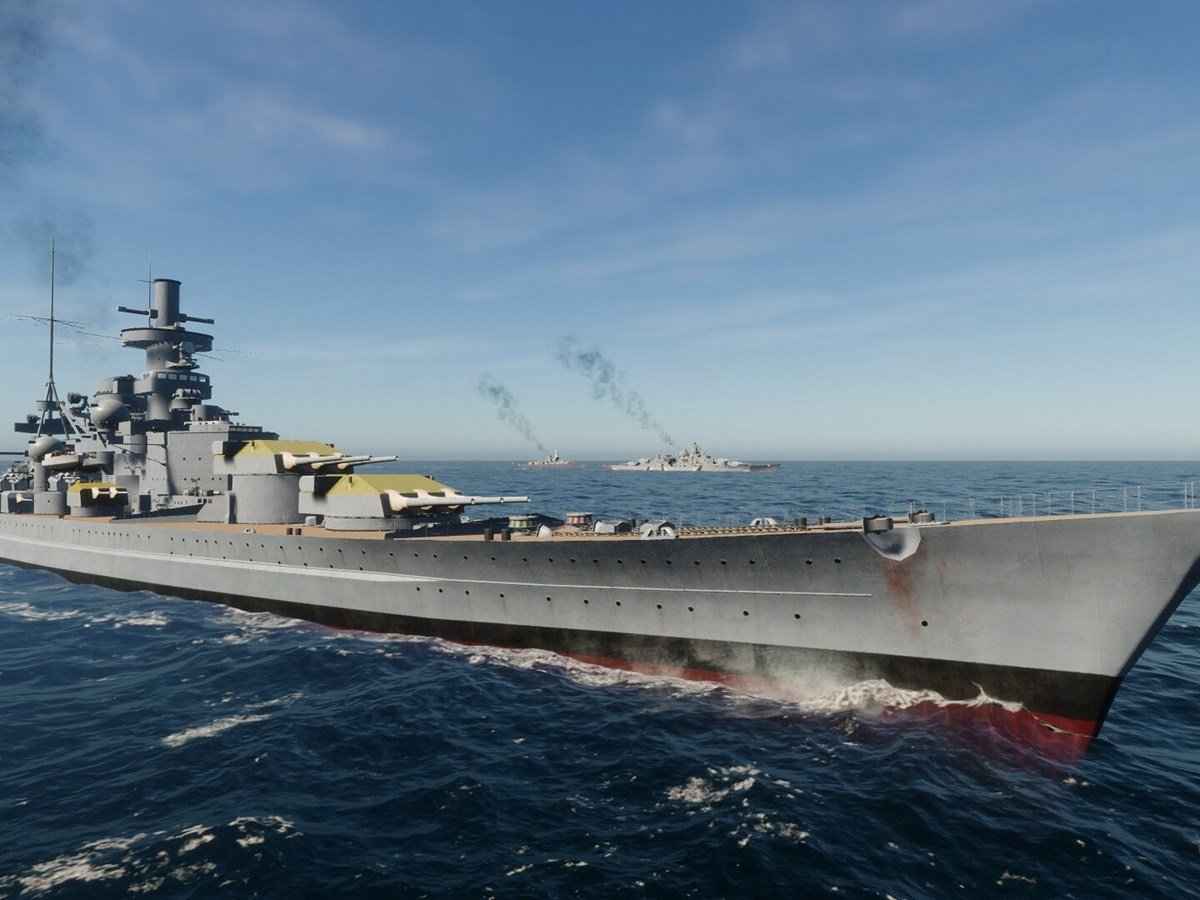
Graphically, Battleship Command sits comfortably in the “B-tier”—comparable to titles like the Ultimate Admiral series or Victory at Sea: Pacific. It’s not state-of-the-art, but compared to the old SSI games of the 90s, it’s a massive leap forward. While it may not match the pristine fidelity of Destroyer: The U-Boat Hunter, it holds its own.
Cruising through heavy weather produces waves that crash over the deck, though the effect can look a bit rigid, lacking the organic water splashes and puddles seen in newer titles. Where the visuals truly shine, however, is in combat. The massive explosions rocking your hull and the melting metal effects make trading salvos look absolutely glorious.
Soundscape
The audio design is brilliant in its choices. The soundtrack features classical masterworks from Johann Sebastian Bach and Ludwig van Beethoven, perfectly suiting the majestic, terrible beauty of the warship you command. The cannon fire sounds serviceable, though I personally want a bass-heavy blast that feels like it’s ruining my eardrums when I zoom in close to the main battery. Crew voice acting is sparse right now, limited to a few standard orders issued here and there.
Content: The Pride of the Kriegsmarine
Presently, players are restricted to commanding the 30,000-ton Scharnhorst-class battleship. This single-ship focus might disappoint players looking to jump between different nations and classes right away.
Because of the political and treaty restrictions during her construction, the Scharnhorst wasn’t the heaviest brawler afloat, and her reliance on high-pressure steam turbines kept her strategically tied to the Atlantic. Her 11-inch (28 cm) main guns were lighter than the 15-inch batteries found on contemporary rivals, but her high speed and heavy armor layout allowed her to survive long, harrowing operations during World War II.

Developer Watch: The team is highly active on Discord and remarkably responsive to player feedback. Modders are already using the Steam Workshop to craft a wealth of historical and hypothetical scenarios. While content is currently limited by the number of modeled ships, the developers have expressed openness to expanding the roster based on the game’s success. Right now, their priority is perfecting the Scharnhorst as a template for future vessels.
The game currently ships with:
- 3 Tutorials: Short, simple, and direct.
- 10 Scenarios: Covering historical and tactical engagements.
- Quick Scenario Creator: An intuitive tool to customize ship placement, weather, theater, and time of day.
- Map Editor: A user-friendly suite allowing players to upload custom missions directly to the Steam Workshop.
The development roadmap focuses on refining existing content, updating the Scharnhorst model, adding NPC ships and aircraft, and implementing shore batteries, mines, and U-boats. A “Patrol” mode is planned for the mid-term alongside torpedo launchers, but the ultimate long-term goal is a full dynamic Campaign, which is what I am most excited to see.
Gameplay: Plotting the Solution
The core gameplay loop features traditional naval simulation objectives: intercept a convoy, sink a specific target, and return to port. You can command a small flotilla by setting waypoints on a tactical map, reminiscent of the old SSI titles, and let the AI pilot the fleet.
If you prefer a hands-on approach, you can order your crew to automate everything, or step directly into the Fire Director Station. Here, you personally dial in the range, bearing, and deflection speed to walk your shells onto the target. This manual gunnery is the beating heart of any good battleship sim. Thankfully, it isn’t overly convoluted; it avoids the dense mechanical frustration of Destroyer: The U-Boat Hunter or the Silent Hunter series.

[Bridge/Map Navigation] ➔ [Fire Director Station] ➔ [Manual Dialing (Range/Bearing)] ➔ [Salvo Loose]
Damage control is equally interactive. You can manually inspect flooded compartments and damaged bulkheads. Interestingly, driving the ship at flank speed causes boiler fouling; while you can take boilers offline for maintenance, this mechanic isn’t fully punishing yet. It acts as an excellent bit of foreshadowing for realistic operational breakdowns down the road.
The radar room features basic switches for power and lighting. It is simple but highly effective. I tested this during a user-made mission titled “Hunt for JW55B,” where I had to navigate heavy rain and pitch-black conditions relying solely on radar pings to track down the enemy. It was a thrilling, suspenseful search-and-destroy operation. Furthermore, the ship’s scout plane can be launched to spot over the horizon, reinforcing the authentic simulation feel over an arcade RTS.
Areas for Improvement
Because the game is in Early Access, there are a few rough edges:
- No Mid-Mission Saves: At the time of writing, you cannot save mid-game. For long engagements, this is a glaring omission. I vividly remember the 1993 game Jutland—it had fantastic graphics and excellent map tools, but I struggled to finish it because the scenarios were massive and lacked a save function. Fortunately, Battleship Command features an incredibly generous time-compression tool that scales up to 2000x speed outside of combat.
- No Direct Bridge Controls: You cannot physically steer the ship from a first-person bridge view. Instead, you interact with a pop-up control overlay. While you can look at the bridge from out the window, you cannot physically command the helm from that perspective yet, though Discord discussions suggest this feature is planned.
- Early Access Jank: There are minor bugs, such as the rigid deck-water animations, a lack of hull pitching in heavy swells, and occasional visibility issues through the optical rangefinders. However, the developers are actively ironing these out.
My Personal Wishlist
Beyond more ships, I hope to see crew attrition and VR support. Titles like Iron Wolf VR and UBOAT: The Silent Wolf prove how immersive naval operations can be in virtual reality. I want to stand on the wing of a colossal steel machine, feeling the digital wind and sea spray while cruising the Atlantic for hours without touching the time-compression button.

By crew attrition, I mean operational fatigue: men getting sick, boilers breaking from being cranked at 29 knots for six hours straight, and the logistical necessity of shore leave.
The Verdict: Who is this for?
Battleship Command is built for the player who has always dreamed of walking the deck of a capital ship, ordering 11-inch guns to loose hell against the Royal Navy in the stormy Atlantic. It is for those who miss the era when naval warfare felt like a grand space opera, where capital ships were the absolute kings of the sea.
If you want to watch two giant steel leviathans slowly blast each other into a magnificent, agonizing mutual destruction while a classical symphony plays in the background, this game is for you. It requires patience for Early Access jank, meaning it won’t appeal to audiences looking for AAA graphics wrapped in microtransaction loot boxes.
MicroProse is steering this project in the right direction, and I eagerly look forward to reviewing the full release.
Support Strategy and Wargaming
I do what I do in Strategy and Wargaming because I love to do this, and I’m never going to stop. If you would like to support me with that, you can buy me a coffee for a dollar if you’re feeling generous. If you can’t, no worries, Strategy and Wargaming will always be free, and I’d love to have you around!
