

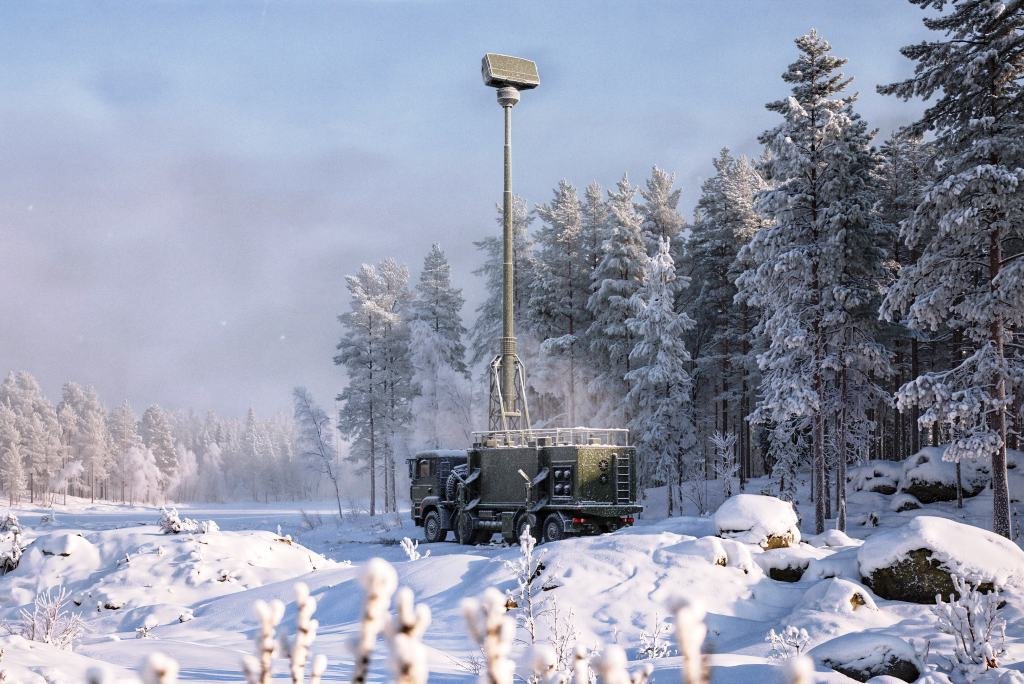
When the word Giraffe is mentioned in the military context, almost everyone thinks of the radar family launched by Ericsson Microwave Systems nearly 50 years ago; the anniversary falls next year. At Eurosatory, Saab, which acquired Ericsson in 2006, presented the latest addition to the family, the Giraffe AMB D. This radar falls within the portfolio of Saab’s Surveillance Division, which is organised in five Business Units, one being Surface Sensors Solutions
Although the name has remained the same, the radars of Ericsson and then Saab, have constantly evolved to remain state-of-the-art. This year it was the turn of the Giraffe AMB (Agile Multi-Beam), which has been around for some 25 years, to be supplanted by a new radar; the Giraffe AMB C in production will be replaced by the Giraffe AMB D; the letter D was chosen because it follows C in the alphabet, but it fits well since it could also be considered the initial of Digital, given that the new radar is in fact entirely digital. The battlefield scenario is changing fast, “So fast that we needed to really cope with this, we needed to do something. And that is why we have now released and launched our new version of the Giraffe AMB,” Puntus Djerf, Head of Marketing and Sales at Saab’s Surveillance Division, Business Unit Surface Sensor Solutions, explained during a briefing at the Paris exhibition.
The variety of air threats has increased, “we have fast ones, really slow ones, flying high, flying low, loitering, and we need to cope with all of them in parallel,” he underlined. Typical of digital systems, the Giraffe AMB D stacked beam 3D radar sees its hardware and its software fully decoupled, which allows a much easier upgrade and flexibility in adapting it to the evolving threat. In the previous version the processing architecture was custom build /server based, the D model architecture being completely server based. In the C model software update was limited to the server part of processing algorithms, while in the new version the antenna function and the complete processing algorithms software is easily upgradable.
Increased enemy jamming activity requires improved electronic counter-counter-measures functionality. “In our new version we are reducing the side lobes even more compared to the previous version, which makes it much harder to jam,” Mr. Djerf explained.
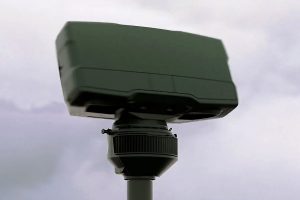
Compared to its predecessor, which antenna had a digital beam forming on receive, the Giraffe AMB D AESA antenna has a digital beam forming both on transmit and receive. All AESA elements are in the antenna, which avoids any waveguide between the antenna and the shelter, as it was the case in the previous model, which used a single TWT (Travelling Wave Tube), the D model using solid state transmit/receiver modules with GaN (gallium-nitride) high power amplifiers, a solution that also ensure graceful degradation. The Giraffe AMB C operates in the C (G/H) band, 5.4-5.9 GHz, while the new D version operates in the C (G) band, 5.25-5.85 GHz.
Saab leveraged its experience in drone detection, tracking, and classification, one of the house specialties, bringing it much further, as the range of the Giraffe AMB D is way greater than that of its predecessor, instrumented range being 250 km, no details being provided of ranges versus types of targets. Greater range gives more time to optimise reaction, a key element when confronted with saturation attack and when a strict ammunition discipline is needed.
Greater range also means a higher number of potential targets into view. “With the new server solution, we have increased our computing power a lot, which means that we can handle a lot more targets at the same time, Puntus Djerf explained. The AMB C was able to handle 200 air and 400 surface targets, for a total of 600, while the new Giraffe AMB D track up to 2,000 targets simultaneously. False alarm rate is always an issue, especially when dealing with small UAVs that might well be confused with sizeable birds. “In our radars we have a lot of processing power, we have what we define dynamic range, we have really stable frequencies, and we suppressed all different kind of noise within the system,” Puntus Djerf explained, adding that the clean signal allows to detect the incoming target earlier, artificial intelligence and machine learning being key to lower the false alarm rate, machine learning having been used since quite some time at Saab, EDR On-Line understood. It is to note that in the Giraffe AMB C the drone tracking capability was offered as option, while in the new radar it is part of the baseline configuration.
Besides its obvious use in air defence tasks, the Giraffe AMB D can also be deployed as a C-RAM (Counter Rocket Artillery Mortar) sensor, while at the same time continuing to provide surveillance and tracking for SHORAD (Short Range Air Defence) and MRAD (Medium Range Air Defence) systems. Compared to the previous version full elevation coverage is over 80°, while in the C model it was over 70°.
The Giraffe AMB D is available in different configurations, the typical one being hosted in a 20-foot ISO container, mounted on an 8×8 truck. When on the move the antenna and the mast are stowed on top of the container and are protected by a guardrail. The mast structure is hinged at the front of the container and tilts forward until it reaches the vertical position, then the hydraulic mast is raised, reaching a maximum height of 16 metres over the ground; two supporting legs per side ensure the system stability. The container hosts the power supply, hydraulics, liquid cooling unit, as well as the operators’ consoles, usually two or three. If the system is “warm” it takes only three minutes to start operating after the truck comes to a halt, the time to elevate the mast at least partially, to allow the compact AESA antenna to start rotating at 60 rpm. The radar low weight and reduced footprint allow it to be packed into a 10-foot container, the presentation seen at Eurosatory showing it installed on a tracked vehicle.
As previously said, decoupling hardware from software ensures easy upgrade through new software releases, minimum hardware upgrade being required through the life cycle, mostly to deal with obsolescence.
The Saab briefing was attended by Major General Jonny Lindfors, Chief of the Swedish Army, and by Brigadier General Jonas Lotsne, Director Land Systems at the Swedish Defence Material Administration (FMV). Counter-UAS being one of the focuses of Eurosatory 2026, and the Giraffe AMB D being a sensor that can be used in that role, EDR On-Line asked MG Lindfors how the Swedish Army intends answering the C-UAS issue. “We are trying to build a layered system. We are partially relying on our legacy CV90s air defence vehicles, but we are also bringing in the Giraffe 1X radar and the Triton gun, as well as electronic attack and electronic warfare sensors,” the General said, underlining that this will provide a mix of passive and active sensors and soft- and hard-kill effectors. “The radar system we are discussing today, the Giraffe AMB D, fills the gap between the Giraffe 1X and the larger Giraffe 4A radar that we are also procuring,” MG Lindford explained, the Giraffe AMB D being meant to replace the older model that has been in service for more than two decades. For shorter ranges the Swedish Army is looking at different types of kinetic effects, such as nets, as well of course at very short distance electronic warfare systems. The service intends to upgrade its CV9040 TriAD self-propelled air defence vehicles (known as Luftvärnskanonvagn 90 or Lvkv 90 in the Swedish Army) armed with the Bofors 40 mm L/70 ant-aircraft gun and fitted with a Thomson CSF Harfang (now Thales) PS-95 S-band radar; as in the Swedish Army the number usually indicates the year the system entered into service, this sensor was definitely not designed to cope with the UAV threat and does not fit the current mission. Regarding the distribution of C-UAS assets within the service, EDR On-Line understood that in rear-area units, those not in contact with the enemy, a specialized C-UAS platoon-level element is planned within each company. No details were provided on the C-UAS defence within manoeuvre units, which will most likely benefit from a layered defensive bubble.

Saab bagged a first order for its new Giraffe AMB D, the SEK 1.2 billion order for “ground-based defence solutions” announced on June 2nd, 2026, referring to these new sensors. This was confirmed by BG Lotsne: “it fits perfectly in the mix of sensors that we have, active sensor, but also passive sensors and other sensors. We are investing a lot in sensors, we are replacing
the fixed coastal sensors that we have in service, and we are also very much in air defence.” Deliveries of the Giraffe AMB D will take place between 2029 and 2030, no numbers being provided.
With the Swedish military as launch customer, Saab is looking with optimism at the export market; beside customers that have been fielding the Giraffe AMB for a long time and may want to replace it with the new version, the Swedish company is also looking at new customers who need to cope with the C-UAS issue and not only. The radars will be produced in the Saab facilities in the Gothenburg area, where the group is investing to cope with the increased demand for those sensors. Saab is of course open to partnering with customers’ nations companies to add local content when needed.
Images courtesy Saab
