

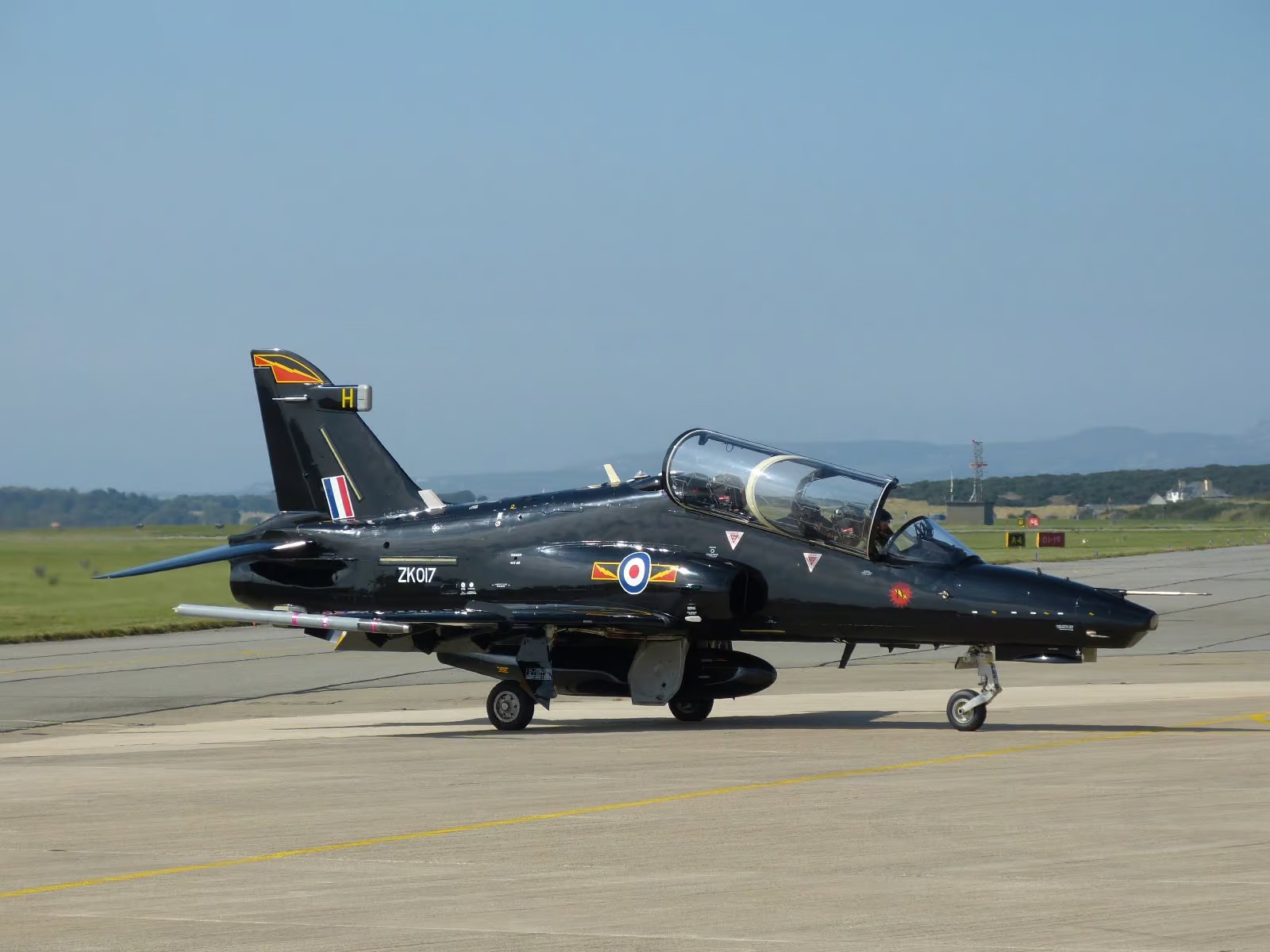

The UK Defence Ministry has issued a request for information (RFI) to industry for the Jet Training System (JTS), launching its RAF Hawk programme, for which the Defence Investment Plan (DIP) pledged £360m in the full recapitalisation. However, that is nowhere near enough to fund a one-to-one replacement of the Hawk T.2 fleet.
Part of the JTS is to replace the 50-year-old Hawk T.1s flown by the Red Arrows aerobatic team with Hawk T.2s currently used for RAF advanced jet training, a role for which they are to be replaced. They were originally expected to exit service in 2040. Still, a series of problems with the Rolls-Royce/Safran Adour engines have seriously restricted aircraft availability, prompting the UK to send RAF students to Italy, Qatar and the United States.
The training element of JTS calls for a platform that can “support the transition to fifth- and sixth-generation air systems,” and enable UK pilots to be ready for “modern and future combat environments,” tender documents state. The new aircraft will form part of a “modernised fast jet training system,” to include ground-based training systems. Interested companies are asked to submit details, a point of contact and their areas of interest to the programme team by 11 September 2026.
Potential aircraft available on the market include the Boeing-Saab T-7A Red Hawk, the Leonardo T-346, Korean Aerospace Industries T-50 and the Turkish Aerospace Industries Hurjet. At Farnborough, BAE Systems, Boeing and Saab formalised a partnership to deliver the JTS programme centred on the T-7A Red Hawk, now being produced for the US Air Force, which would be assembled in the UK. None of the other potential competing companies have announced any agreement to a UK partnership. The DIP stipulated that part of a new Jet Training System would have to have a significant UK workshare.

by David Oliver
