

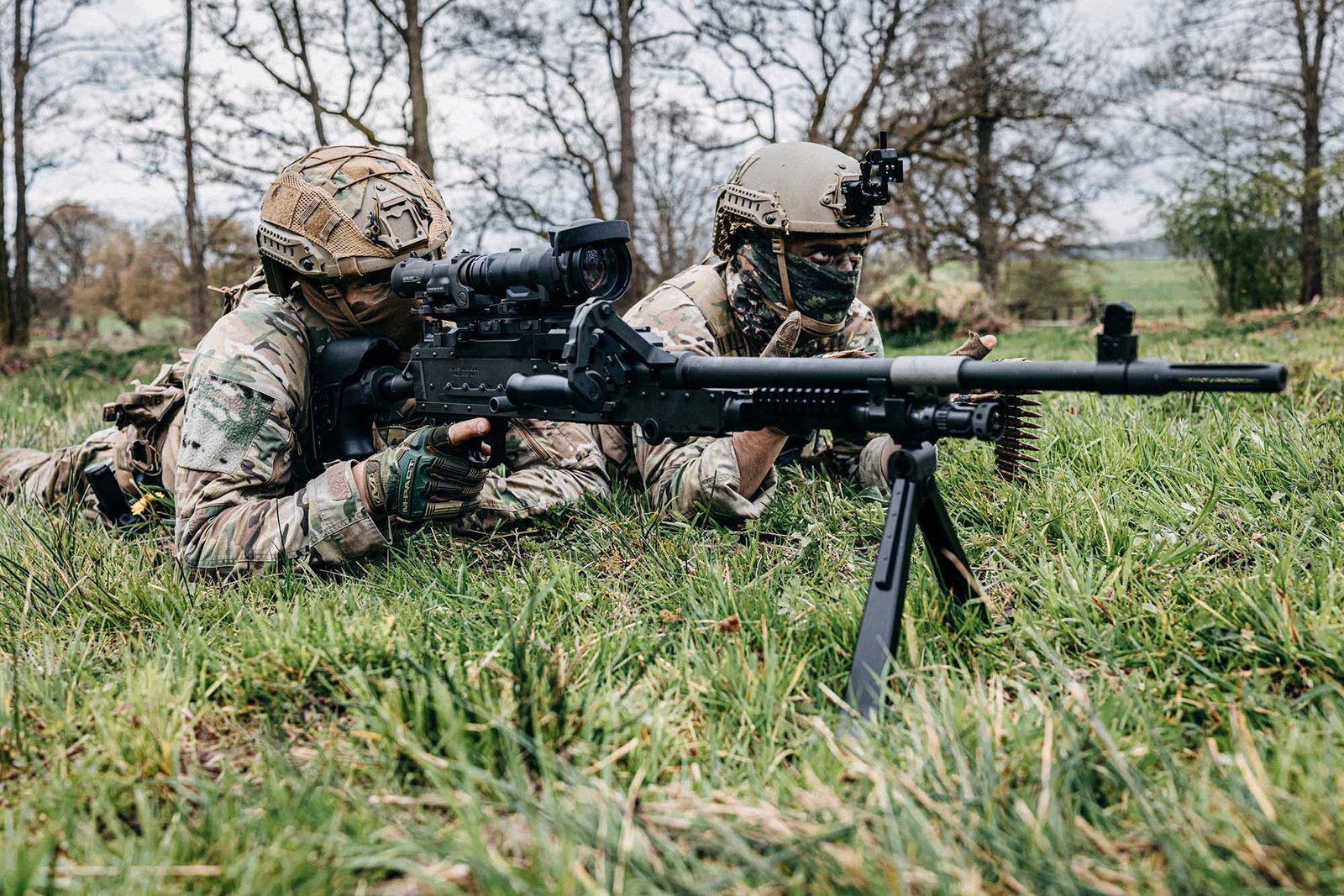
This summer ESD headed to Liège in Belgium, courtesy of the Wallonia Export & Investment Agency, to participate in a press visit designed to provide an introduction to the defence ecosystem in Wallonia. The objective was to show the depth of the defence sector in this part of Belgium and to pave the way for international investment into the defence sector and/or providethe basis for partnerships between Walloon defence companies and other European or international companies
Wallonia has always been an important location for defence manufacturing; it started in the Middle Ages with the manufacture of artillery, but by the 16th century the gunmakers of Liège had predominantly turned to the manufacture of small arms. Liège benefitted from a strategic location in the heart of Europe, it also benefitted from substantial deposits of iron and coal, as well as ample wood resources. The small arms production capabilities of Liège made control of the city strategically important during the French Revolution and the First French Empire.
The next important development in the defence industrial development of Liège was the arrival of John Cockerill, along with his father and brother. By 1817 they had established an iron works, this was followed by a machine building facility and later by steel production. The John Cockerill company still exists today as a diversified industrial grouping, with the John Cockerill Defence activity as one of the top two defence industrial enterprises in Wallonia. Wallonia had continued to evolve into a major heavy industrial centre and it would take advantage of technological developments that would emerge across the 19th century. Small arms manufacturing had primarily rested with small companies, producing small runs of essentially hand-built weapons. It was Henri Pieper in the mid-1880s who was credited with beginning the move towards machine-based mass production of weapons.
Corporate Leaders
At this time, small arms manufacture in the Liège area was conducted by numerous small companies. However, when the Belgian Army decided that it needed to adopt a modern bolt action rifle and that said rifle would need to be produced in significant numbers in Belgium, it required industrial change. This resulted in a number of small arms companies joining together to establish Fabrique Nationale d’Armes de Guerre in Herstal, better known today as FN. FN would win the Belgian rifle order and would go on to produce the Mauser rifle under licence. The resulting M1889 Mauser was the first Mauser to utilise small bore smokeless powder ammunition in the 7.65×53 mm calibre.
In the 1890s FN would go on to work with legendary US small arms designer John Moses Browning, a relationship that saw the design of numerous advanced small arms and a relationship that continued until the death of Browning’s in Liège in November 1926. The Browning legacy is commemorated in the name of the holding company FN Browning, which is responsible for the FN, Browning and Winchester brands.
The importance of small arms to the history of Liège is evidenced by the extraordinary collection of small arms at the Grand Curtius museum which encompasses historical weapons right up to current generation small arms. The Grand Curtius building is also fascinating and if small arms are not your thing, the museum also has collections devoted to archeology and decorative arts. As an aside, the Jupiler brewery in Liège might suit those not disposed to museums.Both FN and John Cockerill Defence are highly successful international brands, they represent the top end of the Walloon defence ecosystem. Like many other places in Europe, prior to the end of the Cold War, Belgium had a small but capable defence industry. For example, SABCA had been established in the 1920s to produce aircraft in Belgium and had later gone on to build such aircraft as the Mirage V and the F-16A/B for the Belgian Air Force. Today SABCA continues to be an aerospace company building components for companies such as Airbus.
International Subsidiaries in Wallonia
Also present in Wallonia are the local operations of European defence giants KNDS and Thales. Thales has 14 sites in Belgium and employs some 1,300 people, one of the most significant Thales activities in Wallonia is the former Forges de Zeebrugge, best known for its comprehensive range of 70 mm rockets. The latest evolution of the 70 mm rocket systems is its development into a C-UAS solution.
The site of KNDS Belgium can trace its history back to 1938, when Edgar Brandt, of mortar fame, decided to open an ammunition production facility, this would later becoming known as Mecar. In 2014, French group Nexter acquired Mecar to enhance its ammunition capabilities, later becoming KNDS. KNDS Belgium produces a wide range of ammunition from 30 mm cannon, to 81 mm and 120 mm mortar and 75 mm, 90 mm and 105 mm armoured vehicle ammunition. Last year they started manufacturing 155 mm NATO ammunition, or to be more precise the shell bodies, these are loaded with energetics at other KNDS facilities, though not in Belgium. It seems that the limitation on 155 mm artillery ammunition production in Europe is related to shortages in terms of energetic materials. Finding a suitable location for an ammunition filling plant is never easy; unsurprisingly the public are never supportive of a facility of this nature near where they live!
Research & Innovation
The defence ecosystem in Wallonia benefits from the presence of numerous research centres and research universities, these are also supported by Walloon government, Belgian government and EU project funding. It is worth noting some of these universities; Royal Military Academy, UC Louvain, Université Libre de Bruxelles (ULB), Liège Université, Université de Mons and the Université de Namur. Research centre include; the Von Karman Institute for Fluid Dynamics, Centre Spatial de Liège and many others.
What is particularly notable is the support for research and innovation, industry and academic working together, with financial support available from local, regional and national government, as well as from the EU. One company encountered on this visit to Wallonia was Belerion, they emerged from Liège Université and is focused on developing C-UAS solutions. Also important in the Walloon defence ecosystem are specialist small companies in such areas as advanced materials. The depth of the defence industry in Wallonia is impressive.
You would not immediately think of Belgium as a serious player in space, but that would be very wrong. Under construction in Charleroi since 2024 for Aerospacelab is their Megafactory, which according to the company, will manufacture 150 kg to 1-ton satellites, with the capacity to produce up to 500 satellites a year. With 7,000 square meters of production area and 4,000 square meters of clean room, it will be the third largest satellite factory in the world and the largest in Europe. With the importance of space capabilities growing and launch options becoming more available, the era of the small satellite could truly begin and see tremendous growth.
When doing an organised press visit, you never quite know what you are going to get. This short visit to see the defence ecosystem in Wallonia was most instructive, there was far more to see than anticipated. What was particularly impressive though was the positive interaction between government, industry and academia and the commitment to further developing the defence ecosystem in Wallonia.
Author: David Saw, Editor-in-Chief of ESD
Click here to read the latest issue of ESD.
