

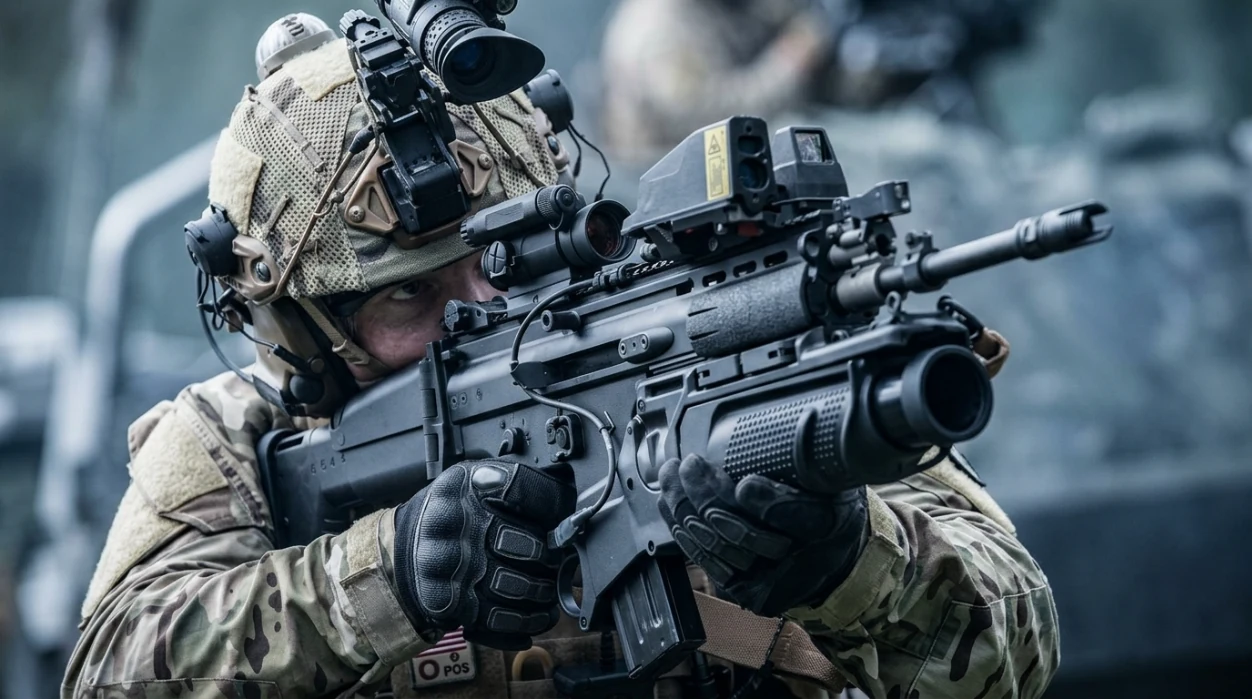
What happens when U.S. special operations forces ask for a rifle family that can handle different calibers while sharing as much commonality as possible? The answer became the FN SCAR.
Developed by Belgian firearms manufacturer FN Herstal for U.S. Special Operations Command (USSOCOM), the SCAR was designed as a modular family of combat rifles rather than a single weapon.
The program centered on two primary configurations: the 5.56×45mm NATO SCAR-L, later designated the MK 16, and the 7.62×51mm NATO SCAR-H, designated the MK 17.
FN won the SCAR competition in 2004, beating nine other vendors that submitted a combined 12 designs. Testing followed, with the first operational fielding to U.S. special operations forces beginning in 2009.
But the FN SCAR’s story is more complicated than a simple success story. The platform did not replace the M4 across U.S. special operations forces. Instead, its 7.62mm variants became particularly important while the 5.56mm MK 16 took a different path.
Today, the SCAR remains an evolving platform. FN introduced a next-generation SCAR family in 2026, adding more than two dozen updates to its commercial SCAR 16S, 17S and 20S models.
To understand why the FN SCAR took this unusual path, we need to start with the military requirement that created it.
What Is the FN SCAR?
The name FN SCAR stands for Special Operations Forces Combat Assault Rifle, and the designation tells you a lot about where the platform came from. It was not originally conceived as a general-purpose rifle for every soldier. It was developed around a U.S. Special Operations Command requirement for a more modular weapon family that could cover different missions and calibers.
At its core, the FN SCAR uses a short-stroke gas piston operating system and a modular architecture. The original military family centered on two rifles: the MK 16, associated with the 5.56×45mm NATO SCAR-L, and the MK 17, the 7.62×51mm NATO SCAR-H. Both were designed around a high degree of commonality rather than being completely unrelated rifles.
That common architecture is one of the platform’s defining ideas. Instead of building separate weapons from scratch for every requirement, FN designed the SCAR family so different configurations could share major components and a familiar layout.

The concept has also evolved considerably since its military introduction. Today’s commercial SCAR 16S, 17S and 20S extend the family into 5.56mm, 7.62mm and precision-oriented configurations, while newer offerings add calibers such as 6.5 Creedmoor and .300 Blackout.
So, when someone says “FN SCAR,” they’re really talking about a platform rather than one fixed rifle. And that distinction becomes important when looking at its history, because the requirements that created the MK 16 and MK 17 shaped almost everything that came afterward.
History and Development of the FN SCAR
The FN SCAR was born from a fairly practical problem: U.S. special operations forces wanted something more capable and adaptable than their existing M4 and M16-family weapons.
In late 2003, USSOCOM approved a requirement for a new combat assault rifle that could support different calibers while maintaining a high degree of parts commonality.
That requirement quickly turned into a global competition. In July 2004, nine vendors submitted 12 designs for three related weapon systems. FN’s proposal stood out because it was developed around the requirements from the beginning rather than being an existing rifle modified for the competition.
The FN design passed the required evaluation criteria and was unanimously selected by the board. In November 2004, FN received the contract covering both the 5.56mm and 7.62mm rifles, as well as the associated 40mm Enhanced Grenade Launcher Module.
The following years were essentially a long reality check. FN conducted developmental testing from August 2005 through January 2006, evaluating endurance, reliability and accuracy while incorporating feedback from military operators. Further acceptance testing ran from May 2006 into June 2007, followed by operational testing involving units including Army Rangers, Navy SEALs and Army Special Forces.
The process eventually produced a weapon system judged operationally effective and suitable in 2008. Initial fielding began in April 2009, with the first SCAR-equipped special operations units deploying overseas later that summer.
That timeline is important because the SCAR wasn’t simply designed on a drawing board and handed to soldiers. It went through years of testing and operator feedback before reaching the field, a process that would ultimately shape both its reputation and its different variants.
FN SCAR Specifications
The FN SCAR is better understood as a rifle family than a single fixed specification. The two best-known military configurations are the 5.56×45mm NATO SCAR-L/MK 16 and the 7.62×51mm NATO SCAR-H/MK 17, built around the same basic modular concept. That common architecture was one of the original goals of the USSOCOM program.
| Specification | SCAR 16 / MK 16 | SCAR 17 / MK 17 |
| Caliber | 5.56×45mm NATO | 7.62×51mm NATO |
| Operating system | Short-stroke gas piston | Short-stroke gas piston |
| Role | Assault rifle/carbine | Battle rifle |
| Military designation | MK 16 | MK 17 |
| Magazine type | STANAG-compatible | SCAR-H |
| Barrel configurations | Multiple | Multiple |
The difference in caliber is more than a number on a specification sheet. The SCAR 16 was designed around the lighter 5.56mm cartridge and the role traditionally associated with assault rifles, while the SCAR 17 uses the larger 7.62mm NATO round and occupies a heavier battle-rifle niche.
Both versions use a short-stroke gas piston system, a feature that became one of the defining characteristics of the SCAR family. FN also built the platform around a monolithic aluminum receiver and cold hammer-forged, chrome-lined barrels, emphasizing durability alongside modularity.

The modern commercial family has expanded considerably beyond those original military configurations. FN’s next-generation SCAR lineup introduced in 2026 includes the SCAR 16S, 17S and 20S, with configurations covering 5.56×45mm, 7.62×51mm, 6.5 Creedmoor and .300 Blackout. FN says the updated platform has undergone testing to 16,000 rounds without failure of a major component.
That variety is precisely why broad claims about the FN SCAR’s weight, length or range can be misleading. Those figures change substantially between models and configurations. For this rifle family, the variant matters just as much as the name on the receiver.
Read more: Top 5 Best Assault Rifles and What Makes Them Stand Out
FN SCAR Variants
The FN SCAR is not one fixed rifle. It is a family of related weapons that has expanded considerably since the original USSOCOM program. The best-known members include the 5.56mm SCAR-L, the 7.62mm SCAR-H, and the precision-oriented MK 20, while FN’s commercial lineup has added several configurations aimed at different users.
The FN SCAR-L, designated MK 16 in U.S. military service, was developed around the 5.56×45mm NATO cartridge. It was intended to provide special operations forces with a modern rifle that could complement or potentially replace existing M4-family weapons.
However, USSOCOM eventually reduced its procurement of the MK 16 because the 5.56mm configuration did not provide enough additional capability over the M4 to justify replacing an established system.
The FN SCAR-H, or MK 17, uses the larger 7.62×51mm NATO cartridge. This version became the more important military variant because it offered a capability that was less directly duplicated by the M4. The heavier SCAR-H could therefore occupy a different role rather than simply competing with an existing 5.56mm carbine.

The platform also evolved into the MK 20 SSR, a precision-oriented derivative of the SCAR-H. Its commercial counterpart, the SCAR 20S, provides a semi-automatic configuration aimed at precision shooting.
FN later introduced the commercial SCAR 16S, 17S and 20S, extending the platform beyond its original military configuration. There is also the compact SCAR-SC, developed for specialized and law-enforcement applications.
More recently, FN has continued updating the family. The 2026 next-generation SCAR lineup introduces further changes across the SCAR 16S, 17S and 20S, demonstrating that the platform has continued evolving rather than remaining tied to its original 2000s design.
The result is a family with a surprisingly wide spread of roles, from compact assault rifles to larger-caliber and precision-oriented configurations.
FN SCAR Military Users and Operators
The FN SCAR’s military footprint is smaller than its worldwide reputation might suggest. Unlike rifles adopted as standard weapons across entire armies, the SCAR has generally found its place in specialized military and security units, where its modular design and availability in different calibers provide a useful combination of capabilities.
The United States remains the most important user because U.S. Special Operations Command created the original SCAR requirement. The MK 16 and MK 17 were developed specifically for USSOCOM, with the first operational fielding beginning in 2009. While the 5.56mm MK 16 did not ultimately replace the M4, the 7.62mm MK 17 established a more lasting role within U.S. special operations.
The Belgian Armed Forces represent another important user. FN Herstal is based in Belgium, and Belgian special operations forces have operated SCAR variants. This makes the rifle an interesting example of a domestic defense product moving from national industry into specialized military service.

The platform has also appeared among specialized forces in France, Luxembourg and Chile, although configurations and roles differ between users. Luxembourg, for example, has selected FN SCAR variants for its military, while French forces have employed SCAR-family rifles in specialized roles.
There is an important distinction when discussing the SCAR’s international users: being photographed with a rifle is not the same as formally adopting it. Open-source lists can mix confirmed procurement with reported use, trials or individual-unit purchases. For that reason, a credible account should prioritize official procurement announcements and manufacturer documentation.
That helps put the FN SCAR’s global presence into perspective. It may not be carried by millions of soldiers, but its adoption by specialized units in several countries demonstrates where the platform’s design has found its strongest niche: forces looking for a modular rifle with options beyond the conventional 5.56mm infantry-carbine formula.
The FN SCAR’s Evolution Into a Modern Rifle Platform
The FN SCAR could easily have become a relic of the 2000s, a specialized rifle designed for a particular U.S. military requirement and remembered mainly for its distinctive appearance. Instead, FN has continued developing the platform, giving it a second life as a modern modular rifle family.
The biggest recent update arrived in January 2026, when FN introduced its next-generation SCAR lineup. The company says the updated platform incorporates more than two dozen improvements, targeting areas such as recoil management, ergonomics, controls, accessory integration and suppressor compatibility.
One notable change is a redesigned hydraulically buffered bolt carrier, which FN says reduces perceived recoil and improves the rifle’s handling characteristics.

The updated design also introduces an M-LOK-compatible handguard, revised controls and an AR-compatible pistol-grip interface. These changes may sound relatively small, but together they show how the SCAR has adapted to expectations that barely existed when the original rifle entered service.
The updated family continues with the SCAR 16S, SCAR 17S and SCAR 20S, covering different roles and calibers. FN also expanded the available chamberings, with the new generation supporting options including 5.56×45mm, 7.62×51mm, 6.5 Creedmoor and .300 Blackout, depending on configuration.
This evolution is significant because the SCAR’s original selling point was modularity. Nearly two decades later, FN is still using that same basic philosophy, but adapting the platform around modern accessories, suppressors and changing user expectations.
In other words, the latest SCAR isn’t an entirely new rifle. It’s something more interesting: an established platform being progressively rebuilt around the needs of a new generation of users.
Why the FN SCAR Still Matters
The FN SCAR’s legacy is not really about replacing the M4. That would be an oversimplification. Its more interesting contribution has been demonstrating what happens when a combat rifle is designed from the beginning around modularity, different calibers and specialized users.
The original USSOCOM program wanted a family of weapons that could share a common architecture while covering different requirements. The result was a platform spanning the 5.56mm MK 16, 7.62mm MK 17 and the precision-oriented MK 20. Even though the MK 16 did not become the M4 replacement that some initially expected, the program showed that a modular rifle could evolve into several distinct configurations.
The MK 17’s continued relevance is particularly important. Its 7.62×51mm NATO chambering gives special operations forces a capability that sits outside the traditional 5.56mm carbine role. The MK 20 then pushes the same basic architecture toward precision applications, showing how the platform can stretch beyond its original assault-rifle concept.
The story continues in the commercial market. FN’s 2026 next-generation SCAR introduces more than two dozen updates, including changes to recoil management, controls, accessory mounting and suppressor compatibility. That is a useful reminder that successful military designs don’t necessarily remain frozen in their original configuration.
Perhaps the most revealing lesson from the FN SCAR is that newer does not automatically mean better. The MK 16’s limited adoption showed how difficult it can be to replace a mature weapon that already has established training, logistics and support infrastructure.
Nearly two decades after its selection, the SCAR remains relevant for a different reason: it has proven capable of adapting. Its lasting value is less about becoming the universal rifle and more about showing how a modular platform can survive changing military requirements without abandoning its original design philosophy.
