

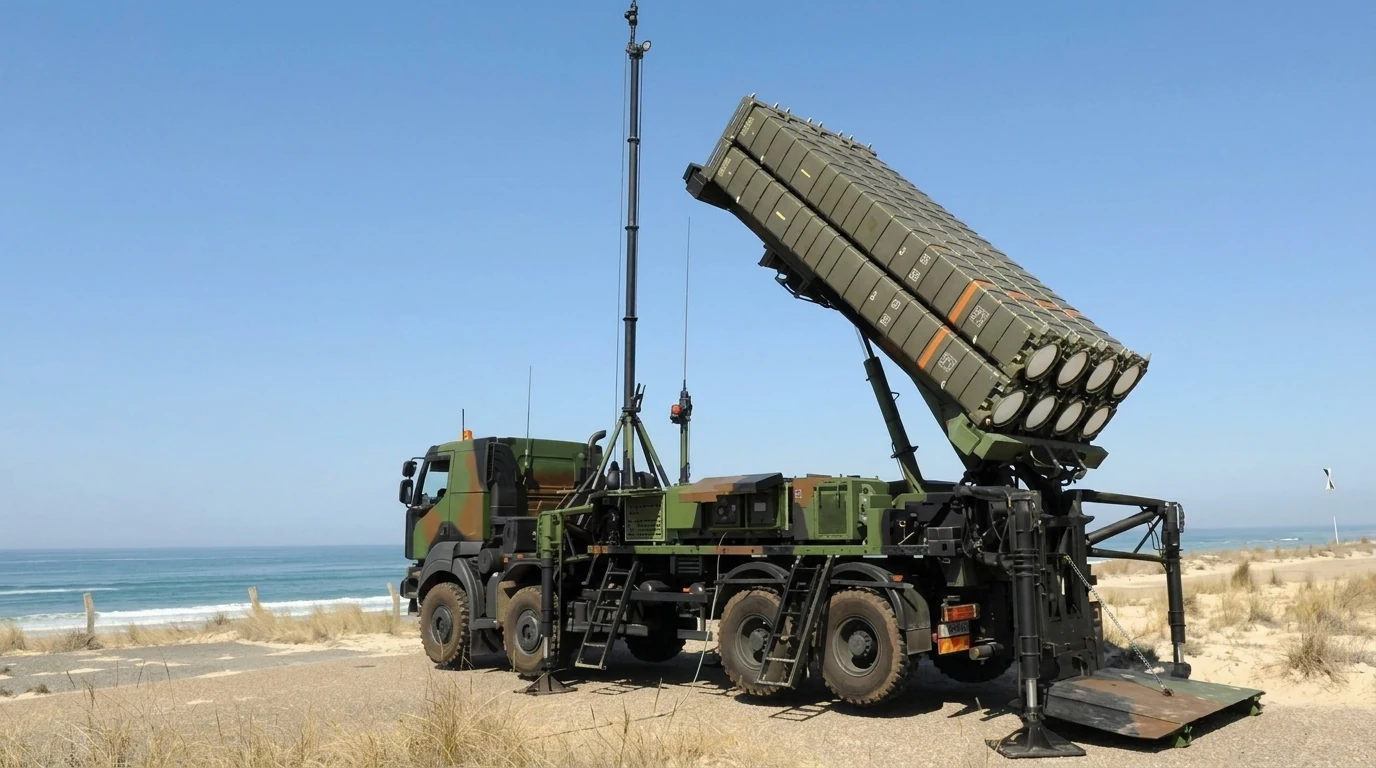
When people talk about elite air defense, one name usually dominates the conversation: Patriot. But here’s the twist, there’s another system, arguably just as sophisticated in some areas, quietly shaping the future of missile defense while flying under the mainstream radar. It’s called SAMP-T.
And if you’ve only heard it mentioned in connection with Ukraine or NATO deployments, you’ve only seen a sliver of the picture.
The SAMP-T air defense system, sometimes called MAMBA, isn’t just another surface-to-air missile battery. It’s Europe’s answer to layered missile defense, built not merely to shoot down aircraft, but to deal with cruise missiles, ballistic threats, drones, and increasingly complex saturation attacks. That matters more now than ever.
Because modern wars don’t wait politely for fighter jets to show up on radar.
Threats arrive low, fast, sometimes swarming. Sometimes hypersonic-adjacent. Sometimes cheap drones costing less than a pickup truck are probing systems worth billions. Strange battlefield math.
That’s where SAMP-T enters the conversation.
Developed by MBDA and Thales under the Eurosam consortium, SAMP-T was designed with a different philosophy than many Cold War-era systems: mobility, multi-threat engagement, and networked warfare from the ground up.
Think of it less as a “missile launcher” and more as a moving defensive ecosystem.
In this guide, we’ll unpack what makes the SAMP-T missile system different, how the ASTER 30 interceptor changed air defense doctrine, why analysts keep comparing SAMP-T vs Patriot, and why the newer SAMP-T NG may become one of Europe’s most important strategic assets.
And maybe, just maybe, you’ll see why this “quiet giant” is suddenly getting very loud.
What is the SAMP-T Air Defense System?
At its core, SAMP-T (short for Sol-Air Moyenne Portée – Terrestre, or “ground-based medium-range air defense”) is Europe’s attempt to solve a very modern problem: how do you stop everything coming at you, from fighter jets to ballistic missiles, without building a system so bulky it can’t move when it matters?
The answer isn’t a single machine. It’s a coordinated unit.

A typical SAMP-T air defense system is made up of several moving parts: a command module, radar unit, multiple launch vehicles, and support elements, all mounted on high-mobility trucks. Not glamorous. But incredibly practical. You can relocate it, redeploy it, hide it, and bring it back online faster than many legacy systems.
That mobility? It’s not a bonus feature. It’s survival.
The system was developed jointly by MBDA and Thales under Eurosam, reflecting a broader European push for defense independence. Instead of relying entirely on U.S.-built systems, countries like France and Italy wanted something tailored to their operational doctrine, flexible, interoperable, and designed for NATO environments.
What makes SAMP-T stand out isn’t just what it can shoot down, it’s how it thinks. The system can track dozens of targets at once and prioritize them in real time. Imagine a crowded sky, multiple incoming threats, and only seconds to decide what matters most. SAMP-T handles that decision-making loop almost instantly.
And unlike older systems built for a single type of threat, this one was designed from day one to deal with complexity. Messy, unpredictable, modern warfare complexity.
Which, frankly, is the only kind that exists anymore.
Key Features and Capabilities of SAMP-T
Here’s where SAMP-T stops being “interesting on paper” and starts looking genuinely formidable.
A lot of air defense systems do one thing well. Some are excellent against aircraft. Others are tuned for ballistic missile defense. A few can counter drones. SAMP-T air defense system tries to do all of it at once, which is much harder than it sounds.
Multi-Threat Interception That Changes the Equation
The headline feature? Layered engagement.
SAMP-T can engage aircraft, cruise missiles, tactical ballistic missiles, and increasingly unmanned threats within a single defensive architecture. That matters because modern attacks rarely arrive one threat at a time anymore.

They stack.
A drone swarm distracts. Cruise missiles slip low. Ballistic threats follow. It’s chess played at Mach speeds.
The system reportedly can engage multiple targets simultaneously, often cited around 10 interceptions at once, with radar tracking far beyond that. For a mobile system, that’s serious density.
360-Degree Defense, No Blind Side
One underrated strength of the SAMP-T missile system is full 360-degree coverage.
Some legacy systems historically performed best in oriented sectors. SAMP-T was designed differently. Its phased-array radar continuously scans all directions, reducing vulnerability from flanking or low-altitude surprise attacks.
That’s huge in missile defense.
Because missiles don’t announce themselves.
Mobility Is a Weapon Too
This gets overlooked constantly.
A fixed defense site can become a target. A mobile one becomes a puzzle.
SAMP-T batteries can deploy rapidly and relocate after engagement, complicating enemy targeting. Military planners call this survivability. Everyone else might call it “hard to kill.”

And maybe this is the real secret sauce: SAMP-T doesn’t rely on brute force alone. It combines mobility, networking, and precision.
Less fortress.
More living defense system.
That distinction is becoming very important.
ASTER Missiles: The Core of the SAMP-T Missile System
If SAMP-T is the brain and nervous system, the ASTER missile family is the fist.
And what a strange, elegant fist it is.
A lot of people assume the SAMP-T air defense system is mainly about its radar or launchers. Fair mistake. But defense professionals often point somewhere else entirely, to the interceptor itself. Because in missile defense, the missile often is the story.
ASTER 30, The Star Player
The centerpiece of SAMP-T is the Aster 30.
It reaches roughly 120 km in many configurations, flies at around Mach 4+, and is built to intercept everything from fast jets to tactical ballistic missiles. But numbers alone miss what makes it unusual.
It doesn’t simply chase targets.
It hunts them.

The missile uses what’s often called “hit agility”, aided by a unique end-game maneuver system sometimes nicknamed PIF-PAF propulsion. Sounds almost comic-book-ish. It isn’t. It allows brutal last-second course corrections, especially useful against maneuvering threats.
Think trying to hit a moving bullet… with another smarter bullet.
That’s the job.
| Missile | Primary Role | Approx. Range |
| ASTER 15 | Short/medium air defense | ~30 km |
| ASTER 30 | Long-range / missile defense | ~120 km+ |
| ASTER 30 B1NT | Advanced ballistic interception | Enhanced |
Why ASTER Feels Different
Most discussions focus on speed. But honestly? Precision matters more.
The ASTER 30 missile was built for “shoot-look-kill” confidence, high kill probability per interceptor. That changes logistics, costs, even battlefield planning.
And then there’s the newer B1NT variant, designed with tougher ballistic missile threats in mind. This is where SAMP-T NG starts looking less like an upgrade and more like a strategic leap.
Small aside, people often compare interceptors like they compare fighter jets. Faster, farther, better.
Reality’s messier.
Guidance, maneuverability, seeker performance under electronic warfare… those decide whether something survives.
And that’s why the missile inside SAMP-T may be its most underestimated advantage. Quietly lethal. Very European in that sense.
SAMP-T Range and Technical Specifications
Numbers don’t tell the whole story, but in missile defense, they do set the boundaries of reality. And SAMP-T sits in a very interesting middle ground: not the longest-range system in the world, but far from limited.
Let’s get specific.
The SAMP-T air defense system typically offers an engagement range of around 100–120 km using the Aster 30. With the newer SAMP-T NG, that envelope stretches closer to 150 km, depending on target type and engagement conditions.
But range alone can be misleading.
Because what matters just as much is what it can intercept within that range.
Engagement Envelope (Simplified View)
| Parameter | SAMP-T Capability |
| Aircraft Interception | Up to ~120 km |
| Ballistic Missile Defense | Short-to-medium range threats |
| Altitude Coverage | Up to ~20–25 km |
| Simultaneous Tracking | Dozens of targets |
| Interception Speed | Hypersonic engagement capability |
Notice something? It’s not just built for horizontal reach, it’s designed for vertical battlespace control too.
Ballistic Missile Capability, The Quiet Strength
Here’s where the SAMP-T missile system gets more interesting.
It can intercept tactical ballistic missiles, generally those with ranges up to ~600 km. That places it firmly in the theater missile defense category, sitting below systems like THAAD but above short-range defenses like NASAMS.
In practical terms, it means SAMP-T can protect:
- Military bases
- Critical infrastructure
- Urban centers
…from some of the most dangerous threats in modern warfare.
Radar and Reaction Time
The radar (traditionally Arabel, evolving in NG versions) can track large numbers of targets simultaneously and feed data into the command system in near real time.
And reaction time?
Measured in seconds. Sometimes less.
Which sounds abstract, until you realize a ballistic missile can travel several kilometers in that same window.
So yes, SAMP-T’s range matters.
But its real strength lies in how efficiently it uses that range, prioritizing, tracking, and engaging threats before they even feel “visible” to the human eye.
That’s not just engineering.
That’s timing, turned into a weapon.
SAMP-T NG: The Next Generation Evolution
If the original SAMP-T was built for the missile threats of yesterday and today, SAMP-T NG feels aimed at what comes next.
And “next” is arriving fast.
Hypersonic glide vehicles. Smarter cruise missiles. Drone saturation attacks. Electronic warfare thick enough to make radars sweat.
Legacy systems struggle when the threat picture gets messy.
The NG version, New Generation, is designed specifically for that mess.

So What Changes?
Quite a lot, actually.
At the heart of SAMP-T NG is a major sensor leap. Older systems used the Arabel radar; NG shifts toward newer AESA radar architectures, including systems like Kronos Grand Mobile HP. That means better detection range, stronger resistance to jamming, and improved tracking against difficult low-observable threats.
Translation?
It sees farther. Thinks faster. Gets fooled less.
Major Upgrades at a Glance
| Feature | SAMP-T | SAMP-T NG |
| Range | ~120 km | Up to ~150 km |
| Radar | Arabel | Advanced AESA radar |
| Ballistic Defense | Strong | Enhanced |
| Processing | Legacy architecture | Faster digital battle management |
| Future Hypersonic Defense | Limited | Improved readiness |
And then there’s the missile evolution.
The upgraded Aster 30 Block 1 NT pushes SAMP-T missile system deeper into anti-ballistic territory, especially against more sophisticated missile profiles.
That’s not a small tweak.
That changes who the system competes with.
Why Analysts Care About NG
This part often gets buried, but it matters.
SAMP-T NG isn’t only a weapons upgrade, it’s strategic signaling.
Europe has been trying to reduce dependency on imported missile defense layers. NG strengthens that ambition. NATO interoperability remains, but with more indigenous muscle.
And there’s a subtle shift happening here: SAMP-T is moving from “European Patriot alternative” to potentially something viewed on its own terms.
That’s a big evolution.
Maybe the bigger story is this,
The original SAMP-T was designed to defend airspace.
SAMP-T NG looks designed to defend the future.
That’s a different mission entirely.
SAMP-T vs Patriot: Two Air Defense Philosophies, Not Just Two Systems
This comparison shows up everywhere, SAMP-T vs Patriot.
And usually it gets flattened into a winner-loser debate.
That misses the point.
Read also: Patriot Missile System Technology: What Makes It So Effective?
These are not identical systems fighting for the same personality slot. They reflect two somewhat different schools of missile defense thinking.
One leans heavily proven and layered through decades of combat evolution. The other was designed later, with modern networked warfare baked in.
Different DNA.
Side-by-Side Snapshot
| Feature | SAMP-T | Patriot PAC-3 |
| Origin | Europe | United States |
| Main Interceptor | ASTER 30 | PAC-3 MSE |
| Range | ~120–150 km | Comparable / varies by missile |
| 360° Coverage | Strong | Improved in newer variants |
| Ballistic Missile Defense | Yes | Yes |
| Mobility | High | High |
| NATO Integration | Full | Full |
On paper? Very competitive.
Where SAMP-T Often Gets Praise
Mobility and multi-role efficiency.
Many analysts like the SAMP-T air defense system because it was designed from the start as both air defense and missile defense, rather than evolving from one into the other.
That matters architecturally.
Also, the Aster 30 interceptor’s maneuverability gets a lot of attention. Some call it one of the most agile interceptors in service.
And agility matters when targets jink.
Where Patriot Holds Weight
Combat record.
Hard to ignore.
The Raytheon Patriot family has decades of operational use, upgrades, and global deployment. That creates trust, militaries value that almost irrationally sometimes.
Because proven systems survive procurement battles.
So Which Is Better?
Honestly? Wrong question.
Better for what?
Defending cities from ballistic threats? Integrated NATO operations? Expeditionary deployment? Budget constraints?
Different answers.
A rough analogy,
Patriot can feel like a heavyweight fortress.
SAMP-T often feels like a fast, intelligent duelist.
Both deadly. Different personalities.
And here’s the part often overlooked: many modern defense planners increasingly see them as complementary, not rivals.
That says something.
When systems stop competing and start overlapping strategically… you may be looking at the future of air defense.
