

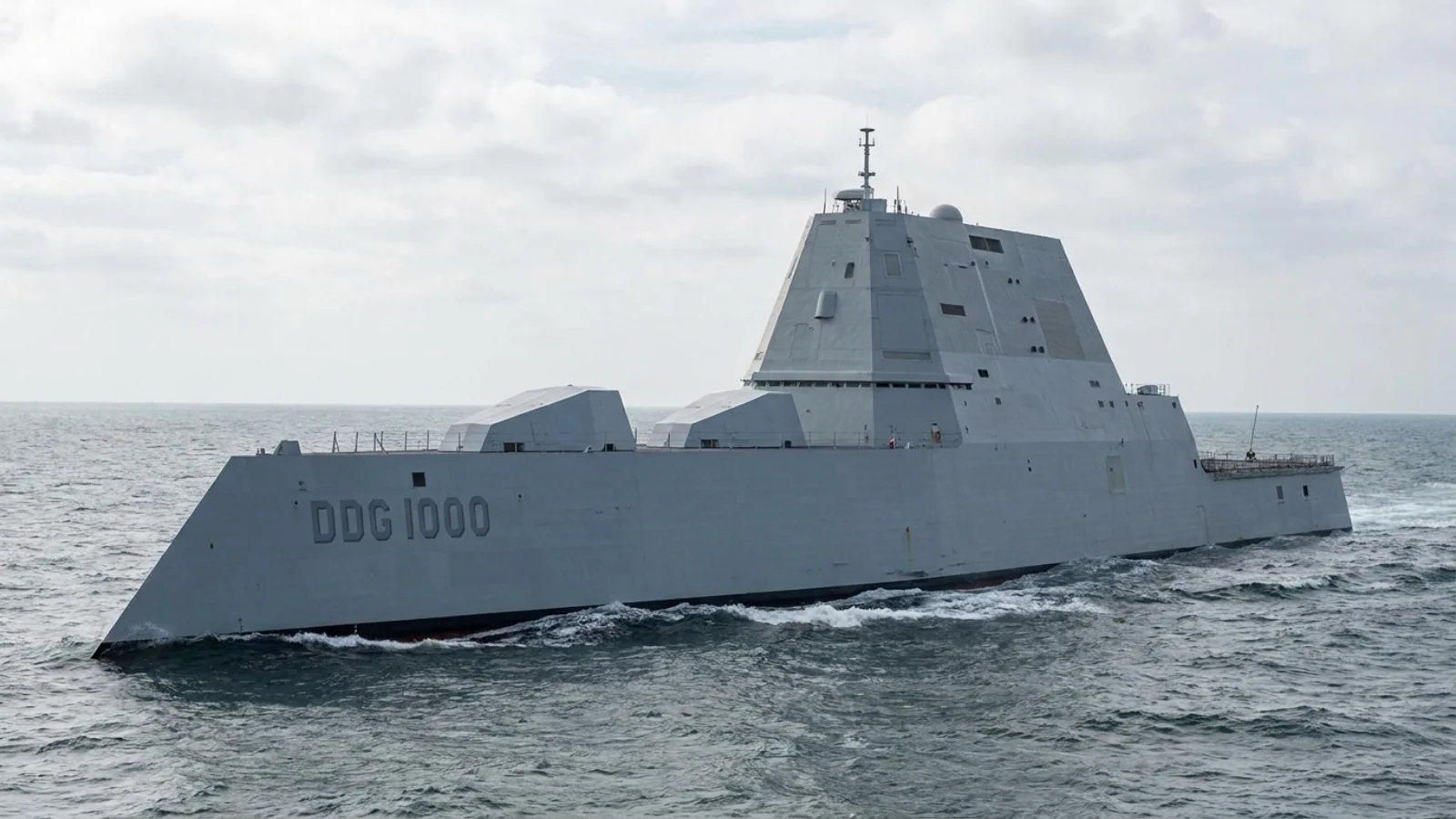
There’s a warship out there that doesn’t look like a warship at all. No towering radar masts. No classic gray silhouette slicing the horizon. Instead, the USS Zumwalt DDG-1000 almost glides into view like something borrowed from a sci-fi storyboard, low, angular, strangely quiet. And that’s not just aesthetic flair. It’s deliberate.
The first time defense analysts saw its design, reactions were… mixed. Some called it revolutionary. Others weren’t so kind, “overpriced experiment” showed up more than once. But here’s the thing: few ships in modern naval history have sparked as much debate while quietly reshaping how future warfare might look.
So what exactly is the USS Zumwalt?
On paper, it’s a guided-missile destroyer. In practice, it’s closer to a floating technology lab packed with systems the navy hadn’t fully fielded before, an integrated electric power system, advanced stealth shaping, and now, a pivot toward hypersonic strike capability. Not bad for a vessel originally designed to bombard coastal targets.
And yes, the numbers are eye-watering. Over $4 billion per ship. Only three built. That alone raises eyebrows.
But cost tells only part of the story. The more interesting question is this: Did the USS Zumwalt DDG-1000 fail… or did it arrive too early?
In this post, you’ll unpack everything, its specs, weapons, stealth tricks, controversies, and the surprising second act it’s stepping into. Because Zumwalt isn’t fading away. If anything, it’s evolving into something far more strategic.
What Is USS Zumwalt (DDG-1000)?
If you strip away the headlines and hot takes, the USS Zumwalt DDG-1000 is, at its core, a rethink of what a destroyer could be in the 21st century. Not an upgrade. Not an iteration. A reset.
The Zumwalt-class program was born in the late 1990s, when the U.S. Navy started asking an uncomfortable question: What happens when future conflicts move closer to shorelines packed with sensors, missiles, and surveillance? Traditional destroyers, like the Arleigh Burke class, were excellent at open-ocean warfare. But near the coast? Riskier.

So Zumwalt was designed for that messy, contested space. Its original mission leaned heavily on land attack, supporting troops ashore with precision strikes while staying nearly invisible to radar. Think of it less as a classic fleet escort and more as a stealthy offshore sniper.
But here’s where it gets interesting.
The Navy initially planned 32 ships in the Zumwalt-class. That number shrank. Fast. Budget pressures, shifting priorities, and the collapse of its main weapon system (we’ll get to that later) reduced the fleet to just three vessels:
- USS Zumwalt (DDG-1000)
- USS Michael Monsoor (DDG-1001)
- USS Lyndon B. Johnson (DDG-1002)
That tiny fleet size changes everything. Instead of forming the backbone of naval operations, Zumwalt became something else, a specialized, almost experimental platform.
And its mission? It’s evolving. Originally built for coastal bombardment, the USS Zumwalt is now being refitted for something far more strategic: long-range hypersonic strike. That shift alone tells you the Navy hasn’t given up on it. Not even close.
So no, Zumwalt isn’t just “a destroyer.” It’s a prototype of the Navy’s future, just one still figuring out what it wants to be when it grows up.
USS Zumwalt Specifications at a Glance
Numbers can be dry. Until the numbers describe a ship that displaces more than some World War II cruisers while being run by a crew smaller than many frigates. Then they get interesting.
The USS Zumwalt DDG-1000 is enormous, about 610 feet (186 meters) long. That makes it longer than an Arleigh Burke-class destroyer. Full-load displacement? Around 15,600 tons. For something officially called a “destroyer,” that borders on cruiser territory.
But raw size isn’t the real story. Automation is.
Where many large warships need 300-plus sailors, Zumwalt operates with roughly 147 core crew, sometimes a bit more depending on mission packages. That’s wildly lean. Think of a skyscraper run with half the staff because the building itself does part of the work.
USS Zumwalt DDG-1000 Specifications
| Specification | USS Zumwalt DDG-1000 |
| Length | 610 ft (186 m) |
| Beam | 80.7 ft |
| Displacement | ~15,600 tons |
| Top Speed | 30+ knots |
| Crew | ~147 |
| Missile Cells | 80 Mk 57 VLS |
| Power Generation | 78 megawatts |
That 78 megawatts matters. A lot.
Its Integrated Power System (IPS) doesn’t just move the ship, it generates enough electricity to potentially support future railguns, directed-energy weapons, and now hypersonic support systems. Most destroyers distribute propulsion and combat power separately. Zumwalt treats power like one giant shared reservoir. Very different philosophy.
And then there’s the tumblehome hull, that weird inward-sloping shape people love arguing about. It reduces radar return dramatically.
Oddly enough, the ship can appear on radar more like a fishing vessel than a major warship. Imagine a battleship dressed as a ghost.
Big. Quiet. Automated. Electrically overbuilt in the best possible way.
That’s USS Zumwalt in numbers, and honestly, the numbers undersell it.
Why USS Zumwalt Is Considered a Stealth Destroyer
Most warships try to survive by absorbing punishment or swatting threats out of the sky. USS Zumwalt DDG-1000 takes a different approach: don’t be seen in the first place.
That starts with its shape, and yes, it looks strange for a reason.

The ship uses a tumblehome hull, where the sides angle inward rather than flare outward like traditional destroyers. It almost looks like the hull was carved by wind. That geometry helps scatter radar waves instead of bouncing them neatly back to enemy sensors.
Result? Reports often describe the ship’s radar signature as comparable to a much smaller vessel. Some have famously compared it to a fishing boat. That may be simplified, maybe even a bit dramatic, but the point stands: for a 15,000-ton warship, it’s unusually hard to track.
And stealth isn’t just the hull.
How Zumwalt Reduces Detection
| Stealth Feature | Purpose |
| Tumblehome hull | Low radar signature |
| Composite deckhouse | Reduced radar reflections |
| Enclosed sensors | Fewer exposed radar returns |
| Exhaust suppression | Lower infrared signature |
| Acoustic quieting | Reduced sonar detectability |
See the pattern? It hides from more than radar.
Heat is masked. Noise is reduced. Even deck equipment is enclosed, because exposed gear creates radar clutter. Traditional destroyers can look visually “busy.” Zumwalt looks almost stripped clean.
There’s a weird elegance to it.
And here’s a rarely discussed angle: stealth at sea isn’t invisibility, it’s decision-making advantage. If an adversary detects you later, or misidentifies you, you’ve already changed the tactical equation.
That’s the real magic.
Some critics focus on cost or weapons problems and miss this entirely: DDG-1000 may be the most radical stealth experiment ever put into a surface combatant.
Not a gimmick. A floating lesson in naval deception. And honestly? The Navy may be borrowing from it for decades.
USS Zumwalt Weapons Systems
Here’s where the USS Zumwalt DDG-1000 story gets messy… and fascinating.
Because its weapons suite is part breakthrough, part cautionary tale.
At the center of the ship sit 80 Mk 57 Peripheral Vertical Launch System cells. Unlike traditional destroyers, where missile cells cluster centrally, Zumwalt spreads them along the ship’s perimeter. That sounds minor, until you realize it improves survivability. If one section takes a hit, a catastrophic chain reaction is less likely. Smart engineering. Quietly revolutionary.
Those cells can launch a mix of weapons, including:
- Tomahawk cruise missiles for land attack
- Standard Missiles (SM series) for air defense
- ASROC anti-submarine weapons
- Future long-range strike payloads
That alone makes DDG-1000 heavily armed.
But everyone talks about the guns.
The ship was built around two Advanced Gun Systems (AGS), 155mm monsters intended to fire precision shells over 60 nautical miles. It sounded futuristic. It kind of was.

Then reality intruded.
The guided ammunition became so expensive, reportedly approaching $800,000 per round, that the Navy canceled procurement. Imagine buying a sniper rifle and deciding each bullet costs too much to fire. Awkward.
And now the twist.
Those troubled gun mounts are being removed to make room for Conventional Prompt Strike hypersonic missiles.
That changes everything.
Zumwalt may be evolving from a troubled gun destroyer into something closer to a stealth missile arsenal.
Funny, isn’t it? The system many critics called obsolete may end up carrying one of the Navy’s most disruptive weapons.
Sometimes failed ideas don’t die.
They mutate.
USS Zumwalt Hypersonic Modernization
If Zumwalt’s first chapter felt uncertain, this next one is… sharper. More focused. Maybe even a little ominous.
The USS Zumwalt DDG-1000 is being transformed into a platform for Conventional Prompt Strike (CPS), the U.S. Navy’s hypersonic weapon program. Translation: missiles that travel at speeds above Mach 5, maneuver unpredictably, and are incredibly difficult to intercept.
This isn’t a minor upgrade. It’s a role reversal.

Originally, Zumwalt was designed to fire precision shells at coastal targets. Now, it’s being reconfigured to launch long-range hypersonic weapons capable of striking high-value targets deep inland, or across vast ocean distances, with very little warning.
To make that happen, the Navy is removing the Advanced Gun Systems entirely. In their place? Large missile tubes designed specifically for CPS.
What Changes with Hypersonic Integration?
| Upgrade Element | Impact |
| Removal of AGS guns | Frees space for larger payloads |
| CPS missile tubes | Enables hypersonic strike capability |
| Software & combat systems update | Supports new targeting profiles |
| Power system utilization | Supports future high-energy systems |
Here’s the subtle but important shift: Zumwalt is no longer about supporting troops at the shoreline. It’s becoming a strategic strike asset, something that fits into great-power competition, particularly in regions like the Indo-Pacific.
And there’s a timing element too.
Hypersonic weapons compress decision windows. Targets have less time to react. Defense systems struggle to keep up. That changes deterrence calculations in ways we’re still figuring out.
So suddenly, that odd, controversial destroyer? It starts to make sense again.
A stealthy platform. Massive power generation. Room for unconventional weapons.
It’s almost as if Zumwalt wasn’t a failed concept, it was just waiting for the right kind of missile to justify its existence.
Why USS Zumwalt Was Controversial
You can’t talk about the USS Zumwalt DDG-1000 without addressing the elephant in the room: controversy. Not mild disagreement, full-on, years-long debate across defense circles, Congress, and naval analysts.
Let’s start with the number everyone remembers: over $4 billion per ship. That figure alone made Zumwalt an easy target. For comparison, an Arleigh Burke-class destroyer typically costs closer to $2 billion (give or take, depending on configuration). So right away, critics asked: Are we getting double the capability?
Short answer? Not exactly, at least not in its original form.

Then came the program cuts. The Navy once envisioned 32 Zumwalt-class ships. That dropped to 24… then 7… and finally just 3 vessels. When a program shrinks that dramatically, unit costs skyrocket. It’s a bit of a vicious cycle, fewer ships mean higher per-unit cost, which invites more criticism, which leads to fewer ships.
And then there was the Advanced Gun System issue. A centerpiece weapon that became practically unusable due to ammunition cost. That didn’t help the narrative.
Core Criticisms of USS Zumwalt
| Issue | Why It Drew Criticism |
| High cost | Perceived imbalance vs capability |
| Small fleet size | Limited strategic impact |
| AGS failure | Key mission capability lost |
| Role confusion | Shift from land attack to strike platform |
| Experimental tech | Higher risk, unclear payoff |
But here’s the part that often gets overlooked.
Zumwalt wasn’t designed to be safe, it was designed to be different. And “different” in military procurement usually means expensive, risky, and misunderstood in its early years.
Some critics labeled it a failure. Others saw it as a stepping stone.
And now, with hypersonic upgrades underway, that second camp is getting louder.
Because controversy has a funny way of aging. What looks like a misstep today can turn into groundwork tomorrow.
Can USS Zumwalt Change Naval Warfare?
Here’s the bigger question lurking behind all the specs and controversy:
Is USS Zumwalt DDG-1000 a one-off experiment… or a preview?
That depends on how you define influence.
If you judge ships by how many copies get built, Zumwalt looks like a dead end. Three ships. Tiny class. Program cuts.
But naval revolutions don’t always arrive in large numbers.
Sometimes they show up as expensive prototypes everyone mocks at first.
Think aircraft carriers in their early years. Same story, in a way.
Zumwalt may matter less as a fleet and more as a testbed for where surface warfare is heading:
- Integrated electric power for future weapons
- Reduced-crewed warships through automation
- Stealth shaping for surface combatants
- Hypersonic strike from naval platforms
- Distributed lethality concepts
That’s not a failed checklist. That’s a roadmap.
And then there’s the Indo-Pacific angle.
A stealthy ship carrying hypersonic weapons in contested waters? That affects strategy, not just tactics.
That’s the sort of thing planners lose sleep over.
Will future destroyers look exactly like Zumwalt? Probably not. Its tumblehome hull alone remains controversial.
But pieces of Zumwalt, its DNA, almost, are likely to survive.
Maybe that’s its strange genius.
Not as the destroyer that replaced everything.
But as the ship that quietly smuggled tomorrow into today.
And if that happens, history may remember USS Zumwalt DDG-1000 less as a troubled experiment…
…and more as a warship that arrived early, took criticism, and bent naval thinking anyway.
