

The Space Force’s $71 billion fiscal 2027 budget request includes about $2.5 billion for commercial services like satellite communications and off-the-shelf capabilities, but officials say commercial components and technology are embedded throughout programs, making the true allocation much higher.
The service has been at the forefront of a larger Pentagon shift toward leveraging private sector investments in defense technology to develop and field systems faster and in larger numbers. In 2024, the Space Force issued its first Commercial Space Strategy, which called for the development of more hybrid government-commercial architectures. Last year, acquisition officials took that a step further, directing program offices to consider how and whether their requirements could be met purely with commercial capabilities.
The fruits of those efforts, according to SSC Commander Lt. Gen. Philip Garrant, are evident in acquisition strategies that have been reworked to factor in off-the-shelf technology, in solicitations that specifically seek commercial solutions, and in contract awards to nontraditional firms.
“What you’re seeing is what I would call the normalization of ‘commercial first,’” he told reporters April 14 at the annual Space Symposium in Colorado Springs. “The acquisition strategies are reflecting that, you’re seeing it in some of the recent solicitations. There’s still pockets of, I’ll call it seed corn, that are absolutely dedicated to commercial. But in general, you’re seeing the programs look to commercial first.”
The Space Force’s budget, which the White House rolled out in early April, requests funding for a handful of dedicated commercial initiatives, but on its face, doesn’t reflect a meaningful increase in spending in these areas. A service spokesperson told Air & Space Force’s Magazine that those funding lines offer a glimpse, but not a complete picture, of how the service is investing in private sector technology. Essentially, they said, the more embedded it is within programs, the harder it is to quantify the total investment.
“Commercial integration falls along a continuum whereby every USSF mission set now seeks to integrate commercial capability into its plans for future programs, in accordance with recent guidance to pursue commercial-first acquisition approaches,” the spokesperson said. “The challenge is showing that a certain percentage of a system, satellite, or capability is commercial tech versus custom built for the government. In reality, many of these systems are a mix of the two.”
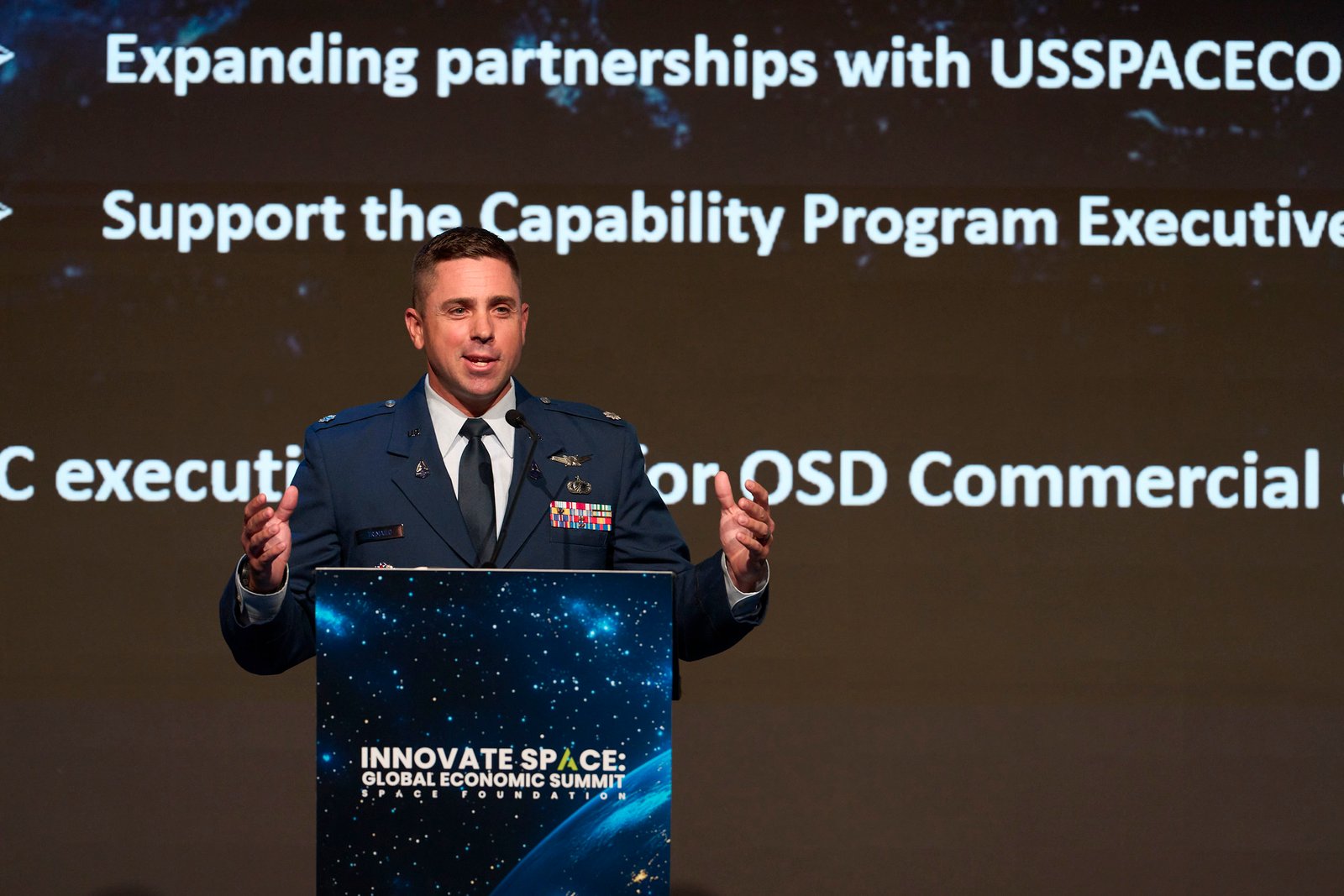
Indeed, Lt. Col. Tim Trimailo, who leads the Space Force’s Commercial Space Office, or COMSO, said that while the impact of the Space Force’s emphasis on leveraging commercially available technology may not be immediately visible, it’s happening both through his office and, more importantly, throughout the space acquisition enterprise.
In an interview with Air & Space Forces Magazine, he pointed to the Space Force’s recent selection of a vendor pool to compete for a program called Andromeda, or RG-XX, which aims to field a fleet of small spacecraft to monitor geosynchronous orbit and augment the legacy Geosynchronous Space Situational Awareness Program. Earlier this month, SSC chose a mix of 14 small and large firms to compete for task orders worth up to $1.8 billion. Those companies offer a mix of commercial-off-the-shelf solutions, including payloads, buses and other subsystems.
“I think Andromeda is a good example of that, of taking your venture-backed companies and leveraging some of those COTS components and putting those things together,” Trimailo said.
He also highlighted the Small Business Innovative Research and Small Business Technology Transfer Research programs, which provide seed funding for firms whose capabilities could benefit government agencies. For the Space Force, the program has helped create a needed bridge between innovative companies and the military’s complex acquisition bureaucracy. The service budgets about $500 million each year for these programs.
COMSO itself is funded through a dedicated commercial services budget line, which dropped from about $168 million in fiscal ‘26 appropriations to just $23 million in the Space Force’s fiscal ‘27 request. Since 2024, Congress has added funding to the commercial services account above what the Space Force has requested. That has supported key efforts for Trimailo’s office, including the Commercial Augmentation Space Reserve, which is building a pool of commercial providers who can provide satellite capacity during peacetime and in conflict. Last year, it helped fund a key effort called Tactical Surveillance, Reconnaissance, and Tracking, which provides space-based ISR capabilities to combatant commands.
Trimailo noted that while that funding helps fuel COMSO projects, the goal is doe those efforts and the associated resources to transition to program offices, not remain under his purview.
“It really is sort of an incubator or pilot for a lot of the efforts that we think might be able to contribute to future programs of record or future major mission area operational capability delivery,” he said. “When they’re ready to graduate and become a real thing, then they should move into those other program elements. … If our office is executing those activities henceforth, we’ve kind of failed.”
