

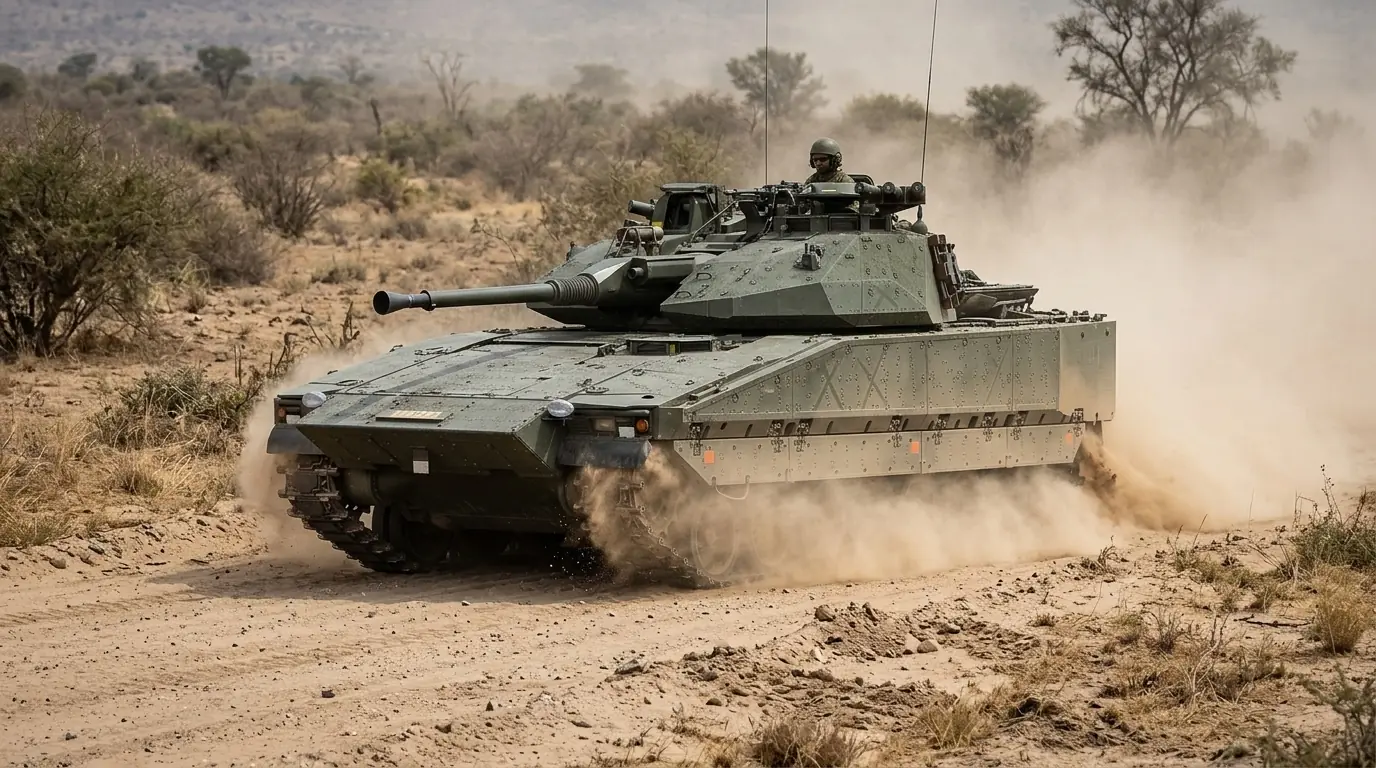
Europe’s armies are buying more than armored vehicles. They’re investing in a way to move infantry through dangerous terrain while giving troops protection and firepower.
The Combat Vehicle 90 (CV90) has become a strong contender for that job. Developed in Sweden, this tracked infantry fighting vehicle combines a cannon-equipped turret with space for dismounted soldiers. Several European countries operate the platform, while newer versions bring more engine power, updated electronics, and room for added equipment.
The timing matters. Russia’s war against Ukraine has pushed European governments to rethink their land forces, ammunition stocks, and ability to sustain long military operations.
Modern infantry fighting vehicles now need to do more than carry soldiers. They must operate under drone surveillance, support troops against armored threats, and remain useful as battlefield technology changes.
The Combat Vehicle 90 offers a practical answer, but it isn’t invulnerable or cheap to maintain. Extra armor and new systems add weight. Advanced electronics require support. And placing orders is only the first step toward building a capable armored force.
So why does Europe keep looking toward the CV90? Its appeal comes from a combination of combat experience, adaptable design, and cooperation between countries that want compatible equipment. The real question is whether that formula can deliver enough vehicles, with enough support, to meet Europe’s growing military needs.
What Is the Combat Vehicle 90?
The Combat Vehicle 90 was built around a simple idea: infantry need protection and firepower, but they also need to keep pace with armored units.
Developed by Sweden’s Hägglunds, now part of BAE Systems, the Combat Vehicle 90 entered service in the 1990s. It was designed for the demands of Nordic warfare, where forests, snow, and uneven ground can make vehicle mobility a serious challenge. Since then, the platform has grown into a family of tracked combat vehicles used by several European countries.
Its main role is that of an infantry fighting vehicle (IFV). Unlike a basic armored personnel carrier, which mainly transports troops, the Combat Vehicle 90 can engage targets with a turret-mounted cannon while carrying infantry inside its protected hull. Those soldiers can then dismount and continue the fight on foot.
That combination changes how a mechanized unit operates. Infantry gain protected transport, while the vehicle provides fire support during movement and after troops leave the vehicle. The exact balance depends on the mission, terrain, and equipment fitted to each variant.
The Combat Vehicle 90 also isn’t a single fixed design. Different countries have ordered versions with different guns, sensors, armor packages, and internal layouts. Some serve as infantry fighting vehicles, while others are configured for roles such as command, reconnaissance, or specialist support.
This flexibility helps explain its export success. A country can select a version that fits its army’s needs without starting an entirely new vehicle program. But the common platform doesn’t make every variant identical, and equipment differences still matter for training and maintenance.
The Combat Vehicle 90 is also not a light tank. Its cannon can threaten many battlefield targets, but its central job remains supporting infantry rather than replacing a main battle tank. That distinction matters when judging what the vehicle can do, and where it needs support from other units.
Combat Vehicle 90 Specifications, Weapons, and Design
The Combat Vehicle 90 Mk IV shows how the Combat Vehicle 90 has changed to meet modern army needs. More engine power and updated electronics give the vehicle room to handle extra equipment, though added weight still brings trade-offs.
BAE Systems lists the MkIV with up to 1,000 horsepower and a gross vehicle weight rating of 38 tonnes. Those figures describe the latest model, not every CV90 in service. Older versions have different engines, weapons, and protection levels.
| Specification | Combat Vehicle 90 MkIV |
| Manufacturer | BAE Systems Hägglunds |
| Engine power | Up to 1,000 hp |
| Gross vehicle weight rating | Up to 38 tonnes |
| Chassis | Tracked |
| Main armament | Depends on customer configuration |
| Transmission | Upgraded X300 series |
| Electronics | Fourth-generation electronic architecture |
| Suspension | Active damping system |
The engine matters because armor, sensors, and defensive systems all add weight. More power helps the vehicle maintain useful mobility as its load grows. But horsepower alone doesn’t tell you how quickly it can move across mud, snow, or broken ground. Track design, suspension, ground pressure, and driver skill also shape performance.

The MkIV’s upgraded electronic architecture is another major change. Modern combat vehicles rely on digital systems to share information, manage sensors, and support crew decisions. A newer architecture can make it easier to integrate fresh equipment without redesigning every system from scratch.
Active damping also helps control the vehicle’s movement over rough terrain. That can improve ride quality and support more stable operation, although the effect depends on terrain and vehicle load.
One common mistake is to treat the Combat Vehicle 90 as a single specification sheet. A Swedish CV9040 and an export CV9035 may carry different guns and equipment. Armor packages can also vary by customer.
For that reason, the MkIV figures are best used as a reference point. They show where the platform is heading, but they don’t describe every Combat Vehicle 90 an army might deploy today.
Why Does Europe Want More Combat Vehicle 90 IFVs?
Europe’s interest in the Combat Vehicle 90 comes down to more than its cannon or armor. European armies want modern tracked vehicles that can carry infantry, support armored units, and remain useful through long periods of service.
Russia’s full-scale invasion of Ukraine has sharpened that demand. European governments have had to reconsider how quickly they could reinforce their eastern flank, replace equipment sent to Ukraine, and sustain mechanized forces during a prolonged conflict. An IFV program takes years to deliver, so decisions made now shape military capacity well into the next decade.
The Combat Vehicle 90 offers one practical advantage: several European countries already operate versions of the platform. That creates opportunities to share experience, align training, and coordinate parts support. It doesn’t mean every country uses identical equipment, but a common vehicle family can make cooperation easier than maintaining entirely separate designs.

The industrial side matters, too. BAE Systems has reported 10 user nations and 17 contracted Combat Vehicle 90 variants. That established user base gives the program a wider support network and helps spread development costs across multiple customers.
A joint purchase could add another benefit. Countries may be able to coordinate orders, improve production planning, and strengthen their domestic defense industries through local assembly or work-sharing agreements. But those gains depend on how a deal is structured. Different national requirements can still create separate configurations and delivery schedules.
In June 2026, reporting described a Nordic-led initiative involving Sweden, Norway, Finland, the Netherlands, and Lithuania, with negotiations still underway. That is evidence of procurement interest, not proof that all five countries had signed a final contract.
The distinction matters. Europe’s demand for armored vehicles is real, but announcements and completed orders aren’t the same thing.
The Combat Vehicle 90’s appeal is that it gives European armies a mature platform they can adapt to their own needs while building on an existing user base. Whether that interest turns into stronger combat power depends on production capacity, delivery times, training, and long-term support.
How Powerful Is the Combat Vehicle 90’s Firepower?
The Combat Vehicle 90’s firepower depends on the version an army buys. That flexibility is one of its strengths, but it also means there’s no single Combat Vehicle 90 weapon setup that represents the entire family.
Several variants use an automatic cannon as their main weapon. Sweden’s CV9040, for example, carries a 40mm Bofors cannon, while export versions such as the CV9035 use a 35mm cannon. Other configurations use different turret systems to meet a customer’s needs.
These weapons give the Combat Vehicle 90 more reach and firepower than a basic troop carrier. An automatic cannon can engage suitable lightly armored vehicles, provide suppressive fire, and support infantry against targets that don’t require a tank’s main gun. The exact effect depends on the ammunition, target, and engagement conditions.
The turret’s sensors matter just as much as the gun. Modern sights can combine daylight cameras, thermal imaging, and range-finding tools to help the crew identify targets in poor light or reduced visibility. Fire-control systems then help calculate the settings needed for an accurate shot.

This doesn’t make the vehicle unbeatable. A cannon-equipped IFV isn’t designed to trade fire directly with every main battle tank, especially at ranges or angles that favor the tank’s heavier armor and larger gun.
Some Combat Vehicle 90 configurations can also carry anti-tank guided missiles, giving them another way to threaten armored targets. But that capability isn’t universal, and it depends on the variant and customer fit.
The key is combined arms. The Combat Vehicle 90 can support infantry and engage a broad range of targets, while tanks, artillery, drones, and other units bring capabilities it doesn’t have. Its cannon is most useful when crews can see the target, choose the right ammunition, and work with the rest of their force.
That’s a more realistic measure of firepower than simply comparing gun calibers.
How Well Is the Combat Vehicle 90 Protected?
The Combat Vehicle 90 has to protect its crew and infantry without becoming too heavy to move across difficult terrain. That balance is harder than it sounds, especially as modern battlefields fill with drones, anti-tank weapons, and sensors that make it harder to move unseen.
The Combat Vehicle 90 uses an armored hull designed to protect occupants from battlefield threats. Depending on the variant and its equipment, protection can include additional armor and systems intended to improve survivability. The exact level varies by customer, so claims about one version shouldn’t automatically be applied to every Combat Vehicle 90.
Extra protection brings a tradeoff. Armor adds weight, which can affect mobility, fuel use, and the load available for other equipment. The CV90 MkIV’s higher weight rating gives designers more room to accommodate upgrades, but it doesn’t remove the limits imposed by the vehicle’s engine, suspension, and tracks.

Modern protection also involves more than steel and composite armor. Some configurations can be fitted with active protection systems designed to detect and counter certain incoming threats before they reach the vehicle. These systems have limits, however. Their effectiveness depends on the threat, the system fitted, and the conditions in which it operates.
Drones create another problem. Small aerial systems can spot vehicles and help guide other weapons toward them. Even a well-armored IFV can be vulnerable if it is detected and repeatedly targeted. Armor alone cannot solve that problem.
Crew training, concealment, tactical movement, and support from other units all matter. A Combat Vehicle 90 operating with infantry, reconnaissance assets, and other armored vehicles has options that a vehicle moving alone may lack.
The common mistake is to treat protection as a single number. In practice, survivability depends on the whole setup: the vehicle’s armor, its defensive systems, the crew’s decisions, and the threats it faces. The Combat Vehicle 90 can be well protected for its role, but it isn’t invulnerable, and no honest assessment should describe it that way.
What Has Combat Experience in Ukraine Revealed About the CV90?
Combat experience in Ukraine has shown why a modern infantry fighting vehicle needs more than a powerful gun. The Combat Vehicle 90 combines protected troop transport, tracked mobility, and direct fire support, but its performance still depends on how crews use it under pressure.
Ukraine received Swedish CV90s as part of military support for its defense against Russia’s full-scale invasion. The vehicles have been used by Ukrainian forces in combat, giving the platform a real operational setting beyond test ranges and manufacturer demonstrations.
That experience matters because modern armored warfare is shaped by threats that can be difficult to see. Drones can spot vehicle movements, artillery can respond to detected positions, and mines can restrict routes before an IFV reaches its objective. Even a capable vehicle must operate within that threat environment.
The Combat Vehicle 90’s tracked chassis helps it move across rough ground, while its cannon gives crews a way to support dismounted infantry. Its armor can also offer protection against certain battlefield threats. But none of those features guarantees survival when a vehicle is exposed, isolated, or targeted by weapons designed to defeat armored platforms.

Comparisons with the American M2 Bradley are useful, though they need care. Both vehicles combine troop transport with cannon fire and are used by Ukrainian forces. Yet different versions, armor fits, crews, tactics, and missions make simple claims about which vehicle is better difficult to support.
Combat reports can reveal strengths and weaknesses, but isolated accounts don’t provide a full measure of fleet performance. A damaged vehicle may be recovered and repaired; a vehicle that completes a mission may still need significant maintenance afterward. Public reporting does not always provide enough detail to compare those outcomes fairly.
The lesson from Ukraine isn’t that the Combat Vehicle 90 has proved itself invulnerable. It’s that a capable IFV can still be valuable when integrated with infantry, reconnaissance, artillery, and other support. The vehicle matters, but so does the force built around it.
Can the Combat Vehicle 90 Meet Europe’s Future Needs?
The Combat Vehicle 90 has a strong position in Europe’s armored vehicle plans, but its long-term value will depend on production, maintenance, and how well the platform adapts to new threats.
The CV90 MkIV gives armies more room for upgrades than earlier versions. Its engine can deliver up to 1,000 horsepower, and its gross vehicle weight rating reaches 38 tonnes. That added capacity helps accommodate new sensors, protection systems, and other equipment as military needs change. It doesn’t mean every customer receives the same configuration, however. Each army must decide which upgrades fit its missions and budget.
That flexibility is useful, but it comes with a cost. More advanced electronics require trained technicians, software support, and replacement parts. Heavier armor can also affect mobility and maintenance demands. A vehicle that looks capable in a specification sheet still needs a reliable supply chain to remain available in the field.

Europe’s growing interest in the Combat Vehicle 90 could help spread some development and support costs across multiple users. Joint procurement may also give manufacturers a clearer picture of demand, making production planning easier. But countries still have different requirements, and separate weapon systems or protection packages can complicate common support.
Delivery schedules matter just as much as orders. A signed contract does not immediately give an army a ready battalion. Vehicles must be built, tested, delivered, and integrated with crews, spare parts, recovery vehicles, and training programs.
The Combat Vehicle 90’s future also depends on how European armies respond to drones and other threats seen in Ukraine. New sensors and defensive systems may help, but no single upgrade can solve every battlefield problem.
The useful question is not whether the Combat Vehicle 90 is Europe’s best IFV in every situation. It’s whether countries can field enough of the right variants and sustain them over time. When evaluating a new Combat Vehicle 90 order, look beyond the headline vehicle count. Check the delivery schedule, support package, and upgrade plan. Those details reveal how much combat power the purchase is likely to provide.
