

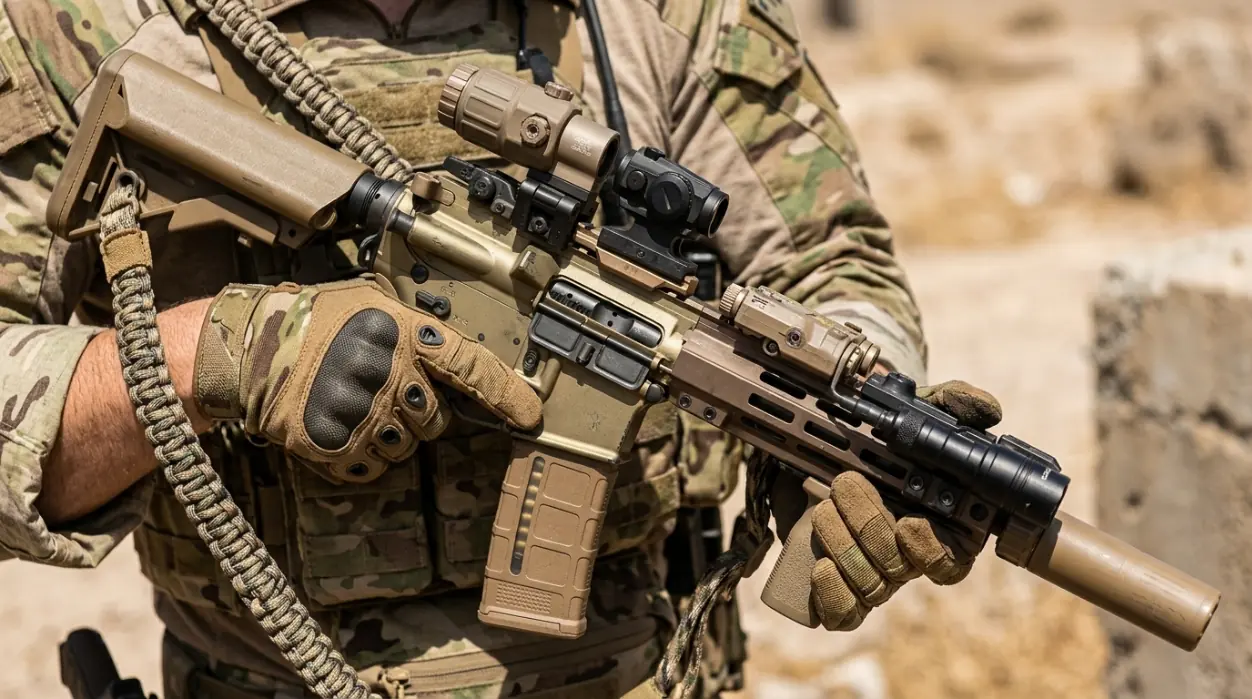
The HK416 rifle was never supposed to be just another rifle wearing the familiar shape of an AR-15. Its real story is about taking a design that soldiers already understood and reworking the machinery inside it for a different set of demands.
Developed by German firearms manufacturer Heckler & Koch, the HK416 combines the familiar layout of the M16/M4 family with an indirect gas-operated system and a locked rotating bolt. Chambered for the NATO-standard 5.56×45mm cartridge, the rifle was designed around modularity, ergonomics and military reliability rather than radical changes in how an infantry rifle looks.
That approach turned out to be remarkably successful.
Norway became the first national military to adopt the HK416 in 2007, while France later selected the HK416F to replace its FAMAS. Germany has now taken the platform even further, adopting the HK416 A8 as the basis for its new G95A1 and G95KA1 standard rifles. In December 2025, the first 300 G95KA1 rifles were handed over to the Bundeswehr, marking the beginning of serial fielding.
So, what explains the HK416’s staying power?
It isn’t simply the piston system, the German engineering or its growing list of military users. The more interesting answer lies in how the rifle balances an older, familiar architecture with the expectations of a modern infantry weapon.
To understand that, it helps to look past the HK416’s distinctive reputation and start with the rifle itself; what it was designed to do, where it came from and why armed forces around the world keep coming back to the same basic platform.
What Is the HK416 Rifle?
At first glance, the HK416 rifle looks familiar. Anyone who has spent time looking at the M16 or M4 family will recognize the basic layout: a straight-line stock and receiver, detachable magazine, adjustable furniture and a long top rail for sights and other equipment. But the resemblance is deliberate. Heckler & Koch took a familiar architecture and changed some of the machinery underneath it.
The HK416 is a 5.56×45mm NATO assault rifle developed by Germany’s Heckler & Koch for military and law-enforcement use. Its defining mechanical feature is an indirect gas-operated system, paired with a locked rotating bolt head. That separates it from the traditional direct-gas operating arrangement associated with the M16 and M4.
The rifle is also built around modularity. Heckler & Koch currently lists the HK416 family with multiple configurations, while the standard specification includes 10-, 20- and 30-round magazines, semi-automatic and full-automatic firing modes and a stated rate of fire of about 850 rounds per minute. The company gives an effective main combat range of 450 meters, with accurate suppressive fire listed out to 600 meters.
That modular philosophy is important because there isn’t really one single HK416. Barrel length, configuration and equipment can change depending on the mission and customer. A compact configuration for specialized troops can therefore look quite different from a longer-barreled infantry rifle while sharing the same basic platform.
And that may be the HK416’s biggest strength: familiarity without being stuck in the past. It retains the handling concepts of the AR-15/M16 family while incorporating a different operating system and modern interfaces for optics and accessories.
Heckler & Koch’s current design includes a full-length NATO STANAG 4694 Picatinny rail and ambidextrous controls, reflecting how much the infantry rifle has evolved beyond simply firing a cartridge.
The interesting part, however, is why Heckler & Koch decided to make those changes in the first place. That takes us back to the history and development of the HK416.
History and Development of the HK416
The story of the HK416 rifle begins with a problem that was surprisingly familiar to Western special operations forces: how do you improve an established rifle without throwing away everything soldiers already know?
Heckler & Koch approached the problem by retaining the basic AR-15/M16 layout while incorporating engineering experience from projects such as the G36, the U.S. XM8 program and work on Britain’s SA80 family. The resulting design originally appeared under the name HKM4, reflecting its close relationship with the M4. The designation was later changed to HK416, with the name referencing the M4 and M16 lineage.

The development was particularly relevant to specialized users who wanted a compact rifle capable of supporting demanding close-quarters missions. Rather than creating an entirely new weapon around a different operating concept, Heckler & Koch effectively rebuilt the internal system while preserving much of the familiar external architecture.
That distinction matters. A soldier transitioning from an M4 did not suddenly encounter an unfamiliar rifle layout, magazine position or basic manual of operation. The HK416 was intended to feel recognizable while bringing a different mechanical approach to the cycling system.
The platform’s international breakthrough came when Norway selected the HK416 in 2007, making it one of the earliest major national military adoptions. France followed years later.
In 2016, the French government formally selected the HK416F to progressively replace the FAMAS, with deliveries beginning in 2017. France’s program eventually called for 117,000 rifles, including standard and shorter configurations.
That progression, from a specialized design project to a standard infantry rifle for major NATO militaries, helped transform the HK416 from an alternative to the M4 into a significant Western small-arms platform.
And the development story didn’t stop there. The same basic architecture continued evolving into newer configurations, including the HK416 A5 and A8, setting the stage for the rifle’s next chapter.
HK416 Rifle Specifications
The HK416 rifle comes in several configurations, so its specifications are not completely identical across the family. Barrel length, stock configuration and other customer-selected features can affect dimensions and weight.
For that reason, the table below focuses on the core specifications published by Heckler & Koch rather than treating every HK416 variant as the same rifle.
| Specification | HK416 |
| Manufacturer | Heckler & Koch |
| Country of origin | Germany |
| Caliber | 5.56×45mm NATO |
| Operating system | Indirect gas-operated |
| Bolt system | Locked rotating bolt |
| Magazine capacity | 10, 20 or 30 rounds |
| Fire modes | Semi-automatic / full-automatic |
| Rate of fire | Approx. 850 rounds/min |
| Muzzle velocity | Approx. 790 m/s |
| Main combat range | Approx. 450 m |
| Suppressive fire range | Up to 600 m |
| Barrel configurations | 11, 12.5, 14.5, 16.5 and 20 in. |
One of the most notable figures is the 850-round-per-minute cyclic rate of fire. That number describes the mechanical cycling rate rather than how quickly a soldier would normally fire during an actual engagement. In practice, ammunition management, accuracy and the mission itself matter far more than simply maximizing the firing rate.
The HK416 also stands out for the number of barrel configurations available. Heckler & Koch lists options from a compact 11-inch barrel through to a 20-inch configuration, allowing the same basic platform to be adapted for different military requirements.
Its 5.56×45mm NATO chambering is another important part of the equation. Rather than introducing a proprietary cartridge, the HK416 uses ammunition already standardized across NATO forces. That gives operators access to an established ammunition ecosystem and makes the rifle easier to integrate into existing military logistics.
There is, however, a catch: “HK416” is a family, not one fixed specification sheet. The A5, A8 and specialized configurations can differ in details, which is why specifications should always be tied to the particular version being discussed. This becomes especially important when looking at the rifle’s evolution into newer variants.
HK416 Variants
One reason the HK416 rifle has remained relevant for so long is that it has never been treated as a single, frozen design. Heckler & Koch has continued developing the platform for different military requirements, producing variants that can look similar from the outside while reflecting very different procurement needs.

HK416 A5
The HK416 A5 represents one of the major steps in the platform’s evolution. It refined the original design with changes aimed at improving ergonomics, ambidextrous operation and compatibility with modern accessories. The A5 became particularly important because it formed the basis for several specialized configurations and later developments.
The broader HK416 family is available with different barrel lengths, allowing users to select configurations according to their requirements rather than adopting exactly the same rifle across every unit.
HK416 A7
The HK416 A7 pushed the platform further toward specialized military applications. It became closely associated with Germany’s special forces requirement and was subsequently designated G95K in Bundeswehr service. Heckler & Koch’s own technical publication describes the G95K as a development of the HK416 A5/A6 family.
The A7 has also found a place outside Germany. In 2023, Luxembourg selected an HK416 A7 configuration as its future standard assault rifle, with both 11-inch and 14.5-inch barrel versions ordered.
HK416 A8
The latest major development is the HK416 A8, which has become particularly significant because of Germany’s decision to make it the foundation of its new standard infantry rifle.
The German Bundeswehr selected the HK416 A8 to replace the G36. The resulting G95A1 uses a 16.5-inch barrel, while the shorter G95KA1 uses a 14-inch barrel. In December 2025, the first 300 G95KA1 rifles were handed over to the Bundeswehr, marking the beginning of serial fielding.
HK416C and Other Configurations
Beyond the main A-series, Heckler & Koch has produced more specialized configurations, including the compact HK416C. The broader family demonstrates an important design philosophy: the HK416 is less a single rifle than a modular platform that can be tailored around different users.
That evolution, from the early HK416 through the A5 and A7 to today’s A8 also helps explain why the rifle has spread well beyond its German origins.
HK416 Military Users and Operators
The strongest evidence of the HK416 rifle’s success is not found in marketing brochures or online popularity. It is in procurement decisions.
Several NATO and European militaries have selected the platform as a standard or specialist service rifle, giving the HK416 a footprint that extends well beyond its German origins.

France and the HK416F
France is perhaps the clearest example. The French military selected the HK416F to replace the FAMAS, ending the long service life of one of the country’s most recognizable military rifles.
The French procurement program calls for 117,000 HK416F rifles, with deliveries beginning in 2017 and continuing through 2028. The French Army uses both standard and shorter versions, allowing the same platform to cover different unit requirements.
The scale is significant. By December 2022, France had already received 69,340 HK416 rifles, showing that the program was far more than a limited special-forces purchase.
Norway and the HK416
Norway was an important early adopter of the platform, selecting the HK416 in 2007. The decision helped establish the rifle as a credible alternative to conventional M16/M4-derived service rifles among European NATO members.
Germany and the G95A1
Germany’s adoption has an interesting twist. Rather than simply purchasing the older HK416 configuration, the Bundeswehr selected the HK416 A8-derived G95A1 and shorter G95KA1 as replacements for the G36.
That decision effectively brought the HK416 back to its country of origin as a new-generation standard infantry rifle.
A Growing European Footprint
Luxembourg has also selected the HK416 A7, ordering both compact and standard configurations. Together, these decisions illustrate something important: militaries are not necessarily choosing the HK416 because they want an entirely new rifle concept. They are choosing a mature platform that can be adapted to existing NATO ammunition, optics, accessories and infantry requirements.
That combination of commonality, modularity and established service experience helps explain why the HK416 has moved from a specialized German design to a widely adopted European military rifle.

HK416 in the U.S. Military
The HK416 rifle has an unusual American connection. The U.S. military did not adopt the HK416 under that name as its standard service rifle. Instead, the platform became the foundation for the M27 Infantry Automatic Rifle, a weapon that has become closely associated with the U.S. Marine Corps.
The M27 began as an effort to replace the Marine Corps’ M249 Squad Automatic Weapon with something lighter and more rifle-like. Based on the HK416, the M27 entered Marine Corps service in 2011. The original concept was an automatic rifle that could provide sustained squad-level fire while offering greater portability than the belt-fed M249.
That role eventually expanded. In 2018, the Marine Corps announced plans to equip infantry Marines with the M27 as their standard individual rifle, replacing the M16A4 and M4A1 within infantry battalions. The change was significant because it moved the HK416-derived design from a specialist automatic-rifle role toward becoming the primary rifle carried by Marine infantry.
The procurement also illustrates the scale of that shift. Marine Corps Systems Command awarded a contract in 2018 allowing for up to 15,000 additional M27s, with an initial order for 5,650 rifles.

The HK416 family also produced the M38 Squad Designated Marksman Rifle, another Marine Corps configuration derived from the M27. It gives selected Marines a rifle configured for the designated-marksman role while retaining the basic M27 architecture.
The result is an interesting evolution: a rifle originally selected to replace a machine gun eventually became the Marine Corps’ standard infantry rifle, while another configuration was adapted for longer-range precision work.
That trajectory says a lot about the HK416 platform. Its importance in the United States is less about replacing the M4 across the entire military and more about how successfully its architecture has been adapted to different Marine Corps requirements.
