

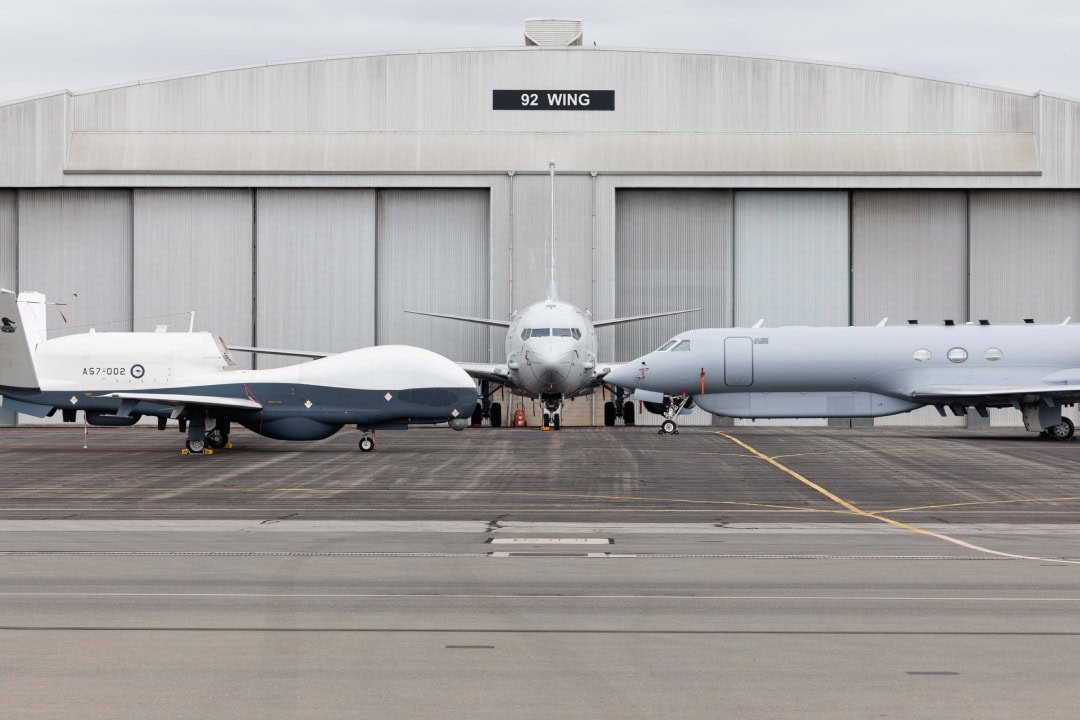
Australia is the only export operator of Northrop Grumman’s MQ-4C Triton high-altitude, long-endurance unmanned aircraft, and the platform has now reached an initial operational capability (IOC).
Simultaneously, the Royal Australian Air Force (RAAF) announced the L3Harris-developed MC-55A Peregrine intelligence, surveillance, reconnaissance and electronic warfare aircraft had achieved IOC too.
The milestones were revealed on 22 September 2026, following what the Department of Defence called “extensive operational testing and evaluation”.
The RAAF’s fleet of three Tritons – with another on order and due for handover in 2028 – has been operating from RAAF Bases Tindal and Edinburgh. They are operated by No. 9 Squadron.
Defence stated, “With the MQ-4C Triton now at IOC, the air force has significantly strengthened its ability to deliver persistent intelligence, surveillance and reconnaissance effects across Australia’s primary area of military interest.”
Jane Bishop, Vice President and General Manager, Global Surveillance Division of Northrop Grumman, also commented: “Achieving initial operating capability with the RAAF is a key step in strengthening the critical ISR capabilities MQ-4C Triton brings to the vast Indo-Pacific.”
She added, “Commanders can now take full advantage of Triton’s ability to provide comprehensive surveillance data that strengthens regional security for joint decision-makers, even in harsh and remote environments. This milestone reflects our strong collaboration with the Australian Defence Force and industry, and we stand ready to continue to deliver this capability for allies around the globe.”
The Triton is just one arm of Australia’s improving maritime domain awareness and ISR capabilities. As mentioned, a second arm, the MC-55A Peregrine also achieved IOC at the same time.
The fourth and final MC-55A will arrive before the end of 2026, and these aircraft are operated by No. 10 Squadron. The RAAF has been giving them a good workout, with an example deploying overseas to the Philippines and South China Sea in July this year.
As a final piece in Australia’s airborne ISR network, the 14th and final Boeing P-8A Poseidon arrived in Australia in May 2026. Furthermore, the first of two Poseidons upgraded with Increment 3 Block 2 enhancements has arrived back home too. Canberra said the upgrade provides “enhanced operational capability while maintaining interoperability with the United States Navy”.
The remaining twelve P-8As will be upgraded within Australia at the hands of Boeing Defence Australia. This work will take place at new A$200 million (US$141 million) deep maintenance and modification facility at RAAF Base Edinburgh.
Three RAAF squadrons operate the P-8A: Nos. 11, 12 and 292 Squadrons.
Defence said these three manned and unmanned platforms – the Triton, Peregrine and Poseidon – significantly strengthen the nation’s “ability to monitor and understand activity across Australia’s region and respond to emerging threats”.
Defence Minister Richard Marles also remarked, “The Albanese government is investing approximately A$5.5 billion [US$3.87 billion] over the decade to continue to enhance the ADF’s air intelligence, surveillance and reconnaissance and maritime patrol and response capabilities that will create additional opportunities for Australian industry well into the future.”
Incidentally, Northrop Grumman announced on 5 August 2026 that it and Boeing had successfully demonstrated enhanced interoperability between the MQ-4C Triton and P-8A Poseidon.

This laboratory demonstration activity saw the two platforms exchanging maritime intelligence through a standardised interface enabling machine-to-machine mission planning and execution.
The P-8A had sent a request for intelligence data, and the MQ-4C used artificial intelligence algorithms to collect, process and share it. This universal command-and-control interface cuts operator workload and accelerates decision-making. It also makes integration across platforms quicker and more cost-effective.
by Gordon Arthur
