

Key Points
- A photo circulating on social media in July 2026 showed a modernized Russian T-80BVM tank with an updated anti-drone cage loaded on a rail flatcar.
- Rostec delivered a batch of upgraded T-90M, T-80BVM, and T-72B3M tanks with similar anti-drone protection to Russian forces on May 9, 2026.
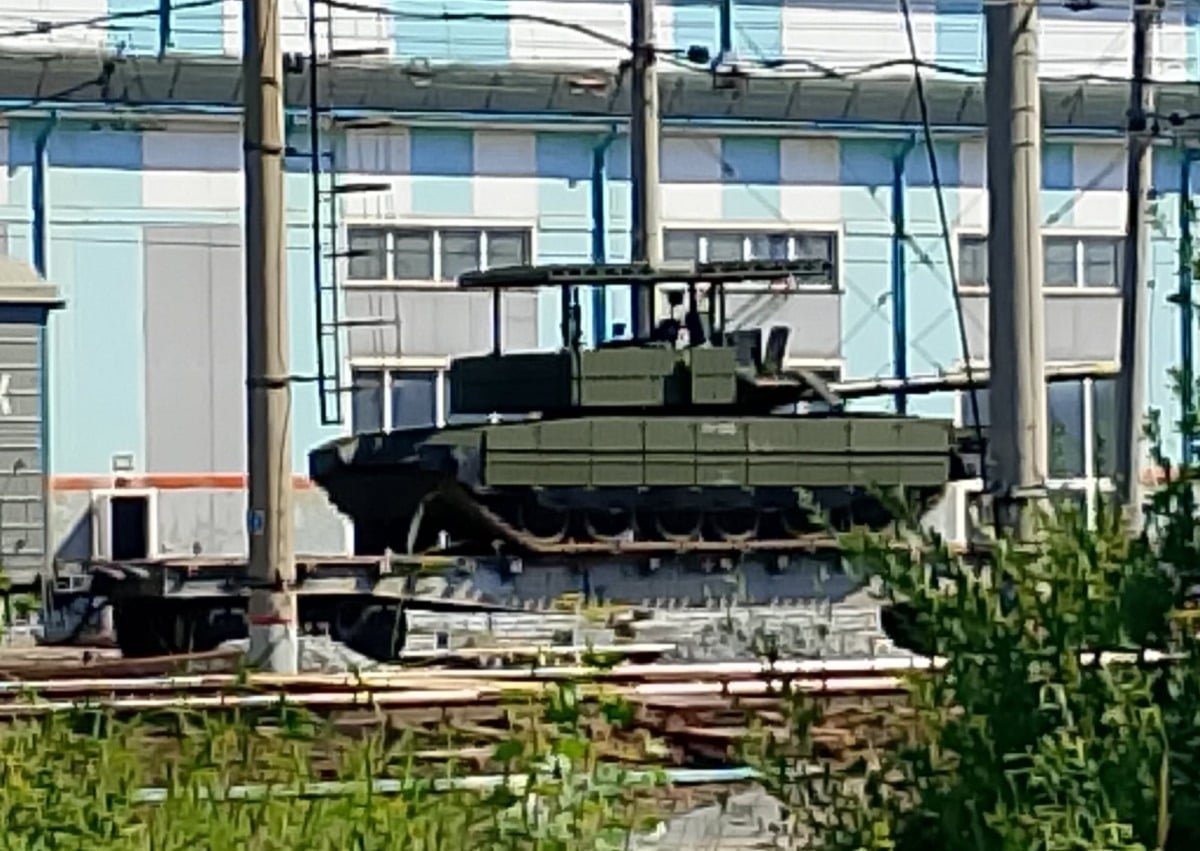
A modernized Russian T-80BVM tank fitted with a reworked drone-defense cage and an upgraded side armor package was spotted loaded onto a railway flatcar in Russia in July 2026, according to a screenshot circulating on social media that shows the tank mid-transport toward an undisclosed destination.
The combat vehicle appears to carry a new turret-mounted anti-drone shield, a wire-mesh or slat-armor structure Russian and Ukrainian troops have nicknamed “Mangal,” meaning barbecue grill, designed to detonate the shaped-charge warheads carried by first-person-view drones and loitering munitions before they can punch through the tank’s thinner top armor.
The image also shows what looks like an updated explosive reactive armor arrangement running along the tank’s side skirts and turret, a protective layer built from small armored blocks that detonate outward when struck, disrupting an incoming anti-tank round before it reaches the vehicle’s main armor. Neither the tank’s exact destination nor the identity of the unit receiving it can be confirmed from a single railcar photo, and the screenshot alone does not establish when or where the video was originally filmed beyond the July 2026 timeframe the post itself claims.
– ADVERTISEMENT – CONTINUE READING BELOW –
The T-80BVM is a modernized version of the Soviet-era T-80BV main battle tank, first publicly revealed during Russia’s Zapad military exercise in 2017 and entering Russian Ground Forces service the following year, built around a gas turbine engine that gives it notably better mobility across varied terrain than its diesel-powered T-72 counterparts. Its core protection suite already replaced the older Kontakt-1 explosive reactive armor found on earlier T-80BV models with Relikt ERA, a newer generation of reactive armor effective against both shaped-charge warheads and kinetic projectiles, covering large portions of the tank’s skirts, hull front, and turret frontal arc.
What appears in the newly circulated image fits a pattern Russian tank manufacturer Uralvagonzavod has followed consistently since Ukrainian drone warfare forced a rethink of Russian armor design. Rostec, the state defense conglomerate that owns Uralvagonzavod, delivered a batch of upgraded T-90M, T-80BVM, and T-72B3M tanks to Russian forces on May 9, 2026, ahead of Victory Day commemorations, a shipment the company described as incorporating lessons learned from combat experience and direct feedback from frontline troops. That May delivery included reinforced anti-drone cages, additional explosive reactive armor coverage on side skirts and rear sections, and the Volnorez electronic warfare suite, a jamming system built with two omnidirectional antennas capable of suppressing drone control signals within a radius of 600 to 1,000 meters (1,969 to 3,281 feet), according to Defense Mirror‘s earlier reporting on the platform’s upgrade path.
Military Watch Magazine reported that the anti-drone cage designs seen on that May delivery represented the latest evolution in protective measures Russian forces began pioneering in 2022, a development the outlet noted has since been increasingly adopted by other militaries abroad, including in South Korea and Israel. If the July railcar sighting shows a further refinement of that same cage design, as the accompanying commentary suggests, it would indicate Uralvagonzavod continues iterating on the concept rather than settling on a single fixed configuration, a pattern consistent with roughly four years of continuous battlefield feedback shaping successive production batches.
Analysis from The National Interest, citing data from the Dutch open-source intelligence group Oryx, which tracks combat losses using verified photos and videos, found that 35 Russian T-80BVM tanks have been captured by Ukrainian forces since 2022, including vehicles fitted with the heaviest version of the anti-drone cage design, sometimes derided online as a “cope cage” due to lingering doubts about its actual effectiveness. The National Interest’s reporting also noted a genuine trade-off built into these heavier cage designs, since the added weight and structure reduces crew situational awareness and limits how far the turret can traverse and aim, meaning better protection against drones can come at the expense of the tank’s combat responsiveness in a direct engagement.
An account attributed to armored vehicle expert Andrey Tarasenko, described in the post accompanying the image, offered a brief assessment of the upgrade shown in the railcar photo.
“This is a step forward compared to the previous one, no joke,” Tarasenko said.
That assessment, if accurate, would suggest the design visible in this particular tank represents a meaningful refinement over earlier cage and armor configurations rather than a cosmetic variation, though Tarasenko’s exact technical basis for that judgment, and his specific credentials, cannot be independently verified from the material available.
