

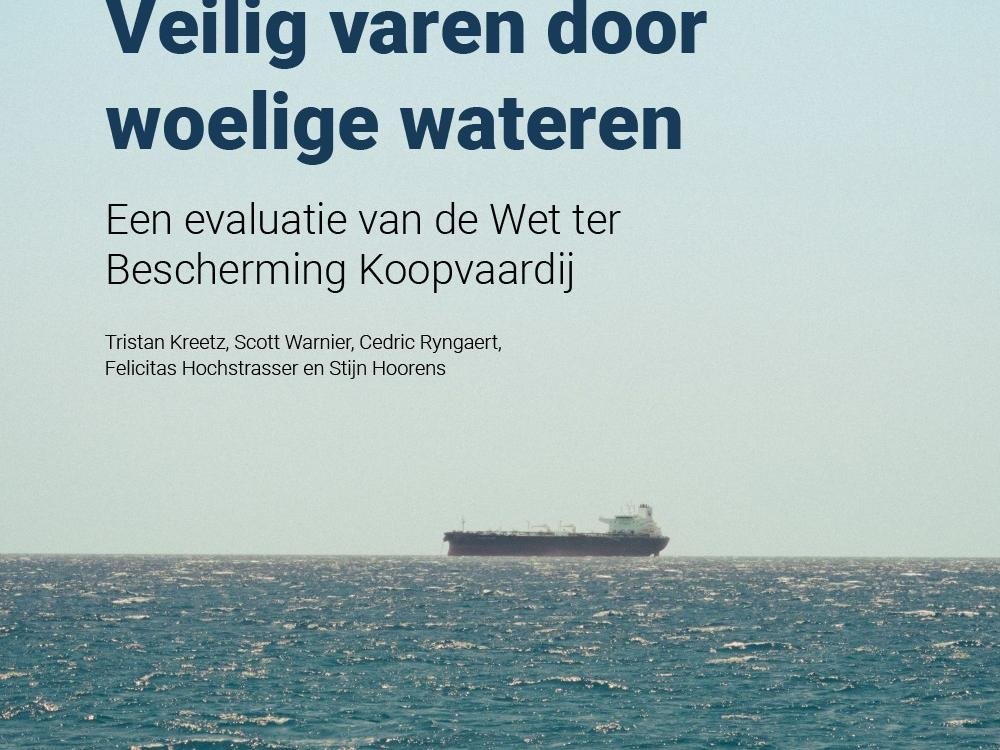
This evaluation examines the Dutch Merchant Shipping Protection Act (WtBK), which since February 2022 has allowed Dutch-flagged merchant vessels to use armed private maritime security teams in designated high-risk areas when Vessel Protection Detachments (VPDs) are unavailable or entail disproportionate costs or diversions. Commissioned by the WODC, the study assesses the Act’s legal framework, implementation, supervision and effectiveness through literature and document reviews, legal and comparative analysis, and stakeholder interviews. The WtBK establishes unusually stringent requirements by international standards, including its “VPD-unless” principle, licensing, weapons-management and reporting obligations. These standards support quality assurance but generate practical difficulties in an international market, including inconsistent foreign good-conduct certification and unclear English-language provisions. A central issue is the current interpretation that private security cannot be authorised where Defence deploys no VPDs, which has effectively halted operations in the risk area since late 2023. This interpretation may not reflect legislative intent and constrains a more flexible option for smaller vessels. Supervision is designed but conducted remotely; floating armouries, generally outside jurisdiction, hinder verification of weapons control and training. Implementation has largely stabilised after start-up problems, although stakeholders seek clearer decisions and coordination among authorities. The Act’s practical effectiveness is difficult to measure because piracy had already declined and no relevant violent incidents have occurred; nevertheless, stakeholders view private teams as flexible, lower-cost options, improving insurability and competitiveness. The two-licensee market risks further concentration.
Key Takeaways
The WtBK imposes stringent requirements on the deployment of private maritime security, even by international standards
The WtBK imposes stringent conditions on private maritime security, particularly through the unique “VPD-unless” principle: private teams may be used only if military protection is unavailable or disproportionate in cost or diversion. These requirements help protect the state monopoly on force and promote quality, but create difficulties in an international market. In particular, rules on foreign certificates of good conduct and training are not always readily applicable, while the English translation contains errors and ambiguities.
Supervision is carefully organised, but can sometimes be difficult to carry out remotely
The WtBK provides structured licensing and reporting arrangements involving the Human Environment and Transport Inspectorate (ILT), Coastguard and other authorities. Yet oversight is difficult because activity takes place remotely and floating armouries, which store and maintain weapons, train personnel and support teams, largely fall outside Dutch jurisdiction. This limits verification of weapons management and training. Procedures for piracy-related violent incidents have also not been tested in practice.
The effectiveness of the WtBK is assessed positively by involved parties, but is difficult to ascertain in practice
Stakeholders see private teams as a flexible, lower-cost option, especially for smaller ships unable to accommodate 11-person VPDs, with potential benefits for insurance and competitiveness. However, effectiveness cannot be conclusively established: piracy had declined before the Act took effect, and no relevant violent incidents have occurred. Since late 2023, the interpretation of “VPD-unless” has effectively prevented both VPD and private-security deployments in the designated risk area.
Recommendations
- Test the entire WtBK process through a scenario-based exercise to identify bottlenecks and enhance cooperation between stakeholders.
- Amend the requirements within the WtBK so that they are more readily applicable in an international context.
- Consider options for tightening supervision of the management of weapons and floating armouries.
- Reconsider the prevailing interpretation of the ‘VPD unless’ principle.
- Make the decision-making process regarding whether or not to deploy VPDs in the risk area more transparent.
- Consider measures to keep the Dutch market attractive to private maritime security companies.
Topics
Citation
RAND Style Manual
Kreetz, Tristan, Scott Warnier, Felicitas Hochstrasser, and Stijn Hoorens, Veilig door woelige wateren: Een evaluatie van de Wet ter Bescherming Koopvaardij: Safe through turbulent waters: Evaluation of the Dutch Merchant Shipping Protection Act, RAND Corporation, RR-A5209-1, 2026. As of November 3, 2026:
Chicago Manual of Style
Kreetz, Tristan, Scott Warnier, Felicitas Hochstrasser, and Stijn Hoorens, Veilig door woelige wateren: Een evaluatie van de Wet ter Bescherming Koopvaardij: Safe through turbulent waters: Evaluation of the Dutch Merchant Shipping Protection Act. Santa Monica, CA: RAND Corporation, 2026. .
This publication is part of the RAND research report series. Research reports present research findings and objective analysis that address the challenges facing the public and private sectors. All RAND research reports undergo rigorous peer review to ensure high standards for research quality and objectivity.
This document and trademark(s) contained herein are protected by law. This representation of RAND intellectual property is provided for noncommercial use only. Unauthorized posting of this publication online is prohibited; linking directly to this product page is encouraged. Permission is required from RAND to reproduce, or reuse in another form, any of its research documents for commercial purposes. For information on reprint and reuse permissions, please visit www.rand.org/pubs/permissions.
RAND is a nonprofit institution that helps improve policy and decisionmaking through research and analysis. RAND’s publications do not necessarily reflect the opinions of its research clients and sponsors.
